SUBSCRIBE TO OUR FREE NEWSLETTER
Daily news & progressive opinion—funded by the people, not the corporations—delivered straight to your inbox.
5
#000000
#FFFFFF
To donate by check, phone, or other method, see our More Ways to Give page.
It's the black gold that drives nations mad and inevitably raises the question of whether America and the former European colonial powers give a damn about human rights as the basis for military intervention. If Libya didn't have more oil than any other nation in Africa would the West be unleashing high-tech military mayhem to contain what is essentially a tribal-based civil war? Once again an American president summons the passions of a human rights crusade against a reprehensible ruler whose crimes, while considerable, are not significantly different from those of dictators the U.S routinely protects.
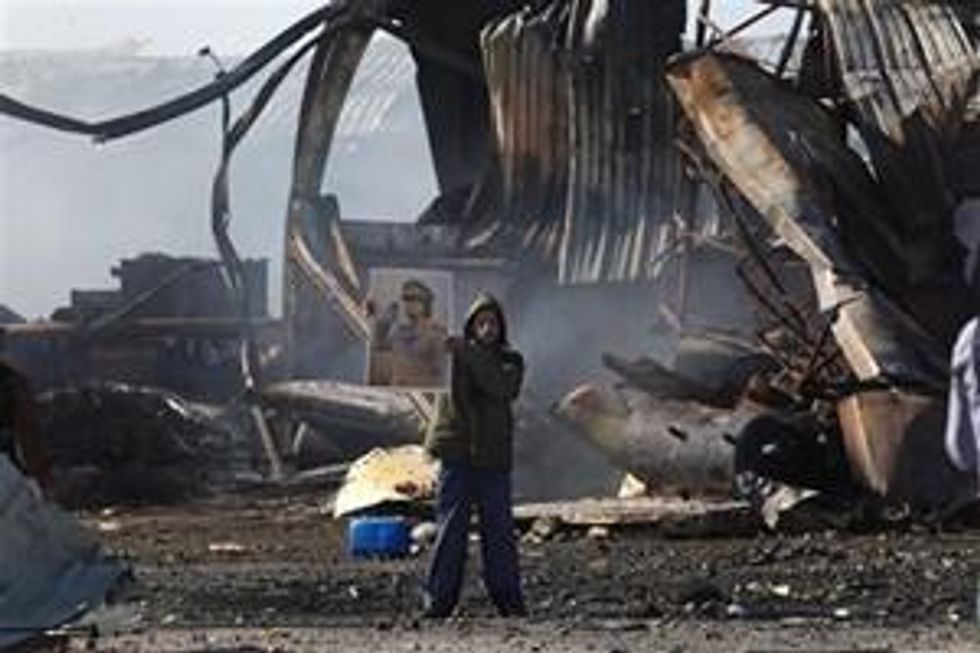
It is difficult to escape the conclusion that Moammar Gadhafi must now go not because his human rights record is egregious but rather because his erratic hold on power seems spent. After all, from the London School of Economics to Harvard, influential foreign policy experts were all too happy until quite recently to accept Libyan payoffs in exchange for a more benign view of Gadhafi's prospects for change under the gentle guidance of what Harvard's Joseph Nye celebrated as "soft power."
But that revisionist appraisal of Gadhafi suddenly became an embarrassment when this nutty dictator--whom few in the world could ever understand, let alone warm to--was exposed by defections from his own armed forces to be akin to rotten fruit destined to drop. Libya's honeymoon with the West, during which leaders led by Tony Blair and George W. Bush thought Col. Gadhafi might finally prove to be a worthy partner more concerned with reliably exporting oil than ineffectively ranting against Western imperialism, has suddenly been abandoned as no longer necessary. As with former U.S. ally Saddam Hussein before him, the Libyan strongman now seemed an awkward relic of a time that had passed him by, and easily replaceable. Not so the royal ruler of Saudi Arabia and the surrogates he finances in Yemen and Bahrain; their suppression of their peoples still falls within acceptable limits because of the vast resources the king manages in a manner that Western leaders have long found agreeable.
But this time, in the glaring light of the democratic currents sweeping through the Mideast, the contradictions in supporting one set of dictators while toppling others may prove impossible for the U.S. and its allies to effectively manage. The recognition, widely demanded throughout the region, that even ordinary Middle Easterners have inalienable rights is a sobering notion not easily co-opted. Why don't those rights to self-determination extend to Shiites in the richest oil province in Saudi Arabia or for that matter to Palestinians in the West Bank or Gaza?
The fallback position for U.S. policymakers is the "war on terror" standard under which our dictators are needed to control super-fanatic Muslims. That's why the U.S trained the Republican Guard led by the son of the despised ruler of Yemen as the counterterrorism liaison with Washington. On Tuesday it was the tanks of the lavishly U.S-equipped Republican Guard that stood as the final line of support surrounding the Presidential Palace as calls for departure of Yemen's dictator increased in intensity. The U.S. was still following the lead of Saudi Arabia, long a financier of the Yemeni ruler.
The Saudi lead was made clearer in the kingdom's support for the royal family in neighboring Bahrain as Saudi troops were sent in along with forces from the United Arab Emirates to suppress Bahraini democracy advocates claiming that freedom would enhance the power of the majority Shiite population. The fraud here is to locate Shiite Iran as the center of terrorism when it was the Sunni monarchies that were most closely identified with the problems that gave rise to al-Qaida. Not only did 15 of the 19 hijackers on 9/11 come from Saudi Arabia but Saudi Arabia and the UAE, along with Pakistan, were the only countries to diplomatically recognize the Taliban regime that harbored al-Qaida. In Bahrain the majority Shiite population is dismissed as potentially under the sway of the rulers of Iran without strong evidence to that effect. Once again it is convenient to ignore the fact that Iran, as was the case with Saddam's Iraq, had nothing to do with the 9/11 attack that launched the U.S. war on terror.
All of which elevates the question of how long will the U.S. and its allies ignore the elephant in the room posed by an alliance for human rights and anti-terrorism with regimes in the Middle East that stand for neither? While the jury is still out on whether the West's attack on Libya will prove to be a boon for that nation's population, at the very least it should expose the deep hypocrisy of continuing to sell huge amounts of arms and otherwise supporting Saudi Arabia and its contingent tyrannies.
It's the black gold that drives nations mad and inevitably raises the question of whether America and the former European colonial powers give a damn about human rights as the basis for military intervention. If Libya didn't have more oil than any other nation in Africa would the West be unleashing high-tech military mayhem to contain what is essentially a tribal-based civil war? Once again an American president summons the passions of a human rights crusade against a reprehensible ruler whose crimes, while considerable, are not significantly different from those of dictators the U.S routinely protects.
It is difficult to escape the conclusion that Moammar Gadhafi must now go not because his human rights record is egregious but rather because his erratic hold on power seems spent. After all, from the London School of Economics to Harvard, influential foreign policy experts were all too happy until quite recently to accept Libyan payoffs in exchange for a more benign view of Gadhafi's prospects for change under the gentle guidance of what Harvard's Joseph Nye celebrated as "soft power."
But that revisionist appraisal of Gadhafi suddenly became an embarrassment when this nutty dictator--whom few in the world could ever understand, let alone warm to--was exposed by defections from his own armed forces to be akin to rotten fruit destined to drop. Libya's honeymoon with the West, during which leaders led by Tony Blair and George W. Bush thought Col. Gadhafi might finally prove to be a worthy partner more concerned with reliably exporting oil than ineffectively ranting against Western imperialism, has suddenly been abandoned as no longer necessary. As with former U.S. ally Saddam Hussein before him, the Libyan strongman now seemed an awkward relic of a time that had passed him by, and easily replaceable. Not so the royal ruler of Saudi Arabia and the surrogates he finances in Yemen and Bahrain; their suppression of their peoples still falls within acceptable limits because of the vast resources the king manages in a manner that Western leaders have long found agreeable.
But this time, in the glaring light of the democratic currents sweeping through the Mideast, the contradictions in supporting one set of dictators while toppling others may prove impossible for the U.S. and its allies to effectively manage. The recognition, widely demanded throughout the region, that even ordinary Middle Easterners have inalienable rights is a sobering notion not easily co-opted. Why don't those rights to self-determination extend to Shiites in the richest oil province in Saudi Arabia or for that matter to Palestinians in the West Bank or Gaza?
The fallback position for U.S. policymakers is the "war on terror" standard under which our dictators are needed to control super-fanatic Muslims. That's why the U.S trained the Republican Guard led by the son of the despised ruler of Yemen as the counterterrorism liaison with Washington. On Tuesday it was the tanks of the lavishly U.S-equipped Republican Guard that stood as the final line of support surrounding the Presidential Palace as calls for departure of Yemen's dictator increased in intensity. The U.S. was still following the lead of Saudi Arabia, long a financier of the Yemeni ruler.
The Saudi lead was made clearer in the kingdom's support for the royal family in neighboring Bahrain as Saudi troops were sent in along with forces from the United Arab Emirates to suppress Bahraini democracy advocates claiming that freedom would enhance the power of the majority Shiite population. The fraud here is to locate Shiite Iran as the center of terrorism when it was the Sunni monarchies that were most closely identified with the problems that gave rise to al-Qaida. Not only did 15 of the 19 hijackers on 9/11 come from Saudi Arabia but Saudi Arabia and the UAE, along with Pakistan, were the only countries to diplomatically recognize the Taliban regime that harbored al-Qaida. In Bahrain the majority Shiite population is dismissed as potentially under the sway of the rulers of Iran without strong evidence to that effect. Once again it is convenient to ignore the fact that Iran, as was the case with Saddam's Iraq, had nothing to do with the 9/11 attack that launched the U.S. war on terror.
All of which elevates the question of how long will the U.S. and its allies ignore the elephant in the room posed by an alliance for human rights and anti-terrorism with regimes in the Middle East that stand for neither? While the jury is still out on whether the West's attack on Libya will prove to be a boon for that nation's population, at the very least it should expose the deep hypocrisy of continuing to sell huge amounts of arms and otherwise supporting Saudi Arabia and its contingent tyrannies.
It's the black gold that drives nations mad and inevitably raises the question of whether America and the former European colonial powers give a damn about human rights as the basis for military intervention. If Libya didn't have more oil than any other nation in Africa would the West be unleashing high-tech military mayhem to contain what is essentially a tribal-based civil war? Once again an American president summons the passions of a human rights crusade against a reprehensible ruler whose crimes, while considerable, are not significantly different from those of dictators the U.S routinely protects.
It is difficult to escape the conclusion that Moammar Gadhafi must now go not because his human rights record is egregious but rather because his erratic hold on power seems spent. After all, from the London School of Economics to Harvard, influential foreign policy experts were all too happy until quite recently to accept Libyan payoffs in exchange for a more benign view of Gadhafi's prospects for change under the gentle guidance of what Harvard's Joseph Nye celebrated as "soft power."
But that revisionist appraisal of Gadhafi suddenly became an embarrassment when this nutty dictator--whom few in the world could ever understand, let alone warm to--was exposed by defections from his own armed forces to be akin to rotten fruit destined to drop. Libya's honeymoon with the West, during which leaders led by Tony Blair and George W. Bush thought Col. Gadhafi might finally prove to be a worthy partner more concerned with reliably exporting oil than ineffectively ranting against Western imperialism, has suddenly been abandoned as no longer necessary. As with former U.S. ally Saddam Hussein before him, the Libyan strongman now seemed an awkward relic of a time that had passed him by, and easily replaceable. Not so the royal ruler of Saudi Arabia and the surrogates he finances in Yemen and Bahrain; their suppression of their peoples still falls within acceptable limits because of the vast resources the king manages in a manner that Western leaders have long found agreeable.
But this time, in the glaring light of the democratic currents sweeping through the Mideast, the contradictions in supporting one set of dictators while toppling others may prove impossible for the U.S. and its allies to effectively manage. The recognition, widely demanded throughout the region, that even ordinary Middle Easterners have inalienable rights is a sobering notion not easily co-opted. Why don't those rights to self-determination extend to Shiites in the richest oil province in Saudi Arabia or for that matter to Palestinians in the West Bank or Gaza?
The fallback position for U.S. policymakers is the "war on terror" standard under which our dictators are needed to control super-fanatic Muslims. That's why the U.S trained the Republican Guard led by the son of the despised ruler of Yemen as the counterterrorism liaison with Washington. On Tuesday it was the tanks of the lavishly U.S-equipped Republican Guard that stood as the final line of support surrounding the Presidential Palace as calls for departure of Yemen's dictator increased in intensity. The U.S. was still following the lead of Saudi Arabia, long a financier of the Yemeni ruler.
The Saudi lead was made clearer in the kingdom's support for the royal family in neighboring Bahrain as Saudi troops were sent in along with forces from the United Arab Emirates to suppress Bahraini democracy advocates claiming that freedom would enhance the power of the majority Shiite population. The fraud here is to locate Shiite Iran as the center of terrorism when it was the Sunni monarchies that were most closely identified with the problems that gave rise to al-Qaida. Not only did 15 of the 19 hijackers on 9/11 come from Saudi Arabia but Saudi Arabia and the UAE, along with Pakistan, were the only countries to diplomatically recognize the Taliban regime that harbored al-Qaida. In Bahrain the majority Shiite population is dismissed as potentially under the sway of the rulers of Iran without strong evidence to that effect. Once again it is convenient to ignore the fact that Iran, as was the case with Saddam's Iraq, had nothing to do with the 9/11 attack that launched the U.S. war on terror.
All of which elevates the question of how long will the U.S. and its allies ignore the elephant in the room posed by an alliance for human rights and anti-terrorism with regimes in the Middle East that stand for neither? While the jury is still out on whether the West's attack on Libya will prove to be a boon for that nation's population, at the very least it should expose the deep hypocrisy of continuing to sell huge amounts of arms and otherwise supporting Saudi Arabia and its contingent tyrannies.