SUBSCRIBE TO OUR FREE NEWSLETTER
Daily news & progressive opinion—funded by the people, not the corporations—delivered straight to your inbox.
5
#000000
#FFFFFF
To donate by check, phone, or other method, see our More Ways to Give page.


Daily news & progressive opinion—funded by the people, not the corporations—delivered straight to your inbox.
'Our legacy of resistance & building never ends'
Tens of thousands of Americans converged on Washington Saturday to commemorate the 60th anniversary of the March on Washington for Jobs and Freedom, a turning point in the 1960s U.S. civil rights movement at which Martin Luther King Jr gave his galvanizing "I have a dream" speech.
Organizers say today's march was not a commemoration but a continuation of the demands made in 1963.
Martin Luther King Jr.'s only grandchild Yolanda Renee King, 15, told the gathering that if she could speak to her grandfather today, she would say, "I am sorry we still have to be here to rededicate ourselves to finishing your work."
"Sixty years ago, Dr. King urged us to struggle against the triple evils of racism, poverty, and bigotry," she said. "Today, racism is still with us. Poverty is still with us. And now gun violence has come for our places of worship, our schools, and our shopping centers."
"When people say my generation is cynical, we say cynicism is a luxury we cannot afford," she said. "I believe that my generation will be defined by action, not apathy."
“We have made progress, over the last 60 years, since Dr. King led the March on Washington,” said Alphonso David, president and CEO of the Global Black Economic Forum. “Have we reached the mountaintop? Not by a longshot.”
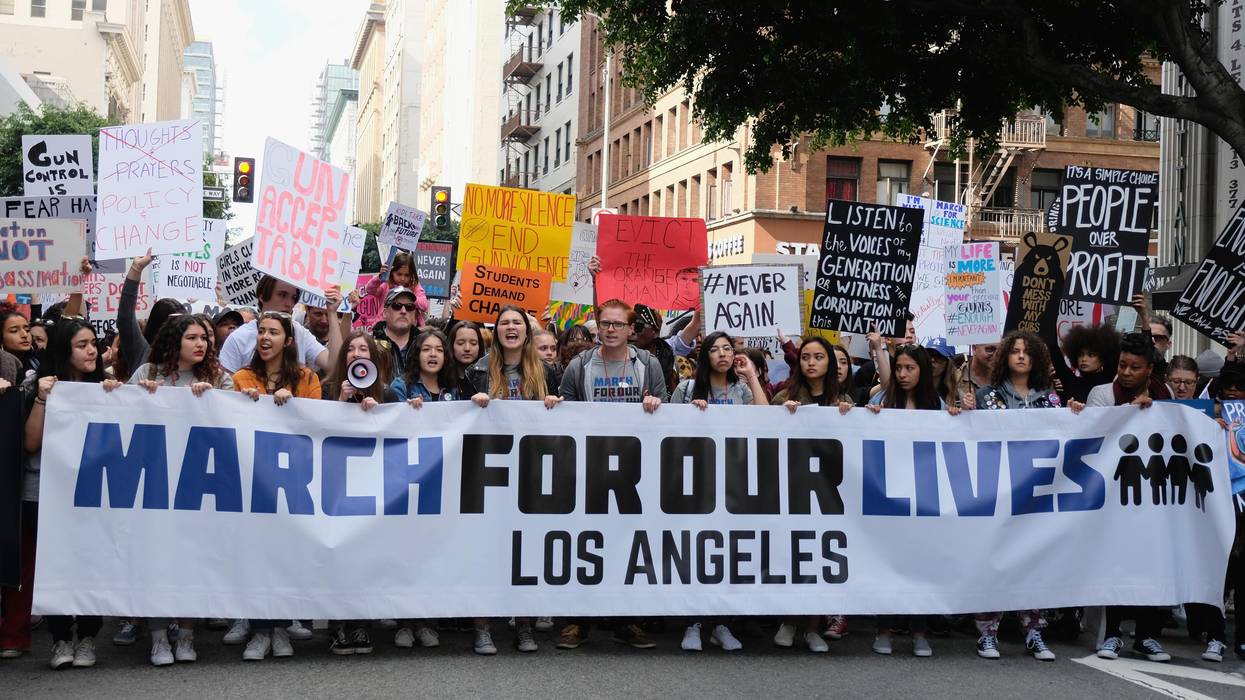
Amid seemingly intractable legislative inertia after the latest of thousands of U.S. mass shootings, youth-led activists are set to reprise the 2018 March for Our Lives protest against gun violence and congressional inaction with events in Washington, D.C. and hundreds of cities and towns in the United States and abroad this Saturday, June 11.
"The 'solutions' of arming teachers, bulletproof doors, all that stuff: It's nonsense."
Swiftly organized in the wake of last month's mass murder of 19 children and two teachers at Robb Elementary School in Uvalde, Texas and the racist massacre of 10 people at a Buffalo, New York supermarket, the second iteration of March for Our Lives is expected to draw hundreds of thousands of demonstrators, including at least 50,000 to the main protest at the Washington Monument on the National Mall.
"We're putting our foot down, and we're saying we had enough of it. The 'solutions' of arming teachers, bulletproof doors, all that stuff: It's nonsense," March for Our Lives national coordinator Serena Rodrigues, 23, told The Washington Post. "It's time for lawmakers to step up or get out of the way."
Speakers at Saturday's Washington, D.C. demonstration will include March for Our Lives co-founders David Hogg and X Gonzalez, who survived the 2018 massacre of 17 students and staff at Marjory Stoneman Douglas High School in Parkland, Florida; the son of a victim of the Buffalo supermarket shooting; Rep. Cori Bush (D-Mo.); American Federation of Teachers president Randi Weingarten; and Yolanda Renee King, the granddaughter of the Rev. Martin Luther King Jr., according to a statement from event organizers.
Now a student at Harvard University, Hogg--who's faced right-wing harassment, including by Rep. Marjorie Taylor Greene (R-Ga.), who called Parkland and other mass shootings false-flag operations by gun-grabbing Democrats--said he's spending his college summer break meeting with lawmakers to press for gun law reform.
"I'm tired of being here. I want to be a college student," he said during Wednesday's U.S. House Oversight Committee gun violence hearing. "I want to go out and have fun and do my job and be a young person that's enjoying my life and not having to be doing the job of what our senators should be doing right now."
In the four years since the first March for Our Lives, there have been more than 100 school shootings and over 170,000 firearm deaths in the United States.
It is estimated that at least one million people in the United States and around the world took part in the March 24, 2018 March For Our Lives, including up to 800,000 demonstrators who attended the main protest in Washington, D.C.
To find a nearby March for Our Lives, click here.
With the Democratic Party on the verge of failure in Congress, the family of Martin Luther King Jr. on Monday joined with other civil rights advocates and faith leaders in Washington, D.C. to demand lawmakers pass national voting rights legislation.
The MLK Day action comes amid a wave of voter suppression efforts advanced by Republican-controlled state legislatures and ongoing obstruction from right-wing Democratic Sens. Joe Manchin (D-W.Va.) and Kyrsten Sinema (D-Ariz.) to change the rules of the filibuster--the Senate's 60-vote threshold rule that critics have dubbed a "Jim Crow relic" used to block key democracy reforms.
The event comes just ahead of a planned effort by Senate Democrats to advance a House-approved bill that combines the Freedom to Vote Act and John R. Lewis Voting Rights Advancement Act. Majority Leader Chuck Schumer will attempt to use a procedural workaround to overcome GOP opposition, but that will only be possible if Manchin and Sinema end their objections to a filibuster carve-out.
The Deliver for Voting Rights campaign, the group behind Monday's march, states that Congress must seize the "historic opportunity" to protect voting rights.
"From the Civil War to the Jim Crow era, the filibuster has blocked popular bills to stop lynching, end poll taxes, and fight workplace discrimination," the campaign says. "Now it's being used to block voting rights. The weaponization of the filibuster is racism cloaked in procedure and it must go."
"There's no time to wait," they added. "We honor Dr. King with action."
Damon Hewitt, president and executive director of the Lawyers' Committee for Civil Rights Under Law--one of the partners of the voting rights campaign--rejected a "sanitized, watered-down recollection of Dr. King" that "is wholly divorced from the reality of his life" and stressed that the slain rights leader's "service was about activism--an engaged leadership that brought our country closer to its stated ideals."
"Dr. King's activism taught us that those who care about freedom must take action to shake loose equality from whatever stands in the way, including cynicism and complacency with the status quo," said Hewitt. "In that spirit, and on this day of remembrance, we will redouble our efforts to defend voting rights and save our democracy."
After a morning "Peace March" kicking off from the Frederick Douglass Memorial Bridge, event organizers were set to hold a noon press conference with speakers including Drum Major Institute president Arndrea Waters King, Poor People's Campaign co-chair Rev. Liz Theoharis, and Black Voters Matter co-founder LaTosha Brown.
In a statement Monday, Brown referenced MLK's remark that "voting rights are the foundation stone of political action" and his legacy "inextricably tied to his lifelong dedication to protecting Black voting rights."
"There is a cruel hypocrisy that, today, the United States Senate has taken a vacation day to acknowledge Dr. King's legacy while two critical voting rights bills--the Freedom to Vote Act and the John Lewis Voting Rights Advancement Act--languish on the Senate floor," said Brown. "Even when Dr. King's children have called for this to be a day on, not off. Martin Luther King III has said there can be 'no celebration without legislation.' And Bernice King asked us to use this day to advocate for changing the filibuster to pass voting rights legislation. And so we are."
Despite some "incredible progress over the years," Brown lamented recent "dangerous Supreme Court decisions, a wave of state-level voter restrictions, and Senate inaction--particularly from Joe Manchin and Kyrsten Sinema--[that] threaten to turn back the clock on election freedom and our ability as a community to build power and make gains economically and with criminal justice reform."
"Today is not just a holiday; it's a call to action on voting rights," she added. "If Senate Majority Leader Schumer and the rest of Senate Democrats really want to honor Dr. King's legacy, then they must pass federal voting rights legislation immediately. And if the Republicans continue to perpetrate the big lie and aid in this slow-motion insurrection, the Senate Democrats must go it alone and carve out an exception to the filibuster to pass the legislation now."
Any discussions of gun violence and the regulations needed to curb it are incomplete unless they include an analysis of how racism plays a role. Government data show that "black Americans are, on average, eight times more likely to be killed by firearms than those who are white." Gun violence by police against ordinary Americans also disproportionately affects people of color--a fact that the Black Lives Matter movement has been organizing around for six years. Thankfully there is a strong connection growing between the movement and the burgeoning youth-led push for gun control.
Only a week before the historic March for Our Lives protests that drew more than a million people out on the streets of the nation's capital and other cities, law enforcement officers fatally shot a 22-year-old black man named Stephon Clark in his own backyard in Sacramento, Calif. The police story of Clark's killing followed a familiar script: He matched the description of a suspect, and officers shot at him because they thought he had a gun and feared for their safety. After firing 20 bullets into Clark's body, police handcuffed the dying young man before starting medical procedures to try to save him. Ultimately, Clark was found to have been "armed" only with a cellphone.
Just two days before the March for Our Lives, local activists and residents protested Clark's killing. They showed up at Sacramento's City Hall, blocked traffic on Interstate 5 and even delayed the start of an NBA game. They made it clear, as other Black Lives Matter protests have been doing, that there will be no business-as-usual while black people continue to be murdered by police.
Over the past several years, Black Lives Matter has repeatedly attempted to make the case to the American public that black lives need to matter because at present they simply don't. Clark's life clearly did not matter to Sacramento police, just as the lives of countless unarmed black men and women have not mattered. Even in the most well-documented and blatantly unjust police killings, such as that of Alton Sterling in Baton Rouge, La., authorities have refused to prosecute killer cops. Meanwhile, Nikolas Cruz, the 19-year-old white man who confessed to massacring 17 people with an assault rifle at Marjory Stoneman Douglas High School in Parkland, Fla., was easily captured alive by police, just as so many other white, male, mass shooters have been.
"We recognize that Parkland received more attention because of its affluence, but we share this stage today and forever with those communities who have always stared down the barrel of a gun."
It was in Florida, where the massacre took place and where the new movement for gun control originates, that Trayvon Martin was gunned down by George Zimmerman six years ago. It was that specific instance of gun violence that gave birth to the now-famous hashtag, #BlackLivesMatter. In the years since the coining of that profound phrase, black activists have led movements all over country, relentlessly drawing attention to how gun violence--by vigilantes as well as by police--affects African-American communities, and demanding justice for victims of that violence.
While the largely white Parkland survivors appear to have been embraced more wholeheartedly by mainstream America for their courageous fight to end gun violence than Black Lives Matter was, the young activists have shown themselves to be critical thinkers. One white student, Jaclyn Corin, said during her speech at Saturday's rally in Washington, D.C.: "We recognize that Parkland received more attention because of its affluence, but we share this stage today and forever with those communities who have always stared down the barrel of a gun." Student activist David Hogg called out the media for failing to include the voices of black survivors of the Parkland shooting, even though a quarter of the students at his school are black.
The organizers of the March for Our Lives did a far better job of centering the voices of people of color than the mainstream media did. Some of the most powerful and noteworthy speeches in D.C. were by black and brown speakers, most of them young girls. Yolanda Renee King, the 9-year-old granddaughter of Martin Luther King Jr., demanded a "gun-free world" in the name of her grandfather's legacy. Parkland survivor Emma Gonzalez brought masses of people to tears with a powerful silence during her speech that lasted the same duration as the school shooting. Eleven-year-old Naomi Wadler proudly represented black women and girls who have been victims of gun violence. And 17-year-old Edna Chavez, from South Central Los Angeles, who lost her brother to gun violence, described how she "learned how to duck from bullets before I learned how to read." And attendees at the march appeared to be a diverse representation of black and brown communities.
Black journalist Jason Johnson, who attended the rally and march in D.C., published an account of it in The Root, titled "Yes, the March for Our Lives Was About Black People, Too--and It's About Time." Johnson lauded the Parkland students' decision to use their privilege to broaden their struggle. "If you have to wrap some Black Lives Matter rhetoric in L.L.Bean and Lululemon in order to get some press coverage and meaningful change, I'm all for it," he wrote, adding that the speaker list offered a "seamless organic integration of black perspectives and black lives."
Rachel Gilmer, co-director of Dream Defenders, a black-led Florida organization formed in the wake of the Martin killing, wrote an op-ed in USA Today about how black organizers joined the March for Our Lives. "We shouldn't conflate the bias in the Parkland students' reception with the students' own politics," she wrote. "They don't have to be told that they have privilege, and they have been among the most vocal in calling attention to the plight of communities of color."
Even Lucy McBath, whose 17-year-old son, Jordan Davis, was killed by a white gun owner, explained why she was "proud" to attend the march: "Inspiring young people--no older than my Jordan was when he was taken from me--are demanding a better future from our leaders and each other." She drew a critical link between the core intersecting issues, saying "I will march for my son, for [Stephon] Clark and for all the black men and women, boys and girls, affected by racism and gun violence."
When Black Lives Matter activists challenged the Democratic Party during the 2016 primary elections and insisted that racial justice be an integral part of any progressive electoral platform, their demands and activist strategies often were misunderstood by mainstream Americans. They were even derided for their steadfastness by the so-called liberal adults in the room, including the nation's first black president, the candidate who might have become the nation's first female president and her husband, a former president.
So one might have forgiven the young students who now lead the movement for gun control if they too had failed to address the racial aspect of violence in our society. But thus far, they seem to instinctively understand the importance of demonstrating that all lives matter equally to them, even if American society has deemed the lives of people of color to be less worthy than white lives. That understanding is precisely what will help the linked movements succeed.