
SUBSCRIBE TO OUR FREE NEWSLETTER
Daily news & progressive opinion—funded by the people, not the corporations—delivered straight to your inbox.
5
#000000
#FFFFFF
To donate by check, phone, or other method, see our More Ways to Give page.


Daily news & progressive opinion—funded by the people, not the corporations—delivered straight to your inbox.
The 15 ministers said that Israel's "strategic partnership, backing, and support of the U.S. and President Donald Trump" make this a "propitious time" to formally steal most of Palestine.
All 15 Israeli government ministers representing Likud on Wednesday urged Prime Minister Benjamin Netanyahu—who leads the right-wing party—to annex the entire West Bank of Palestine before the end of the Knesset's summer session on July 27, citing support from U.S. President Donald Trump.
The ministers, along with Likud Knesset Speaker Amir Ohana, sent a letter to Netanyahu asserting that "this is the time to approve in government a decision to apply sovereignty" over Judea and Samaria, the biblical name for the West Bank, which includes East Jerusalem.
"Following the state of Israel's historic achievements in the face of Iran's Axis of Evil and its sympathizers, the task must be completed and the existential threat from within must be eliminated, to prevent another massacre in the heart of the country," the letter argues, referring to the recent 12-day war between Israel and Iran, in which the United States intervened by bombing Iranian nuclear sites.
"The strategic partnership, backing, and support of the U.S. and President Donald Trump have made it a propitious time to move forward with it now, and ensure Israel's security for generations," the ministers said. "The October 7 massacre proved that the doctrine of settlement blocs and the establishment of a Palestinian state in the remaining territory is an existential danger to Israel. It's time for sovereignty."
Asked during a Wednesday press briefing for reaction on the ministers' call to annex the West Bank, U.S. State Department spokesperson Tammy Bruce replied, "I think that is specifically something that the White House would be able to answer for you, but I also know that our position regarding Israel... is that we stand with Israel and its decisions and how it views its own internal security."
Netanyahu is set to travel to Washington, D.C. next week to meet with Trump, despite an International Criminal Court warrant for the Israeli leader's arrest for alleged crimes against humanity and war crimes in Gaza including murder and forced starvation.
I asked State Dept spox Bruce about Israeli minister’s call to annex the occupied West Bank — she referred me to the WH, saying the US "stand with Israel and its decisions.”
I followed up asking if the two-state solution remains US policy, she said Trump is “realistic… Gaza is… pic.twitter.com/GdtN0tTDdy
— Rabia İclal Turan (@iclalturan) July 2, 2025
Palestinians and their defenders warned during the 2024 U.S. presidential election cycle that a victoriousTrump might lift the few guardrails the Biden administration had placed on Israel and unleash Netanyahu to seize all of Palestine. The goal of Israel's far right is expansion of Israeli territory to include what proponents call "Greater Israel," which is based on biblical boundaries that stretched from Africa to Turkey to Mesopotamia.
Netanyahu has repeatedly displayed maps showing the Middle East without Palestine, all of whose territory is shown as part of Israel. However, annexation had previously been most closely associated with far-right figures outside Likud like Finance Minister Bezalel Smotrich of the Religious Zionist Party and National Security Minister Itamar Ben-Gvir of Jewish Power.
Following Trump's reelection last November, Smotrich said that "the year 2025 will be, with God's help, the year of sovereignty in Judea and Samaria."
"The only way to remove the threat of a Palestinian state from the agenda is to apply Israeli sovereignty over the settlements in Judea and Samaria," he continued. "I have no doubt that President Trump, who showed courage and determination in his decisions during his first term, will support the state of Israel in this move."
Smotrich praised Wednesday's letter, declaring he'll be ready to impose Israeli sovereignty over the West Bank as soon as Netanyahu "gives the order," according to The Times of Israel.
Israeli Justice Minister Yariv Levin, one of the Likud members who signed the letter, said Wednesday: "I think that this period, beyond the current issues, is a time of historic opportunity that we must not miss. The time for sovereignty has come, the time to apply sovereignty. My position on this matter is firm, it is clear."
Israel occupied the West Bank, along with the Gaza Strip, Egypt's Sinai Peninsula, and the Golan Heights in Syria during the Six-Day War in 1967. Israel eventually withdrew from the Sinai but unilaterally annexed East Jerusalem in 1980 while keeping control of the rest of the West Bank and Golan Heights. Although Israel dismantled settlements and withdrew troops from Gaza in 2005, it is still considered an occupier under international law and its conduct during the current invasion, bombardment, and siege of the coastal enclave is the subject of an International Court of Justice (ICJ) genocide case.
Since 1967, Israel has steadily seized more and more Palestinian land in the West Bank while building and expanding Jewish-only settlements there. Settlement population has increased exponentially from around 1,500 colonists in 1970 to roughly 140,000 at the time of the Oslo Accords in 1993—under which Israel agreed to halt new settlement activity—to around 770,000 today. Settlers often attack Palestinians and their property, including in deadly pogroms, in order to terrorize them into leaving so their land can be stolen. In recent weeks, Israeli settlers have attacked Israel Defense Forces soldiers they view as standing in their way and Palestinians alike in the West Bank.
From 1978 until new guidelines were announced by then-Secretary of State Mike Pompeo during the first Trump administration, the U.S. State Department also considered Israel's settlements to be "inconsistent with international law."
In July 2024, the ICJ found Israel's occupation of Palestine to be an illegal form of apartheid that must be ended as soon as possible. The tribunal also said that Israeli settler colonization of the West Bank amounts to annexation, also a crime under international law. Article 49 of the Fourth Geneva Convention states that an "occupying power shall not deport or transfer parts of its own civilian population into the territory it occupies."
As the world's attention is focused on Gaza, Israeli soldiers and settlers have killed upward of 950 Palestinians in the West Bank and East Jerusalem since October 2023, including at least 200 children, while wounding thousands more, according to the United Nations Office for the Coordination of Humanitarian Affairs.
Arab citizens of Israel "are now criminalized for simply sitting in their homes following the news on Gaza," lamented one professor.
Human rights and free speech advocates on Thursday decried Israeli lawmakers' passage of legislation criminalizing the viewing of social and other media supportive of the Palestinian resistance struggle.
Knesset lawmakers voted 13-4 to amend Article 24 of Israel's Counterterrorism Law—which prohibits "demonstrating identification with a terrorist organization and incitement to terrorism"—to include a temporary two-year ban on "systematic and continuous consumption of publications of a terrorist organization under circumstances that indicate identification with the terrorist organization."
The amendment identifies Hamas and Islamic State as terrorist groups and allows the Ministry of Justice to add more organizations to the list.
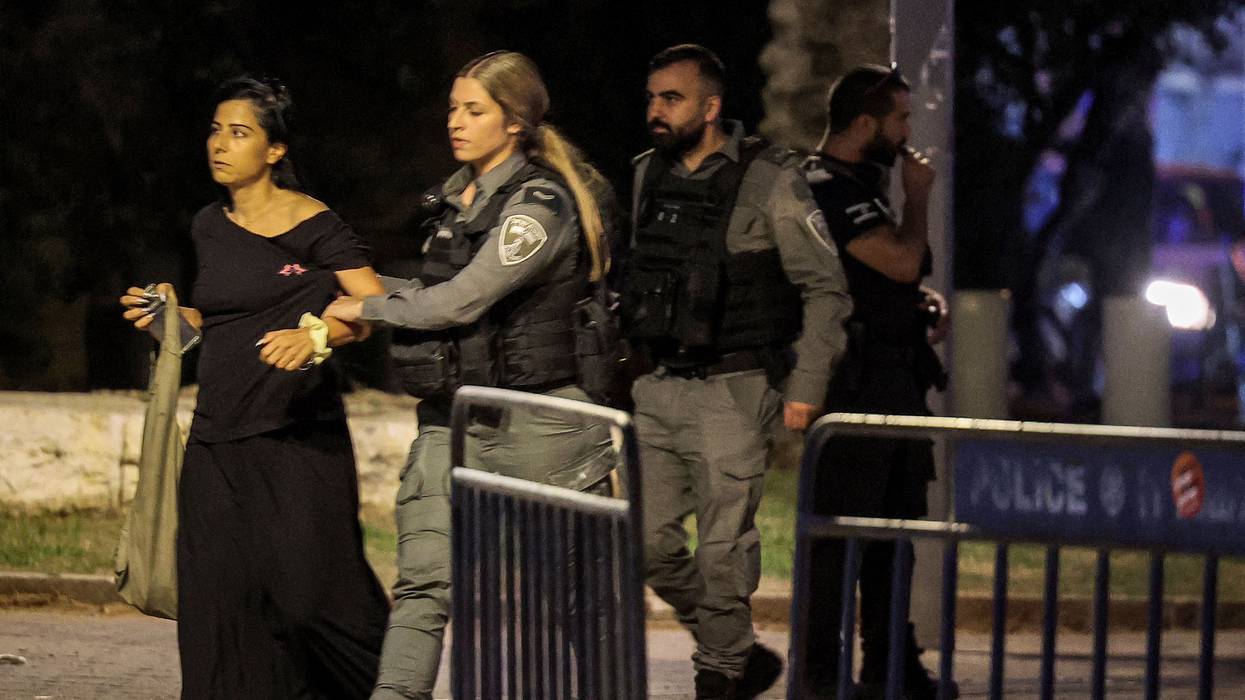
Offenders face up to one year behind bars. Videos posted on social media Thursday showed Israeli police at the home of an Arab Israeli woman informing her she was being arrested for allegedly "sharing content that sympathizes with and encourages terrorist actions... and supporting content that incites violence and terrorism."
Adalah-The Legal Center for Arab Minority Rights in Israel said in a statement that "this law is one of the most intrusive and draconian legislative measures ever passed by the Israeli Knesset, since it makes thoughts subject to criminal punishment" and "violates the constitutional right to freedom of speech and is used to muzzle legitimate political expression."
Adalah continued:
At a time when Israeli authorities are ramping up their campaign to stifle the freedom of expression of Palestinian citizens of Israel, conducting extensive surveillance of their online communications, and making unprecedented arrests for alleged speech-related offenses, the Israeli Knesset has enacted legislation that criminalizes even passive social media use. This legislation encroaches upon the sacred realm of an individual's personal thoughts and beliefs and significantly amplifies state surveillance of social media use. Adalah will petition the Supreme Court to challenge this law.
The New Israel Fund (NIF), a U.S.-based progressive advocacy group, called the amendment "dangerous" and "driven by far-right extremists intent on taking Israel backward."
NIF warned that "at a time when dissent is being crushed all over Israel, this law seeks to further silence any internal critics."
The group said the Counterterrorism Law already "has a history of discriminatory use" and "includes extremely blurry concepts" that "if read broadly could include... the entirety of Palestinian society."
Israel's Counterterrorism Law is rooted in the 1945 Emergency Rules enacted by British rulers of what was then called Mandatory Palestine amid a yearslong wave of terrorist attacks by Jewish militant groups targeting U.K. officials, British and Arab civilians, and even a ship full of Holocaust refugees. Many of its provisions remain in place today.
Even before the current war on Gaza, Israel's government faced international condemnation for designating humanitarian groups as "terrorist organizations."
In a joint statement, far-right Israeli Justice Minister Yariv Levin and Defense Minister Yoav Gallant said the amendment "will strengthen the administrative measures that can be used against the terrorist organizations and terrorist operatives, and will enable a more effective suppression of channels of recruitment, financing, and transfer of funds for terrorist purposes."
The 1.2 million Arab citizens of Israel are the descendants of the approximately 150,000 Palestinians allowed to remain in the country following the ethnic cleansing of over 750,000 of their compatriots during the foundation of the modern Israeli state. Although they officially enjoy equal rights under the law, human rights defenders in Israel and around the world say Arab Israelis live as second-class citizens due to structural discrimination.
Since the Hamas-led attacks on Israel last month that killed more than 1,400 civilians and soldiers, Palestinian citizens of Israel have faced a sweeping campaign of arrests for defending resistance against Israeli crimes including occupation, settler colonization, ethnic cleansing, apartheid, and a war in which Israeli forces have now killed over 10,800 people, while displacing 70% of the population of Gaza and obliterating much of the strip.
Many Arab Israelis have been fired from their jobs and face societywide attacks on freedom of speech and association. There is also widespread police harassment and intimidation, including arrests for protesting what even Israeli scholars are calling the "genocide" in Gaza.
Since October 7, more than 100 Palestinian citizens of Israel have been arrested for social media posts, including well-known singer and influencer Dalal Abu Amneh, who was accused of "incitement" for expressing online solidarity with the people of Gaza.
Critics say no one is immune from the Israeli crackdown on free speech, pointing to Thursday's arrest of former Knesset lawmakers for holding a peace vigil in Nazareth.
"Arresting Arab leaders is an alarming escalation by the government, revealing a perilous disregard for the entire Arab community," the Association for Civil Rights in Israel said on social media. "The police unjustly interfered with a protest vigil in Nazareth, violating freedom of expression and acting irresponsibly against the law."
"The past month represents an unprecedented juncture in the government's relationship with Arab society," the group added. "Despite the responsible leadership demonstrated within the Arab community, the minister of national security takes every measure to sow incitement and division."
Ironically, that minister—Itamar Ben-Gvir of the far-right Jewish Power party—was convicted in 2007 by an Israeli court of inciting racism and supporting terrorism.
"We are going to show them that the power of the people is stronger than that of the people in power," said one demonstrator.
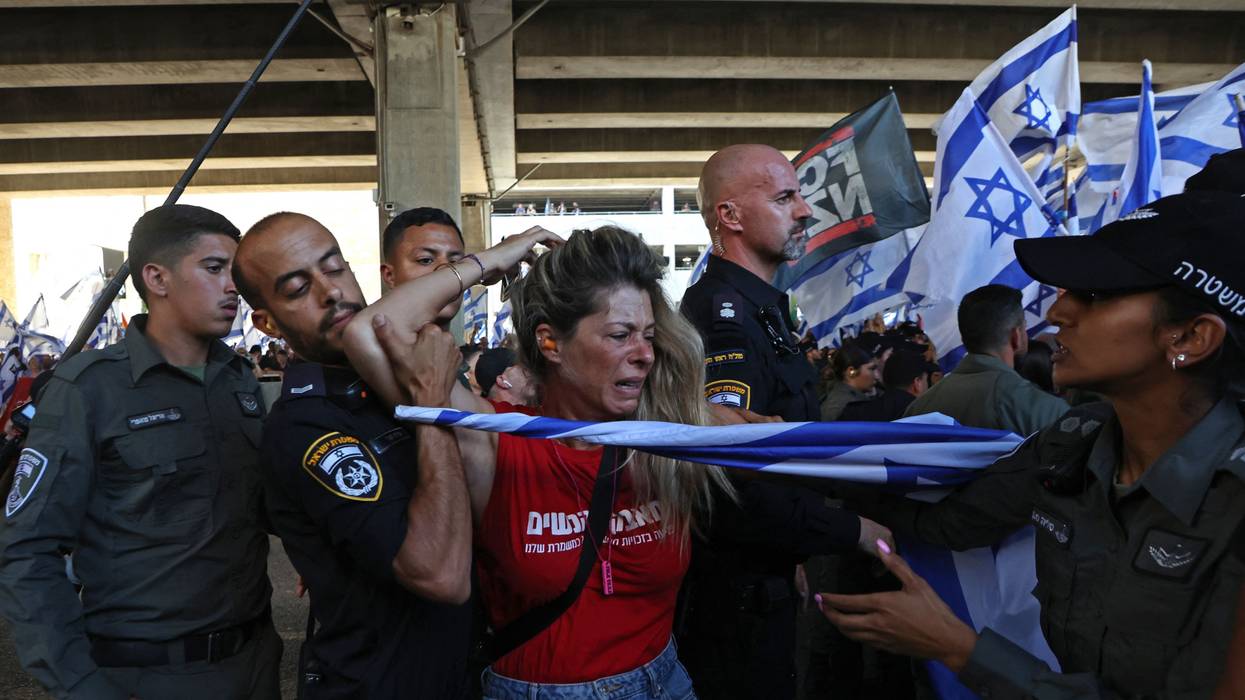
At least tens of thousands of Israelis on Tuesday took to the streets, shutting down highways, and marching through the country's main international airport in a "day of disruption" after the nation's far-right governing coalition advanced a deeply controversial overhaul of the legal system critics condemn as a "judicial coup."
Demonstrators thronged the highways leading to cities including Tel Aviv, Jerusalem, and Haifa, pitching tents, blocking roadways, and hanging banners from overpasses.
At Ben Gurion International Airport near Lod, thousands of protesters defied police warnings and marched through the arrivals hall.
Israeli police said at least 66 people were arrested. Widespread police violence—including spraying water cannons at protesters, charging into crowds on horseback, and an attack on at least one journalist—was recorded and posted on social media.
Ami Eshed, Tel Aviv's police commander, resigned last week due to what he claimed was political interference by Israeli Prime Minister Benjamin Netanyahu's far-right government and its desire to use excessive force to quash the ongoing pro-democracy protests.
"I could have easily met these expectations by using unreasonable force that would have filled up the emergency room... at the end of every protest," Eshed said on Israeli television.
Protesters—some of whom flew in from as far afield as the United States—represented a broad cross-section of Israel's center and left wing; however, Israeli-American journalist Emily Schrader said on Twitter that she "saw dozens of people screaming" at demonstrators opposing the illegal Israeli occupation of Palestine "to get out of the protest."
Speaking at a Tel Aviv protest, opposition leader Benny Gantz of the National Unity party said that "ultimately, the protests will block this judicial coup."
Gantz implored police to refrain from violence: "These are not enemies. You don't use this force on citizens."
One protester named Grace told Middle East Eye that she believes "Israel is deteriorating towards complete dictatorship and corruption, and we are trying to stop it. Whatever laws this government doesn't like, it cancels, so all the power goes into government hands and away from the public."
"The message we have for the government is no one here will agree to live in a dictatorship," she added. "We are seeing an extreme government that wants to create an extreme country, and we don't want that to happen. We are going to show them that the power of the people is stronger than that of the people in power."
Hundreds of Israel Defense Forces reservists specializing in cyberwarfare reacted to Monday's parliamentary vote by announcing they will stop reporting for duty.
"We will not continue to develop cyber capabilities for a criminal regime, and we will not train the future generation of offensive cyber," the reservists said in a statement. "Our work cannot continue under such a severe legal and moral cloud."
Hundreds of members of the women-led Bonot Alternativa movement rallied outside the U.S. consulate in Tel Aviv to protest the judicial bill, with another demonstration planned for Tuesday afternoon at the Israeli consulate in New York.
"The Israeli government is destroying Israel as we know it—a Jewish and democratic state—it is harming the independence of the courts... banishing women from the public sphere, and harming our core democracy," Bonot Alternativa said in a plea to U.S. President Joe Biden.
"The members of the 'most extreme' government, as President Biden put it, are attacking freedom of expression, the right to protest, and the rights of women and minorities," the group added. "Don't stand by. Don't let the Jewish state be destroyed."
The White House on Tuesday urged Israeli authorities to respect protesters' rights.
"As the administration has said, both U.S. and Israeli democracy are built on strong institutions, checks and balances, and an independent judiciary," a U.S. National Security Council spokesperson told Haaretz.
"The president has said consistently, both privately and publicly, that fundamental reforms like this require a broad basis of support to be durable and sustained," the spokesperson added. "The president has been clear he hopes Prime Minister Netanyahu will work to find a genuine compromise."
Tuesday's protests were sparked by Israeli lawmakers' overnight 64-56 vote to provisionally support a key piece of the highly contentious judicial overhaul that would repeal the "reasonableness" standard used by the Supreme Court to overrule egregious government decisions like then-Prime Minister Yitzhak Rabin's refusal to fire Cabinet Minister Aryeh Deri, leader of the ultra-Orthodox Shas party, after a 1993 fraud and bribery indictment.
The broader plan, proposed earlier this year by Israeli Justice Minister Yariv Levin—a member of Netanyahu's Likud party—would allow a 50%+1 parliamentary majority to override rulings issued by the Supreme Court, which also sits as the High Court of Justice and has been accused by human rights groups of giving legal cover to war crimes and crimes against humanity including apartheid and the illegal occupation of Palestine.
The proposed reforms would also increase government control over judicial appointments and make it more difficult for the Supreme Court to annul legislation by requiring the assent of more justices.
Furthermore, Levin's proposal would turn legal advisers who serve government ministries from professional appointees accountable to the attorney general into political appointments controlled by Cabinet ministers.
Critics have accused Netanyahu—who faces multiple criminal corruption charges—of attempting to weaken the judiciary in a bid to boost his chances of dodging prosecution. Netanyahu is prohibited from personal involvement in the judiciary overhaul due to a conflict of interest related to the charges against him.
If right-wing reforms giving Prime Minister Benjamin Netanyahu and members of parliament more power over the judiciary are passed, "the protests will intensify," said organizers.
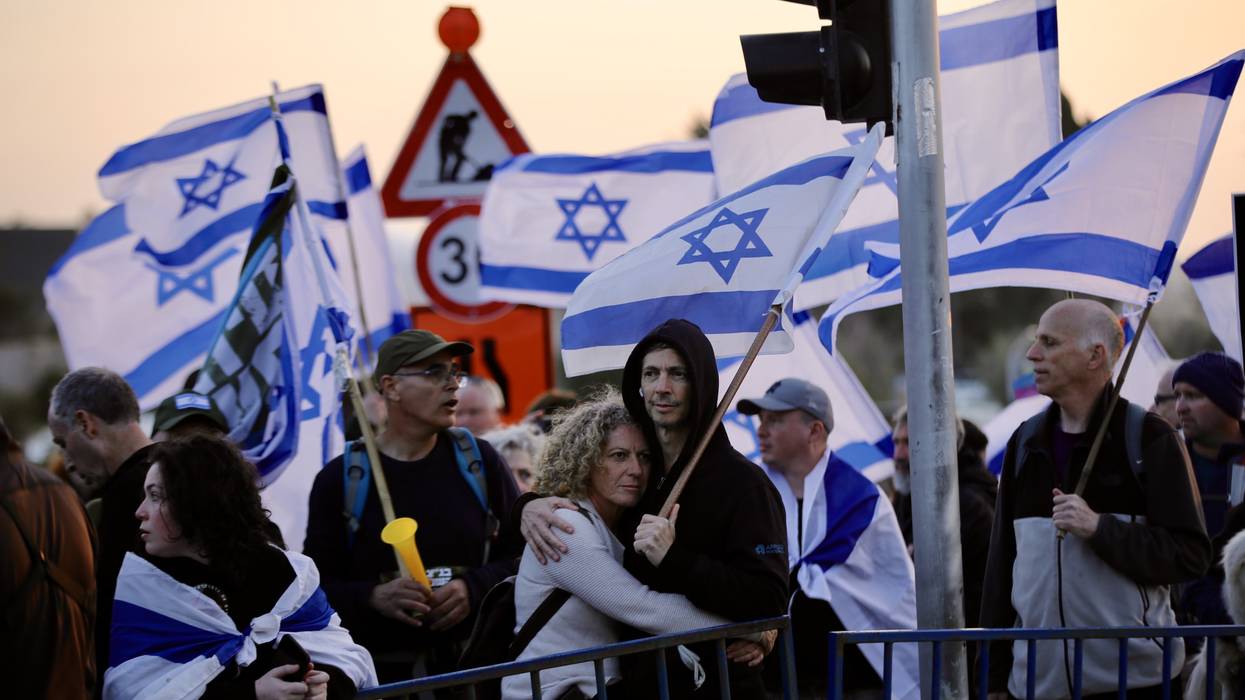
Tens of thousands of people opposed to the far-right Israeli government's proposed judicial overhaul once again hit the streets of Jerusalem and Tel Aviv on Monday, where they implored lawmakers to vote against the measures during the afternoon's first reading.
"On the morning of the vote, small groups of protesters sat down outside the front doors of some coalition lawmakers' homes in a bid to block them from leaving for parliament. They were removed by the police," The New York Times reported. After blocking highways to Jerusalem, protesters gathered outside parliament, where doctors "set up a mock triage station for 'casualties of the judicial reform.'"
Despite weeks of massive demonstrations, members of the Israeli Knesset are expected to pass the legislation, which is supported by right-wing Prime Minister Benjamin Netanyahu and his close ally, Justice Minister Yariv Levin.
If that happens, the Supreme Court's ability to overrule parliament would be weakened, as a simple 61-vote majority could override the court's decisions; the Supreme Court's ability to review and strike down attempts to change Israel's 13 quasi-constitutional "Basic Laws" would be abolished; and the ruling coalition would gain control of the Judicial Appointments Commission, a panel tasked with picking new judges.
The legislation must be approved three times to become law, with Monday afternoon's vote marking the first step in the process. Israeli President Isaac Herzog, a largely ceremonial figure, and opposition leader Yair Lapid have pleaded for Netanyahu's government to delay the legislation, to no avail.
On the eve of the initial vote, Levin said, "We won't stop the legislation now, but there is more than enough time until the second and third readings to hold an earnest and real dialogue and to reach understandings."
But as the Times noted, "critics have dismissed the government's position as disingenuous, arguing that once the bills have passed a first vote, only cosmetic changes will be possible."
Organizers, for their part, said Monday that "with the passage of the dictator's bill, the protests will intensify," according to i24 News.
Opponents "say the proposed overhaul would place unchecked power in the hands of the government, remove protections afforded to individuals and minorities, and deepen divisions in an already fractured society," the Times reported. They also worry that "Netanyahu, who is standing trial on corruption charges, could use the changes to extricate himself from his legal troubles."
In addition, Al Jazeera reported, opponents fear that "Netanyahu's nationalist allies want to weaken the Supreme Court to establish more settlements on land the Palestinians seek for a state. But settlements, which are considered illegal under international laws, have continued under successive Israeli governments. Nearly 600,000-750,000 Israelis now live in illegal settlements in the occupied West Bank and East Jerusalem."
Last week, Netanyahu's administration granted retroactive "legalization" to nine such settlements, and the prime minister has also intensified deadly raids, killing at least 50 Palestinians in occupied territories so far this year.
A right-wing neutering of the Supreme Court could exacerbate Israel's regime of violent dispossession and ethnic cleansing.
But the weekslong demonstrations against the proposed judicial overhaul "include very few Palestinians," Jewish Currents editor Peter Beinart observed Sunday in a Times op-ed titled "You Can't Save Democracy in a Jewish State."
"In fact, Palestinian politicians have criticized them for having, in the words of former Knesset member Sami Abu Shehadeh, 'nothing to do with the main problem in the region—justice and equality for all the people living here,'" Beinart wrote.
"The reason is that the movement against Mr. Netanyahu is not like the pro-democracy opposition movements in Turkey, India, or Brazil—or the movement against Trumpism in the United States," he added. "It's not a movement for equal rights. It's a movement to preserve the political system that existed before Mr. Netanyahu's right-wing coalition took power, which was not, for Palestinians, a genuine liberal democracy in the first place. It's a movement to save liberal democracy for Jews."
For Palestinians, Israel is not a democracy but rather an apartheid state, an assessment shared by numerous human rights groups around the world. The Israeli government has enacted discriminatory laws against Palestinians and colonized their land for decades, including under Lapid.
According to Beinart: "The principle that Mr. Netanyahu's liberal Zionist critics say he threatens—a Jewish and democratic state—is in reality a contradiction. Democracy means government by the people. Jewish statehood means government by Jews. In a country where Jews comprise only half of the people between the Jordan River and the Mediterranean Sea, the second imperative devours the first."
"Ultimately, a movement premised on ethnocracy cannot successfully defend the rule of law," he added. "Only a movement for equality can."
"It is not necessary to send the Proud Boys to storm the Capitol to attempt a coup," said one former Israeli ambassador. "Abusing a tiny legislative majority to crush the judiciary and the nature of Israel's democracy is also a coup."
Israeli liberals and critics around the world sounded the alarm Thursday over a plan by Israel's new far-right government to dramatically limit the power of the country's judiciary, in part by allowing a simple parliamentary majority to overturn Supreme Court rulings.
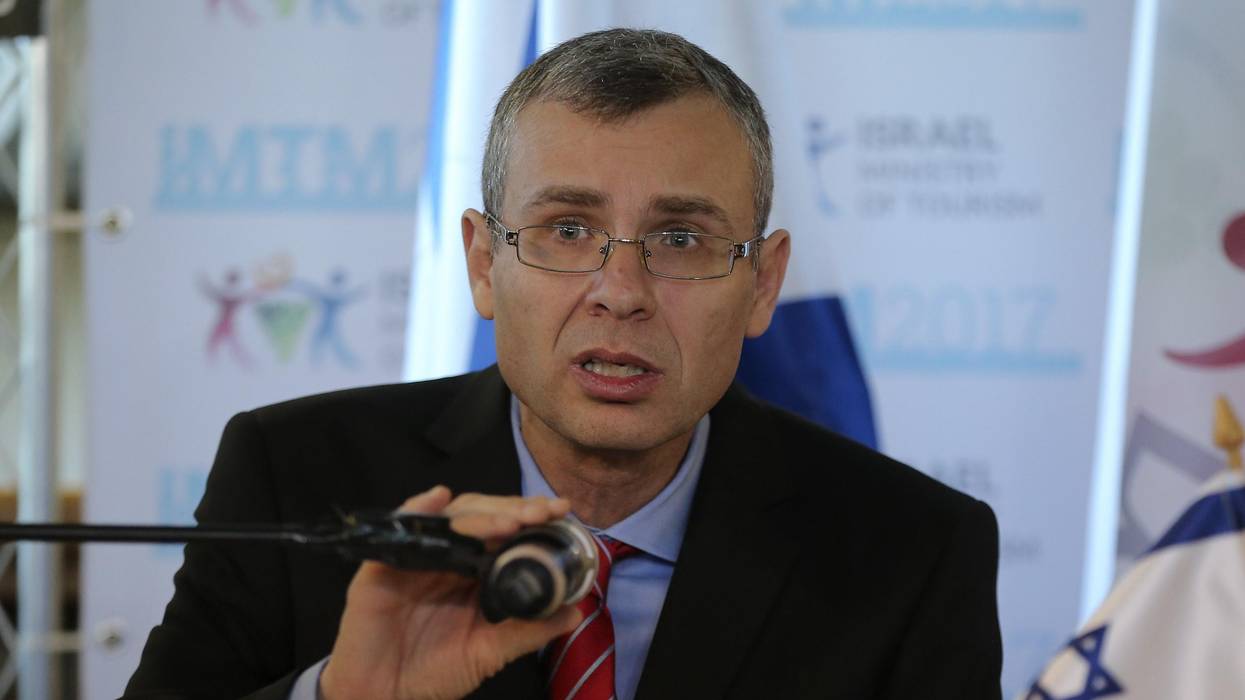
On Wednesday, Israeli Justice Minister Yariv Levin—a member of Prime Minister Benjamin Netanyahu's Likud party—released a set of proposals he said were aimed at "strengthening democracy, rehabilitating governance, restoring faith in the judicial system, and rebalancing the three branches of government."
"Judicial review? Gone. Separation of powers? Dead. Checks and balances? Kiss it goodbye."
However, opponents of the plan condemned it as a "political coup" and a "dagger in the rule of law."
"The night of January 4, 2023 will go down in history as the beginning of the regime coup in Israel, on its way to becoming a clone of Hungary/Poland/Russia/Turkey," journalist Yossi Verter wrote for the liberal Israeli newspaper Haaretz.
"A democratically elected government is assassinating democracy, for the glory of so-called democracy... on the way to the next step, the annulment of Netanyahu's trial," he added, referring to the prime minister's ongoing corruption case.
U.S.-based Partners for a Progressive Israel tweeted: "Judicial review? Gone. Separation of powers? Dead. Checks and balances? Kiss it goodbye."
The most contentious part of Levin's plan is an "override clause" that would allow a 50%+1 parliamentary majority to override rulings issued by the Supreme Court, which also sits as the High Court of Justice and has been accused by human rights groups of giving legal cover to war crimes and crimes against humanity including apartheid and the illegal occupation of Palestine.
As Haaretz's Amir Tibon noted: "Israel does not have a constitution, and the separation between the legislative and executive branches is very weak as the government almost always holds a majority in the Knesset [parliament]. This makes the Supreme Court the only institution with the power to limit government actions and legislation passed by a parliamentary majority. Now Levin wants to take that power away."
"For instance," he added, " if the government passed a law that clearly favored ultra-Orthodox citizens and hurt the rights of secular Israelis, and the Supreme Court then struck it down, all it would take to reinstate the discriminatory law is 61 votes in the Knesset."
Levin's proposal would also change how Israel's judges are selected.
"Today, the Judicial Appointments Committee includes politicians from both the government and the opposition, judges, and representatives of the Israel Bar Association," Tibon explained. "Levin wants to increase the power of the politicians and decrease that of judges and lawyers, effectively giving the government the power to appoint judges and, critically, Supreme Court justices."
The Israel Bar Association opposes Levin's proposal.
"Another change he wants to promote is to make it more difficult for the Supreme Court to annul legislation by requiring a larger majority of justices, and not just a regular majority, for any such decision to take effect," Tibon added. When this idea is combined with increasing the government's control over judicial appointments and the override clause, it becomes clear that Levin, in essence, wants the Supreme Court's ability to conduct judicial reviews to become a dead letter."
Furthermore, Levin's proposal would turn legal advisers who serve government ministries from professional appointees accountable to the attorney general into political appointments controlled by Cabinet ministers.
Finally, Levin is seeking to rescind the "reasonableness" standard used by the Supreme Court to overrule egregious government decisions like then-Prime Minister Yitzhak Rabin's refusal to fire Cabinet Minister Aryeh Deri, leader of the ultra-Orthodox Shas party, after a 1993 fraud and bribery indictment.
Levin's proposal came a day before the High Court of Justice heard arguments for and against the so-called Deri Law, legislation recently passed by the Knesset to allow Deri to serve as minister of both health and the interior despite his prior conviction and imprisonment for bribery, tax fraud, and breach of trust.
Levin's predecessor, Gideon Sa'ar, likened the proposed judiciary overhaul to "regime change," while Benny Gantz, leader of the opposition National Unity Party, called the plan "a major danger to the private citizen."
"We don't have a balanced system. We don't have a constitution to protect us. We don't have two houses [of parliament]," Gantz told Haaretz. "We have a government that with its majority controls the Knesset, and now together they will control the court."
Yair Lapid, who stepped down as Israel's prime minister last week and now leads the opposition, wrote: "Like a gang of criminals, the day before the High Court hearing on the Deri law, the government placed a loaded gun on the table. What Yariv Levin presented today is not legal reform, but rather a threatening letter. They are threatening to destroy the entire constitutional structure of Israel."
"A country that removes basic democratic checks and balances and eviscerates the independence of the judiciary can no longer be referred to seriously as a full democracy."
Daniel Sokatch, CEO of the liberal, U.S.-based New Israel Fund, said in a statement that "a country that removes basic democratic checks and balances and eviscerates the independence of the judiciary can no longer be referred to seriously as a full democracy."
"If Israel's new ruling coalition approves this legislation, it would strip power from the High Court of Justice, one of the few remaining institutions willing to protect human rights, individual freedoms, and democratic values," he continued.
"The international community, including the United States government, should see this move for what it is," Sokatch added, "a lurch towards autocracy, weakening Israel's legal system and democracy, and paving the way towards an attempt to further marginalize the most vulnerable in Israel and under Israel's control, including Palestinians, Arab citizens of Israel, members of the LGBTQ+ community, and migrants."