

SUBSCRIBE TO OUR FREE NEWSLETTER
Daily news & progressive opinion—funded by the people, not the corporations—delivered straight to your inbox.
5
#000000
#FFFFFF
To donate by check, phone, or other method, see our More Ways to Give page.
Daily news & progressive opinion—funded by the people, not the corporations—delivered straight to your inbox.
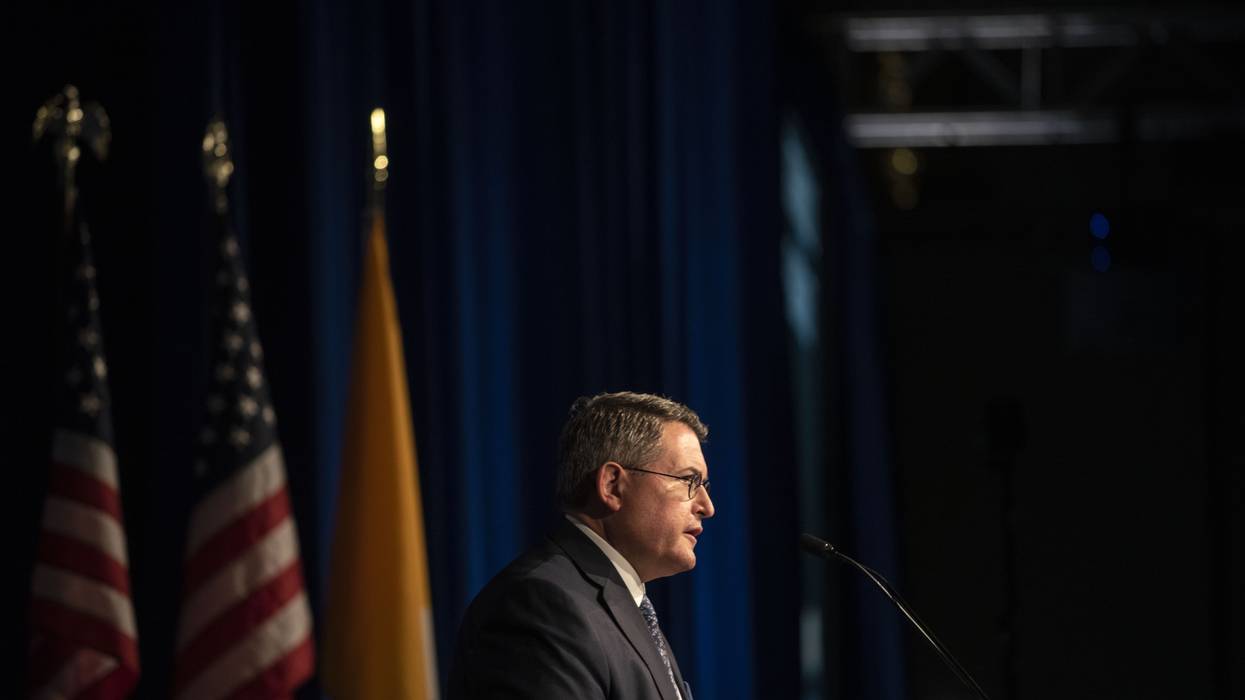
"Americans deserve a legal system that isn't influenced by billionaires and special interest backers pushing an agenda at the expense of working families," said a watchdog group leader.
Ahead of U.S. Supreme Court arguments next week, a watchdog group asserted Wednesday that right-wing Justices Samuel Alito and Clarence Thomas must recuse themselves from a case "whose outcome could have sweeping consequences," citing "significant conflicts of interest" due to their relationships with "conservative kingpin Leonard Leo."
In Federal Communications Commission v. Consumers' Research, a right-wing group is challenging the constitutionality of the FCC's Universal Service Fund program.
Vox's Ian Millhiser reported Wednesday that "if the Supreme Court accepts an argument raised by a federal appeals court, which struck down the federal program, it would bring about one of the biggest judicial power grabs in American history, and hobble the government's ability to do, well, pretty much anything."
In the new report about Alito and Thomas, the watchdog Accountable.US issued a similar warning about the case's potential impacts: "Effectively defunct for almost a century, the nondelegation doctrine prohibits Congress from passing off its legislative power to federal agencies... Reviving the doctrine would cripple agencies' ability to govern consumer safeguards, social security, Medicare, and more during a time when the Trump administration has begun to slash federal agencies."
"Now before the high court, the case presents an obvious conflict of interest for many of the justices who are personally tied to (and in some cases, friends of) the conservative activist Leonard Leo, who is closely connected to Consumers' Research," the analysis explains, pointing to reporting that Leo is the group's "main backer."
While "all six conservatives now sitting on the Supreme Court can credit Leo with helping to shepherd their confirmations," the watchdog's report states, the right-wing legal activist is "close personal friends" with Alito and Thomas.
According to the report:
"Americans deserve a legal system that isn't influenced by billionaires and special interest backers pushing an agenda at the expense of working families. Justices Thomas and Alito's cozy ties to Leonard Leo and thereby Consumers' Research fly straight in the face of that, and present a clear conflict of interest impeding their ability to rule impartially on the case," said Accountable.US president Caroline Ciccone in a statement.
"Public trust in the Supreme Court is already at an all-time low because of misguided conduct by justices–this case threatens to degrade it further," Ciccone continued. "The Supreme Court simply cannot be trusted to defend the Constitution if it doesn't adopt an obligatory, enforceable code of conduct that cleans up the impropriety that's existed on the court for years. Thomas and Alito must recuse themselves and restore a semblance of integrity to the highest court."
In addition to releasing the report, Accountable.US and two other groups, Take Back the Court and United for Democracy, argued for Alito and Thomas' recusal in a letter to Chief Justice John Roberts—who on Tuesday publicly condemned right-wing attacks on the federal judiciary.
"The Supreme Court has been engulfed by corruption scandals, many of which centering around the right-wing justices' overly friendly relationships with powerful billionaires and special interests," United for Democracy senior adviser Meagan Hatcher-Mays said Wednesday. "At the same time that Justices Thomas and Alito were accepting lavish gifts and trips from billionaires, they were hearing cases with those same billionaires' legal interests at stake."
"It's impossible for the American public to trust in Supreme Court rulings when this kind of glad-handing is taking place," she added. "The appearance of impropriety is clear in FCC v. Consumers' Research given Leonard Leo's long-time friendship with Justices Thomas and Alito and his financial entanglements with Consumers’ Research. Justices Thomas and Alito must recuse themselves immediately."
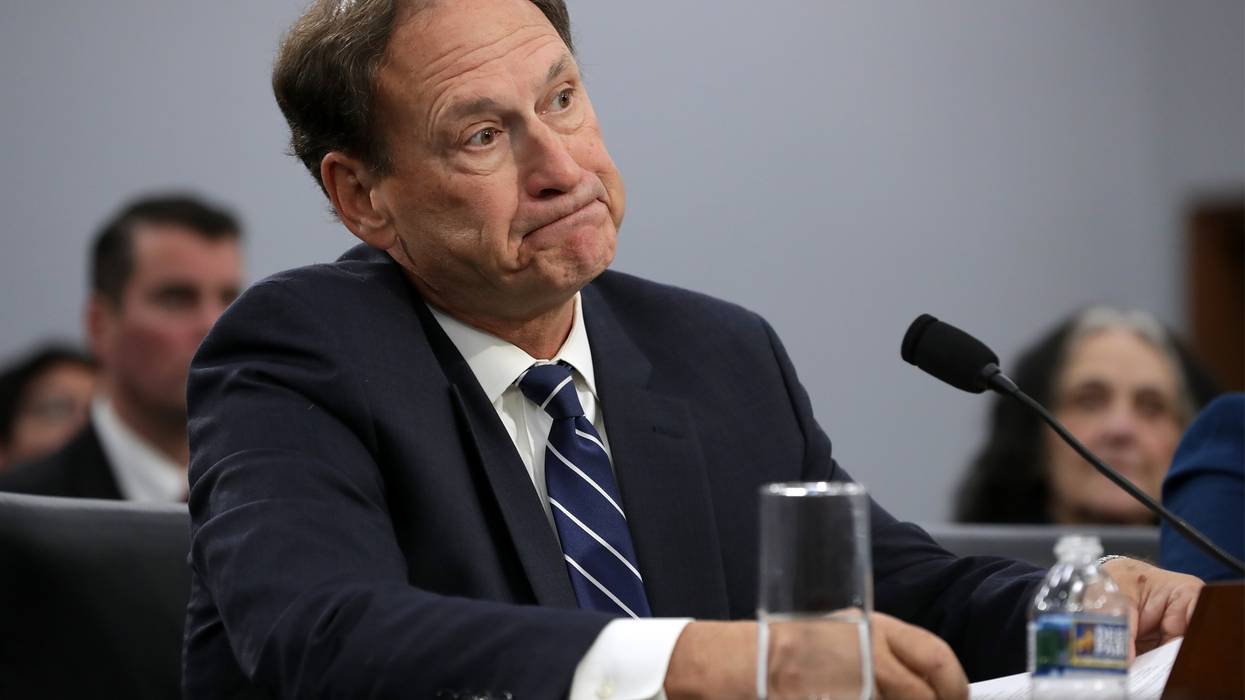
"It's hard to read this comically bad letter as anything other than a challenge to Congress to either assert its constitutional authority or admit fecklessness," said one group.
Despite his family's display of two flags associated with the "Stop the Steal" movement that baselessly claims the 2020 election was stolen from former President Donald Trump, U.S. Supreme Court Justice Samuel Alito said Wednesday that he will not recuse himself from two cases that pertain to the election and Trump supporters' effort to stop the results from being certified.
The justice wrote to the House of Representatives and the Senate to tell lawmakers that his wife, Martha-Ann Alito, was solely responsible for flying the two flags on the family's properties in Virginia in 2021 and New Jersey last year.
Justice advocates and Democrats in Congress have called on Alito to recuse from a case regarding Trump's claim that he has immunity from federal election interference charges and one in which the court is deliberating whether defendants who participated in the January 6, 2021 attempted insurrection should be charged with obstructing an official proceeding.
The demands for recusal—not the first to target Alito—came in recent weeks after The New York Times reported that an upside down flag had flown at his family home in Virginia just after January 6, and that a flag reading, "Appeal to Heaven" had been displayed last year at his New Jersey beach house, right around the time that one of the cases arrived at the Supreme Court.
Both flags were carried by some rioters on January 6 and have been embraced by the Stop the Steal movement.
The display of the flags, said Alito, "do not meet the conditions for recusal set out" by the court's ethics code, which was introduced last year and does not include an enforcement mechanism.
In his letters, Alito suggested that the push for accountability for the flag displays represents a violation of his wife's rights, noting that "she has the legal right to use the property as she sees fit."
"She makes her own decisions, and I have always respected her right to do so," wrote Alito, leading one progressive strategist to point out that the justice wrote the majority opinion in the Supreme Court ruling that revoked the constitutional right to obtain abortion care.
Brett Edkins, managing director of policy and political affairs for Stand Up America, called on the Senate to take "immediate action" to stop Alito's "bald-faced display of judicial misconduct."
"Justice Alito's refusal to recuse himself from cases related to January 6th is unacceptable," said Edkins. "By dismissing concerns about potential bias and conflicts of interest and placing the blame on his wife, he is making a mockery of the fundamental principles of impartiality and fairness upon which the Supreme Court was founded."
Edkins called on Senate Majority Leader Chuck Schumer (D-N.Y.) to "schedule a floor vote on a binding code of conduct for justices" and urged Sen. Dick Durbin (D-Ill.) to "fulfill his duty as chair of the Senate Judiciary Committee by launching a thorough investigation into Justice Alito's actions and corruption on the court."
Durbin sent a letter last week to Chief Justice John Roberts asking him to support the call for Alito's recusal and requesting a meeting with him, but progressives have said the senator should go further to ensure accountability for Alito's actions.
Rep. Alexandria Ocasio-Cortez (D-N.Y.) said last week that the Senate Judiciary Committee should subpoena Alito and open a formal investigation into his family's display of the flags.
Sarah Lipton-Lubet, president of Take Back the Court Action Fund, said Wednesday that it was tempting to "make fun of Alito for scribbling off the judicial equivalent of a 'my wife ate my homework' note."
"But the joke will be on all of us if Congress lets this be the last word on his recusal from election-related cases," said Lipton-Lubet. "It's hard to read this comically bad letter as anything other than a challenge to Congress to either assert its constitutional authority or admit fecklessness."
The court is expected to rule on the two Trump-related cases in late June.
Advocates have previously called on Alito to recuse from certain cases after it was revealed that he benefited from luxury travel paid for by a billionaire who had had business before the court.
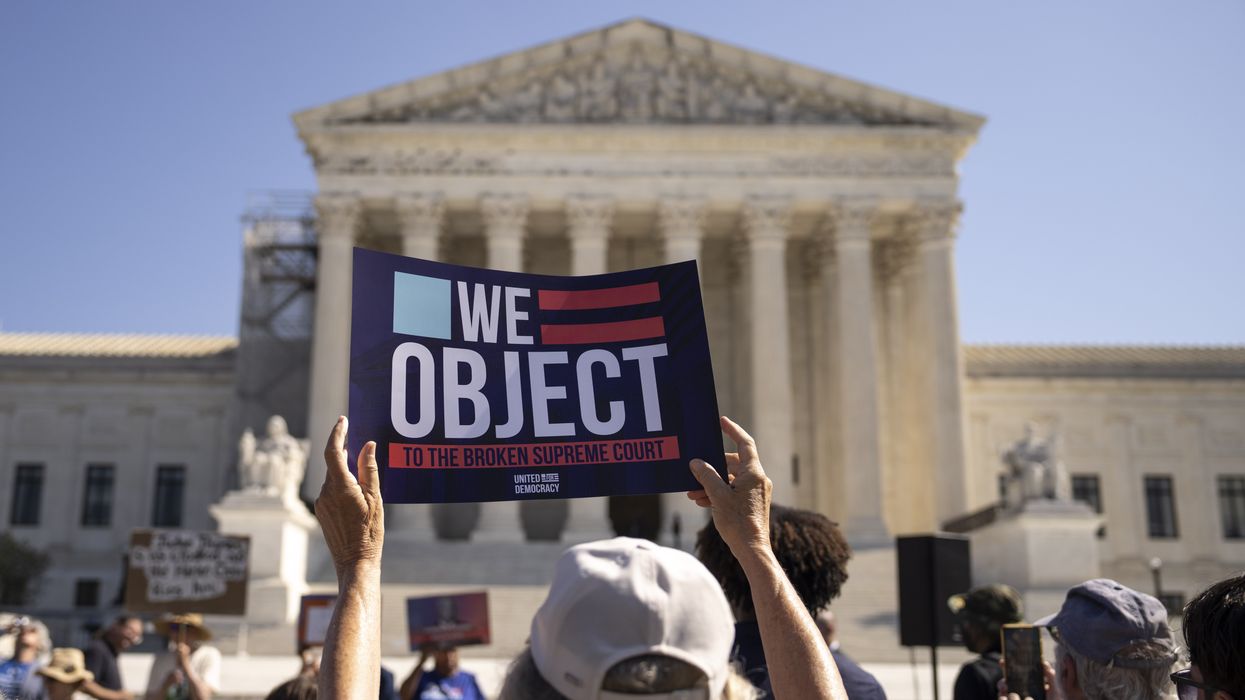
"Supreme corruption demands supreme transparency," said one campaigner behind the new effort.
A trio of progressive watchdog groups on Thursday unveiled a new database detailing the "troubling connections" between the U.S. Supreme Court's right-wing justices, the conservative organizations that have intervened in cases before the court, and the wealthy donors funding them.
Take Back the Court, Revolving Door Project, and True North Research published the database at SupremeTransparency.org, which "shines a spotlight on the complex web connecting justices to powerbrokers and the organizations that those powerbrokers fund, lead, and are otherwise linked to."
The watchdogs found that nearly 1 in 7 amicus briefs filed during the 2023-24 Supreme Court term were lodged by at least one powerbroker-affiliated organization. This affects 32 different cases before the court.
"The current U.S. Supreme Court has gone rogue."
For example, in Moore v. United States—in which the Supreme Court could preemptively ban or limit wealth taxes—half of all amicus briefs were filed by groups affiliated with right-wing powerbrokers.
In Loper Bright Enterprises v. Raimondo, groups funded by billionaire industrialist Charles Koch want to scupper the Chevron deference, a 40-year precedent under which judges defer to the legal interpretations of federal agencies if Congress has not passed any laws on an issue. Powerbroker-affiliated organizations have filed more than one-third of the amicus briefs seeking to overturn the Chevron doctrine.
"Far too often people with insidiously close ties to justices like Clarence Thomas and Samuel Alito, such as Harlan Crow and Paul Singer, signal their interest in the outcome of cases by funding, leading, or influencing organizations that file amicus briefs," Revolving Door Project executive director Jeff Hauser said in a statement.
"There is just as much of a conflict of interest when a justice hears a case involving a benefactor as a named party and one in which the person who illicitly enabled their luxurious lifestyle is 'merely' similarly situated to one of the parties," Hauser added.
According to SupremeTransparency.org:
The current U.S. Supreme Court has gone rogue. The right-wing justices that make up the court's supermajority frequently toy with precedent and the rule of law to issue opinions that not only defy the will of a majority of Americans, but also rewrite constitutional principles, overturn widely respected legal precedents, and gut longstanding rules that protect the public interest.
In just the 2021 and 2022 Supreme Court terms alone, the court overturned Roe v. Wade after 49 years; gutted both the decades-old Clean Air Act and Clean Water Act; overturned a 100+ year old gun safety law; eroded the National Labor Relations Act (adopted as part of New Deal reforms to protect workers); broke with their own procedures regarding standing to sue in order to block student debt relief; and reversed decades of precedent to end the decadeslong practice of race-conscious college admissions policies that promoted diversity and redressed discrimination. But this radically reactionary court and its radically reactionary justices aren't acting alone.
"Supreme corruption demands supreme transparency," said Take Back the Court president Sarah Lipton-Lubet. "It's no secret that the many of the rich benefactors cozying up to the conservative justices are the same people who fund right-wing organizations with business before the court."
"But too often, stories about the Supreme Court don't connect these dots—and as a result, they leave us with an incomplete picture," she continued. "The truth is right-wing powerbrokers are seemingly paying to play; they're funding groups that are weighing in on court cases even as they buy access to the justices who will rule on those cases."
"It's just one of the ways our Supreme Court is deeply, fundamentally broken," Lipton-Lubet added. "And it's a reminder of how urgent and necessary it is that we reform this corrupt court."
Last year, the Supreme Court adopted a Code of Conduct that contained few new rules, no enforcement mechanism, and was widely panned as a toothless public relations stunt. Bolder proposals for reforming the high court include term limits and increasing the number of justices.
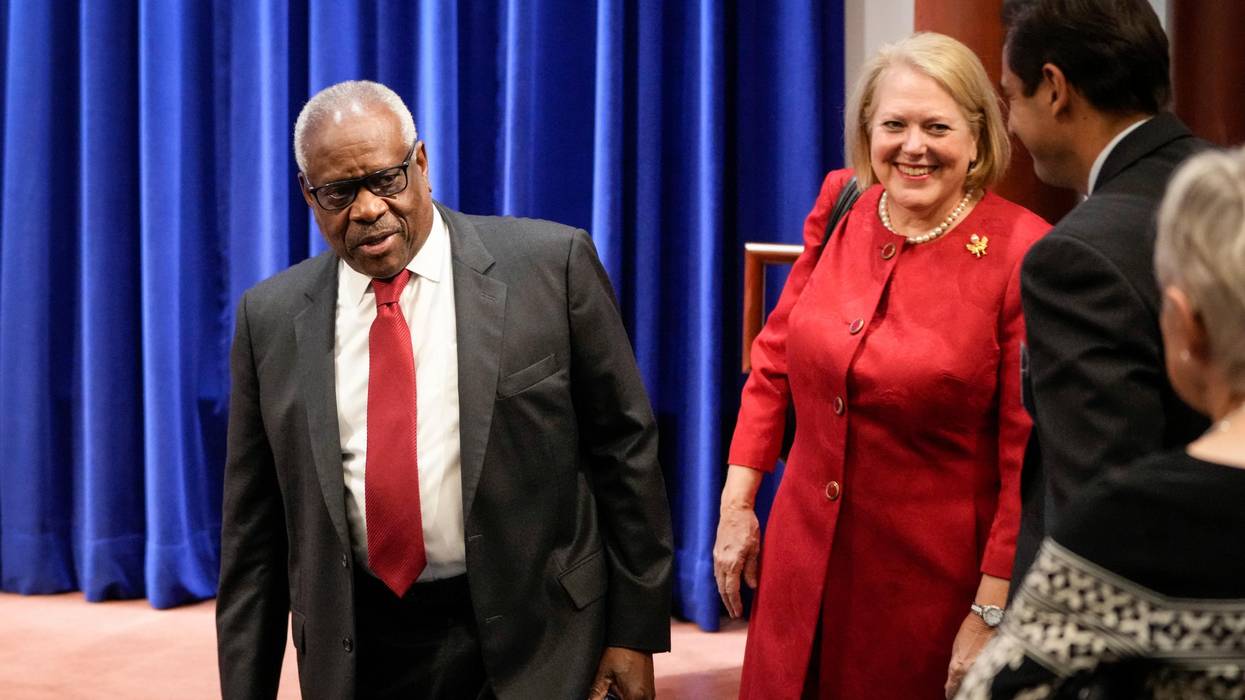
Critics also suggested that by hearing the case, the justices are trying to "buy him time to retake the White House."
Immediately after the U.S. Supreme Court on Wednesday agreed to take former President Donald Trump's immunity case, Justice Clarence Thomas faced pressure to not participate due to his wife's involvement in efforts to overturn the 2020 election.
"Clarence Thomas must recuse himself from this case," asserted Stand Up America, echoing the progressive advocacy group's demand for another Trump case argued before the court earlier this month. Although the justice's wife, right-wing activist Ginni Thomas, was part of the push to stop the certification of the 2020 results, he has not recused himself from relevant cases.
The immunity case that the high court now plans to hear in late April stems from Trump's 2020 election interference, which culminated in the January 6, 2021 insurrection. Following a probe led by Special Counsel Jack Smith, Trump was indicted in August. The likely Republican presidential nominee faces 91 charges across four criminal cases, two related to the election.
In a statement welcoming the Supreme Court's move Wednesday, Trump doubled down on his presidential immunity argument. He had asked the justices to weigh in after an appellate panel ruled that he could not claim immunity in the federal election case, echoing a December decision by Judge Tanya Chutkan of the U.S. District Court for the District of Columbia.
After Chutkan rejected Trump's immunity claim, Smith asked the Supreme Court to skip the appeals process, but the justices declined. Them taking the case now means that Chutkan must wait to begin the trial, just months from the November election.
"The Supreme Court's decision to hear Trump's appeal and delay arguments until April is a deliberate attempt to postpone accountability for Trump's role in the January 6th attack on our country," declared Stand Up America executive director Christina Harvey. "It also gives Trump a free pass on the campaign trail in the meantime. At a time when trust in the Supreme Court is at record lows, decisions like these only reinforce Americans' belief that Supreme Court justices are politicians in robes."
"Further raising concerns is Justice Thomas' continued refusal to recuse himself from this case and others related to the efforts to overthrow the 2020 election—efforts his wife participated in and pressured state officials to support," she said. "The American people deserve swift and transparent justice, not a protracted legal process that allows Trump to evade responsibility for his actions."
Take Back the Court Action Fund president Sarah Lipton-Lubet pointed out that "when it comes to helping corporations or restricting reproductive freedom, the Republican Supreme Court justices have shown they can work at breakneck speed."
"So why the holdup on this case?" she continued. "The obvious answer is that they know Trump's claims are dangerous and laughable, but they want to buy him time to retake the White House anyway."
While Trump didn't appoint Thomas, he did send three other right-wingers to the court: Justices Amy Coney Barrett, Neil Gorsuch, and Brett Kavanaugh.
This post has been updated with comment from former President Donald Trump and Mark Joseph Stern.
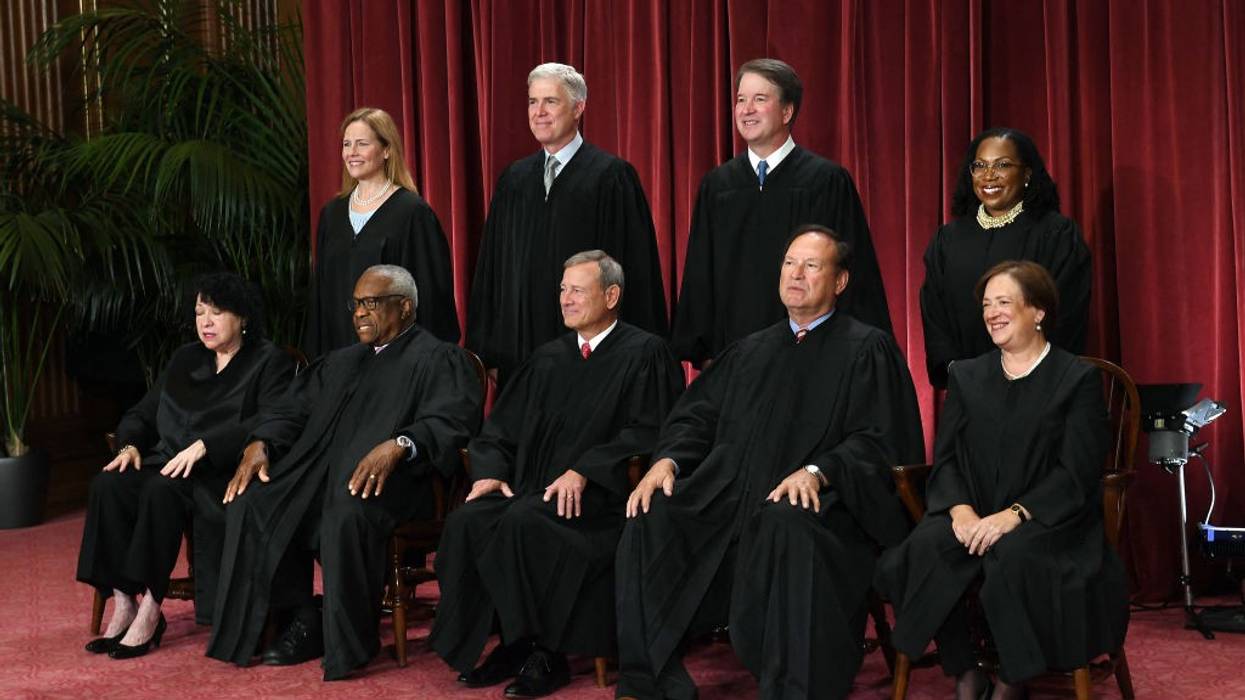
"This unenforceable public relations document serves absolutely no purpose other than to permit the media to revert to pretending that our unaccountable and unethical Supreme Court retains legitimacy," one advocate said.
In the wake of a series of high-profile scandals surrounding the relationship between right-wing justices and billionaires, the U.S. Supreme Court announced on Monday that it had formally adopted a new Code of Conduct.
The 14-page code is based on requirements for lower court judges, and most of the rules it outlines are not new, the court said. Watchdog groups have been widely critical of the new document, which does not stipulate how the conduct it promotes will be enforced, with the Revolving Door Project labeling it a "toothless PR stunt."
"This unenforceable public relations document serves absolutely no purpose other than to permit the media to revert to pretending that our unaccountable and unethical Supreme Court retains legitimacy," the project's executive director Jeff Hauser said in a statement.
Pressure on the Supreme Court to reform its ethics rules has mounted since ProPublica revealed in April that Justice Clarence Thomas had failed to disclose more than two decades worth of trips he had taken that had been paid for by billionaire Harlan Crow. Additional reporting in June uncovered the fact that Justice Samuel Alito had also taken undisclosed trips financed by hedge fund billionaire Paul Singer, who had appealed to the court to side with him in business disputes.
In response to these and other revelations of financial gifts to justices from wealthy and influential individuals, Democrats on the Senate Judiciary Committee advanced legislation in July that would require the court to follow stricter disclosure rules, adhere to an enforceable ethics code, and explain any recusal decisions to the American people. It would also enable investigations of any suspected breaches of the ethics code. Sen. Sheldon Whitehouse (D-R.I.), who led the push for the law, said that the Supreme Court's newly announced code was not an effective substitution.
"This is a long-overdue step by the justices, but a code of ethics is not binding unless there is a mechanism to investigate possible violations and enforce the rules," Whitehouse said in a statement. "The honor system has not worked for members of the Roberts Court. My ethics bill would create a transparent process for complaints and allow a panel of chief judges from the lower courts to investigate and make recommendations based on those complaints."
In the newly published code, the justices promised to "uphold the integrity and independence of the judiciary" and "avoid impropriety and the appearance of impropriety," among other key points. It stipulated that "a justice should not allow family, social, political, financial, or other relationships to influence official conduct or judgment," or "knowingly convey or permit others to convey the impression that they are in a special position to influence the justice."
However, the code begins with a statement that the court had "largely" already adhered to the tenets of the document, saying that the lack of an official code had "led in recent years to the misunderstanding that the justices of this court, unlike all other jurists in this country, regard themselves as unrestricted by any ethics rules." It says the primary purpose of the new code was "to dispel this misunderstanding."
"This document reeks of a cover-up for, among others, Justice Clarence Thomas," Hauser said in response to the preamble. "The list of weak ethics-adjacent aphori[s]ms is prefaced by a statement from the justices that they have 'largely' been complying with the loose norms they set forth today. Yet Thomas' conduct, in particular, has long been at odds with any pretense to any remotely serious standard of ethics."
"Will a risible PR stunt succeed in relieving pressure off a Supreme Court that is rightly widely deemed to be in crisis?"
Stand Up America managing director for policy and political affairs Brett Edkins said the document was "clearly" a response to public outrage over the ProPublica revelations.
"The court is attempting to halt momentum for transparency and real reform," Edkins said in a statement. "Congress must use its authority as a co-equal branch of government to pass a code of ethics with real enforcement mechanisms, and the Senate Judiciary Committee should move forward with subpoenas of Harlan Crow and Leonard Leo. The American people deserve to know the full scope of this court's corruption."
A committee vote on the committee on whether or not to issue such subpoenas was postponed last week, as NBC News reported.
Take Back the Court Action Fund president Sarah Lipton-Lubet also saw the code as a response to public pressure.
"With 53 uses of the word 'should' and only six of the word 'must,' the court's new 'code of ethics' reads a lot more like a friendly suggestion than a binding, enforceable guideline," Lipton-Lubet said in a statement.
Lipton-Lubet added that the document's lack of enforcement was more evidence that the court "cannot police itself."
"We've all seen what happens when it is left to do so, and the result is public confidence in the illegitimate Supreme Court has reached an all-time low," Lipton-Lubet continued. "Now is not the time to let up. Congress should move forward with actual ethics rules as soon as possible."
Trevor Potter, president of Campaign Legal Center and a former Republican chairman of the Federal Election Commission, said the code "may seem like a step in the right direction" but was "little more than an effort to assuage public outrage without assuming any actual accountability."
"Every other branch of government has a dedicated body responsible for enforcing its ethics code, yet the court does not even attempt to create one for itself here," Potter continued. "This 'code' changes nothing about the existing system of ethics self-policing in the Supreme Court. In fact, buried at the end of the document, the Court says they may rely on a variety of sources in interpreting the requirements of the ethics code—business as usual."
Senate Majority Leader Chuck Schumer (D-N.Y.) said the code was an "important first step," but added that "the lack of any way to enforce the code of conduct should any justice decide to ignore it is a glaring omission."
Ultimately, Hauser said the code was a "big test" for media and legal elites.
"Will a risible PR stunt succeed in relieving pressure off a Supreme Court that is rightly widely deemed to be in crisis?" Hauser asked. "People who care about the rule of law must hope those who lead our national coverage about the Supreme Court are not readily co-opted by lawyering that, truth be told, is not even especially slick or sophisticated."
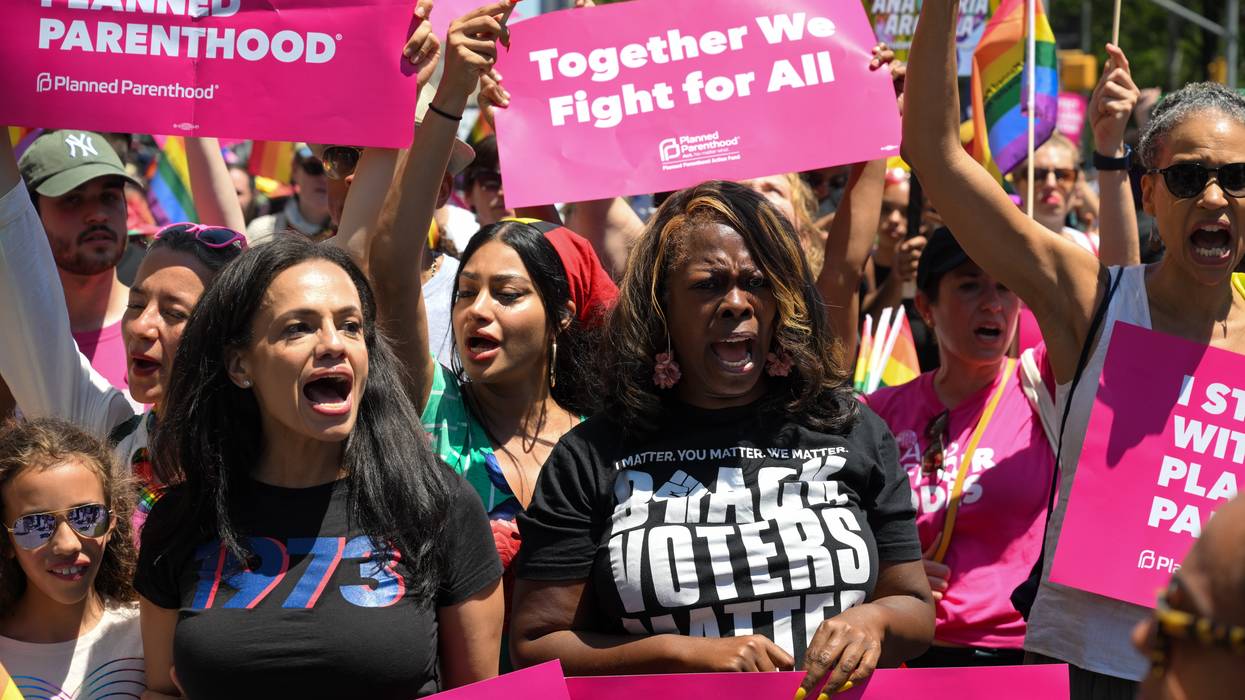
"A few short years ago, we were told court expansion was a pipe dream," said one advocate. "With support from groups boldly advocating at the state level to leading national organizations, our movement is growing stronger every day."
Justice advocates marked what they called a "huge" development in the fight for court reform on Monday as Planned Parenthood joined a national coalition that's pushing for the expansion of the U.S. Supreme Court, with the president of the reproductive rights organization saying the court's "capture" by the far right calls for "structural" change.
Alexis McGill Johnson, who leads the Planned Parenthood Action Fund and Planned Parenthood Federation of America, said Monday that the group is joining Just Majority, a coalition including more than 35 groups that are currently on a nationwide tour highlighting ethics violations at the Supreme Court and how reforms including expansion could help protect democracy and secure justice on the highest judicial panel in the country.
"We should be able to make our own decisions about our lives, bodies, and futures," said Johnson in a statement Monday. "The unrelenting attacks on our basic freedoms—including through the courts—demand that we reform our federal court system. Abortion rights, voting rights, LGBTQ+ rights, our democratic institutions, and so much more are at stake."
Johnson spoke to MSNBC's "Inside With Jen Psaki" on Sunday about Planned Parenthood's decision to join the court expansion movement, as other rights groups including NARAL Pro-Choice America, Latino Victory, and Newtown Action Alliance have in recent weeks.
The group was pushed toward its decision, she said, as U.S. District Judge Matthew Kacsmaryk ruled last month that mifepristone, a pill used in medication abortions, should be taken off the market.
"The reality is, the court now has been fully captured in so many areas," Johnson said. "The fact that you have, again, this lone Texas judge, that can now bring cases, you can form shop there, bring cases to the Fifth Circuit, which is also conservative and up to the Supreme Court now, which has a conservative supermajority... And that is a way to circumvent the way in which popularly elected decisions are made."
"We need to see expanded courts, from the lower courts all the way up to the Supreme Court," she added. "We need to see term limits. We need to see ethical reforms."
Planned Parenthood's decision to join the court expansion movement, which has been led by groups including Demand Justice and Take Back the Court, comes as right-wing Supreme Court justices, particularly Justice Clarence Thomas, have faced intense criticism over alleged ethics violations. Recent reports have pointed to evidence that Thomas has for years received financial gifts from Texas Republican megadonor Harlan Crow without disclosing those financial ties as required by federal law, and Justices Neil Gorsuch and John Roberts have also faced scrutiny about their failure to disclose financial transactions and payments.
"It's really important to call for structural reforms that sustain progress," said Johnson. "It would be one thing to call for a justice to step down for whatever reason, but the reality is that the way in which the system has been captured requires us to engage in structural reform in a different way."
On social media, Johnson said Planned Parenthood's "expanded position" on the courts reflects an expansion of its "commitment" to protecting reproductive rights.
Demand Justice called Planned Parenthood's decision "an inflection point for the Supreme Court reform movement."
"The endorsement of key groups in the progressive ecosystem like Planned Parenthood shows just how far this campaign has come," said Brian Fallon, executive director of the group. "The public has awoken to the dangers of a captured, corrupt judiciary and is demanding solutions. The composition of the court will obviously not be changed overnight, but the consensus about the need for bold, sweeping reforms is growing by the day, and the salience of the court as a political issue has never been higher."
Sarah Lipton-Lubet, president of Take Back the Court, said Planned Parenthood's joining of the movement shows how court expansion has become "a mainstream progressive policy goal with the support of more than 60 members of Congress and some of the most respected and powerful abortion rights champions in our movement."
"A few short years ago, we were told court expansion was a pipe dream," said Lipton-Lubet. "With support from groups boldly advocating at the state level to leading national organizations, our movement is growing stronger every day. The right-wing extremists on the Court can try to rip our rights away, but we're fighting back even stronger—and we're going to win."
The Supreme Court has been expanded seven times in the past. Reform advocates also called for an addition of seats of lower federal courts to reflect growth in population, diversity, and the number of cases that judges hear.
"It won't be easy and it won't happen overnight but we WILL expand the Supreme Court," said Doug Lindner, senior director of judiciary and democracy for the League of Conservation Voters. "We WILL protect our abortion rights and our climate from these extremists. And we WILL pass on a vibrant, multiracial democracy to the next generation."