SUBSCRIBE TO OUR FREE NEWSLETTER
Daily news & progressive opinion—funded by the people, not the corporations—delivered straight to your inbox.
5
#000000
#FFFFFF
To donate by check, phone, or other method, see our More Ways to Give page.
Daily news & progressive opinion—funded by the people, not the corporations—delivered straight to your inbox.
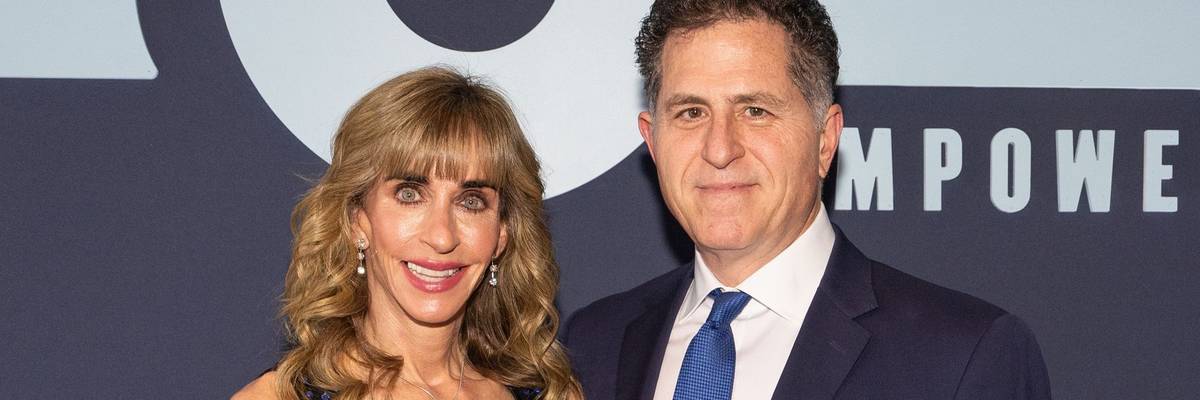
Susan Dell and Michael Dell attend the 12th Annual Mack, Jack & McConaughey Gala at ACL Live on April 25, 2024 in Austin, Texas.
"If the White House were serious about supporting families struggling with the costs of living, it would be advocating for investments in childcare," said one children's advocate.
After Silicon Valley CEO Michael Dell and his wife, philanthropist Susan Dell, announced Tuesday their plan to invest $6.25 billion in seed money in individual investment accounts for 25 million American children, adding to the number of kids who would receive so-called "Trump Accounts" that were included in the Republican spending bill this year, advocates acknowledged that a direct cash investment could feasibly help some families.
But the National Women's Law Center (NWLC) was among those wondering whether the Dells' investment of $6.25 billion—a fraction of their $148 billion fortune—would ultimately benefit wealthy investors far more.
“While we support direct investments in families, the Trump Accounts being hailed by the White House are a policy solution that doesn’t meet most families’ needs,” said Amy Matsui, the vice president of income security and child care at NWLC. “As currently structured, these accounts will just become another tax shelter for the wealthiest, while the overwhelming majority of American families, who are struggling to cover basic costs like food, childcare, and housing, will be hard pressed to find the extra money that could turn the seed money into a meaningful investment."
The Dells, who are behind Dell Technologies, announced the investment plan months after President Donald Trump signed the One Big Beautiful Bill into law. The tax and spending law includes a provision that would start an investment account for every US citizen child born between January 2025-December 2028, with a $1,000 investment from the US government.
As Jezebel reported, the couple's contribution would got to an additional 25 million children, up to age 10, who were born prior to the 2025 cut-off date for the initial Trump Accounts.
"Around 80% of children born between 2016-2024 would theoretically qualify, although there are cutoffs based on household income: Applying families would have to live in ZIP codes where the median household income is less than $150,000 per year," wrote Jim Vorel.
In the corporate press, the Dells were applauded for making what they called the largest single private charitable donation to US children, but Vorel questioned the real-world impact of "a gift of $250, thrown vaguely in the direction of millions of American families by members of our billionaire ruling class."
"What can that money realistically do in terms of providing for a child’s future?" he wrote. "Is it the seed that is going to allow them to go to college, to buy a house some day? Does that really seem likely? Or are we primarily talking about billionaires running PR campaigns for a president who recently hit new second term lows in his overall approval numbers?"
The success of the individual investment accounts hinges on whether Americans and their employers—who can contribute up to $2,500 per year without counting it as taxable income—will be able to consistently and meaningfully invest money in the accounts until their children turn 18, considering that about a quarter of US households are living paycheck to paycheck, according to a recent poll.
"Do you know many families in 2025 that would describe themselves as having a spare $5,000 per year to immediately start investing in a government-backed investment account, even if that might be relatively sound financial strategy? Or are the families in your orbit already scraping to get by, without being able to commit much attention to investing in the future?" asked Vorel, adding that the artificial intelligence "bubble" is widely expected to soon burst and drag the stock market in which Trump is urging families to invest "into a deep pit of despair."
"As is so often the case, the families most benefited by the concept of Trump Accounts will be those ones who are already on the best financial footing, aka the wealthiest Americans," he wrote.
Jonathan Cohn of Progressive Mass was among those who said the Dells' investment only served to demonstrate how "they should pay more in taxes" to ensure all US children can benefit from public, not private, investment in education, healthcare, and other social supports.
"The government should not be funding only what can secure the sympathies of erratic rich people," said Cohn.
The NWLC argued the Trump Accounts are an example of the White House's embrace of "pronatalism"—the belief that the government should incentivize Americans to have more children—but fall short of being a policy that would actually make a measurable positive impact on families.
“In the end, this policy mirrors the rest of the law: another giveaway to the richest Americans that leaves everyone else further behind," said Matsui. "If the White House were serious about supporting families struggling with the costs of living, it would be advocating for investments in childcare, an expanded Child Tax Credit, and undoing the historic cuts to SNAP and Medicaid.”
Dear Common Dreams reader, It’s been nearly 30 years since I co-founded Common Dreams with my late wife, Lina Newhouser. We had the radical notion that journalism should serve the public good, not corporate profits. It was clear to us from the outset what it would take to build such a project. No paid advertisements. No corporate sponsors. No millionaire publisher telling us what to think or do. Many people said we wouldn't last a year, but we proved those doubters wrong. Together with a tremendous team of journalists and dedicated staff, we built an independent media outlet free from the constraints of profits and corporate control. Our mission has always been simple: To inform. To inspire. To ignite change for the common good. Building Common Dreams was not easy. Our survival was never guaranteed. When you take on the most powerful forces—Wall Street greed, fossil fuel industry destruction, Big Tech lobbyists, and uber-rich oligarchs who have spent billions upon billions rigging the economy and democracy in their favor—the only bulwark you have is supporters who believe in your work. But here’s the urgent message from me today. It's never been this bad out there. And it's never been this hard to keep us going. At the very moment Common Dreams is most needed, the threats we face are intensifying. We need your support now more than ever. We don't accept corporate advertising and never will. We don't have a paywall because we don't think people should be blocked from critical news based on their ability to pay. Everything we do is funded by the donations of readers like you. When everyone does the little they can afford, we are strong. But if that support retreats or dries up, so do we. Will you donate now to make sure Common Dreams not only survives but thrives? —Craig Brown, Co-founder |
After Silicon Valley CEO Michael Dell and his wife, philanthropist Susan Dell, announced Tuesday their plan to invest $6.25 billion in seed money in individual investment accounts for 25 million American children, adding to the number of kids who would receive so-called "Trump Accounts" that were included in the Republican spending bill this year, advocates acknowledged that a direct cash investment could feasibly help some families.
But the National Women's Law Center (NWLC) was among those wondering whether the Dells' investment of $6.25 billion—a fraction of their $148 billion fortune—would ultimately benefit wealthy investors far more.
“While we support direct investments in families, the Trump Accounts being hailed by the White House are a policy solution that doesn’t meet most families’ needs,” said Amy Matsui, the vice president of income security and child care at NWLC. “As currently structured, these accounts will just become another tax shelter for the wealthiest, while the overwhelming majority of American families, who are struggling to cover basic costs like food, childcare, and housing, will be hard pressed to find the extra money that could turn the seed money into a meaningful investment."
The Dells, who are behind Dell Technologies, announced the investment plan months after President Donald Trump signed the One Big Beautiful Bill into law. The tax and spending law includes a provision that would start an investment account for every US citizen child born between January 2025-December 2028, with a $1,000 investment from the US government.
As Jezebel reported, the couple's contribution would got to an additional 25 million children, up to age 10, who were born prior to the 2025 cut-off date for the initial Trump Accounts.
"Around 80% of children born between 2016-2024 would theoretically qualify, although there are cutoffs based on household income: Applying families would have to live in ZIP codes where the median household income is less than $150,000 per year," wrote Jim Vorel.
In the corporate press, the Dells were applauded for making what they called the largest single private charitable donation to US children, but Vorel questioned the real-world impact of "a gift of $250, thrown vaguely in the direction of millions of American families by members of our billionaire ruling class."
"What can that money realistically do in terms of providing for a child’s future?" he wrote. "Is it the seed that is going to allow them to go to college, to buy a house some day? Does that really seem likely? Or are we primarily talking about billionaires running PR campaigns for a president who recently hit new second term lows in his overall approval numbers?"
The success of the individual investment accounts hinges on whether Americans and their employers—who can contribute up to $2,500 per year without counting it as taxable income—will be able to consistently and meaningfully invest money in the accounts until their children turn 18, considering that about a quarter of US households are living paycheck to paycheck, according to a recent poll.
"Do you know many families in 2025 that would describe themselves as having a spare $5,000 per year to immediately start investing in a government-backed investment account, even if that might be relatively sound financial strategy? Or are the families in your orbit already scraping to get by, without being able to commit much attention to investing in the future?" asked Vorel, adding that the artificial intelligence "bubble" is widely expected to soon burst and drag the stock market in which Trump is urging families to invest "into a deep pit of despair."
"As is so often the case, the families most benefited by the concept of Trump Accounts will be those ones who are already on the best financial footing, aka the wealthiest Americans," he wrote.
Jonathan Cohn of Progressive Mass was among those who said the Dells' investment only served to demonstrate how "they should pay more in taxes" to ensure all US children can benefit from public, not private, investment in education, healthcare, and other social supports.
"The government should not be funding only what can secure the sympathies of erratic rich people," said Cohn.
The NWLC argued the Trump Accounts are an example of the White House's embrace of "pronatalism"—the belief that the government should incentivize Americans to have more children—but fall short of being a policy that would actually make a measurable positive impact on families.
“In the end, this policy mirrors the rest of the law: another giveaway to the richest Americans that leaves everyone else further behind," said Matsui. "If the White House were serious about supporting families struggling with the costs of living, it would be advocating for investments in childcare, an expanded Child Tax Credit, and undoing the historic cuts to SNAP and Medicaid.”
After Silicon Valley CEO Michael Dell and his wife, philanthropist Susan Dell, announced Tuesday their plan to invest $6.25 billion in seed money in individual investment accounts for 25 million American children, adding to the number of kids who would receive so-called "Trump Accounts" that were included in the Republican spending bill this year, advocates acknowledged that a direct cash investment could feasibly help some families.
But the National Women's Law Center (NWLC) was among those wondering whether the Dells' investment of $6.25 billion—a fraction of their $148 billion fortune—would ultimately benefit wealthy investors far more.
“While we support direct investments in families, the Trump Accounts being hailed by the White House are a policy solution that doesn’t meet most families’ needs,” said Amy Matsui, the vice president of income security and child care at NWLC. “As currently structured, these accounts will just become another tax shelter for the wealthiest, while the overwhelming majority of American families, who are struggling to cover basic costs like food, childcare, and housing, will be hard pressed to find the extra money that could turn the seed money into a meaningful investment."
The Dells, who are behind Dell Technologies, announced the investment plan months after President Donald Trump signed the One Big Beautiful Bill into law. The tax and spending law includes a provision that would start an investment account for every US citizen child born between January 2025-December 2028, with a $1,000 investment from the US government.
As Jezebel reported, the couple's contribution would got to an additional 25 million children, up to age 10, who were born prior to the 2025 cut-off date for the initial Trump Accounts.
"Around 80% of children born between 2016-2024 would theoretically qualify, although there are cutoffs based on household income: Applying families would have to live in ZIP codes where the median household income is less than $150,000 per year," wrote Jim Vorel.
In the corporate press, the Dells were applauded for making what they called the largest single private charitable donation to US children, but Vorel questioned the real-world impact of "a gift of $250, thrown vaguely in the direction of millions of American families by members of our billionaire ruling class."
"What can that money realistically do in terms of providing for a child’s future?" he wrote. "Is it the seed that is going to allow them to go to college, to buy a house some day? Does that really seem likely? Or are we primarily talking about billionaires running PR campaigns for a president who recently hit new second term lows in his overall approval numbers?"
The success of the individual investment accounts hinges on whether Americans and their employers—who can contribute up to $2,500 per year without counting it as taxable income—will be able to consistently and meaningfully invest money in the accounts until their children turn 18, considering that about a quarter of US households are living paycheck to paycheck, according to a recent poll.
"Do you know many families in 2025 that would describe themselves as having a spare $5,000 per year to immediately start investing in a government-backed investment account, even if that might be relatively sound financial strategy? Or are the families in your orbit already scraping to get by, without being able to commit much attention to investing in the future?" asked Vorel, adding that the artificial intelligence "bubble" is widely expected to soon burst and drag the stock market in which Trump is urging families to invest "into a deep pit of despair."
"As is so often the case, the families most benefited by the concept of Trump Accounts will be those ones who are already on the best financial footing, aka the wealthiest Americans," he wrote.
Jonathan Cohn of Progressive Mass was among those who said the Dells' investment only served to demonstrate how "they should pay more in taxes" to ensure all US children can benefit from public, not private, investment in education, healthcare, and other social supports.
"The government should not be funding only what can secure the sympathies of erratic rich people," said Cohn.
The NWLC argued the Trump Accounts are an example of the White House's embrace of "pronatalism"—the belief that the government should incentivize Americans to have more children—but fall short of being a policy that would actually make a measurable positive impact on families.
“In the end, this policy mirrors the rest of the law: another giveaway to the richest Americans that leaves everyone else further behind," said Matsui. "If the White House were serious about supporting families struggling with the costs of living, it would be advocating for investments in childcare, an expanded Child Tax Credit, and undoing the historic cuts to SNAP and Medicaid.”