
SUBSCRIBE TO OUR FREE NEWSLETTER
Daily news & progressive opinion—funded by the people, not the corporations—delivered straight to your inbox.
5
#000000
#FFFFFF
To donate by check, phone, or other method, see our More Ways to Give page.


Daily news & progressive opinion—funded by the people, not the corporations—delivered straight to your inbox.
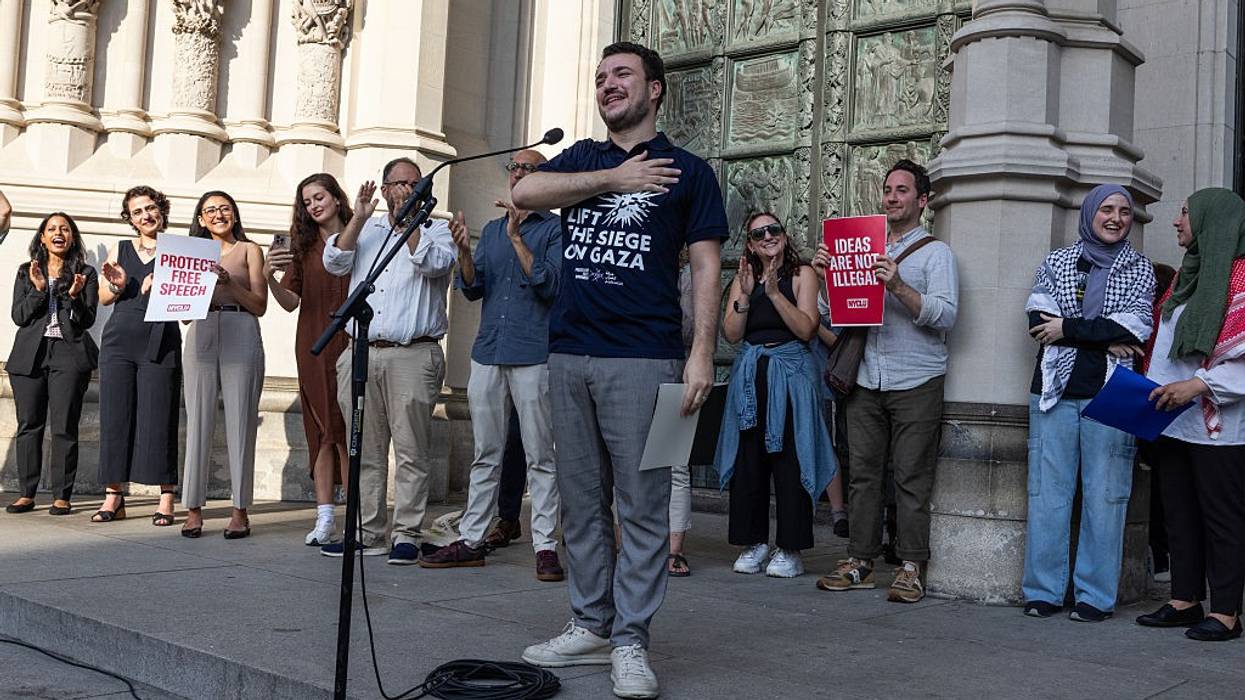
Palestinian human rights advocate, Mahmoud Khalil, knows authoritarianism when he sees it. “I lived under the Assad regime [in Syria]. I know how that feels.”
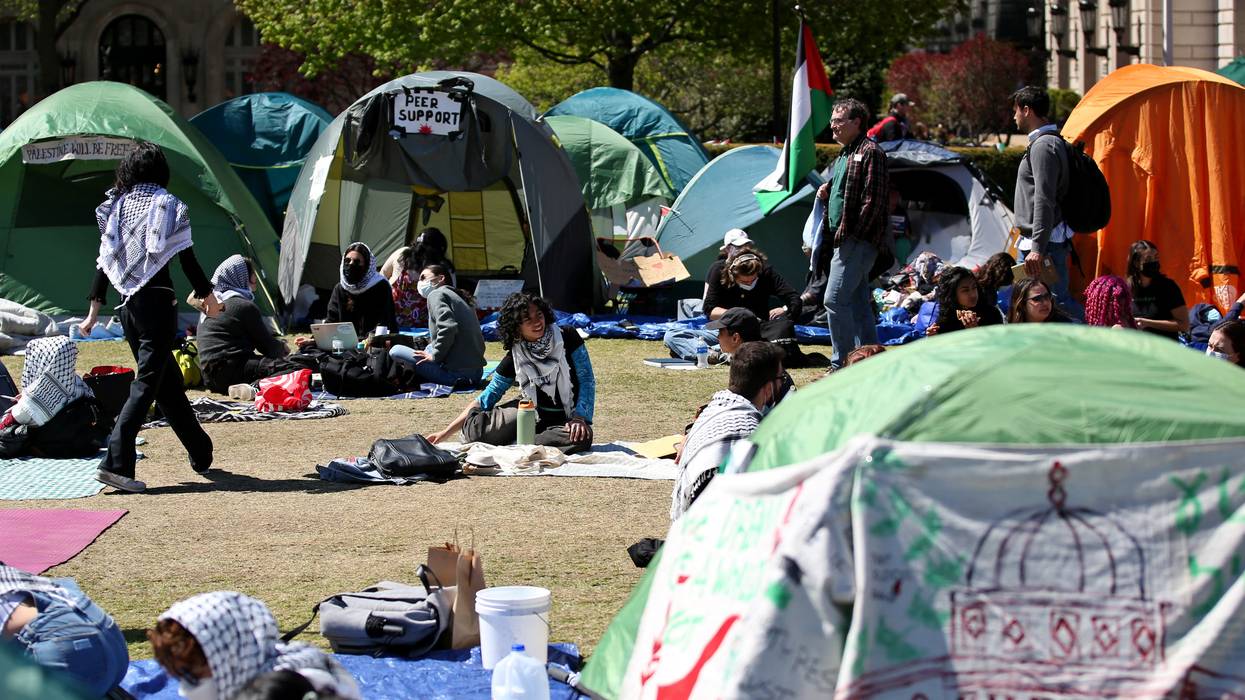
A negotiator for the pro-Palestine student protests on Columbia University's campus in 2024, Khalil and I spoke late last month. Thousands of National Guard had already been deployed to Los Angeles and Washington DC, supposedly to “crack down” on crime, leading to hundreds of arrests and seizures.
Khalil was arrested and seized — by unidentified men, without a warrant, at his home — this March. Snatched away from his pregnant wife he was transported in shackles to an ICE detention center in Louisiana, where he was held for 104 days until a New Jersey judge ordered him to be released. A legal, permanent resident who had committed no violence and broken no law, Khalil’s detention was just the first and most visible abduction in a wave of arrests targeting international students and faculty who were speaking out against genocide in Gaza.
Reflecting on his experience, Khalil said: “I think people mistakenly think that what's happening is far from their doors. They think that this would never happen to them, whether, you know, because of their social status, because of their ethnicity or any of that.”
People call it the “Palestine Exception.” That’s the idea that all sorts of behaviors and speech that are acceptable in other contexts are selectively denied and punished when it comes to advocacy around Palestine. Conversely, many Americans have believed that if they only steer clear of the issue of Palestine and the treatment of Palestinians, their rights to free speech and assembly will be protected and secure; that they will be “safe.”
As we spoke, President Trump (a convicted felon) was ordering National Guard troops to Memphis, Tennessee, and Portland, Oregon, and calling for “expanded deployments” to other places. At a crackpot convening of the nation’s top brass, Trump urged the military to use US cities as “military training grounds” For what? For domination? Occupation?
“What's happening around us should alarm us that this is at our door, it's in our house,” said Khalil.
Palestine may not be the exception, but rather the test. The treatment of Palestinians and human rights advocates like Khalil has tested our tolerance for cruelty and authoritarianism, and until recently, it’s a test that our anti-fascist movements have failed. Go down the list that scholars have compiled. What do authoritarians do? They name an enemy, declare an emergency, and invoke extraordinary, often military powers to shock and intimidate every credible source of opposition and dissent, the law, the media, the academy, free speech, and other politicians. Mahmoud Khalil has seen all those moves up close, and he is far from alone. Speaking in solidarity with Gaza has cost jobs, funding, landed people on watchlists and led to widespread campus arrests.
He thought it couldn't happen here. He thought that in the US, people had rights. Having left Syria and coming to prestigious Columbia University to take up graduate studies with a view to becoming a diplomat, Khalil, too, thought that he was safe:
“I was, to be honest, like I was confident, you know, nothing would happen to me. I never did anything wrong. I literally was protesting a genocide.”
He was wrong, and he learned different, and Americans are also learning.
National Guard and ICE agents have arrived in Portland, where they’ve fired pepper balls at senior citizens, journalists, and shot one priest in the head as he attempted to pray for peace. Federal agents including ICE and Border Patrol have started patrolling the streets of Chicago, where they’ve reportedly shot chemical munitions at civilians in broad daylight.
On September 30, the very next day after Khalil and I talked, federal agents rappelled in darkness from a Black Hawk helicopter onto the roof of a five story building in South Chicago’s South Shore, kicking down doors, deploying flashbang grenades, and forcibly entering nearly every apartment, removing adults and kids, zip tying their hands before separating them from their parents.
“It’s not that the US is becoming authoritarian. It is authoritarianism now,” said Khalil.
Khalil is once again under a deportation order, issued by the same immigration court judge who oversaw his detention in March. Citing paperwork errors on his visa application, he’s once again threatened with deportation to Algeria or Syria where his life would be under threat.
“Americans need to wake up,” said Khalil.
It all makes one think about that Palestinian experience we’re not supposed to speak about. What if, instead of the Palestinian exception, we need to be talking about the Israelification of the U.S.?
Millions of Americans are clearly fed up, with war, with their government’s allegiance to a foreign country, to militarism, to police violence, to the unprecedented restrictions on freedom of speech in the U.S., and more.
The mass protests at dozens of U.S. universities cannot be reduced to a stifling and misleading conversation about antisemitism.
Thousands of American students across the country are not protesting, risking their own futures and very safety, because of some pathological hate for the Jewish people. They are doing so in a complete rejection of, and justifiable outrage over, the mass killing carried out by the state of Israel against defenseless Palestinians in Gaza.
They are angry because the bloodbath in the Gaza Strip, starting on October 7, is fully funded and backed by the U.S. government.
Young Americans, who are not beholden to the self-interests or historical and spiritual illusions of previous generations, are declaring that “enough is enough.”
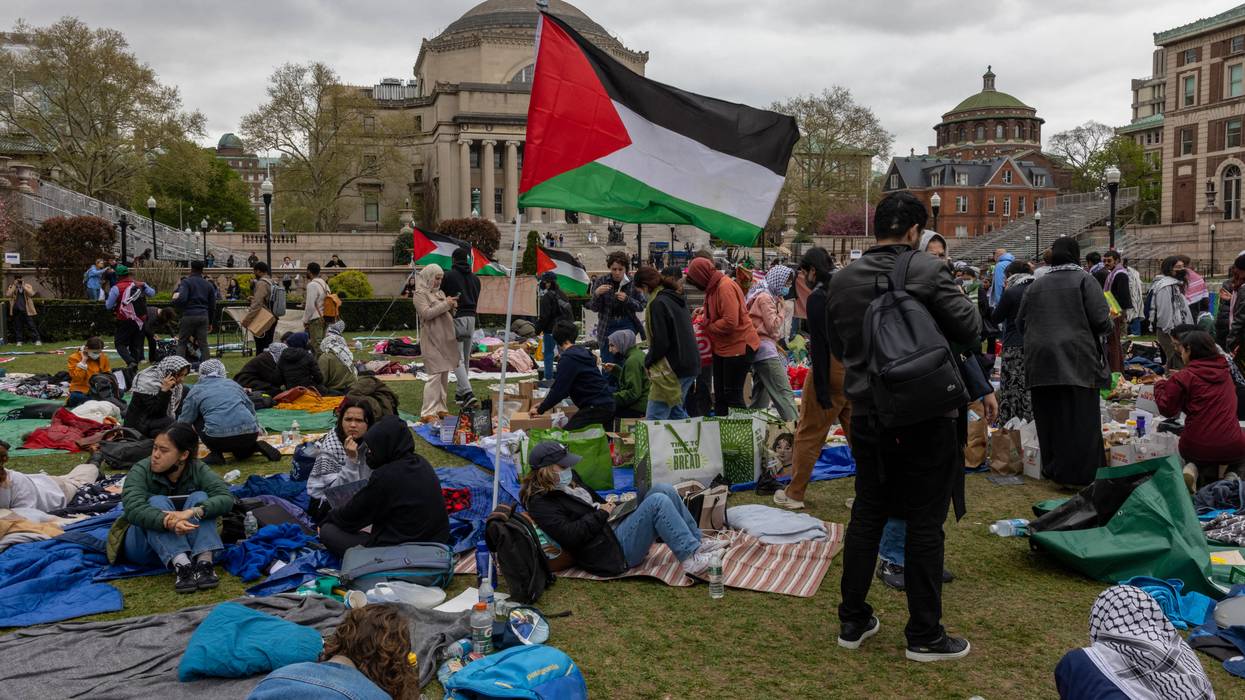
These mass protests began at Columbia University on April 17 before covering all of U.S. geography, from New York to Texas and from North Carolina to California.
The protests are being compared, in terms of their nature and intensity, to the anti-war protests in the U.S. against the Vietnam War in the 1960s and 70s.
While the comparison is apt, it is critical to note the ethnic diversity and social inclusiveness in the current protests. On many campuses, Arab, Muslim, Jewish, Black, Native American, and white students are standing shoulder to shoulder with their Palestinian peers in a unified stance against the war.
None of them is motivated by fear that they could be drafted to fight in Gaza, as was, indeed, the case for many American students during the Vietnam War era. Instead, they are united around a clear set of priorities: ending the war, ending U.S. support of Israel, ending their universities’ direct investment in Israel, and the recognition of their right to protest. This is not idealism, but humanity at its finest moments.
Despite mass arrests, starting at Columbia, and the direct violence against peaceful protesters everywhere, the movement has only grown stronger.
On the other side, U.S. politicians, starting with President Joe Biden, accused the protesters of antisemitism, without engaging with any of their reasonable, and globally-supported, demands.
Once again, the Democratic and Republican establishments stood together in blind support for Israel.
Biden condemned the “antisemitic protests,” describing them as “reprehensible and dangerous.”
A few days later, the Speaker of the U.S. House of Representatives, Mike Johnson (R-La.), visited the university under tight security, using language that is hardly suitable for a country which claims to embrace democracy and respect freedom of expression and right of assembly.
“We just can’t allow this kind of hatred and antisemitism to flourish on our campuses,” he said, adding: “I am here today joining my colleagues, and calling on President (Minouche) Shafik to resign if she cannot immediately bring order to this chaos.”
Shafik, however, was already on board, as she was the one who had called for the New York Police Department to crack down on the protesters, falsely accusing them of antisemitism.
U.S. mainstream media has helped contribute to the confusion and misinformation regarding the reasons behind the protests.
The Wall Street Journal, once more, allowed writers such as Steven Stalinsky to smear young justice activists for daring to criticize Israel’s horrendous genocide in Gaza.
“Hamas, Hezbollah, the Houthis, and others are grooming activists in the U.S. and across the West,” he alleged, thus, once more taking a critical conversation about U.S. support of genocide into bizarre and unsubstantiated directions.
U.S. establishment writers may wish to continue to fool themselves and their readers, but the truth is that neither Hezbollah nor Hamas “recruiters” are active in Ivy League U.S. universities, where young people are often groomed to become leaders in government and large corporations.
All such distractions are meant to avoid the undeniable shift in American society, one that promises a long-term paradigm shift in popular views of Israel and Palestine.
For years prior to the current war, Americans have been changing their opinions on Israel, and their country’s so-called “special relationship” with Tel Aviv.
Young Democrats have led the trend, which can also be observed among independents and, to some extent, young Republicans.
A statement that asserts that “sympathies in the Middle East now lie more with the Palestinians than the Israelis” would have been unthinkable in the past. But it is the new normal, and latest opinion polls regarding the subject, along with Biden’s dwindling approval ratings, continue to attest to this fact.
The older generations of American politicians, who have built and sustained careers based on their unconditional support for Israel, are overwhelmed by the new reality. Their language is confused and riddled with falsehoods. Yet, they are willing to go as far as defaming a whole generation of their own people—the future leaders of America—to satisfy the demands of the Israeli government.
In a televised statement on April 24, Israeli Prime Minister Benjamin Netanyahu described the protesters as “antisemitic mobs” who “have taken over leading universities,” alleging that the peaceful protesters are calling “for the annihilation of Israel.” His words should have outraged all Americans, regardless of their politics and ideology. Instead, more U.S. politicians began parroting Netanyahu’s words.
But political opportunism shall generate a blowback effect, not just in the distant future, but in the coming weeks and months, especially in the run-up to the presidential elections.
Millions of Americans are clearly fed up, with war, with their government’s allegiance to a foreign country, to militarism, to police violence, to the unprecedented restrictions on freedom of speech in the U.S., and more.
Young Americans, who are not beholden to the self-interests or historical and spiritual illusions of previous generations, are declaring that “enough is enough.” They are doing more than chanting, and rising in unison, demanding answers, moral and legal accountability, and an immediate end to the war.
Now that the U.S. government has taken no action, in fact continues to feed the Israeli war machine in its onslaught against millions of Palestinians, these brave students are acting themselves. This is certainly an awe-inspiring, watershed moment in the history of the United States.
"The violent repression we're facing as peaceful anti-war protesters is appalling."
A day after Columbia University officials warned it may call on the National Guard to remove nonviolent student protesters who have been occupying campus lawns since last week in solidarity with Gaza, advocacy group Palestine Legal on Thursday filed a federal civil rights complaint demanding an investigation into the school's "discriminatory treatment of Palestinian students and their allies."
The school discriminated against pro-Palestinian protesters last week when President Minouche Shafik summoned New York Police Department officers in riot gear to arrest more than 100 students, said Palestine Legal.
The complaint details how the escalation against students, who have set up an encampment on campus to demand Columbia divest from companies that work with the Israeli government and to support calls for a cease-fire in Gaza, is part of a monthslong pattern of the university's targeting of pro-Palestinian students.
According to Palestine Legal, students of all backgrounds who have demanded an end to Israel's U.S.-backed massacre of Palestinians in Gaza "have been the target of extreme anti-Palestinian, anti-Arab, and Islamophobic harassment, including receiving multiple death threats, being harassed for wearing keffiyehs or hijab, doxxed, stereotyped, being treated differently by high-ranking administrators including... Shafik, an attack with a chemical agent that led to at least 10 students requiring hospitalization and dozens of others, including a Palestinian student, seeking medical attention, and more."
Columbia student Maryam Alwan, who Palestine Legal is representing in the complaint to the U.S. Department of Education's Office for Civil Rights, said the university has "utterly failed to protect [her] from racism and abuse."
"Beyond that, the university has also played a role in this repression by having me arrested and suspended for peacefully protesting Israel's genocide in Gaza," said Alwan. "The violent repression we're facing as peaceful anti-war protesters is appalling. Palestinian students at Columbia deserve justice and accountability, not only for Israel's decadeslong oppression and violence against our people, but for the racism and discrimination we've experienced here on Columbia's campus."
Palestine Legal is representing four students in the case, as well as Columbia Students for Justice in Palestine, which was suspended from the campus late last year after holding anti-war protests.
The group called Columbia's threat to call in the National Guard "gravely concerning."
"Columbia's vicious crackdown on student protests calling for Palestinian freedom amidst an ongoing genocide should alarm us all. Students have always been at the forefront of the most pressing social issues of the day," said Palestine Legal staff attorney Sabiya Ahamed.
College campuses have been the sites of frequent pro-Palestinian protests since October, and the NYPD's crackdown on Columbia students last week galvanized students at universities across the country.
The Biden administration has said little about the student demonstrations, but President Joe Biden referred to them broadly as "antisemitic protests" this week.
"We urge federal civil rights officials to do what Columbia has disgracefully failed to," said Ahamed. "Ensure the rights of Palestinian and allied students are protected at a moment when their voices are most essential."
"There is a question of historical responsibility towards injustice, genocide, and fascism," said Stephen Kapos. "If you are indifferent, if you do not take a stand, you acquire a degree of guilt."
A Holocaust survivor opposed to Israel's war on Gaza on Wednesday told U.S. student protesters they're on the right side of history, and that the global wave of demonstrations against the slaughter and starvation of Palestinians will soon force Western leaders to face up to their complicity in genocide.
Stephen Kapos, 86, was 7 years old in 1944 when he was separated from his family during the Nazi extermination of Jews in his native Hungary. Most of his family was murdered in the Holocaust but Kapos survived and moved to the United Kingdom after the 1956 Soviet invasion of Hungary.
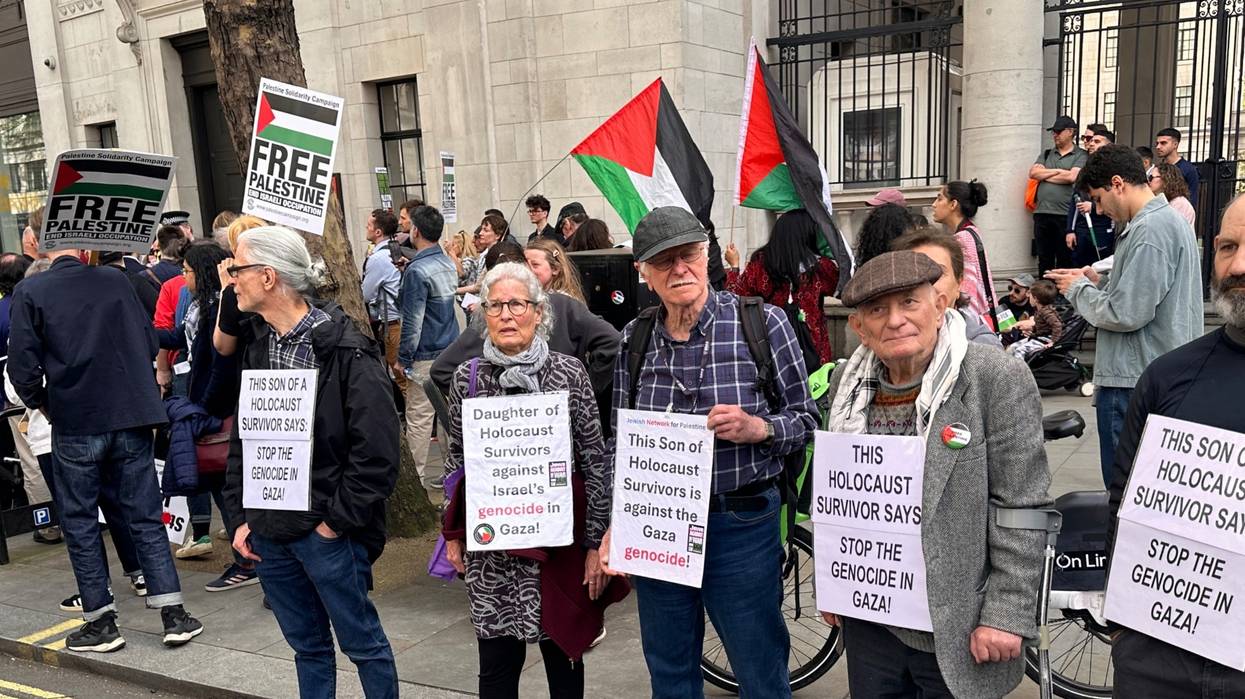
Kapos is part of a small group of Shoah survivors and their descendants who "demonstrate disagreement with the use of the Holocaust experience as a cover by the Zionists and the state of Israel." They attend protests wearing signs around their necks reading, "This Holocaust Survivor Says Stop the Genocide in Gaza!"
"As a Holocaust survivor, my message to the brave student protesters in America is just keep doing it. Don't give up," Kapos said in a video published by Double Down News. "We are doing exactly the same, and in the long term we are going to prevail."
Holocaust Survivor Message to US Campus Protesters:
This survivor of the Holocaust is against Genocide in Gaza & conflating Jewishness with Zionism, which does nothing but increase antisemitism.
Your protests are so persistent, large and global that eventually the Western… pic.twitter.com/IDCH0NTO6m
— Double Down News (@DoubleDownNews) April 24, 2024
Kapos' comments came amid a growing wave of pro-Palestine student protests—many of them Jewish-led—on dozens of U.S. university and college campuses in response to Israel's U.S.-backed war on Gaza, which the International Court of Justice in January found "plausibly" genocidal and which many Israeli and international experts say is undoubtedly a genocide.
According to Gazan and international officials, more than 122,000 Palestinians have been killed or maimed during 202 days of near-relentless Israeli attacks. This figure includes around 11,000 people who are missing and presumed dead and buried beneath the rubble of hundreds of thousands of bombed-out buildings. Around 90% of Gaza's 2.3 million people have been forcibly displaced. Starvation and dehydration caused by Israel's bombardment and blockade of Gaza are killing children and other vulnerable people.
Instead of condemning Israeli leaders, the Biden administration has lavished them with billions of dollars in U.S. military aid while providing diplomatic cover for Israeli crimes and blocking recognition of Palestinian statehood at the United Nations.
As the suffering in Gaza continues, U.S. students have set up encampments or staged other forms of protest, some of which have been brutally repressed by police—who have also attacked and arrested journalists and bystanders.
On Wednesday, far-right Israeli Prime Minister Benjamin Netanyahu implored U.S. authorities to crack down even harder on the students, whom he called an "antisemitic mob."
Highlighting video footage of Netanyahu comparing the student protests to what happened at German universities during the rise of Nazism, Kapos said that "the way that the Israeli government is using the memory of the Holocaust in order to justify what they're doing to the Gazans is a complete insult to the memory of the Holocaust."
He said he is also protesting "the conflating of Jewishness with Zionism, which is what the Israeli state is trying to do, which does nothing but increase antisemitism."
Kapos predicted that "today's marches are having a very hopeful aspect that is so large, so persistent, so global that eventually the Western leadership—which are trying to deny what is actually going on—will be forced to face up to it, and I think we are not far from that."
"Today's marches are having a very hopeful aspect that is so large, so persistent, so global that eventually the Western leadership—which are trying to deny what is actually going on—will be forced to face up to it."
"There is a question of historical responsibility towards injustice, genocide, and fascism," Kapos asserted. "If you are indifferent, if you do not take a stand, you acquire a degree of guilt without any doubt and I think it is imperative to assert opposition and even some degree of disadvantage and risk if you want to be guilt-free when history judges what's happening."
Kapos and his comrades are part of a long history of Holocaust survivors speaking out against Israeli crimes against Palestinians.
Long before today's growing acknowledgment that Israel is an apartheid state, Suzanne Weiss—whose parents were murdered in Nazi-occupied France—said in 2010 that "the Palestinians are victims of ethnic cleansing and apartheid" and that "the Israeli government's actions toward the Palestinians awaken horrific memories of my family's experiences under Hitlerism."
Hajo Meyer, who survived 10 months in the Auschwitz death camp in Poland, argued during his lifetime that "what is happening to the Palestinians every day under the occupation" was "almost identical" to "what was done to the German Jews before the 'Final Solution,'" and that instead of making Jews safer, Israeli policies and practices were stoking the flames of antisemitism.
Holocaust survivors who stand up for Palestinian rights have been condemned by critics as "antisemites" and "self-hating Jews" who, in Meyer's case, allegedly abused his status as a Holocaust survivor.
Kapos, who has experienced such slurs, is undaunted and says he has no plans to stop protesting. During a recent rally in London he vowed, "I'll keep doing it as long as the bombing and apartheid and the injustice is going on."
Correction: This article originally said that Suzanne Weiss had passed. We are very delighted to hear she is alive and well.
"Why do we even have these institutions of higher learning if we won't let students speak their conscience and protest?" said one University of Texas professor.
This is a developing story... Please check back for possible updates...
Civil rights advocates on Wednesday expressed alarm at a rapid escalation by Texas state troopers who descended on a student-led protest at University of Texas at Austin, which was organized in solidarity with Gaza and other U.S. college students taking part in a growing anti-war movement.
UT students gathered on campus at midday and were promptly given two minutes to disperse by state troopers, who had already been called to the scene.
The troopers were equipped with riot gear, with some carrying assault rifles and several stationed on horses.
Erick Lara, a 20-year-old sophomore, told The Dallas Morning News that the nonviolent protest transformed "within minutes" after the police began arresting demonstrators.
"I didn't think it would escalate this far," he told the outlet. "And I didn't think there would be this much police intervention from what's supposed to be a peaceful protest. Not very peaceful when there's a bunch of aggressors around, especially on horses."
The organizers called the gathering "The Popular University" and said it was aimed at pressuring UT to "divest from death."
The protesters walked out of their classes to demand UT divest from weapons manufacturers in order to end its complicity in Israel's U.S.-backed assault on Gaza, which has killed at least 34,262 Palestinians.
Student-run newspaper The Daily Texan reported roughly 50 state troopers were deployed to stop the initial protest of about 150-200 people.
Ryan Chandler, a reporter for NBC affiliate KXAN-TV and UT alum, reported that there were at least 10 students detained.
"Went here for four years, never saw anything like this," said Chandler, posting a video of a group of police pushing one student to the ground and arresting them.
Joseph Pierce, a Stony Brook University professor who attended graduate school at UT, also said the escalation was an unusually "drastic response to students advocating for an end to the genocide of the Palestinian people."
"It is a response that did not occur when in 2005 we protested the anti-gay marriage bill; in the late 2000s when we protested anti-immigration bills; in the 2010s when we protested the open-carry bill," Pierce said. "It is a clear attempt at silencing Palestinian and anti-Zionist Jewish voices."
The students faced the state troopers in a standoff on the university's main street.
"This violence against peaceful student protesters at UT Austin is absolutely horrifying—and should be condemned in the strongest terms by every politician and mainstream journalist," said former New Yorker editor Erin Overbey.
UT media and Middle East studies professor Nahid Siamdoust said the university "brought out everything but the kitchen sink to make sure" students couldn't erect an anti-war encampment like students at Columbia University, New York University, and other schools across the U.S. have in recent days.
The university had informed organizers with the on-campus Palestine Solidarity Committee on Tuesday that exercising their First Amendment rights in support of Palestinians in Gaza would "violate our policies and rules."
"The freedom to protest is integral to our democracy," said the ACLU of Texas Wednesday amid reports of the crackdown. "UT Austin students have a First Amendment right to freely express their political opinions—without threats of arrest and violence."
Faced with the largest student uprisings since South Africans toppled apartheid, President Jacob Zuma pledged Friday to halt tuition fee increases in 2016. This prompts declarations of victory and calls to continue the mass mobilizations until free education is achieved for all.
"A famous victory won by the hard struggle of students. We are all humbled," Salim Vally, associate professor of education and director of the Center for Education Rights and Transformation at the University of Johannesburg, told Common Dreams. "The determination and resoluteness of the students forced the hand of government. This was clear to many even before the sun rose this morning."
"Many lessons learned and an incredibly important educational experience for us all," Vally continued. "Foremost of which is that unity and mass struggle works."
Following a meeting with student organizers and university management, Zuma told reporters, "On the matter at hand, we agreed that there will be a zero increase in university fees in 2016."
The president's concessions were widely celebrated, but not everyone was satisfied. "We should have free education," said Bongani Shabangu, 18, who is studying at a Pretoria university, in an interview with The Irish Independent. Most of us are from poor families."
And, when large crowds rallied outside the main government complexes in Pretoria on Friday to demand that Zuma address them directly, police forces pelted them with water cannons, stun grenades, and tear gas.
What's more, many are still furious at police brutality against protesters and are calling for the government to drop steep charges levied against dozens of demonstrators who were detained.
Patrick Bond, professor of Political Economy at the University of the Witwatersrand in Johannesburg, told Common Dreams that students have won a "historic victory over South African neoliberalism."
However, he continued: "Other student demands remain outstanding: free tertiary education for poor and working people as the overall goal, and an end to labor casualization and outsourcing for low-paid university workers. Many such workers barely receive $100/month, and with a poverty line of $60/person/month, raising a family on starvation wages is impossible."
Sparked by tuition hikes of up to 11.5 percent at numerous universities, weeks of student protests have swept at least 18 campuses and shut down the country's top universities. Many call for free education in a society beset with deep inequities. "The current system continues to exclude most black South Africans and other historically disadvantaged groups," anthropologist Vito Laterza explained on the blog Africa is a Country.
As thousands rallied Thursday at the ruling ANC's headquarters in Johannesburg, student leader Mcebo Dlamini declared: "The ANC government will never give us free education. We must take it." Students' speeches at the demonstration are captured in the video below.
The protests follow the ongoing Rhodes Must Fall movement of "students and staff members mobilizing for direct action against the reality of institutional racism at the University of Cape Town,"--which is working towards the long-term goal of decolonizing higher education. Their demands include the implementation of "a curriculum which critically centers Africa and the subaltern" and the removal of "all statues and plaques on campus celebrating white supremacists."
According to Bond, the mass protests that led to Friday's concessions constitute a "boost to anti-austerity activism," especially relevant given Finance Minister Nhlanhla Nene's punishing reforms.
"A victory has been won, but the battle for free quality public education from pre-primary to higher education continues," Vally said. "The market orientation of higher education remains, reproducing and reflecting the inequalities of the wider society. This includes privatization, outsourcing, competitiveness, user fees, racism, patriarchy, and managerialism."
Vally added: "We now have the beginning of a new movement increasingly steeled in the struggle."
Following moves by the state of New Jersey to defund public schools in exchange for a flood of privately run charter schools, hundreds of students in Newark walked out of classes in protest on Thursday.
According to the Newark's Star Ledger, almost 1,000 students from about nine schools gathered in front of City Hall around 1 p.m. with microphones and signs.
The protest was organized by the Newark Students Union, calling the protest the "March of Shame," specifically targeting Superintendent Cami Anderson's "One Newark" reorganization plan. The plan is set to close or downsize several public schools, fire a range of teachers, and move privately run charter schools into public buildings.
"Holding bullhorns and signs - some with the word 'liar' in bold letters above the silhouettes of New Jersey Gov. Chris Christie and state-appointed Newark Superintendent Cami Anderson - hundreds of middle and high school students walked out of schools and into the streets of this economically struggling city," Al Jazeera America reports.
"Newark students: stand up, fight back!" the students chanted throughout the rally.
"The Anderson administration is not afraid to take quality schools away but is scared of students engaging in their right," Newark Students Union president Kristin Towkaniek, told the crowd. "It's your right to be here."
"I'm walking out because the voices of the students need to be heard, and they will be heard," said Towkaniuk ahead of the march.
"They said (the plan) will make Newark schools better," Jose Leonard, a 16-year-old at Arts High School, told Al Jazeera America. "They've been saying that for 20 years and we haven't seen anything. It's like they don't care about the students."
The protest follows a growing trend in students putting their foot down in opposition to a countrywide trend of defunding public education.
As Al Jazeera America reports:
In February, Pennsylvania Gov. Tom Corbett canceled his appearance at a Philadelphia public school after students and teachers at the school planned a protest over his budget cuts, which forced many of the city's schools to cut all extracurricular activities. In Oklahoma, an estimated 25,000 converged on the capitol earlier this week to protest low school funding. Protests have also been held in Oregon and in Camden, N.J.
The protests in Newark aren't new, either. Last year, high schools students formed the Newark Students Union and held a protest in the city's downtown area, followed by another in March of this year.
"What's happening in Newark follows a national pattern as we see states fund schools less than they did before the (2008) recession started," said Jeff Bryant, a fellow the Campaign for America's Future.
American Federation of Teachers New Jersey has video of the protest:
#NPSWalkout2014NewarkStudents @RasJBaraka @UnitedNJ march against One Newark plan to close schools and lay off teachers.
______________________
The 'casserole' movement in Canada -- a phenomenon that first grew out of student protests against an increase in tuition fees earlier this year and escalated in size and media coverage after the passage of Bill 78 brought unprecedented numbers of people to street marches in Montreal and evening rallies of banging pots and pans across Quebec -- is now threatening to spread across the country as more and more Canadians rally to the cause and adopt it as their own.
"On Wednesday, May 30, starting at 8pm, people from coast to coast to coast all over Canada are showing solidarity by banging pots and pans everywhere," reads an announcement for 'Night of Casseroles' on a facebook page established to help organize the event. "This will be the first of many casseroles nights across Canada. Once Quebec student students stop the tuition hike and Law 78, we're all going to Stop Harper together."
Such language demonstrates a desire by organizers to expand the protests both geographically and politically. Over 15,000 have already confirmed their attendance, say organizers, but they expect turnout numbers to be much higher. The event will see meet-ups in over 60 communities in Canada, from Saltspring Island to St John's, as well as international rallies in London, Paris, Washington, New York and other locations.
"We need to have an open and democratic discussion about the direction of our society. The current model, where governments give billions in tax cuts to profitable corporations and high income earners, and then plead poverty as they slash our social programs, is broken." --Derrick O'Keefe, Vancouver activist and organizer
"I'm very surprised," said Kevin Audet-Vallee, 24, speaking to The Guardian at a protest last Friday. "Now that the ordinary citizens are in the streets I think the government is really in trouble, because the middle class is in the streets. At first [critics of student protesters] were saying we were radicals. These are not radicals."
"All we did was set up a Facebook page, what this has become is entirely organic," said Ethan Cox, a Montreal writer who has been covering the student strike, and who helped come up with the idea for the cross-Canada Casserole. "People from across the country took the idea and ran with it. Many communities have made posters, distributed flyers and held planning meetings. In the space of 72 hours this has grown to over 60 cities and more than 15,000 people, which goes to show how much support is out there for what's happening in Quebec."
"The issues faced by the student movement in Quebec, and the citizens who have joined them, are the same ones faced across this country," added Vancouver activist, and co-creator of the event, Derrick O'Keefe. "We need to have an open and democratic discussion about the direction of our society. The current model, where governments give billions in tax cuts to profitable corporations and high income earners, and then plead poverty as they slash our social programs, is broken."
In addition to supporting the students' demand for a tuition freeze in Quebec, protesters will be calling for the repeal of Bill 78.
"It is no exaggeration to say that Bill 78 is the most serious threat to our civil liberties since the War Measures Act. It has been judged unconstitutional by the Quebec Bar Association, constitutional expert Julius Grey and a wide variety of civil liberties and human rights organizations, including Amnesty International," said Cox. "Governments cannot be allowed to resolve their problems by legislating away the right to dissent, to protest. There can be no resolution of the situation in Quebec until this draconian law is repealed."