

SUBSCRIBE TO OUR FREE NEWSLETTER
Daily news & progressive opinion—funded by the people, not the corporations—delivered straight to your inbox.
5
#000000
#FFFFFF
To donate by check, phone, or other method, see our More Ways to Give page.
Daily news & progressive opinion—funded by the people, not the corporations—delivered straight to your inbox.

AI is already inside election administration; before it moves deeper into the count, results have to stay verifiable.
Tallying the results of Washington, DC’s first ranked-choice election in June took about 10 days—longer than many voters are used to. In an age when artificial intelligence can generate an answer in seconds, waiting days for election results can feel old-fashioned, inefficient, even suspicious. And it is about to matter far more widely. This November, 17 states, cities, and counties will use ranked-choice voting, including Maine and Alaska statewide, in races that could help decide control of Congress. More voters than ever will watch results take days to resolve, and more will be asked to trust a count they cannot see.
But that slowness may be one of its most democratic features.
I come to this question from health informatics, where I study how even AI-generated information that sounds clear, fluent, and helpful still requires careful review before it reaches a patient. The same verification problem applies to elections. The more authoritative a system sounds, the more important it becomes to make sure the output can be checked.
DC’s June 16 primary followed a system that requires more than a simple tally: Voters rank candidates, and if no candidate receives more than 50% of first-choice votes, lower-performing candidates are eliminated, and votes are redistributed according to voters’ next choices. New York City already uses ranked-choice voting in local primary and special elections.
AI may soon be able to produce election results in seconds. That does not mean it should.
There is nothing wrong with ranked-choice voting, but it must be carried out with verifiable results. Because election counting is not just a math problem; it is a trust problem, especially in the US today, where election workers face harassment, routine counting delays are recast as fraud, and many voters already doubt institutions before a single ballot is counted.
In this climate, counting ranked-choice votes in a way that allows for public verification might take longer than people are used to. Every ballot must be tied to a voter-verifiable record. Every round of tabulation must be explainable. Every disputed outcome must be auditable by people who can inspect the evidence themselves.
AI is not yet counting votes, but AI and machine-assisted systems are already touching elections before ballots are counted, including information voters receive, and how their signatures are reviewed. In 2024, X’s Grok chatbot gave users false information about ballot deadlines; after election officials from five states complained, X changed Grok so election-related questions directed users to Vote.gov, the federal government’s official voting information website. In North Carolina, 10 counties piloted automated signature-verification software for absentee-by-mail ballots in 2024. The pilot did not affect whether any ballot was counted, but later reporting found reliability problems: The software failed to match about 11% of signatures, most software-flagged signatures were approved after human review, and technical issues complicated the test. Neither example is the same as artificial intelligence counting votes, but both show how software can shape what voters are told or what happens before a ballot enters the count.
I have seen the problem in my own research. AI systems can cite studies that do not exist, with titles, authors, and journals that look real until you check them. A 2026 Nature analysis warned that hallucinated citations are polluting scientific literature, and OpenAI researchers have warned that some training and evaluation systems reward guessing over acknowledging uncertainty. A system that gives a confident answer may look more useful, even when that confidence is misplaced, than one that says, “I don’t know.”
That matters because elections often turn on ballot conditions that are not immediately machine readable and need human review: stray marks, undervotes, overvotes, damaged ballots, or ambiguous voter intent. In races where the margin between the candidates is narrow, a few disputed ballots can change the result. These questions should not be resolved by a system whose rules, error rates, or decision process the public cannot understand or meaningfully examine. They should be handled through documented procedures, human review, paper records, and public audits.
Human counting is also imperfect. But precisely because humans are fallible, democratic systems have developed safeguards such as paper ballots, bipartisan observation, chain-of-custody rules, cure processes, recounts, and post-election audits. Risk-limiting audits, for example, hand check samples of paper ballots and can trigger a fuller count if the sample does not support the reported result. Colorado was the first state to conduct a statewide risk-limiting audit in 2017; today, all Colorado counties conduct one before results are certified. Other states have since adopted, required, or piloted risk-limiting audits.
The best election systems do not ask voters to trust either a person or a machine. They produce evidence. That is where current policy is behind the curve. States have moved quickly to regulate AI-generated deepfakes in campaign communications, because fake videos and robocalls can mislead voters. But far less attention has been paid to the AI inside election administration itself. That gap should close before AI moves deeper into election administration, especially into decisions that could affect whether a ballot is accepted, cured, rejected, or counted.
Federal and state governments should establish clear standards for AI used in anything election related. The Brennan Center for Justice has called for such safeguards around quality, transparency, consistency, certification, and monitoring. Election offices should have to explain to the public what an AI system does, who checks it, and how voters can verify the evidence. AI systems whose rules, error rates, or decision process the public cannot understand or meaningfully examine should not make final decisions about whether a ballot counts.
Voters have a role, too. Ask your local election officials whether AI tools are being used anywhere in election administration and how those decisions can be audited. Ask how voters will know if the AI setup gets something wrong. And volunteer as a poll worker. You don't need a background in elections; local officials train you. Democracy needs more people who understand how ballots are handled, checked, and verified.
AI may soon be able to produce election results in seconds. That does not mean it should. The labor of democracy is not a bottleneck in need of streamlining. It is part of the safeguard.
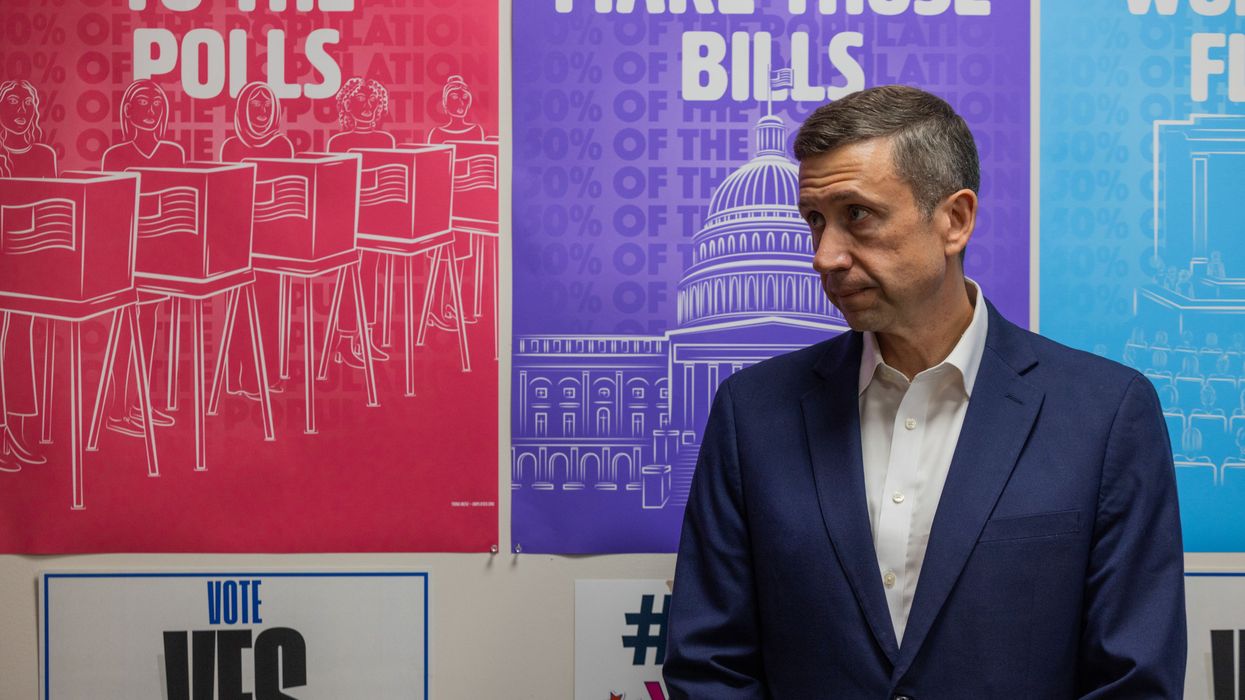
One pollster argued that ranked-choice "gives a better chance to new faces, outsider candidates, people with grassroots movements, people who run positive campaigns, people who have something new to offer."
Progressives are hopeful that a new push for ranked-choice voting could allow for more primary races in which candidates who accurately reflect the priorities of the party’s voters rise to the top.
Ranked-choice voting (RCV), which lets voters rank candidates in order of preference rather than voting for a single one, was instrumental in the unexpected triumph of New York City Mayor-elect Zohran Mamdani in this summer’s Democratic primary.
Axios reported Monday that Democratic National Committee (DNC) Chair Ken Martin has recently met with advocates seeking to implement RCV in the party's 2028 presidential primary.
Among them were reportedly Rep. Jamie Raskin (D-Md.), pollster Celinda Lake, organizers with the nonprofit FairVote Action, and several other figures in the Democratic Party.
Raskin is a long-time advocate for ranked-choice voting. In 2019, leading up to what would be a chaotic and crowded 2020 primary, he wrote in Common Dreams, along with political organizers Adam Eichen and Rob Richie, that:
RCV is the best way to allow greater voter choice without wasted votes and unrepresentative winners...
It will help any party gain stronger nominees and provide more clarity about what voters really want going into conventions. Because voters’ backup choices matter, candidates with RCV tend to run more positive campaigns, seek common ground, and respect their opponents’ supporters.
Notably, that scenario is exactly what played out in New York City’s Democratic primary. City Comptroller Brad Lander, another progressive mayoral candidate, was able to encourage his voters to rank the more popular Mamdani without fear of splitting the votes and helping their centrist opponents.
At a time when Democratic voters have historically low levels of trust in their party's leaders, Lake told Axios that "[RCV] gives a better chance to new faces, outsider candidates, people with grassroots movements, people who run positive campaigns, people who have something new to offer. It really meets the moment."
New York City is the highest-profile practitioner of RCV, which it adopted in 2019 for party primaries. But others include Maine and Alaska, as well as cities like San Francisco and Minneapolis.
Republicans have aggressively sought to outlaw ranked-choice voting in states where they have legislative control. In 2024, Louisiana, Alabama, Mississippi, Oklahoma, and Kentucky all passed bills to outlaw RCV—bans that may hinder its implementation as a new nationwide system, even in Democratic primaries.
Meanwhile, in Colorado, Nevada, Idaho, and Oregon, voters rejected RCV during last year's elections following industry-backed pushes against it.
In a letter to the editor of the Anchorage Daily News on Sunday, a reader pointed out that President Donald Trump's calls for any Indiana lawmakers who vote against redistricting the state in the GOP's favor to be "PRIMARIED" was evidence of why RCV "is important for protecting our democratic process."
“In ranked-choice voting, no one person, nor small group of people, can keep a candidate in their party off the final ballot because they don’t agree with a particular partisan attitude,” he wrote.
In order for the DNC to implement ranked-choice voting, it would need support from its Rules and Bylaws Committee, whose members are appointed by Martin. It would also need majority support from the DNC's roughly 450 members, which include state party leaders and others elected by states. Axios reported that enthusiasm among members is mixed.
Progressive commentators have expressed excitement at the idea: "This would be a fantastic pro-democracy stance," wrote the left-wing Breaking Points co-host Krystal Ball on social media.
But others doubted that party powerbrokers, who worked behind the scenes to stop the insurgent campaigns of Sen. Bernie Sanders (I-Vt.) in 2016 and 2020, would ever implement a reform that would cede so much power to outsider candidates.
“This is a great idea,” said Sanders’ 2020 press secretary, Briahna Joy Gray. “They won’t do it.”

"We're now 8 points away from sending Andrew Cuomo back to the suburbs," said mayoral candidate and state Assemblymember Zohran Mamdani.
New York City mayoral candidate and state Assemblymember Zohran Mamdani, a democratic socialist who is running on a platform focused on affordability, is chipping away at former Democratic New York Gov. Andrew Cuomo's lead in the race ahead of the June 24 primary, which will be conducted via ranked choice voting.
Results of a poll from Emerson College Polling, PIX11, and The Hill released on Wednesday found that in the first round of voting, 35% of voters support Cuomo, 23% support Mamdani, a democratic socialist, and 11% support city Comptroller Brad Lander.
The new poll shows other candidates, such as former city Comptroller Scott Stringer, state Sen. Jessica Ramos, and state Sen. Zellnor Myrie, earning less than 10% of the vote. The survey was conducted from May 23-26 among 1,000 registered voters, including 606 Democratic primary voters.
In the tenth round of rank choice simulation, Cuomo wins with 54% of the vote and Mamdani earns 46%, a gap of 8 points, according to the poll.
A Marist poll from earlier in May had Cuomo prevailing over Mamdani in the fifth round by 24 points, when excluding undecided voters.
"We're now 8 points away from sending Andrew Cuomo back to the suburbs," Mamdani wrote on X on Wednesday, reacting to the most recent poll results.
According to The Hill, Cuomo's spokesperson downplayed the results of the poll and emphasized that Cuomo remains the frontrunner.
Cuomo resigned as governor in 2021 following the release of a report which found that he had sexually harassed several women. He denies wrongdoing. He officially entered the mayoral race in March.
Waleed Shahid, a communications and political strategist, offered his analysis of the poll on Thursday, writing that "to break through, Mamdani has to become the default progressive choice—not just for the left, but for the white liberals who likely backed [Elizabeth] Warren, [Pete] Buttigieg, and [Joe] Biden in 2020," speaking of the 2020 Democratic presidential primary. "And it also means making real inroads into Cuomo's base—especially Black voters and moderate Manhattanites."
Shahid appeared to direct other candidates who are broadly considered to the left of Cuomo to drop out.
"If you're nowhere near 2nd (Stringer, Ramos, Myrie, etc.), work through your five stages of political grief. Take one for the team... and stop wasting time to protect your pride. This city's bigger than any one person," he wrote.
Bill Neidhardt, a political strategist, who, according to Gothamist, is an adviser for New Yorkers for Lower Costs, a political action committee supporting Mamdani, referenced the polling results and wrote on Thursday: "Democrats need to CONSOLIDATE behind Mamdani."
The most recent poll came a day after Mamdani announced the top lines of an internal poll that has him earning 27% in the first round while Cuomo notches 40% of the vote. In the final round, that internal poll has Cuomo prevailing in the final round of voting with 56% of the vote compared to Mamdani's 44%.
Mamdani has become a viable contender in the race in part because of an impressive ground game. Volunteers with his campaign have knocked on 600,000 doors around the city, according to a statement sent to multiple outlets this week.
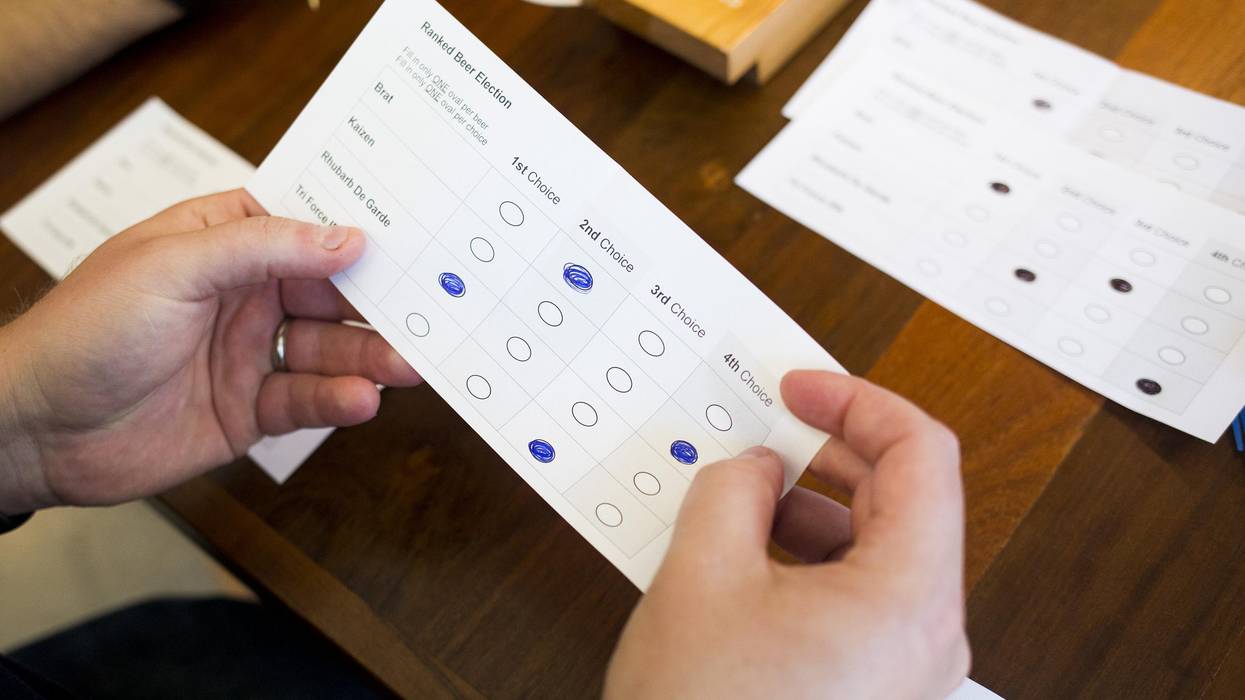
Six states have banned the practice and voters rejected referendums in four states; however, Democratic strategists and funders behind this year’s push for RCV may be able to learn from the losses.
It’s been a bad year for advocates of ranked-choice voting reforms.
Legislatures in five states banned the reform outright, as did voters in Missouri. And voters in four states—Colorado, Idaho, Nevada, and Oregon—rejected referendums on adopting the new system. Only in the District of Columbia did a majority vote in favor of adopting the reform, and Alaskans chose to keep ranked-choice voting by a remarkably close 0.25% margin.
However, Democratic strategists and funders behind this year’s push for RCV may be able to learn from the losses. In three of the four ballot measure states, RCV initiatives were combined with a proposal for open primaries, flipping typical supporters to opponents. In Colorado and Nevada, where RCV was combined with open primaries, progressive groups joined the opposition, and business interests flooded the coffers of the PACs supporting the measures.
Despite recent setbacks, the coalition advocating in favor of ranked-choice voting appears to be changing.
The pushback against ranked-choice voting (RCV)—which allows voters to rank candidates according to their preference instead of choosing just one—is typically part of a larger Republican-aligned effort to restrict voting rights by limiting voting by mail, banning ballot drop boxes, and raising the threshold for passage of popular ballot initiatives.
MAGA groups oppose the practice as likely to favor Democrats and moderate Republicans over their candidates. Indeed, “election integrity” groups associated with Leonard Leo and Cleta Mitchell have been attacking ranked-choice voting options in their larger sweep to restrict voting rights, and the American Legislative Exchange Council (ALEC), the right-wing bill mill, has developed and circulated model legislation to prohibit it.
“Special interests are pushing a novel and complicated election process called ranked-choice voting,” ALEC’s model bill states. The group contends that the alternative voting system creates “a conflict between local and state election processes,” a claim legal scholars rebut. ALEC also highlights ranked-choice voting as systematically undermining the nation’s election systems in its annual “essential policy solutions” report for 2025.
At ALEC’s annual meeting in 2023, the custom hotel room keys featured anti-RCV branding. Key card sponsors gain access to lawmakers and VIP events at the conference, according to sponsorship materials obtained and reviewed by the Center for Media and Democracy (CMD).
Republicans, with some exceptions, have historically opposed ranked-choice voting. After former Alaska Gov. Sarah Palin (R) lost a special House election in 2022—which was decided through ranked-choice voting—Republicans railed against it, with party leaders denouncing it as a “scam.” The Republican National Committee called for banning RCV “in every locality and level of government.”
Since then there has been a surge of interest in banning RCV for local, state, and federal elections. This year alone, bans passed in Louisiana (SB 101), Alabama (SB 186), Mississippi (SB 2144), Oklahoma (HB 3156), and Kentucky (HB 44), where the legislature overrode the governor’s veto of the bill. Previously, bans have been passed in Florida (SB 524, 2022), Idaho (HB 179, 2023), Montana (HB 598, 2023), South Dakota (SB 55, 2023), and Tennessee (SB 1820, 2022). Anti-RCV bills were introduced but never made it out of committee in Ohio and South Carolina.
In Missouri, the legislature paired RCV with a redundant measure to outlaw voting by noncitizens—which is already illegal in all federal elections—and sent it out to voters in what critics dismissed as partisan “ballot candy.”
In South Carolina (HB 4591, 2024), one of the bill’s two primary sponsors, Bill Taylor, is an ALEC member, as was the primary sponsor of the South Dakota bill (SB 55, 2023) that banned RCV.
In Colorado, the failed effort to adopt ranked-choice voting—Proposition 131, which also would have eliminated single-party primaries—was primarily backed by Colorado Voters First, which received significant funding from industry and business interests.
Colorado Voters First received $2 million from Ben Walton, heir to the Walmart fortune; $600,000 from the Colorado Chamber of Commerce; $500,000 from Chevron; $100,000 from Kimbal Musk, Elon Musk’s brother; $496,000 from Voters for the American Center; and nearly $550,000 from private equity executives.
The largest donations came from Kent Thiry, a former healthcare executive who is board co-chair of Unite America, a large nonprofit that has spent significantly on ranked-choice voting ballot measures across the country. He donated a total of nearly $6 million to Colorado Voters First, while Unite America donated a total of $5.8 million.
Thiry has become a major player in Colorado politics, and has successfully fought for election reform ballot measures since 2016.
The main group opposing the proposition, Voters Rights Colorado, raised approximately $380,000, with its largest contributions coming from labor groups such as AFSCME and the National Education Association (NEA), as well as civic groups.
The coalition behind the no vote argued that the measure would disproportionately hurt progressive and pro-labor candidates, and most opposing groups were primarily concerned with the implementation of “jungle” primaries, not RCV.
The Colorado Working Families Party called the proposition “snake oil of the highest order” and expressed concern that it would “increase the role of big money in Colorado politics.”
The proposition risks “giving an even greater advantage to wealthy candidates and a bigger voice to special interests,” said Aly Belknap, Executive Director of Colorado Common Cause.
Some, however, worry about RCV more generally.
“There’s this feeling among progressives that ranked-choice voting is good for us, but here in Colorado, we fundamentally disagreed that Proposition 131 would help progressives, at least at the state level,” said Sean Hinga, deputy director of AFSCME Colorado. He believes the measure would “harm our ability to get labor candidates elected.”
AFSCME and Common Cause supported the RCV measure in Oregon.
Colorado voters rejected the RCV proposition 53.5% to 46.5%.
Idaho’s Proposition 1 would have both instituted ranked-choice voting and ended closed primaries. The GOP-controlled legislature had tried to preemptively ban the measure from ever coming up for a vote, and the legislature had banned RCV the previous year. If it had passed, the ballot measure would have repealed the state law.
The initiative was supported by the Idaho Education Association and Idahoans for Open Primaries, which received $3 million from national PACs such as Unite America and a related group ($1.8 million), Article IV ($2.2 million), and Way Back PAC ($250,000), according to campaign finance disclosures.
Article IV, a 501(c)(4) nonprofit based in Virginia, is led by George Wellde III, a former Goldman Sachs investor. Working alongside Democratic operatives is the group’s treasurer, Cabell Hobbs, who has been the subject of a Federal Elections Commission complaint for helping a pro-Trump super PAC make illegal campaign contributions. Article IV is not required to publicly disclose its donors.
Way Back PAC, a hybrid PAC (also known as a Carey Committee), is based in Wyoming and mostly focuses on supporting independent and Democratic candidates in Western states.
The state GOP and many Republican representatives opposed the measure. Idaho Rising, the main opposition group, spent $321,000 on media advertising against the measure, according to its disclosures, and a constellation of smaller groups, including Secure Idaho Elections and Idaho Fair Elections, also worked to oppose it. One Person One Vote—a PAC that raised $250,000 in the four months it existed before the election—raised half of its funds from local Idahoan Larry Williams, the subject of a campaign finance complaint.
Nearly 70% of voters in Idaho voted against the measure.
This year Nevada voters reversed their position on ranked-choice voting. In 2022, a majority of voters supported RCV, whereas this year, 53% voted against the proposition, known as Question 3, which was paired with a proposal for open primaries. Since the Nevada constitution requires voters to approve a ballot question twice before it is enacted, its failure to pass this year prevents it from becoming law.
Both state parties opposed the measure. The Nevada ACLU took no position on it.
Vote Yes on 3, the main group supporting the measure, received $13 million from Article IV, $6.4 million from Unite America, and $250,000 from Wynn Resorts, according to the group’s financial disclosures.
The opposition campaign, spearheaded by Protect Your Vote Nevada, raised approximately $2 million from a single group called Nevada Alliance, a progressive-leaning organization that is not required to disclose its donors.
Nearly 57% of Oregon voters rejected Measure 117, which would have established statewide ranked-choice voting.
Yes on 117 PAC, the main group supporting the measure, spent nearly $9.4 million on the campaign, and received over $5.8 million from the 501(c)(4) nonprofit Oregon Ranked Choice Voting, by far the largest contributor to the PAC. It also received $2.8 million from Article IV, as well as funding from labor organizations and the Sierra Club.
The major group opposing the measure—Concerned Election Officials—raised a total of $1,380.
Alaskans voted to retain ranked-choice voting—voting no on Ballot Measure 2—by only 743 votes.
Yes On 2, the primary PAC advocating for repeal of RCV, raised approximately $117,000 between July and October, with the largest donations being $10,000.
The anti-repeal effort, led by No On 2, raised nearly $14 million between June and late October, including $5.5 million from Unite America PAC, $4.4 million from Article IV, and $2 million from Action Now Initiative, the action arm of the philanthropic organization Arnold Ventures.
Despite recent setbacks, the coalition advocating in favor of ranked-choice voting appears to be changing. Even where efforts to implement RCV failed, the donors backing various ballot measures illustrate just how varied the groups interested in pushing for this election reform are.
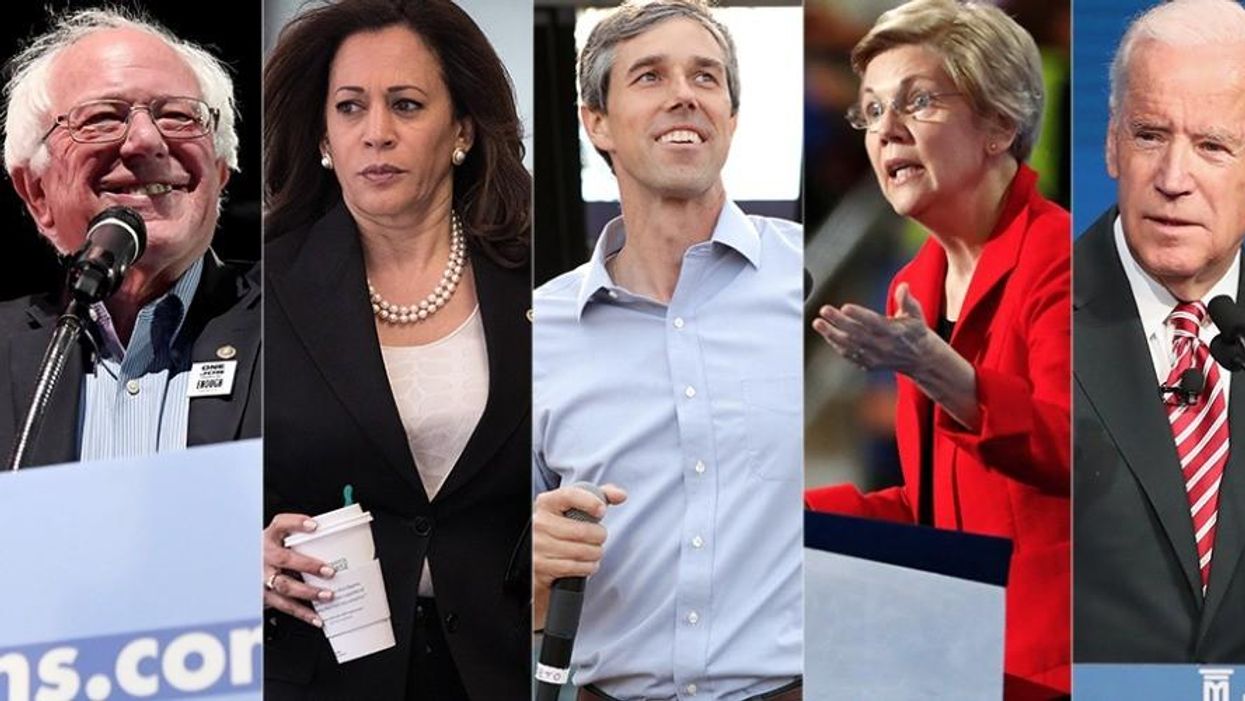
With dozens of Democrats lining up to run for President in 2020, now is the time to adopt ranked choice voting in early states to guarantee that primary winners have clear majority support. Greater choices for voters is welcome, but crowded primaries can produce "winners" with less than 25 percent of the vote. Meantime, millions of Democratic voters could fail to elect any delegates at all because their candidate falls below the 15 percent qualifying threshold. Someone could easily win the nomination over the expressed opposition of most primary voters.
Consider the 2016 Republican primaries, which featured more than a dozen credible candidates. With provocative rhetoric making him the favorite of a passionate minority, Donald Trump captured the nomination despite falling short of a majority in the first 40 primaries and caucuses and polls indicating he would have lost in most early contests in head-to-head races against opponents like Sens. Marco Rubio (R-Fla.) and Ted Cruz (R-Texas).
Next year's Democratic race presents the same fractured dynamics. Moreover, Democrats require states to allocate delegates in proportion to the vote, so that a candidate winning a state with 33 percent of the vote takes about a third of the delegates, not all. This "fair reflection" principle makes more votes count. But winning the nomination on the first convention ballot requires a candidate to arrive with more than half the delegates; otherwise, super-delegates have an equal say in deciding a brokered convention. Democrats will need as much fine-grained information as possible about what their voters really want.
Current voting rules can also turn the goal of a "fair reflection" into a distorted funhouse mirror. To earn delegates, a candidate must exceed 15 percent of votes; all others are shut out. In caucus states like Iowa, backers of candidates below this threshold can move to a backup second choice to make their vote count. But "single choice voting" allows no backups. With a crowded field, more than half the vote easily could be cast for candidates below the threshold; it's even possible that no candidate would qualify for delegates in some states. Expect finger-pointing among like-minded voters splitting the vote, tied to factors like shared ethnicity (African American Sens. Cory Booker and Kamala Harris), ideology (progressive Sens. Elizabeth Warren, Sherrod Brown and Bernie Sanders), and experience (several mayors may run).
Ranked choice voting (RCV) is the best way to allow greater voter choice without wasted votes and unrepresentative winners. RCV was used successfully last year in Maine's congressional election and has been adopted for elections in 22 American cities and counties and the national legislatures in Australia and Ireland and for most party leader elections in Canada, New Zealand and the United Kingdom.
New Hampshire and other states should pass laws to enable voters to rank their presidential choices first, second and so on. To reveal the state's majority winner, voters' first choices are tallied. The last-place candidate is defeated, and ballots for that candidate count for their next ranked choice. When down to instant runoff between the strongest two candidates, the winner always earns a majority of the vote. Democrats could allocate delegates fairly based on vote totals at the point when all remaining candidates exceeded 15 percent of votes. Caucus states are even easier, as it only means changing party rules and choosing among relatively inexpensive ballot-tallying options.
RCV works for all parties. It will help any party gain stronger nominees and provide more clarity about what voters really want going into conventions. Because voters' backup choices matter, candidates with RCV tend to run more positive campaigns, seek common ground, and respect their opponents' supporters. That means primaries will see less of the divisive rhetoric that can weaken nominees in the general election.
RCV's experience statewide in Maine and in several of our most diverse cities demonstrates it engages new voters and invigorates democracy. Last June, more San Francisco voters cast RCV ballots for mayor than in the non-RCV races for governor and Senate. In Maine, turnout increased, and voter error was minuscule. In its seven-way Democratic primary for governor, more than three times as many voters ranked at least six candidates as ranked one, debunking concerns that ranking candidates may be difficult or time-consuming.
With voters clearly ready to rank more than one candidate in what is shaping up to be a talented field, why weaken their vote by denying them that power? States and major parties have every reason to establish ranked choice voting around the nation as a key feature of the 2020 elections.
Campaign finance reform advocate and Harvard Law professor Lawrence Lessig announced Tuesday that he is forming a committee to explore entering the Democratic primary for president--a job from which he says he would resign as soon as Congress passed a package of pro-democracy reforms.
"I want to run," Lessig wrote in the Huffington Post on Tuesday. "But I want to run to be a different kind of president. 'Different' not in the traditional political puffery sense of that term. 'Different,' quite literally. I want to run to build a mandate for the fundamental change that our democracy desperately needs. Once that is passed, I would resign, and the elected Vice President would become President."
He calls it "Presidency as referendum," meant to address "the deep sense that most Americans have that their government is not theirs."
Lessig's campaign and potential White House residency would solely focus on passing the Citizen Equality Act of 2017, which he says aims to restore "the right that all of us have in a representative democracy to be represented equally."
"That right has been violated in America today--and brazenly so," he said. "In the way campaigns are funded, in the way the poor and overworked are denied equal freedom to vote, and in the way whole sections of American voters get written into oblivion by politically gerrymandered districts that assure their views are not represented, we have allowed the politicians to cheat us of the most fundamental commitment of a democracy: equal citizens. And until we find a way to create a mandate to demand equality for citizens, we will never find a way to make real change possible."
Among other things, the Citizen Equality Act calls for overturning Citizens United, instituting Ranked Choice Voting, and adopting a campaign finance proposal that would give every voter a voucher to contribute to fund congressional and presidential campaigns and provide matching funds for small-dollar contributions to congressional and presidential campaigns.
As for his successor, Lessig told the Washington Post that he would pick a vice president "who is, clearly, strongly identified with the ideals of the Democratic Party right now," offering Sen. Elizabeth Warren (D-Mass.) as one possibility. He said Sen. Bernie Sanders (I-Vt.), who has railed against big money in politics on the campaign trail, was another option.
Lessig acknowledges that Sanders, more than any other presidential candidate, has talked extensively about the need for electoral reform.
"Sanders is a rare hero among politicians," Lessig wrote at the HuffPo. "Throughout his career, he has been unwavering in his advocacy for the issues he believes in, however unpopular. There isn't a triangulating bone in his body. And as people have come to know him and his history, they are inspired by a man who has stuck by his principles and whose principles are now more relevant and true than ever. The picture of 28,000 people attending a rally more than a year before an election shows hope for a democracy."
But even an "extraordinary" candidate like Sanders, Lessig continued, "is always divided among the 8 or 10 issues at the core of their campaign."
"What should be obvious to everyone--or at least the 82% of Americans who believe 'the system is rigged'--is that none of these incredible reforms is possible until we un-rig the rigged system first," he argued. "We've lived through 'change you can believe in.' What we need now is a reason to believe in change."
This is not the first time Lessig has experimented with an unconventional strategy for effecting political change. As Politico reports, Lessig recently left his position as chairman and CEO of Mayday PAC, a high-profile Super PAC he co-founded to back candidates committed to reforming campaign finance laws. But despite spending more than $10 million in 2014, the Super PAC had a spotty record of success, seeing victory in just two of the eight races it targeted, according to an analysis by Politico.
For more, watch the video below: