SUBSCRIBE TO OUR FREE NEWSLETTER
Daily news & progressive opinion—funded by the people, not the corporations—delivered straight to your inbox.
5
#000000
#FFFFFF
To donate by check, phone, or other method, see our More Ways to Give page.
Daily news & progressive opinion—funded by the people, not the corporations—delivered straight to your inbox.
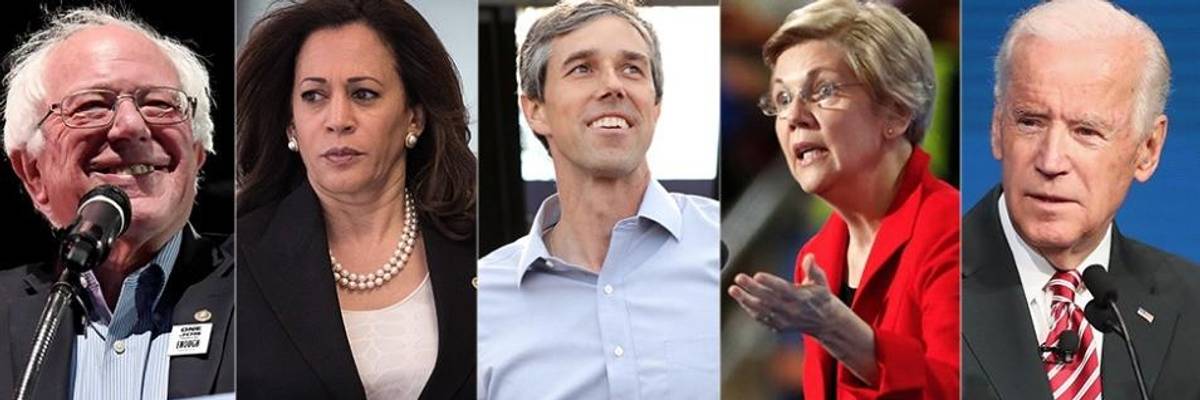
Sen. Bernie Sanders (I-Vt.), Sen. Kamala Harris (D-Calif.), former Rep. Beto O'Rourke (D-Texas), Sen. Elizabeth Warren (D-Mass.), and former vice president Joe Biden.
With dozens of Democrats lining up to run for President in 2020, now is the time to adopt ranked choice voting in early states to guarantee that primary winners have clear majority support. Greater choices for voters is welcome, but crowded primaries can produce "winners" with less than 25 percent of the vote. Meantime, millions of Democratic voters could fail to elect any delegates at all because their candidate falls below the 15 percent qualifying threshold. Someone could easily win the nomination over the expressed opposition of most primary voters.
Consider the 2016 Republican primaries, which featured more than a dozen credible candidates. With provocative rhetoric making him the favorite of a passionate minority, Donald Trump captured the nomination despite falling short of a majority in the first 40 primaries and caucuses and polls indicating he would have lost in most early contests in head-to-head races against opponents like Sens. Marco Rubio (R-Fla.) and Ted Cruz (R-Texas).
Next year's Democratic race presents the same fractured dynamics. Moreover, Democrats require states to allocate delegates in proportion to the vote, so that a candidate winning a state with 33 percent of the vote takes about a third of the delegates, not all. This "fair reflection" principle makes more votes count. But winning the nomination on the first convention ballot requires a candidate to arrive with more than half the delegates; otherwise, super-delegates have an equal say in deciding a brokered convention. Democrats will need as much fine-grained information as possible about what their voters really want.
Current voting rules can also turn the goal of a "fair reflection" into a distorted funhouse mirror. To earn delegates, a candidate must exceed 15 percent of votes; all others are shut out. In caucus states like Iowa, backers of candidates below this threshold can move to a backup second choice to make their vote count. But "single choice voting" allows no backups. With a crowded field, more than half the vote easily could be cast for candidates below the threshold; it's even possible that no candidate would qualify for delegates in some states. Expect finger-pointing among like-minded voters splitting the vote, tied to factors like shared ethnicity (African American Sens. Cory Booker and Kamala Harris), ideology (progressive Sens. Elizabeth Warren, Sherrod Brown and Bernie Sanders), and experience (several mayors may run).
Ranked choice voting (RCV) is the best way to allow greater voter choice without wasted votes and unrepresentative winners. RCV was used successfully last year in Maine's congressional election and has been adopted for elections in 22 American cities and counties and the national legislatures in Australia and Ireland and for most party leader elections in Canada, New Zealand and the United Kingdom.
New Hampshire and other states should pass laws to enable voters to rank their presidential choices first, second and so on. To reveal the state's majority winner, voters' first choices are tallied. The last-place candidate is defeated, and ballots for that candidate count for their next ranked choice. When down to instant runoff between the strongest two candidates, the winner always earns a majority of the vote. Democrats could allocate delegates fairly based on vote totals at the point when all remaining candidates exceeded 15 percent of votes. Caucus states are even easier, as it only means changing party rules and choosing among relatively inexpensive ballot-tallying options.
RCV works for all parties. It will help any party gain stronger nominees and provide more clarity about what voters really want going into conventions. Because voters' backup choices matter, candidates with RCV tend to run more positive campaigns, seek common ground, and respect their opponents' supporters. That means primaries will see less of the divisive rhetoric that can weaken nominees in the general election.
RCV's experience statewide in Maine and in several of our most diverse cities demonstrates it engages new voters and invigorates democracy. Last June, more San Francisco voters cast RCV ballots for mayor than in the non-RCV races for governor and Senate. In Maine, turnout increased, and voter error was minuscule. In its seven-way Democratic primary for governor, more than three times as many voters ranked at least six candidates as ranked one, debunking concerns that ranking candidates may be difficult or time-consuming.
With voters clearly ready to rank more than one candidate in what is shaping up to be a talented field, why weaken their vote by denying them that power? States and major parties have every reason to establish ranked choice voting around the nation as a key feature of the 2020 elections.
Dear Common Dreams reader, It’s been nearly 30 years since I co-founded Common Dreams with my late wife, Lina Newhouser. We had the radical notion that journalism should serve the public good, not corporate profits. It was clear to us from the outset what it would take to build such a project. No paid advertisements. No corporate sponsors. No millionaire publisher telling us what to think or do. Many people said we wouldn't last a year, but we proved those doubters wrong. Together with a tremendous team of journalists and dedicated staff, we built an independent media outlet free from the constraints of profits and corporate control. Our mission has always been simple: To inform. To inspire. To ignite change for the common good. Building Common Dreams was not easy. Our survival was never guaranteed. When you take on the most powerful forces—Wall Street greed, fossil fuel industry destruction, Big Tech lobbyists, and uber-rich oligarchs who have spent billions upon billions rigging the economy and democracy in their favor—the only bulwark you have is supporters who believe in your work. But here’s the urgent message from me today. It's never been this bad out there. And it's never been this hard to keep us going. At the very moment Common Dreams is most needed, the threats we face are intensifying. We need your support now more than ever. We don't accept corporate advertising and never will. We don't have a paywall because we don't think people should be blocked from critical news based on their ability to pay. Everything we do is funded by the donations of readers like you. When everyone does the little they can afford, we are strong. But if that support retreats or dries up, so do we. Will you donate now to make sure Common Dreams not only survives but thrives? —Craig Brown, Co-founder |
With dozens of Democrats lining up to run for President in 2020, now is the time to adopt ranked choice voting in early states to guarantee that primary winners have clear majority support. Greater choices for voters is welcome, but crowded primaries can produce "winners" with less than 25 percent of the vote. Meantime, millions of Democratic voters could fail to elect any delegates at all because their candidate falls below the 15 percent qualifying threshold. Someone could easily win the nomination over the expressed opposition of most primary voters.
Consider the 2016 Republican primaries, which featured more than a dozen credible candidates. With provocative rhetoric making him the favorite of a passionate minority, Donald Trump captured the nomination despite falling short of a majority in the first 40 primaries and caucuses and polls indicating he would have lost in most early contests in head-to-head races against opponents like Sens. Marco Rubio (R-Fla.) and Ted Cruz (R-Texas).
Next year's Democratic race presents the same fractured dynamics. Moreover, Democrats require states to allocate delegates in proportion to the vote, so that a candidate winning a state with 33 percent of the vote takes about a third of the delegates, not all. This "fair reflection" principle makes more votes count. But winning the nomination on the first convention ballot requires a candidate to arrive with more than half the delegates; otherwise, super-delegates have an equal say in deciding a brokered convention. Democrats will need as much fine-grained information as possible about what their voters really want.
Current voting rules can also turn the goal of a "fair reflection" into a distorted funhouse mirror. To earn delegates, a candidate must exceed 15 percent of votes; all others are shut out. In caucus states like Iowa, backers of candidates below this threshold can move to a backup second choice to make their vote count. But "single choice voting" allows no backups. With a crowded field, more than half the vote easily could be cast for candidates below the threshold; it's even possible that no candidate would qualify for delegates in some states. Expect finger-pointing among like-minded voters splitting the vote, tied to factors like shared ethnicity (African American Sens. Cory Booker and Kamala Harris), ideology (progressive Sens. Elizabeth Warren, Sherrod Brown and Bernie Sanders), and experience (several mayors may run).
Ranked choice voting (RCV) is the best way to allow greater voter choice without wasted votes and unrepresentative winners. RCV was used successfully last year in Maine's congressional election and has been adopted for elections in 22 American cities and counties and the national legislatures in Australia and Ireland and for most party leader elections in Canada, New Zealand and the United Kingdom.
New Hampshire and other states should pass laws to enable voters to rank their presidential choices first, second and so on. To reveal the state's majority winner, voters' first choices are tallied. The last-place candidate is defeated, and ballots for that candidate count for their next ranked choice. When down to instant runoff between the strongest two candidates, the winner always earns a majority of the vote. Democrats could allocate delegates fairly based on vote totals at the point when all remaining candidates exceeded 15 percent of votes. Caucus states are even easier, as it only means changing party rules and choosing among relatively inexpensive ballot-tallying options.
RCV works for all parties. It will help any party gain stronger nominees and provide more clarity about what voters really want going into conventions. Because voters' backup choices matter, candidates with RCV tend to run more positive campaigns, seek common ground, and respect their opponents' supporters. That means primaries will see less of the divisive rhetoric that can weaken nominees in the general election.
RCV's experience statewide in Maine and in several of our most diverse cities demonstrates it engages new voters and invigorates democracy. Last June, more San Francisco voters cast RCV ballots for mayor than in the non-RCV races for governor and Senate. In Maine, turnout increased, and voter error was minuscule. In its seven-way Democratic primary for governor, more than three times as many voters ranked at least six candidates as ranked one, debunking concerns that ranking candidates may be difficult or time-consuming.
With voters clearly ready to rank more than one candidate in what is shaping up to be a talented field, why weaken their vote by denying them that power? States and major parties have every reason to establish ranked choice voting around the nation as a key feature of the 2020 elections.
With dozens of Democrats lining up to run for President in 2020, now is the time to adopt ranked choice voting in early states to guarantee that primary winners have clear majority support. Greater choices for voters is welcome, but crowded primaries can produce "winners" with less than 25 percent of the vote. Meantime, millions of Democratic voters could fail to elect any delegates at all because their candidate falls below the 15 percent qualifying threshold. Someone could easily win the nomination over the expressed opposition of most primary voters.
Consider the 2016 Republican primaries, which featured more than a dozen credible candidates. With provocative rhetoric making him the favorite of a passionate minority, Donald Trump captured the nomination despite falling short of a majority in the first 40 primaries and caucuses and polls indicating he would have lost in most early contests in head-to-head races against opponents like Sens. Marco Rubio (R-Fla.) and Ted Cruz (R-Texas).
Next year's Democratic race presents the same fractured dynamics. Moreover, Democrats require states to allocate delegates in proportion to the vote, so that a candidate winning a state with 33 percent of the vote takes about a third of the delegates, not all. This "fair reflection" principle makes more votes count. But winning the nomination on the first convention ballot requires a candidate to arrive with more than half the delegates; otherwise, super-delegates have an equal say in deciding a brokered convention. Democrats will need as much fine-grained information as possible about what their voters really want.
Current voting rules can also turn the goal of a "fair reflection" into a distorted funhouse mirror. To earn delegates, a candidate must exceed 15 percent of votes; all others are shut out. In caucus states like Iowa, backers of candidates below this threshold can move to a backup second choice to make their vote count. But "single choice voting" allows no backups. With a crowded field, more than half the vote easily could be cast for candidates below the threshold; it's even possible that no candidate would qualify for delegates in some states. Expect finger-pointing among like-minded voters splitting the vote, tied to factors like shared ethnicity (African American Sens. Cory Booker and Kamala Harris), ideology (progressive Sens. Elizabeth Warren, Sherrod Brown and Bernie Sanders), and experience (several mayors may run).
Ranked choice voting (RCV) is the best way to allow greater voter choice without wasted votes and unrepresentative winners. RCV was used successfully last year in Maine's congressional election and has been adopted for elections in 22 American cities and counties and the national legislatures in Australia and Ireland and for most party leader elections in Canada, New Zealand and the United Kingdom.
New Hampshire and other states should pass laws to enable voters to rank their presidential choices first, second and so on. To reveal the state's majority winner, voters' first choices are tallied. The last-place candidate is defeated, and ballots for that candidate count for their next ranked choice. When down to instant runoff between the strongest two candidates, the winner always earns a majority of the vote. Democrats could allocate delegates fairly based on vote totals at the point when all remaining candidates exceeded 15 percent of votes. Caucus states are even easier, as it only means changing party rules and choosing among relatively inexpensive ballot-tallying options.
RCV works for all parties. It will help any party gain stronger nominees and provide more clarity about what voters really want going into conventions. Because voters' backup choices matter, candidates with RCV tend to run more positive campaigns, seek common ground, and respect their opponents' supporters. That means primaries will see less of the divisive rhetoric that can weaken nominees in the general election.
RCV's experience statewide in Maine and in several of our most diverse cities demonstrates it engages new voters and invigorates democracy. Last June, more San Francisco voters cast RCV ballots for mayor than in the non-RCV races for governor and Senate. In Maine, turnout increased, and voter error was minuscule. In its seven-way Democratic primary for governor, more than three times as many voters ranked at least six candidates as ranked one, debunking concerns that ranking candidates may be difficult or time-consuming.
With voters clearly ready to rank more than one candidate in what is shaping up to be a talented field, why weaken their vote by denying them that power? States and major parties have every reason to establish ranked choice voting around the nation as a key feature of the 2020 elections.