

SUBSCRIBE TO OUR FREE NEWSLETTER
Daily news & progressive opinion—funded by the people, not the corporations—delivered straight to your inbox.
5
#000000
#FFFFFF
To donate by check, phone, or other method, see our More Ways to Give page.
Daily news & progressive opinion—funded by the people, not the corporations—delivered straight to your inbox.
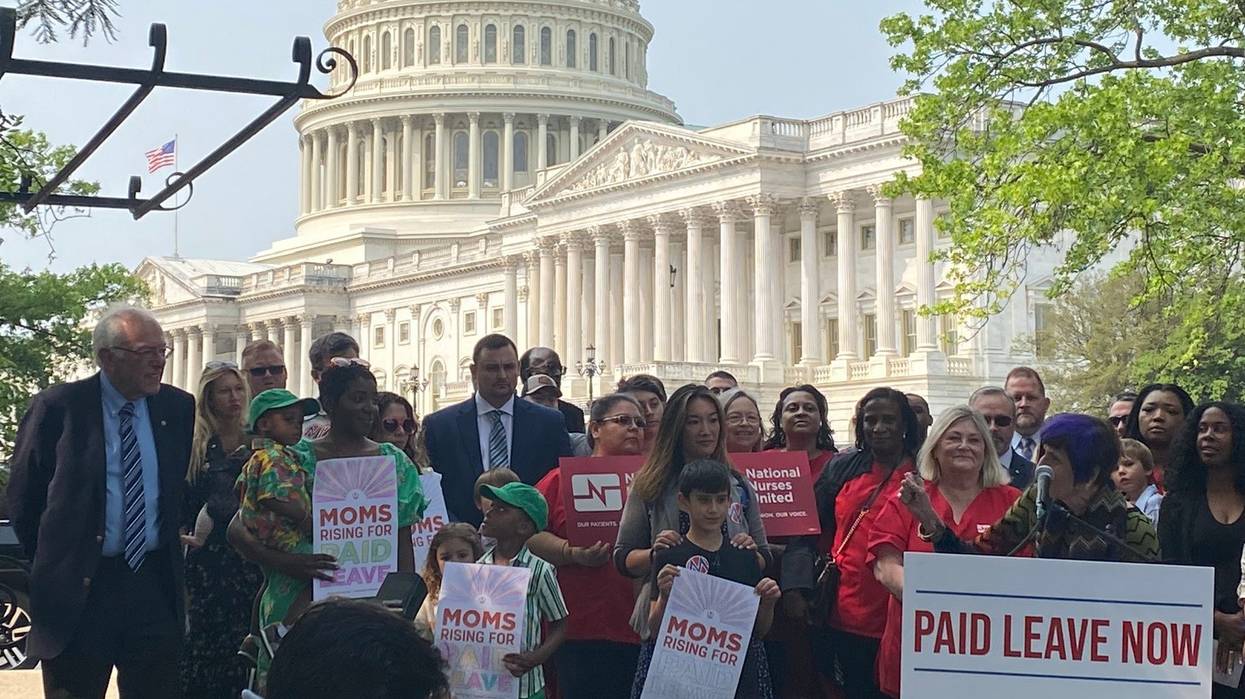
"It is a total disgrace that millions of workers are having to choose between their job and caring for their family, their newborn child, or themselves when they are sick and in need of care," said Sen. Bernie Sanders.
Mothers along with leaders from nursing and railway unions joined U.S. Rep. Rosa DeLauro as well as Sens. Bernie Sanders and Kirsten Gillibrand on Capitol Hill Wednesday morning to introduce two bills that would guarantee paid leave nationwide.
A fact sheet from Sanders' office highlights that "34 million American workers in the U.S. lack paid sick time entirely, including 25% of the private sector workforce and 9% of the public sector workforce," and such policies are "particularly inaccessible" for low-wage workers.
"It is time to end this absurdity," declared Sanders, who chairs the Senate Committee on Health, Education, Labor, and Pensions (HELP). "It is time for the United States to join nearly every other major country in the world and finally guarantee paid sick leave."
"In the richest country in the history of the world, it is a total disgrace that millions of workers are having to choose between their job and caring for their family, their newborn child, or themselves when they are sick and in need of care," he asserted. "It is time Congress passed this legislation to ensure workers receive the basic dignity and benefits that they deserve."
DeLauro and Gillibrand (D-N.Y.) also unveiled an updated version of the Family and Medical Insurance Leave (FAMILY) Act, which would ensure that all workers in the United States have access to paid leave for serious medical events. The legislation would provide up to 12 weeks of partial income annually and ensure those with the lowest pay earn up to 85% of their normal wages.
The FAMILY Act would also ensure workers who have been at their job for over 90 days have the right to be reinstated after their leave, allow states to continue administering existing programs, and establish a new Office of Paid Family and Medical Leave. As DeLauro noted, she and Gillibrand have been fighting for versions of their bill for the past decade.
"Thirty years ago, we broke ground by enshrining the Family and Medical Leave Act into law, providing unpaid family and medical leave for working Americans," she said. "Let's break ground again by making it paid. Since 2013, I have been proud to be joined by Sen. Gillibrand in introducing the FAMILY Act, which would establish the nation's first universal, comprehensive paid family and medical leave program. This year, the fight continues, as we reintroduce a strengthened FAMILY Act to meet families where they are now and ensure no one has to make the impossible choice between their job and the health of themselves or their loved ones."
The proposals are backed by dozens of advocacy organizations and unions, with several groups and activists demanding swift passage of both bills—though the odds are unlikely, with slim Democratic control of the Senate and the House's GOP majority.
"I had my first child, I was a public school teacher, and I had to drain all my sick time to try to maintain some income during my unpaid maternity leave," said Rachel Shelton, a MomsRising member from Asheville, North Carolina, in a statement.
"That was a huge challenge, because babies get sick!" Shelton explained. "When I had my second, I made the tough decision to leave my job because the situation was unsustainable. It shouldn't be this hard to balance caregiving and work. We need Congress to pass the FAMILY Act and Healthy Families Act, now. It's past time we guarantee all working people the paid leave and paid sick days we need to care for our families and for ourselves."
National Nurses United also supports both bills. The organization's president, Jean Ross, said that "nurses want what is best for patients, and that's why our union supports paid sick and family leave for all workers. Nurses see the negative health consequences on patients when they are unable to take leave due to their own illness, or the need to care for family."
"Nobody should have to choose between their own health or the health of their loved ones, and their livelihood," Ross stressed. "Further, nursing is a majority female profession, and paid sick and family leave is essential to ensuring that nursing becomes a sustainable profession."
The introductions—which also featured remarks from Senate Majority Leader Chuck Schumer (D-N.Y.) and Senate Appropriations Committee Chair Patty Murray (D-Wash.)—come after a year of railway workers, backed by key congressional allies including Sanders, gaining national attention for their fight for paid leave in the face of dangerous working conditions and industry greed.
Mike Baldwin, president of the Brotherhood of Railroad Signalmen, said Wednesday that "the BRS would like to thank those members of Congress who support paid sick leave. Rail workers were deemed essential during the pandemic. They came to work sick because they didn't want to miss a day's pay, or worse be disciplined for their absence."
"This legislation is important to rail workers," he said of the HFA. "It is an essential need, and it isn't just a frivolous want."
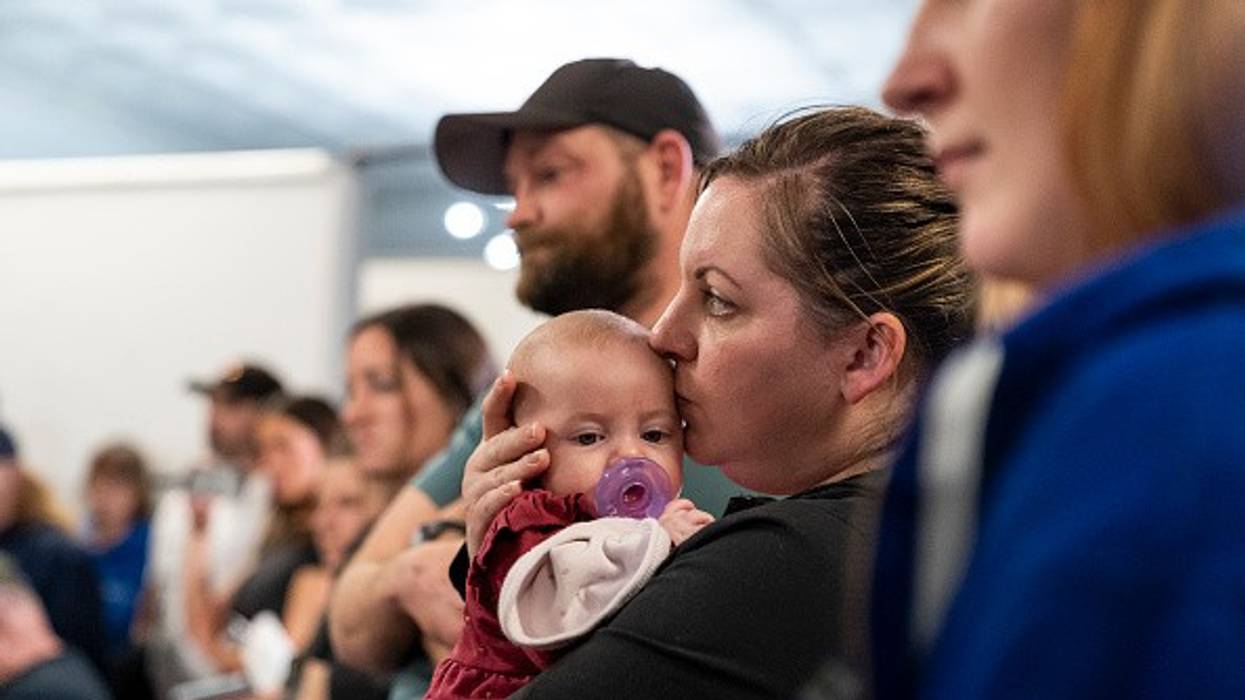
"Voters across party lines are in favor of increased safety measures," according to think tank Data for Progress.
Almost half of U.S. voters surveyed by progressive think tank Data for Progress blame rail company Norfolk Southern for the February 3 train derailment in East Palestine, Ohio which forced 1,500 residents to evacuate, contaminated soil and water, and has been blamed for causing a number of symptoms even as officials claim air and water monitoring hasn't shown dangerous levels of pollution.
Forty-nine percent of the 1,243 people surveyed by Data for Progress from February 17-22 said they believed Norfolk Southern was responsible for the crash, including 50% of Democrats, 52% of Independents, and 47% of Republicans.
Nineteen percent said they didn't know who to blame, while 10% blamed the U.S. Department of Transportation.
The poll was taken as the National Transportation Safety Board (NTSB) released its preliminary assessment of the derailment of the train, which was carrying hazardous materials including vinyl chloride. As Common Dreams reported Thursday, the report found the crash was likely caused by a wheel bearing failure due to overheating.
Eddie Hall, national president of the Brotherhood of Locomotive Engineers and Trainmen (BLET), pointed out after the report was released that rail companies have aggressively pushed to loosen safety regulations, spending "nearly a half billion dollars lobbying Congress" in the past two decades as they attempt to reduce train crews to just one person and pushed back as the Obama administration sought to require more modern braking systems on trains carrying hazardous materials.
Rail workers have also blamed major rail companies' use of Precision Scheduled Railroading (PSR), which requires train to run on strict schedules and cuts back on equipment and train crews, for the crash and others like it.
NTSB Chair Jennifer Homendy said Thursday the board is now examining Norfolk Southern's use of "wayside defect detectors," which did not alert the train crew quickly enough to the overheated wheel bearing, and said the board could issue safety recommendations to regulators or the rail company.
ProPublica reported on Wednesday that Norfolk Southern has at times instructed train crews "to ignore alerts from train track sensors designed to flag potential mechanical problems"—a policy union leaders say is "emblematic" of PSR. The NTSB did not suggest that was the case with the derailment in East Palestine.
Fifty-eight percent of respondents to the Data for Progress survey said they believe there are not enough safety regulations in place for railroad companies that transport hazardous material.
"Voters across party lines are in favor of increased safety measures, including 89% of voters who support setting higher standards for maintenance on railroads and strengthening safety regulations on railroad cars carrying explosive substances," reported the group. "Eighty-six percent of voters support placing limits on the length and weight of freight trains carrying hazardous materials."
The poll results were released as Rail Workers United (RWU), an inter-union caucus of rail workers, demanded that regulators and lawmakers take action to stop companies like Norfolk Southern from prioritizing speed and profits over safety.
"Every day we go to work, we have serious concerns about preventing accidents like the one that occurred in Ohio," RWU general secretary Jason Doering said. "As locomotive engineers, conductors, signal maintainers, car inspectors, track workers, dispatchers, machinists, and electricians, we experience the reality that our jobs are becoming increasingly dangerous due to insufficient staffing, inadequate maintenance, and a lack of oversight and inspection."
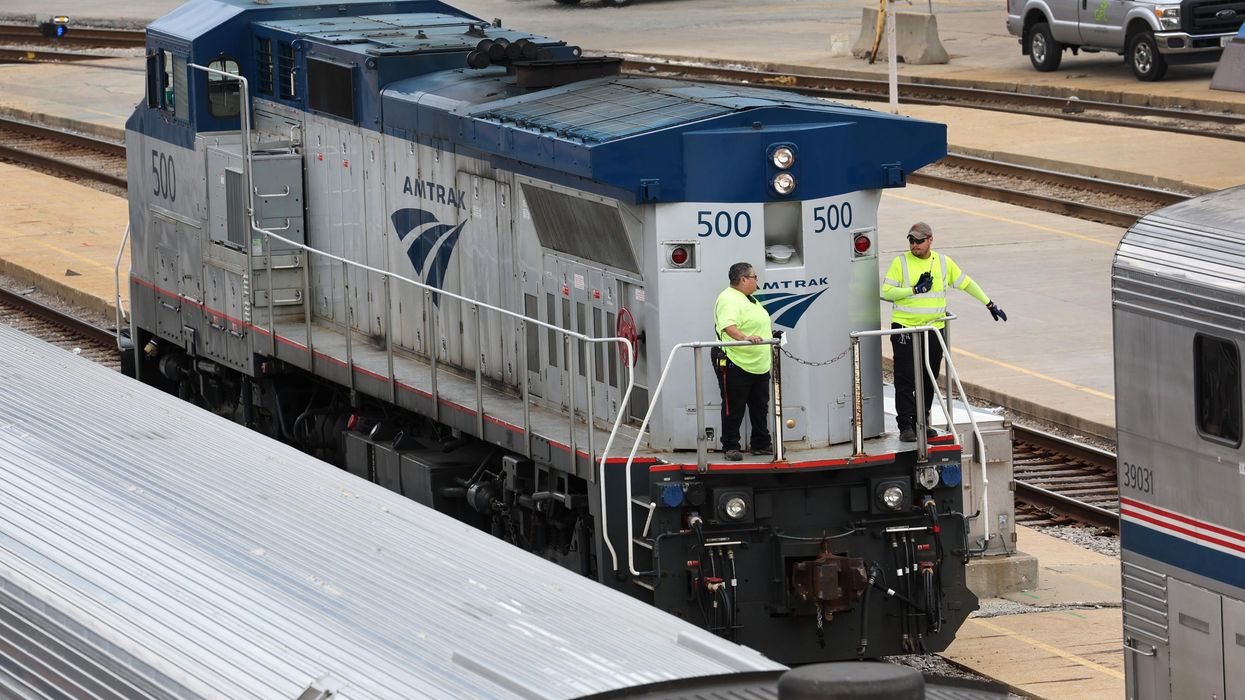
Some lessons from the (almost) Great Railroad Strike of 2022.
Bernie Sanders clutched both sides of the sturdy wooden podium at the UAW Local 578 hall in Oshkosh, Wisconsin, as he prepared to address a packed house of 400 union workers, students, campaign staff, and curiosity seekers. Looking like a cross between a history professor and a professional wrestler from a bygone era, the Independent U.S. Senator from Vermont leaned in, then rocked back and forth. He was pacing himself before launching into another stem-winder lecture on income inequality and the state's fiercely contested U.S. Senate race, whose Republican incumbent, Ron Johnson, lives in Oshkosh.
"We're going to have to knock down a wall or two," Sanders remarked. "This is a good turnout."
Oshkosh, a city of 67,000 people, was built by a union workforce. Its sawmills were organized in the late nineteenth century, and the University of Wisconsin campus a few miles up the road was the state's first teachers college, founded in 1871. Labor's roots run deep here on the western shore of Lake Winnebago.
In recent years, Winnebago County has become a bellwether. When it goes narrowly blue or grazes the 50 percent mark, Democrats win statewide. Blue-collar Oshkosh anchors the county, and Democrats must ramp up turnout here to win tightly contested races.
Democrats lost the U.S. Senate race in November's midterm elections but prevailed in the race for governor, and kept the Oshkosh-based state assembly seat in the Democratic fold, thereby staving off a Republican run for a supermajority in the lower house. In November, Governor Tony Evers lost Winnebago County by just one percentage point.
For the first time in decades, Democrats are on track to burnish their street credentials as a truly economic populist party, a sharp turn from the ideologies and philosophies of the previous three Democratic administrations: neoliberalism (Barack Obama), neo-neoliberalism (Bill Clinton), and rudderless-ism (Jimmy Carter).
Shifts in the gubernatorial race have been significant since 2010 in the outer-ring suburbs of Milwaukee, namely Waukesha and Ozaukee Counties. But movement in counties like Winnebago and Eau Claire—the latter of which saw a sixteen-point increase for the Democratic gubernatorial candidate between 2010 and 2022—which have college and working class populations, was not as well noticed. Democrats held their own in rural areas like Wood County, home to Verso Paper, which was shuttered two years earlier and had supported more than 900 local jobs, along with countless logging jobs in the Northwoods.
One month after Democrats beat expectations in the 2022 midterm elections by holding on to the U.S. Senate and denying Republicans a working majority in the House, President Joe Biden broke from his populist, pro-labor moorings and spiked a good labor contract proposal by the railway workers' unions.
When rank-and-file members of four of the twelve unions rightly rejected a proposal that did not grant them enough paid sick days, Biden invoked the Railway Labor Act of 1926 and sent the rebuffed contract to Congress for ratification. It was the first time a President had applied that law since 1992, when then-U.S. Senator Joe Biden was one of just six Senators to oppose the measure.
Biden breached the trust of American workers and did untold damage to his brand as the "most pro-union President you've ever seen." Progressive Democrats understood both the symbolism and the substance of the President's actions. But thanks to quick work by Sanders and Democratic Representative Pramila Jayapal, of Washington State, progressives put a separate measure up for a vote that included seven days of paid sick leave, to add to the railway contract bill. However, the Senate failed to reach cloture, and the measure died. (Yet another reason to ax the filibuster.)
The Railway Labor Act is an outdated labor law that was designed to placate workers at a time when they were achieving significant momentum. Its roots were in the Great Railroad Strike of 1877, when workers took one too many pay cuts on the chin and decided to fight back. One striking worker famously stated, "I might as well die by the bullet as to starve to death by inches."
Laws were soon passed to set up arbitration panels to salve workers' grievances. But members of Congress struggled to pin down an effective mediation and arbitration system to resolve grievances. President Woodrow Wilson came close to fixing this when he nationalized the rail industry in 1917. But shortly after World War I, Wilson returned power to the railroad owners, and the industry oligarchs have been screwing over workers ever since.
Then came the cure-all: the New Deal's National Labor Relations Act of 1935. It, too, was designed to quell labor unrest. President Franklin D. Roosevelt could not allow unregulated union activity to upend the New Deal. While the act's true intent was to pump the brakes on union momentum, its initial effects were quite promising for the labor movement. Unions became recognized across the country and among all private-sector industries. By the end of the Great Depression, enrollment in unions had shot up almost three-fold, from 7 to 20 percent of employed workers.
But as soon as labor started grabbing the upper hand, Congress responded with the Taft-Hartley Act in 1947 over President Harry Truman's veto, which limited job actions, made union dues voluntary, and prohibited closed shops. The bipartisan vote spelled the beginning of the end of the modern-day labor movement. When it took effect in the aftermath of World War II, one out of three private-sector workers were in a union. Three years later, union density had fallen by 10 percent. It rebounded briefly, but by the end of the 1960s, its downward trajectory was clear.
Tim Jacobson of UAW Local 578 looks exactly like you would expect a union steward to look. He has a commanding presence, is tall, muscular, and has a frame built for a hard hat. He hunches over slightly, no doubt the result of decades on the Oshkosh Defense assembly line fastening bolts and panels onto military tactical trucks.
Elbowing his way through a scrum of fans after Sanders's speech, Jacobson presented the Senator with a T-shirt from the union local. Sanders gladly accepted it, held it up to an approving crowd, and slipped out the side door.
Jacobson was stoked that Sanders had made it to his union hall. For almost two years, he and his union brothers and sisters had been trying to grab the attention of national leaders. In June 2021, Oshkosh Corporation, the parent company of his employer, selected Spartanburg, South Carolina, rather than Wisconsin, to fill a multi-billion-dollar U.S. Postal Service (USPS) contract to build the next fleet of electric postal vehicles. The contract was won on the merits and track record of the work by Jacobson and his colleagues, not because of an empty warehouse in the Palmetto State, leading many critics to accuse the company of pulling a bait-and-switch.
Aside from a brief clash in the House Committee on Oversight and Reform earlier in the year between Representative Alexandria Ocasio-Cortez, Democrat of New York, and a USPS representative, Local 578's plight garnered scant national attention. While most would have given up, Jacobson soldiered on. His persistence and advocacy were the reason Sanders took a break from a nationwide campus tour to get out the youth vote—a vote that made the difference in the midterm elections—to meet and rally with workers in Oshkosh.
What happened to Jacobson represents a bigger problem—not in organized labor, but in American and global industry. Chief executive officers are recruited not for their knowledge and understanding of how a certain industry works, but for other factors. According to Byron Hanson of the Curtin Graduate School of Business, "Industry experience is not as big a success factor as what people think it would be. My sense of success factors is more context-related or expertise-related."
While worker wages have stagnated in the past four decades, chief executive officer compensation has skyrocketed. From 1978 to 2021, it increased by 1,460 percent, according to an analysis by the Economic Policy Institute. Concurrently, the average worker's compensation package has grown at literally 1 percent of that rate.
During a visit to a local paper mill in the Fox River Valley, I once asked a now former paper executive what was in a rail car below his office window. "I'm not sure," he responded. "In fact, I don't really know what we actually do, I'm just here to run the place."
While he undoubtedly knew the difference between a paper roll and a roll of toilet paper, the executive's limited insight into a fundamental part of his business was revealing. If he didn't know what the hell was going on, who did? One year later, the company fell into bankruptcy.
It's union workers like Jacobson who dedicate an entire career to a single industry at a single plant. Unsurprisingly, manufacturing workers have the highest tenure—five years—of all major private industries in the United States. And for organized shops, with the union wage premium, workers stick around longer.
When workers at Appleton Coated in Combined Locks, Wisconsin, rallied to save their mill after it had been sold at a receivership sale in late 2017, it was the union that convinced a judge to give them another shot. And it was the workers' expertise that executed a new business model that made the company profitable. (Just over two years later, the owner—a scrap dealer that had bought the mill for parts—made tens of millions of dollars in profit by reselling it in 2020.)
When it came time to bring 1,000 union jobs to Oshkosh, it was Jacobson and UAW Local 578 President Bob Lynk who flew to Washington, D.C., to make their case to USPS officials and to lobby their members of Congress. Meanwhile, Oshkosh Defense executives were feted by anti-union South Carolina business groups, including being given the South Carolina Manufacturing Commerce and Expo's "Smart Move Award" for 2022.
If the workers are the ones tending to the shop, shouldn't they figure more prominently in industry? And shouldn't they be treated a little better?
Democrats should make clear whose side they are really on in the new Congress. One way to do that is to adopt an economic bill of rights, not unlike the one FDR proposed in January 1944, or what labor activists like University of Wisconsin–Green Bay professor emeritus Harvey Kaye and writer John Nichols, a contributor to The Progressive, have been championing of late. And that is to lay out in no uncertain terms what the American worker can count on from the Democratic Party in order to achieve "the essentials of a good life, regardless of their income, race, religion, gender, sexual orientation, or country of origin."
In states like Wisconsin, where Democrats beat expectations and met crucial goals like re-electing Tony Evers as governor and denying the GOP a supermajority in the state legislature, credit is owed to folks like Ben Wikler, chair of the Democratic Party of Wisconsin, for injecting real resources into crucial races. Equally important, however, are workers like Jacobson, who should be credited with reminding elected leaders and candidates who it was that built the Democratic Party—and the nation—in the first place.

"The industry can and must guarantee at least seven paid sick days to every rail worker in America," said the Vermont senator in renewed push.
A day after sustained pressure from labor advocates resulted in an historic paid leave deal between one freight rail company and two unions representing thousands of its workers, U.S. Sen. Bernie Sanders on Thursday launched a renewed push for at least seven days of paid sick leave for all railroad employees in the United States, noting that the industry can easily afford to reform its stringent attendance policies.
"At a time of record-breaking profits, the industry can and must guarantee at least seven paid sick days to every rail worker in America," said the Vermont Independent senator. "In the year 2023 that is not a whole lot to ask."
Sanders noted that rail companies have recently posted record earnings for 2022, with the largest corporations reporting more than $26 billion in profits.
Late last month, Union Pacific—which defeated labor unions and progressive advocates in labor negotiations late last year, avoiding a contract that would have included paid sick leave for workers—reported $7 billion in income. It spent $6.3 billion on stock buybacks and just $4.6 billion on employee pay and benefits.
Rail giants "are doing extremely well," said Sanders, who chairs the Senate Health, Education, Labor, and Pension (HELP) Committee. "And what did they do with those record-breaking profits? Did they spend it on making the rail industry safer?... Did they spend that money on improving the horrendous working conditions that exist today in the rail industry?"
"No, they didn't do that," the senator continued. "They spent over $20 billion of their profits on stock buybacks and dividends to make their wealthy shareholders even wealthier."
Sanders added that seven guaranteed paid sick days would cost the rail industry just $321 million annually—less than 1.2% of its profits.
The senator led an effort late last year to pass an amendment to guarantee paid sick leave for workers, as Congress and the Biden administration got involved in contract negotiations to avoid a rail strike. The amendment won the support of every Senate Democrat except for Sen. Joe Manchin (D-W.Va.), and six Republicans joined them in backing the proposal, which failed to pass. Congress then voted to compel four rail unions to accept a contract without paid sick days.
At Thursday's press conference, Sanders was joined by representatives from rail unions including SMART-TD, the Brotherhood of Locomotive Engineers and Trainmen, and the Brotherhood of Maintenance of Way Employes, who applauded his efforts to ensure fair working conditions.
The lack of paid sick leave "puts an engineer and a conductor in a hard spot because when they get sick they have to make a hard decision on showing up to work not well-rested, distracted, getting on a train with 10,000 tons, possibly some seriously hazardous materials on board... or you can face the wrath of the attendance policy," said Adam West, a conductor with CSX Transportation. "If you're at the end of the attendance policy, you're not going to get to the doctor's appointment, your'e not gong to get to the dentist, and you're not going to get the preventative care that you need to stay healthy."
Sanders said that if railroad executives "do not come to the table and negotiate an acceptable agreement with the unions," he will use his authority as chairman of the HELP Committee to call on them to testify at hearings, adding "we certainly will bring legislation to the floor."
"People across the country are seeing the reality of what these workers are going through, and the American people are behind these workers overwhelmingly," he said.

An inter-union alliance of rail workers argued Tuesday that the massive freight train crash in East Palestine, Ohio late last week was a predictable consequence of Wall Street-backed policy decisions that have hollowed out the industry's workforce, pushed remaining employees to chronic exhaustion, and sacrificed safety for profits.
In an assessment of the Norfolk Southern (NS) train derailment based on currently available information, Railroad Workers United (RWU) wrote that "the root causes of this wreck are the same ones that have been singled out repeatedly, associated with the hedge fund-initiated operating model known as 'Precision Scheduled Railroading' (PSR)."
The group noted that the "immediate cause" of the wreck "appears to have been a 19th-century-style mechanical failure of the axle on one of the cars—an overheated bearing—leading to derailment and then jackknifing tumbling cars."
"There is no way in the 21st century, save from a combination of incompetence and disregard to public safety, that such a defect should still be threatening our communities," wrote RWU, which supports nationalization of the U.S. rail system.
"Forty percent of the weight of NS 32N was grouped at the rear third of the train, which has always been bad practice and made more dangerous with longer heavier trains," the statement continued. "This fact almost certainly made the wreck dynamically worse. But increasingly the PSR-driven carriers, driven to cut costs and crew time by any means necessary, cut corners and leave crews and the public at risk."
According to RWU, "The short-term profit imperative, the so-called 'cult of the Operating Ratio'—of NS and the other Class 1 railroads—has made cutting costs, employees, procedures, and resources the top priority. In this case, NS and the other carriers have eliminated many of the critical mechanical positions and locations necessary to guarantee protection against these kinds of failures."
The crash in Ohio "has been years in the making," the group added. "What other such train wrecks await us remains to be seen. But given the modus operandi of the Class One rail carriers, we can no doubt expect future disasters of this nature."
"The PSR-driven carriers, driven to cut costs and crew time by any means necessary, cut corners and leave crews and the public at risk."
Matthew Jinoo Buck, a senior fellow at the American Economic Liberties Project, explained in The American Prospect last year that "using PSR, railroad management's job is to drive down the 'operating ratio,' or operating expenses as a percentage of revenue."
"In other words, Wall Street judges railroads' success based in part on spending less money running the railroad and more on stock buybacks or dividends," Buck wrote. "Theoretically, focusing on lowering operating ratios pushes railroads to be more efficient, to do more with less. But when railroads have the market power they have today, they can instead 'do less with less,' as shippers and workers put it."
Norfolk Southern, the product of a merger between Norfolk and Western Railway and Southern Railway, appears to have followed that model closely.
The company announced a $10 billion stock buyback program last March and has consistently raised its dividend, rewarding shareholders while refusing to provide its workers with basic benefits such as paid sick leave.
For the full year of 2022, Norfolk Southern reported record-breaking operating revenues of $12.7 billion.
As Buck wrote last year, "The driving force behind PSR’s widespread adoption was railroad executive E. Hunter Harrison and investor Bill Ackman, a notorious hedge fund manager."
"After the two pushed through PSR at the Canadian Pacific railroad, Ackman's colleague Paul Hilal opened an investment fund called Mantle Ridge, which invested $1.2 billion in CSX and successfully pushed CSX to appoint Harrison CEO," he continued. "Under Harrison, and with the backing of CSX's board, who saw larger bottom lines in sight, CSX pushed through PSR despite complaints from shippers who reported long delays or lost shipments. Every other railroad has adopted PSR or PSR equivalents; industry watchers say the one holdout yet to officially adopt PSR, BNSF, has adopted PSR-like measures."
The crash in Ohio late Friday forced many local residents to evacuate to escape a possible explosion and the release of toxic fumes from the train cars, several of which were carrying vinyl chloride.
RWU said Tuesday that while many people in the area "were and remain evacuated, and property damage to both rail and non-railroad property will no doubt soar into the millions, we dodged a bullet as no rail workers and no trackside residents were killed."
"This time," the group added.

"A worker should not be fired for going to the doctor. Yet it is 2023 and railroaders are fighting for sick leave in the richest country on Earth," said one rail union leader.
Sen. Bernie Sanders announced Tuesday that he will join rail workers later this week to launch a fresh push for at least seven days of paid sick leave, an effort that comes months after Congress and the Biden White House forced workers to accept a contract without a single paid sick day to avert a potential strike.
Joining Sanders (I-Vt.) and rail union representatives at the Thursday press conference in Washington, D.C. will be Sen. Mike Braun (R-Ind.), one of the handful of Republican senators who voted for Sanders' amendment to add a week of paid sick leave to the White House-brokered contract deal.
The Vermont senator's amendment ultimately fell seven votes short of the 60 needed to overcome the Senate filibuster.
Since lawmakers' December vote to impose the contract despite opposition from unions representing a majority of U.S. rail workers, progressive members of Congress and rail employees have continued pressuring the Biden administration and ultra-profitable railroads to provide paid sick leave, overhaul their exploitative and untenable scheduling systems, and implement stronger safety standards.
On December 9, Sanders and more than 70 of his Democratic colleagues in the House and Senate sent a letter urging President Joe Biden to use his executive authority to "take quick and decisive action to guarantee these workers paid sick leave"—something he has yet to do.
Sanders, the chair of the Senate Health, Education, Labor, and Pensions Committee, is expected in the coming months to introduce legislation that would require rail corporations to guarantee their workers a minimum number of paid sick days.
At Thursday's press conference, according to Sanders' office, union leaders will demand that "companies provide them with at least seven paid sick days."
"Rail labor is committed to pursuing and securing paid leave for workers this year to create a safer, healthier national rail system for all."
The event will come just two weeks after Union Pacific, one of the largest rail corporations in North America, reported a record $7 billion in profits for 2022. The company spent significantly more on stock buybacks last year than it did on worker pay and benefits.
Sanders' office noted Tuesday that "guaranteeing seven paid sick days to rail workers would cost the industry just $321 million dollars—less than 1.2% of profits in a single year."
Marking the 30th anniversary of the Family and Medical Leave Act, U.S. rail unions unanimously adopted a resolution last week declaring that "all of rail labor is united and resolved to fight for paid sick leave for all railroad workers through collective bargaining or voluntary agreement, and that rail labor will further call upon all elected and appointed government officials and government agencies to pass a national paid sick leave law that covers all railroad workers with paid sick leave without penalty or punishment."
“A worker should not be fired for going to the doctor. Yet it is 2023 and railroaders are fighting for sick leave in the richest country on Earth," Greg Regan, president of the Transportation Trades Department of the AFL-CIO, said in a statement Monday. "Absent a national paid sick leave policy, the burden of securing this humane policy falls onto the shoulders of workers and the unions that represent them."
"Rail labor is committed to pursuing and securing paid leave for workers this year to create a safer, healthier national rail system for all," Regan added.

"Instead of buying back their own stock, UP should be investing in their employees by offering paid sick leave, reasonable schedules, and a better quality of life for railroaders," said one union president.
Union Pacific, one of the largest rail corporations in the United States, said Tuesday that it brought in record revenue and profits last year as it successfully fought off workers' push for paid sick leave.
The company reported $7 billion in net income for 2022 as a whole and said it spent a whopping $6.3 billion repurchasing its own shares—significantly more than the $4.6 billion it spent on employee pay and benefits last year.
“Instead of buying back their own stock, UP should be investing in their employees by offering paid sick leave, reasonable schedules, and a better quality of life for railroaders," Ed Hall, the newly elected president of the Brotherhood of Locomotive Engineers, told CNN on Tuesday. "This is the only way the railroad will be able to solve their recruitment and retention problems and keep the trains running."
Union Pacific was one of the major rail carriers involved in White House-brokered contract talks late last year that produced an agreement without any guaranteed paid sick days, rejecting a central demand of rail workers.
Labor unions representing a majority of U.S. rail workers rejected the proposed agreement and threatened to strike, but Congress intervened in the long-simmering contract dispute in December to impose the White House-backed deal on employees, sparking furious backlash from rank-and-file union members and progressive allies.
"President Biden campaigned on a week of paid sick leave for all working people, and then he had the opportunity right here but didn't take action. He favored the corporations," Matt Weaver, a rail worker and member of the Brotherhood of Maintenance of Way Employes Division (BMWED) in Ohio, told In These Times contributor Jeff Schuhrke, who detailed rail workers' ongoing fight for paid leave and safety measures in a piece last week.
Facing continued pressure from employees and some activist investors, Union Pacific and other rail giants are "weighing offering paid sick days—or are already doing so—along with schedule changes and other steps to improve employees' work-life balance," Bloomberg reported Monday.
"Costs will still be a key consideration for the railroads—and their investors," the business outlet added. "Voluntary paid sick leave and more flexible schedules would add to the expense of the labor agreement, which over five years raises salaries by 24%, pays bonuses totaling $5,000, and adds one day a year of personal leave. That could come at the expense of dividends and share buybacks, which have soared in recent years."
"Workers remain skeptical that they'll truly benefit from the tradeoff," Bloomberg continued. "Railroads historically have been quick to furlough staff during downturns, have required long hours with little flexibility, and have imposed strict attendance policies that allow the railroads to operate with fewer workers."
As Railroad Workers United put it in a Twitter post on Tuesday, "Never take the Union Pacific at face value."