SUBSCRIBE TO OUR FREE NEWSLETTER
Daily news & progressive opinion—funded by the people, not the corporations—delivered straight to your inbox.
5
#000000
#FFFFFF
To donate by check, phone, or other method, see our More Ways to Give page.


Nearly 7 in 10 respondents said they were "very" or "somewhat" concerned about the health of the banking industry following SVB's collapse, and 82% said they supported Congress taking action to strengthen banking rules in order to avoid another failure.
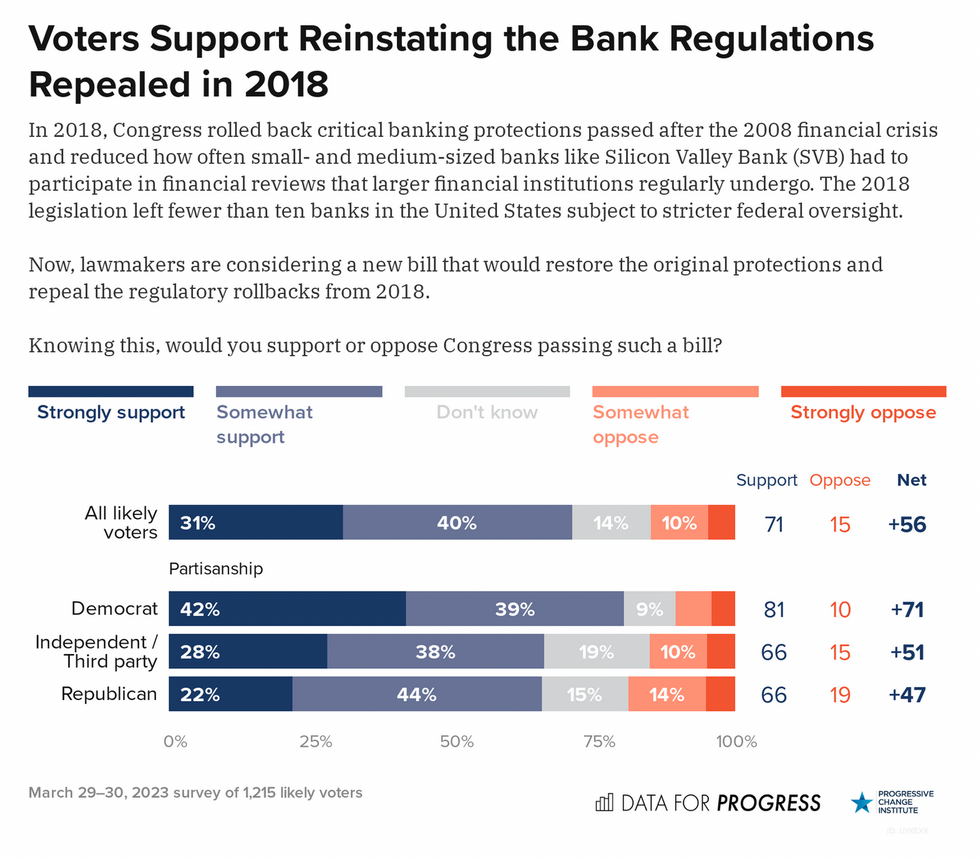
More than 70% said they would support the reinstatement of "critical banking rules" that were rolled back in 2018. Those rules weakened regulations for banks with between $50 billion to $250 billion in assets, and Sen. Elizabeth Warren (D-Mass.) and Rep. Katie Porter (D-Calif.) said last month that their repeal was a major driver of SVB's collapse as they introduced the Secure Viable Banking Act to impose the rules once again.
The Biden administration said after the collapse that it would take steps including creating an emergency fund to make sure all SVB deposits were covered and demanded that executives be held accountable for bonuses that were handed out in the hours before the bank failed, but 90% of respondents told Data for Progress that they had heard little or nothing about the proposed reforms.
"While voters strongly support reforms in the banking sector and the actions taken by the Biden administration in the wake of SVB's collapse, these results signal that the administration has room to expand communication on the subject and claim this issue for Democrats," said Data for Progress.
The organization noted that likely voters were more supportive of President Joe Biden's plan when told the administration had created an "emergency fund" than when the fund was described as a "bailout" and when they were told that SVB's client base, made up largely of "billionaire tech investors and multimillion-dollar companies," had been helped by the fund.
The poll indicates, said the Progressive Change Campaign Committee, that Democratic leaders have an opportunity "to raise the volume on bank reform and accountability—and be seen as challenging power on behalf of everyday people."
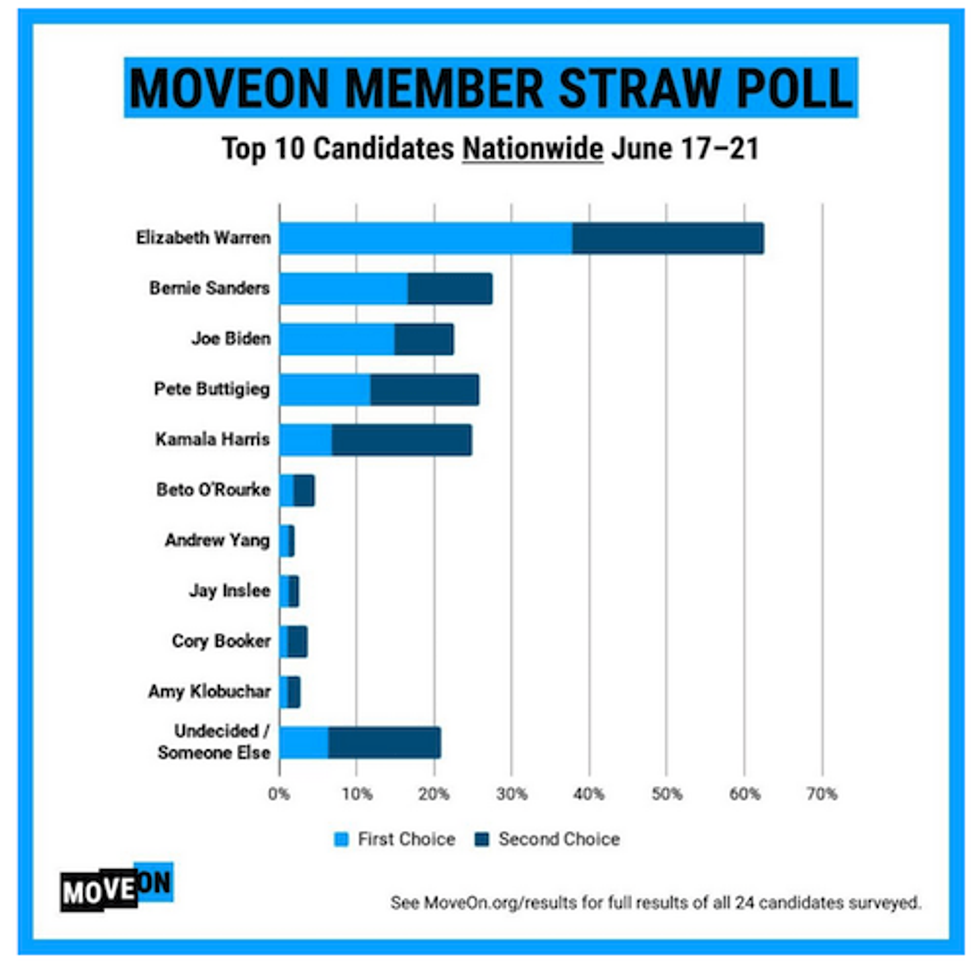
The MoveOn poll targets the left-leaning progressives that make up its supporters. Nonetheless, the group's federal endorsement manager Allison Pulliam said in a statement, the poll's findings indicate the Democratic Party faithful are beginning to coalesce around a small number of top-tier candidates.
"MoveOn members make up a huge part of the Democratic Party's base," said Pulliam, "and this poll is clearly good news for Sen. Warren, showing that she's gained substantial support from MoveOn members over the past six months and is also well positioned to continue building support given that she's also the top second choice candidate of our membership."
In comments Monday to The Hill about Warren's chances in the primary, Progressive Change Campaign Committee co-founder Adam Green said that he believes Warren is uniquely positioned to pick up more supporters from Biden backers and undecideds. Green's group endorsed Warren minutes after she announced her run for president in February.
"Bernie supporters are pretty hard core and are not the cornerstone of any Warren strategy," Green told The Hill. "Biden voters and undecided voters are the biggest honey pots for Elizabeth Warren because they are disproportionately pundit voters who prioritize electability."
The MoveOn poll indicates that Warren is already picking up some of that support.
Tuesday also marked the release of a national poll from Emerson Polling that found Biden still leading the pack of Democrats with 34 percent. Sanders was close behind at 27 percent while Warren, in contrast to her strong showing among MoveOn voters, was a distant third at 14 percent.
The large Democratic field will debate for the first time on Wednesday and Thursday. Warren will be the lone frontrunner on the first day with nine others polling at under five percent. Biden and Sanders face off against Buttigieg, Harris, and six other candidates on Thursday.

Public Policy Polling surveyed Americans in three House districts--Iowa's 4th, represented by Republican Steve King; New Hampshire's 1st, represented by Democrat Chris Pappas; and South Carolina's 1st, represented by Democrat Joe Cunningham. These are all swing, frontline congressional districts, the kind where both parties worry most about winning control. They are all also in early caucus or primary states for the 2020 presidential races. Together they give a good look at how an issue plays in "tough" districts and states.
What did we find? Do Republicans and Independents like getting ripped off by drug corporations? Nope.
The survey asked about allowing Medicare to negotiate with drug corporations, a commonsense policy that could save over a hundred billion dollars a year for taxpayers and seniors.
Q: Some have proposed allowing Medicare to negotiate lower drug prices, which could save over a hundred billion dollars a year for taxpayers and seniors. Do you support or oppose this idea?
Iowa's 4th Congressional District is 22.5 points more Republican than the average district in the nation, a deeply red district represented by a Republican, and yet 80 percent of voters want Medicare to directly negotiate with drug corporations.

New Hampshire's 1st Congressional District is 4.4 points more Republican than average, a swing district that leans slightly Republican and is currently held by a Democrat. Here 84 percent of voters want Medicare to directly negotiate with drug corporations.

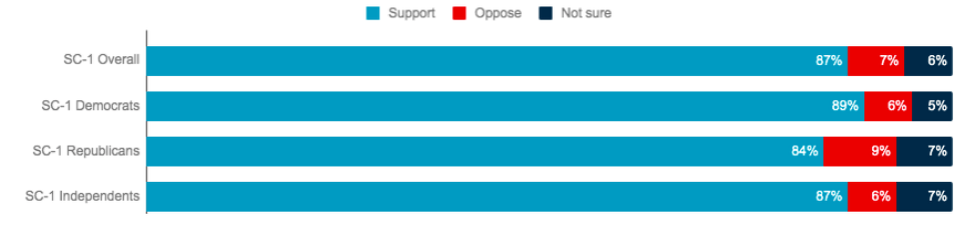
South Carolina's 1st Congressional District is 18.9 points more Republican than the average district, yet here 87 percent of voters want Medicare negotiation.
In Washington, D.C., there is a thing called conventional wisdom. Sometimes it is true--like always carrying an umbrella in April and March--but too often what is called conventional wisdom is actually just industry talking points masquerading as insight. There is no industry more adept at distorting the conversation in D.C. than the pharmaceutical industry.
Right now there is a bill sponsored by Representative Lloyd Doggett (D-TX) and 123 of his fellow Democrats (more than half of the Democratic caucus) that instructs Medicare to negotiate drug prices. Representative Doggett and his colleagues who are sponsors of the Medicare Negotiation and Competitive Licensing Act of 2019 are clearly listening to the American people. The backers of this bill also know that when it comes to pharma, a bill needs to have real teeth. So if a drug company refuses to negotiate in good faith, the bill empowers government to allow generic competition and end the company's monopoly.
There is a bit of this so-called conventional wisdom that an army of lobbyists is trying to speak into existence. It goes something like this: Conservative and independent voters in this country don't want to touch a company's monopoly. We decided to actually ask the voters what they thought, and, as we expected, the American people want lower drug prices and support using generic competition to get there if a company is abusing their monopoly.
Q: "Some have proposed allowing generic competition on lifesaving drugs when the government determines that a drug company has abused their monopoly and raised the price beyond patients' ability to pay. This would allow other companies to manufacture the drug and provide it to consumers at a more affordable cost, and it would end a company's monopoly on the drug. Do you support or oppose this idea?"
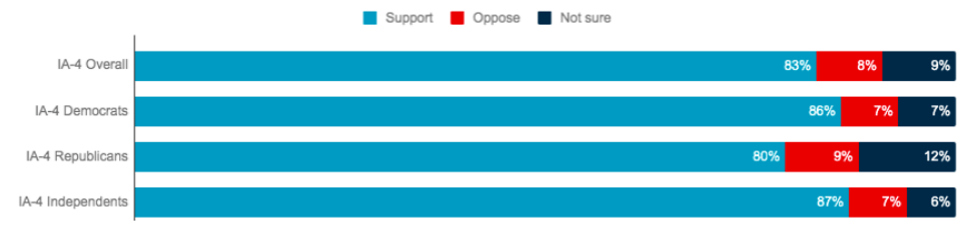
83 percent of voters in Iowa's deeply red 4th Congressional District, including 80 percent of Republicans, support generic competition.
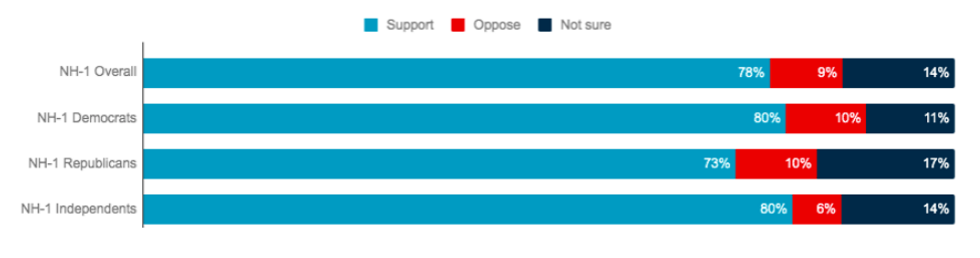
78 percent of voters in New Hampshire's 1st Congressional District, including 73 percent of Republicans, support generic competition.
83 percent of voters in South Carolina's 1st Congressional District, including 78 percent of Republicans, support generic competition.
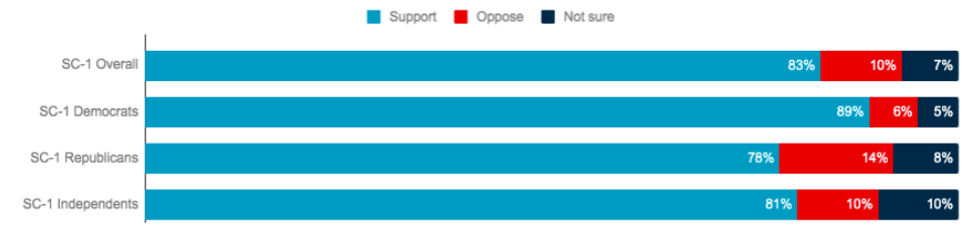
Voters across the country understand that with our tax dollars already paying for the research to develop new prescription drugs, we should be able to access lifesaving drugs at prices we can afford.
These polling numbers show that politicians of all parties have absolutely no excuse for treating big pharma with kid gloves. Anyone who cites "political concerns" or says they are "in a tough district" is making excuses. This has nothing to do with their frontline voters and everything to do with their frontline donors--pharma CEOs and shareholders.
Americans deserve to know if their elected officials are working for the voters who put them in office, or for their donors. That's why a new coalition, including Social Security Works, the Progressive Change Campaign Committee, Business Initiative for Health Policy, Center for Popular Democracy Action, and NETWORK Lobby for Catholic Social Justice are developing a new scorecard to track key votes on prescription drug pricing.
This scorecard will allow us to see which members of Congress support key legislation to lower the cost of drugs for seniors and working families--and which members of Congress are standing in the way. It will be a vital tool as we work to make prescription drugs accessible and affordable to all Americans.
In November 2020, every member of the House and one-third of the Senate will be up for reelection. Drug prices will be at the top of voters' minds, and we will make sure that they know exactly where their elected leaders stand. Those who refuse to be bold will pay the price.
This article was produced by Economy for All, a project of the Independent Media Institute.