

SUBSCRIBE TO OUR FREE NEWSLETTER
Daily news & progressive opinion—funded by the people, not the corporations—delivered straight to your inbox.
5
#000000
#FFFFFF
To donate by check, phone, or other method, see our More Ways to Give page.
Daily news & progressive opinion—funded by the people, not the corporations—delivered straight to your inbox.
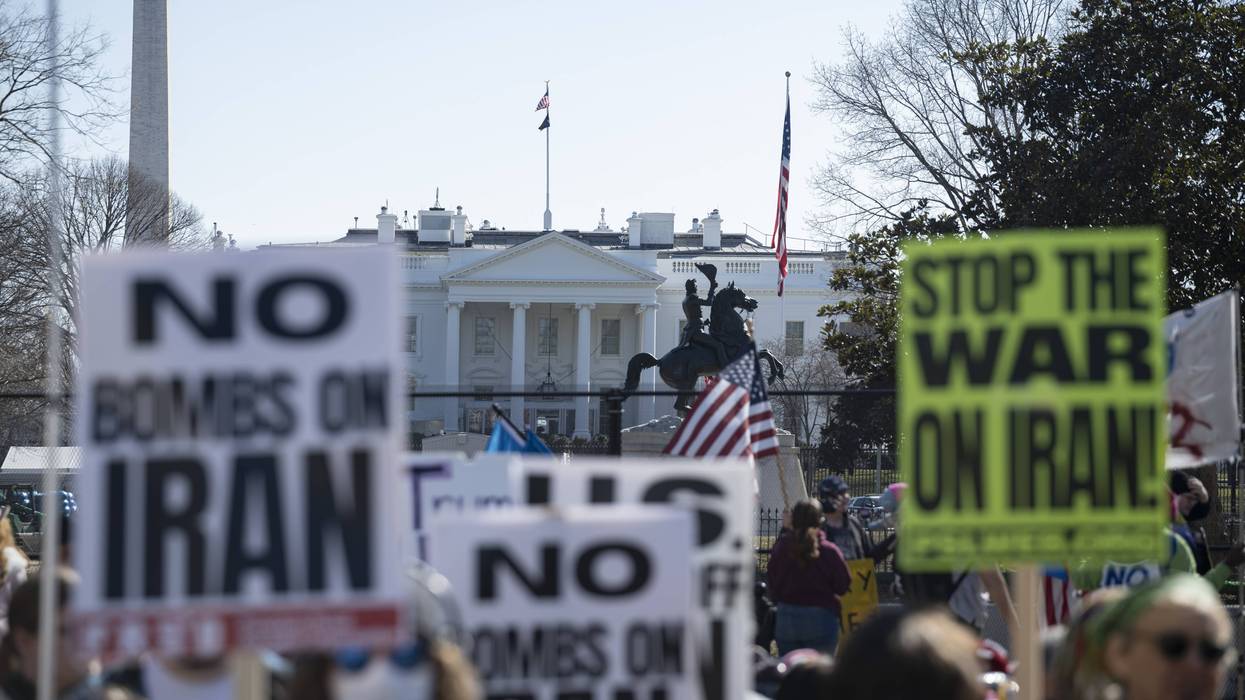
"If this goes on... this is going to become a political disaster," said one foreign policy expert.
President Donald Trump's war in Iran is extraordinarily unpopular, according to a poll conducted shortly after the US and Israel carried out massive strikes on the country Saturday.
The survey, conducted by Reuters/Ipsos, found that just 27% of voters approved of the strikes, which have killed at least 555 Iranians as of Monday morning and resulted in retaliation from Iran that has killed at least four US service members, with more casualties expected according to a spokesperson for the US Joint Chiefs of Staff.
Meanwhile, 43% of respondents disapproved of the military action, while 29% said they were not sure.
A majority of Republicans said they approved of the strikes, with 55% expressing support. Still, 13% disapproved, and a noteworthy 31% said they were unsure.
Approval is dismal with nearly everyone else. Only 19% of independents expressed support compared to 44% who disapproved. And though Democratic leaders in Congress have done little to stand in the way of the strikes, their voters are overwhelmingly against them: 74% said they disapproved, while just 7% approved.
The poll reflects a wider skepticism of US military intervention, with 56% of respondents saying the president was too quick to deploy military force in recent months, including in Venezuela, Syria, and Nigeria.
Compared with previous US military interventions in the Middle East, such as the invasions of Iraq and Afghanistan, which—at least at their outset—enjoyed broad support from the American public following intense government efforts to drum up support, there has been little effort by the Trump administration to define the purpose of war with Iran.
Trump's justification for launching the war has shifted wildly since he began amassing troops in the region. Trump has most recently said the strikes were intended to stop an "imminent threat" from Iran; meanwhile, the Pentagon has told Congress there was no sign Iran was planning an attack unless the US did so first.
The president previously said his push for war was to prevent Iran from developing a nuclear weapon, an assertion at odds with his claim that his strikes in June "obliterated" the country's nuclear capabilities.
Trita Parsi, executive vice president of the Quincy Institute for Responsible Statecraft, told Al Jazeera that Trump's shifting explanations reek of "desperation."
"It's very clear that Trump has a tremendous difficulty finding a justification for this war of choice that he's embarked on," he said. "The reality is that if this goes on for another week or two, this is going to become a political disaster."
"So now he's suddenly, desperately, using all kinds of justifications: Liberating the Iranian people, Iran is fighting against civilization," Parsi said. "If he actually had a case, he would have stuck to that point and made it clearly. But he doesn't have one."
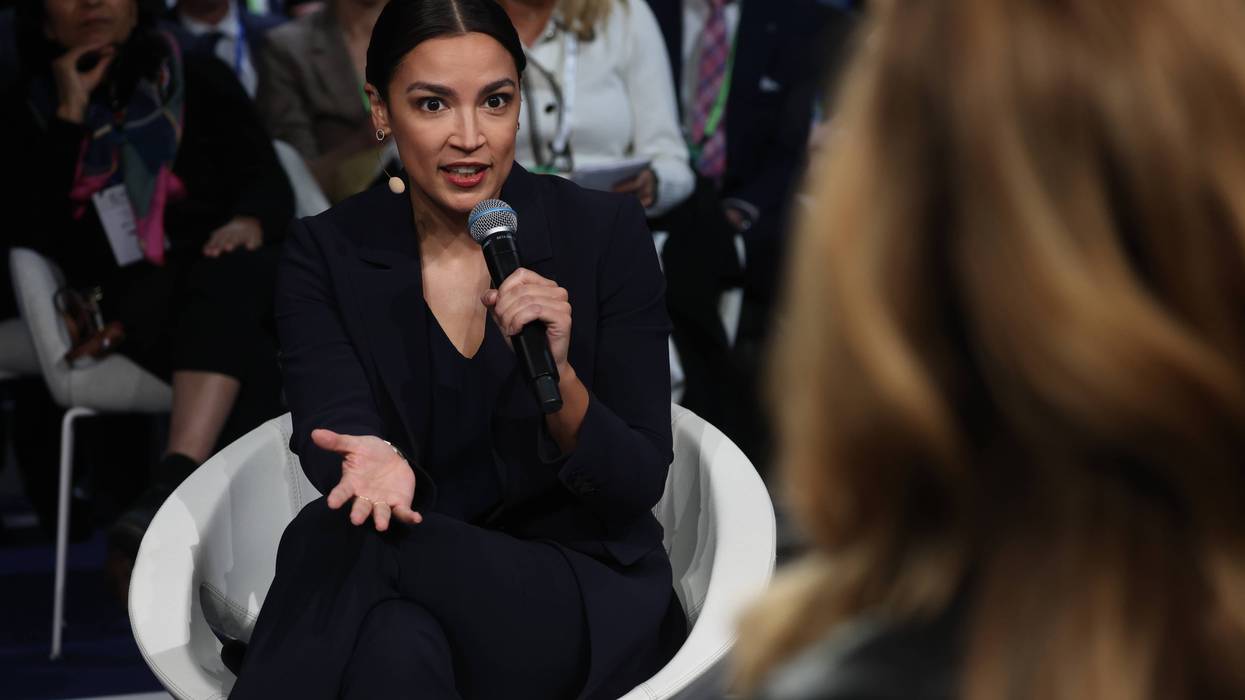
"An unmistakable majority wants a party that will fight harder against the corporations and rich people they see as responsible for keeping them down," wrote the New Republic's editorial director.
Democratic voters overwhelmingly want a leader who will fight the superrich and corporate America, and they believe Rep. Alexandria Ocasio-Cortez is the person to do it, according to a poll released this week.
While Democrats are often portrayed as squabbling and directionless, the poll conducted last month by the New Republic with Embold Research demonstrated a remarkable unity among the more than 2,400 Democratic voters it surveyed.
This was true with respect to policy: More than 9 in 10 want to raise taxes on corporations and on the wealthiest Americans, while more than three-quarters want to break up tech monopolies and believe the government should conduct stronger oversight of business.
But it was also reflected in sentiments that a more confrontational governing philosophy should prevail and general agreement that the party in its current form is not doing enough to take on its enemies.
Three-quarters said they wanted Democrats to "be more aggressive in calling out Republicans," while nearly 7 in 10 said it was appropriate to describe their party as "weak."
This appears to have translated to support for a more muscular view of government. Where the label once helped to sink Sen. Bernie Sanders' (I-Vt.) two runs for president, nearly three-quarters of Democrats now say they are either unconcerned with the label of "socialist" or view it as an asset.
Meanwhile, 46% said they want to see a "progressive" at the top of the Democratic ticket in 2028, higher than the number who said they wanted a "liberal" or a "moderate."
It's an environment that appears to be fertile ground for Ocasio-Cortez, who pitched her vision for a "working-class-centered politics" at this week's Munich summit in what many suspected was a soft-launch of her presidential candidacy in 2028.
With 85% favorability, Bronx congresswoman had the highest approval rating of any Democratic figure in the country among the voters surveyed.
It's a higher mark than either of the figures who head-to-head polls have shown to be presumptive favorites for the nomination: Former Vice President Kamala Harris and California Gov. Gavin Newsom.
Early polls show AOC lagging considerably behind these top two. However, there are signs in the New Republic's poll that may give her supporters cause for hope.
While Harris is also well-liked, 66% of Democrats surveyed said they believe she's "had her shot" at the presidency and should not run again after losing to President Donald Trump in 2024.
Newsom does not have a similar electoral history holding him back and is riding high from the passage of Proposition 50, which will allow Democrats to add potentially five more US House seats this November.
But his policy approach may prove an ill fit at a time when Democrats overwhelmingly say their party is "too timid" about taxing the rich and corporations and taking on tech oligarchs.
As labor unions in California have pushed for a popular proposal to introduce a billionaire's tax, Newsom has made himself the chiseled face of the resistance to this idea, joining with right-wing Silicon Valley barons in an aggressive campaign to kill it.
While polls can tell us little two years out about what voters will do in 2028, New Republic editorial director Emily Cooke said her magazine's survey shows an unmistakable pattern.
"It’s impossible to come away from these results without concluding that economic populism is a winning message for loyal Democrats," she wrote. "This was true across those who identify as liberals, moderates, or progressives: An unmistakable majority wants a party that will fight harder against the corporations and rich people they see as responsible for keeping them down."
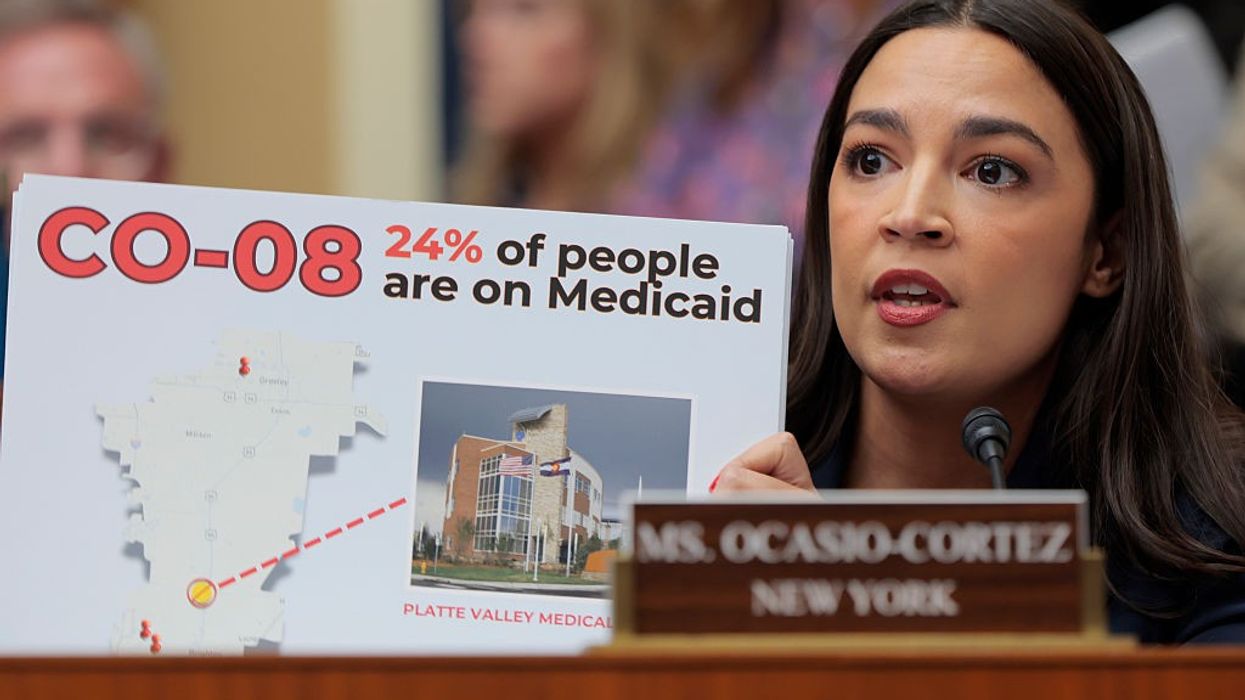
A survey this week showed the congresswoman leading the vice president 51-49 in a hypothetical presidential matchup.
Rep. Alexandria Ocasio-Cortez gave a cheeky reaction after a poll suggested that she'd slightly edge out Vice President JD Vance in a hypothetical presidential election in 2028.
The survey of over 1,500 registered voters, published Wednesday by The Argument/Verasight, showed Ocasio-Cortez (D-NY) leading Vance 51-49 and winning back several key voting demographics that propelled Trump's return to the White House last year.
As she walked out of the Capitol building Wednesday evening, the Bronx congresswoman was asked about the poll by Pablo Manríquez, the editor of Migrant Insider.
She responded to the question with a laugh: "These polls three years out, they are what they are. But, let the record show I would stomp him! I would stomp him!" she said before getting into her car.
Neither Ocasio-Cortez nor Vance has officially announced a presidential run. But Vance is considered by many to be a natural successor to President Donald Trump. The president and his allies have suggested he could run for an unconstitutional third term.
Ocasio-Cortez, meanwhile, is reportedly mulling either a presidential run or a bid to take down the increasingly unpopular Senate Minority Leader Chuck Schumer (D-NY).
More than two years out from a Democratic primary, Ocasio-Cortez is considered a likely choice to fill the progressive lane in 2028, with support for increasingly popular, affordability-focused policies, including Medicare for All.
However, despite her strong support among young voters, early polls show her behind California Gov. Gavin Newsom and former Vice President Kamala Harris for the Democratic nomination.
Wednesday's poll showed that in a hypothetical contest against Vance, Newsom had a 53% to 47% edge, a margin only slightly larger than Ocasio-Cortez's.

"Democratic politicians who continue to support sending weapons to Israel are acting in direct defiance of their own constituents' wishes," said one progressive commentator.
As its genocidal actions in Gaza become more brazen by the day, support for Israel among Americans has reached a record low.
According to a Quinnipiac University poll released Wednesday, 60% of voters across all parties now say they oppose the United States sending more military aid to Israel, while just 32% say they support it. The pollster said it was the greatest amount of opposition it has recorded for the US-Israel alliance since it first asked the question in November 2023.
Opposition is even stronger among Democratic voters: 75% of them now oppose sending military aid to Israel, compared with just 18% who still support it.
Also for the first time ever in a Quinnipiac poll, more voters, 37%, said they sympathized with the Palestinians—an all-time high—compared with just 36% who said they sympathized with the Israelis—an all-time low.
In recent months, Israeli politicians have begun moving forward with a plan to fully occupy the Gaza Strip and permanently empty it of its inhabitants, which international humanitarian organizations have described as an "ethnic cleansing."
On Wednesday, every member of the United Nations Security Council, with the exception of the United States, joined in a statement backing the Integrated Food Security Phase Classification's declaration that Israel was creating a "man-made" famine in Gaza.
Meanwhile, even Israel's leaders have found it impossible to defend its "double-tap" strike on Nasser Hospital in Khan Younis on Monday, in which the Israel Defense Forces launched a strike on the medical facility before launching another attack shortly afterward on the journalists and medical personnel who came to respond to the destruction.
That attack killed at least 20 people, adding to the potentially well over 100,000 Palestinians who experts estimate have been killed over the course of the nearly two-year military onslaught.
According to the Quinnipiac poll, 50% of Americans now agree with the international community's assessment that Israel is perpetrating a genocide in Gaza. This includes 77% of Democrats and 51% of independents.
When Democrats were polled last month by Gallup, just 8% of them said they supported Israel's military actions in the Gaza Strip, a dramatic decline from October 2023, when 36% expressed support.
In recent weeks, as the images of death and starvation coming out of Gaza have grown increasingly heinous and ubiquitous, some Democratic politicians have begun to take a harsher stance against Israel.
Last month, a majority of Democrats in the Senate, for the first time, voted in favor of resolutions introduced by Sen. Bernie Sanders (I-Vt.) to suspend US assault weapons and 1,000-pound bombs to Israel.
Twenty-seven Democrats voted for the resolution halting assault rifles, and 24 voted for the resolution to stop the sale of bombs. Notably, the top Senate Democrat, Minority Leader Chuck Schumer (D-N.Y.), voted against both resolutions.
Despite overwhelming support from their voters, the Democratic National Committee on Tuesday voted down a resolution calling for the US to suspend military aid to Israel.
"Democratic politicians who continue to support sending weapons to Israel are acting in direct defiance of their own constituents' wishes," said Nathan J. Robinson, the editor-in-chief of Current Affairs Magazine, in response to news of the latest polling numbers.
Previous polls have indicated that opposition to former President Joe Biden's arming of Israel was a primary reason why Democratic voters chose to abandon the Democratic Party in 2024, potentially costing then-Vice President Kamala Harris the election.
Rep. Rashida Tlaib (D-Mich.) said the poll showed that "Democrats continuing to ignore their base on the Palestine issue is insane," adding that if they continue down this path, "they will continue to lose."

Eighty-five percent of Americans now support "allowing immigrants, who were brought to the U.S. illegally as children, the chance to become U.S. citizens if they meet certain requirements over a period of time," according to Gallup.
Americans' support for immigration in the United States is at a record high despite the fact that American voters mere months ago elected a president who ran on enacting the largest deportation operation in the country's history.
A new poll from Gallup shows that 79% of Americans think that immigration is a good thing for the country, which is the highest number ever recorded in Gallup's 24-year history of measuring U.S. voters' attitudes on the immigration.
Furthermore, the Gallup poll shows that 85% of Americans now support "allowing immigrants, who were brought to the U.S. illegally as children, the chance to become U.S. citizens if they meet certain requirements over a period of time" and 78% support "allowing immigrants living in the U.S. illegally the chance to become U.S. citizens if they meet certain requirements over a period of time."
Support for deporting all undocumented immigrants back to their home countries, meanwhile, garners just 38% support from Americans, which is a drop of nine percentage points from the 47% of Americans who said they supported deporting all undocumented immigrants one year ago.
Voters surveyed in the poll also had decidedly negative views of U.S. President Donald Trump's handling of immigration, as just 35% approved of how he was handling the issue while 62% disapproved. The numbers get even worse for Trump when it comes to Latino voters, who were a key constituency that Trump made major gains with in the 2024 presidential election.
"At 21%, Hispanic Americans' approval of Trump’s handling of immigration is 14 points below the national average," writes Gallup. "With respect to immigration levels, Hispanic adults are slightly more likely than U.S. adults overall to say immigration should be decreased (39% vs. 30%, respectively) as well as to consider immigration a bad thing (25% vs. 17%), but the majority in both cases still express pro-immigration views."
The low support for Trump's immigration policies in the Gallup poll is notable because polls in the past have consistently shown that it's his strongest issue among American voters.
Aggregated polling data compiled by data analyst G. Elliott Morris have consistently shown that Trump has higher approval on immigration than on other major issues, although that support has also fallen over the last several months. Back in February, Trump's net approval on handling immigration was +10.8 percentage points, whereas today his net approval on the issue stands at -3.2 percentage points.
The new data on immigration comes as the Trump administration has been launching high-profile raids of workplaces suspected of employing undocumented immigrants, including a Thursday afternoon raid of a farm in Camarillo, California that drew significant local protest.
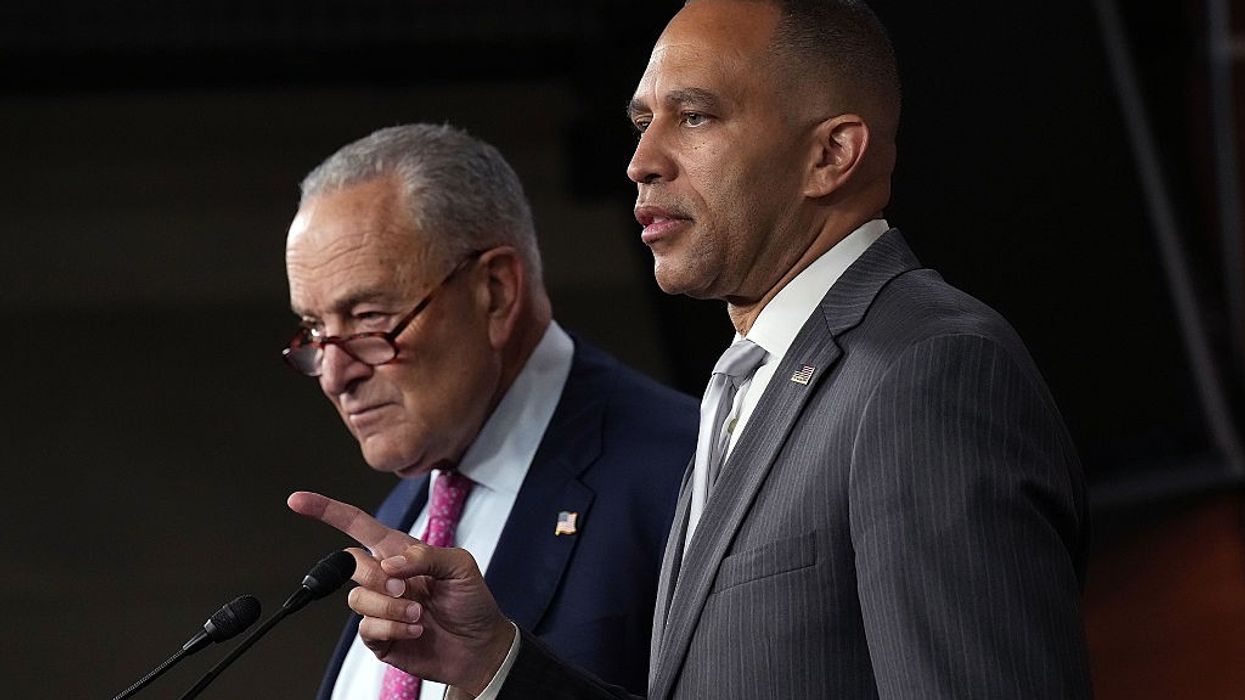
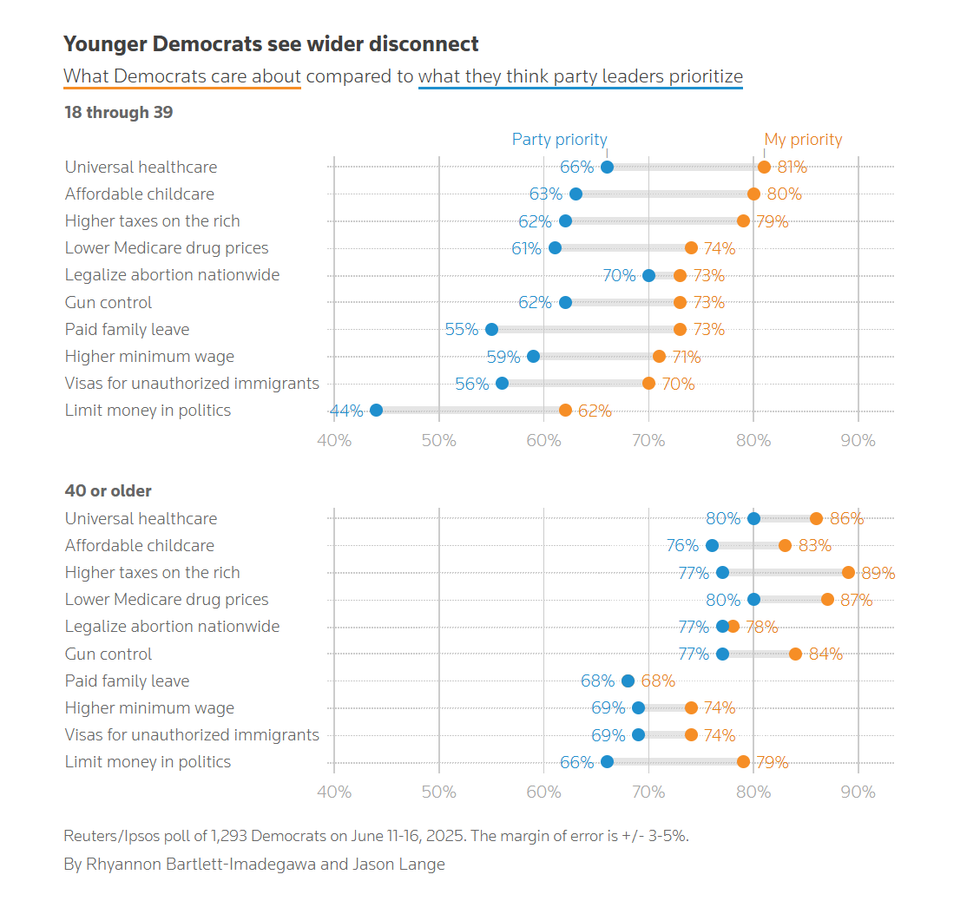
Voters described universal healthcare, affordable childcare, and higher taxes on the rich as top priorities in a new Reuters/Ipsos poll. But they were less likely to believe that party leaders shared those priorities.
Democratic voters want new leadership that will prioritize their day-to-day needs and do more to challenge corporate power, according to a poll published Thursday.
Sixty-two percent of the nearly 1,300 self-identified Democrats who responded to the new Reuters/Ipsos poll agreed with the statement that "the leadership of the Democratic Party should be replaced with new people," while just 24% wanted to keep the old guard around.
The new data delivers another blow to party leaders such as Senate Minority Leader Chuck Schumer (D-N.Y.) and House Minority Leader Hakeem Jeffries (D-N.Y.), who have faced growing scrutiny for failing to effectively oppose President Donald Trump in the eyes of their constituents.
The poll, conducted from June 11-16, revealed stark gaps between the agenda Democratic voters would like to see prioritized and what they perceive as party leadership's priorities. Voters overwhelmingly support populist economic policies, according to the data, but doubt that party leaders share those goals—with young voters especially skeptical.
 (Graphic: Reuters/Ipsos)
Across all age groups, more than three-quarters of voters described universal healthcare, affordable childcare, and higher taxes on the rich as top priorities. But voters were less likely to believe that party leaders did as well.
Voters between ages 18 to 39 especially had a grim view of leadership. While 81% said they wanted universal healthcare, just 66% said they thought party leadership did too. On limiting money in politics, 62% said it was a priority, compared with just 44% who thought leadership felt the same.
Democrats over 40 were even more inclined to believe in top progressive agenda items. Although they perceived less of a divide between their views and those of party leaders, a significant gap remained.
Following Kamala Harris' defeat in the 2024 election, many corporate-friendly pundits embraced the narrative that voters perceived the Democratic policy agenda as too far left. But the Reuters/Ipsos poll suggests the opposite.
As Sharon Zhang wrote for Truthout, "The majority of federally elected Democrats actually oppose proposals like Medicare for All, and many party leaders have actively worked to sabotage support for such ideas," including Schumer, who declined to support Sen. Bernie Sanders' Medicare for All bill this year.
"Far from taxing the rich," she added, "party leaders have also cozied up to billionaires." Tech giants including Google, Microsoft, Amazon, and Apple all donated millions of dollars to the Harris campaign.
Ben Tulchin, a pollster for Bernie Sanders' 2016 and 2020 presidential campaigns, told Reuters that Democratic Party had "room for improvement" on showing Americans that they "are the ones standing up for working people."
"It needs to transform itself into a party that everyday people can get excited about," Tulchin said. "That requires a changing of the guard."

A new survey suggests presenting voters with the former president’s dictatorial rhetoric could help Democrats win in November.
Former president Donald Trump has made a slew of authoritarian statements since he launched his campaign for a second White House term at the end of 2022, but a new poll suggests most voters are unaware of many of the concerning things he's said.
Trump has said he intends to be a dictator on "day one," claimed that immigrants are "poisoning the blood of our country," called his political opponents "vermin," and more. A poll obtained by The New Republic, which was done by veteran Democratic pollster Geoff Garin for the group Save My Country, finds a lot of people are not familiar with these statements.
"The poll asked them about ten of Trump's most authoritarian statements... Trump's claim that immigrants are 'poisoning the blood of our country'; his vow to pardon rioters who attacked the Capitol; his promise to prosecute the Biden family without cause; his threat to inflict mass persecution on the 'vermin' opposition, and a few more," writes Greg Sargent of The New Republic.
"Result? 'Only 31% of respondents said they previously had heard a lot about these statements by Trump,' the memo accompanying the poll concluded," he adds.
This is maddening: New polling conducted by Dems finds that an alarmingly small percentage of voters surveyed are familiar with Trump's most blatant authoritarian threats, such as his "dictator" quote.
This is bad. But it's also an opportunity. 1/
Link:https://t.co/tjIecbzP7G
— Greg Sargent (@GregTSargent) March 5, 2024
The poll was conducted in three swing states—Arizona, Michigan, and Pennsylvania—and the pollster spoke with 400 voters in each state. The pollster chose not to include anyone who "voted for Trump in 2020 and also said Biden didn't legitimately win." Those are likely voters who would never get behind Biden.
Once respondents were made aware of Trump's authoritarian statements, they viewed him more negatively. This shows that Democrats may have to educate voters on what Trump's been saying about his intentions if they want to win in November.
"For instance, after hearing them, the percentage who see him as 'out for revenge' jumped by five points, the percentage who see him as 'dangerous' rose by nine points, and the percentage who see him as a 'dictator' climbed by seven points," Sargent writes.
President Joe Biden is currently behind Trump in recent national polls, and he wants the election to be about preserving democracy, so informing voters of how Trump's statements represent a threat to democracy may benefit him. Based on Garin's poll, voters seemingly have not been made aware of what Trump has been saying through the media.
Planned Parenthood is fighting back. The embattled women's healthcare provider on Tuesday filed a lawsuit, arguing that Louisiana's Republican Governor Bobby Jindal acted illegally by blocking Medicaid funding to the group.
Though the suit marks the first legal action taken by Planned Parenthood against the most recent GOP-led effort to defund the abortion provider, it will likely not be the last. "Planned Parenthood is also eyeing the Republican governors in Arkansas and Alabama who have taken similar steps to eliminate its Medicaid funding," The Hill reported Tuesday.
During a press conference on Tuesday announcing the lawsuit, Cecile Richards, president of Planned Parenthood Federation of America, lambasted the group's partisan attackers.
"This political grandstanding could have real and devastating consequences for the women, men, and young people who rely on us," she said. "And that's why we're going to fight this with everything we've got."
Launched by the organization's Gulf Coast chapter and three patients against the Louisiana Department of Health and Hospitals, the lawsuit is requesting a federal court to issue a temporary restraining order to block Jindal's order. Otherwise, Medicaid funds would be blocked from going to Planned Parenthood starting Sept. 2.
Other efforts to stymie the essential healthcare provider are also stumbling. Five states that launched investigations into Planned Parenthood's operations--responding to calls from Republicans and anti-choice groups after the controversial release of deceptively edited, undercover videos--reportedly found no wrong-doing. Ten other states have announced they have no intention of investigating the group.
"Planned Parenthood follows all laws and has very high medical standards, and that's what all of these investigations are finding," the group's executive vice president, Dawn Laguens, said in a statement released Friday. "All of this stems from totally false claims made by anti-abortion extremists who are pursuing a political agenda that is far outside the mainstream."
According to a poll published last week, 54 percent of Americans support federal funding for the group.