SUBSCRIBE TO OUR FREE NEWSLETTER
Daily news & progressive opinion—funded by the people, not the corporations—delivered straight to your inbox.
5
#000000
#FFFFFF
To donate by check, phone, or other method, see our More Ways to Give page.
Daily news & progressive opinion—funded by the people, not the corporations—delivered straight to your inbox.
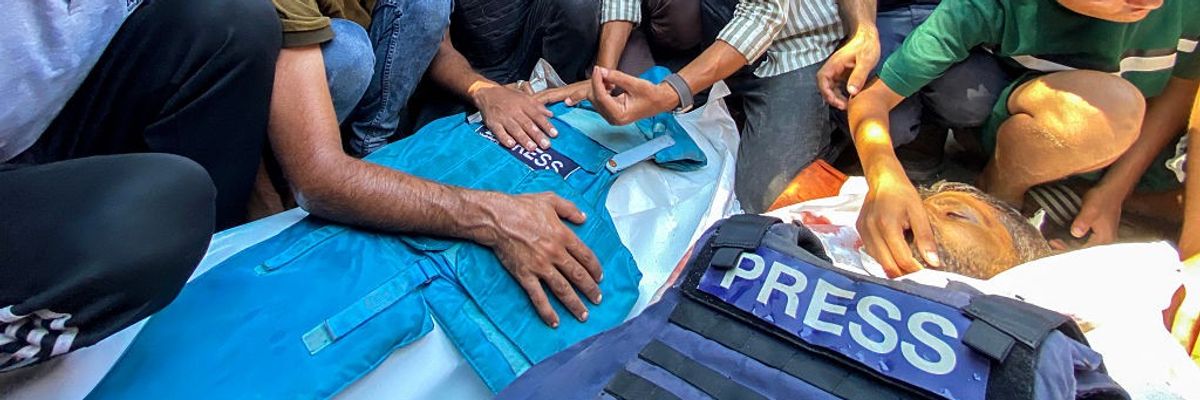
People mourn over the bodies of Palestinian journalists who were killed in an Israeli strike on Nasser hospital in the southern Gaza Strip, on August 25, 2025.
"Israel's broadcasted killing of journalists in Gaza continues while the world watches and fails to act firmly on the most horrific attacks the press has ever faced in recent history," said one press freedom advocate.
Israel is drawing harsh criticism after it launched a pair of strikes at Nasser Hospital in southern Gaza on Monday that left at least 20 people dead, including journalists and healthcare workers.
As reported by CNN, Israel launched "back-to-back strikes on the Nasser Hospital in Khan Younis" that were "separated by only a matter of minutes." The second strike killed some emergency crew members who had rushed to the scene in the wake of the first strike.
The strikes drew immediate condemnation from press freedom groups who accused Israel of intentionally attacking reporters in Gaza and dismissed claims by Israeli Prime Minister Benjamin Netanyahu that the strikes were a "tragic mishap."
Thibaut Bruttin, the director general of Reporters Without Borders, said Israel attacked the journalists in an attempt to prevent them from delivering news about the famine in Gaza.
"How far will the Israeli armed forces go in their gradual effort to eliminate information coming from Gaza?" he asked. "How long will they continue to defy international humanitarian law? The protection of journalists is guaranteed by international law, yet more than 200 of them have been killed by Israeli forces in Gaza over the past two years."
He then called upon the United Nations Security Council to set an emergency meeting to enact "concrete measures... to end impunity for crimes against journalists, protect Palestinian journalists, and open access to the Gaza Strip to all reporters."
Sara Qudah, regional director at the Committee to Protect Journalists, called out the international community for letting Israel get away with launching military strikes against reporters.
"Israel's broadcasted killing of journalists in Gaza continues while the world watches and fails to act firmly on the most horrific attacks the press has ever faced in recent history," she said. "These murders must end now. The perpetrators must no longer be allowed to act with impunity."
The United Nations Relief and Works Agency for Palestine Refugees in the Near East (UNRWA) accused Israel of "silencing the last remaining voices reporting about children dying silently amid famine" in Gaza, while charging the international community with reacting with "indifference and inaction."
"This cannot be our future new norm," said UNRWA. "Compassion must prevail. Let us undo this man-made famine by opening the gates without restrictions [and] protecting journalists, humanitarian and health workers. Time for political will. Not tomorrow, now."
Former New York Times public editor Margaret Sullivan said that her fellow journalists needed to hold the Israeli government to account for its actions.
"Journalists everywhere need to stand in solidarity on this killing spree and resulting news blackout," she wrote on Bluesky.
And Drop Site News' Ryan Grim ripped into Netanyahu's claim that his government "deeply regrets the tragic mishap" that occurred at the hospital.
"Israel deeply regrets the tragic mishap of striking a hospital and then waiting 17 minutes until rescue workers gathered and striking it again," Grim commented sarcastically on X.
Israel has previously claimed that attacks on so-called "safe zones" and on aid workers were mistakes.
Dear Common Dreams reader, It’s been nearly 30 years since I co-founded Common Dreams with my late wife, Lina Newhouser. We had the radical notion that journalism should serve the public good, not corporate profits. It was clear to us from the outset what it would take to build such a project. No paid advertisements. No corporate sponsors. No millionaire publisher telling us what to think or do. Many people said we wouldn't last a year, but we proved those doubters wrong. Together with a tremendous team of journalists and dedicated staff, we built an independent media outlet free from the constraints of profits and corporate control. Our mission has always been simple: To inform. To inspire. To ignite change for the common good. Building Common Dreams was not easy. Our survival was never guaranteed. When you take on the most powerful forces—Wall Street greed, fossil fuel industry destruction, Big Tech lobbyists, and uber-rich oligarchs who have spent billions upon billions rigging the economy and democracy in their favor—the only bulwark you have is supporters who believe in your work. But here’s the urgent message from me today. It's never been this bad out there. And it's never been this hard to keep us going. At the very moment Common Dreams is most needed, the threats we face are intensifying. We need your support now more than ever. We don't accept corporate advertising and never will. We don't have a paywall because we don't think people should be blocked from critical news based on their ability to pay. Everything we do is funded by the donations of readers like you. When everyone does the little they can afford, we are strong. But if that support retreats or dries up, so do we. Will you donate now to make sure Common Dreams not only survives but thrives? —Craig Brown, Co-founder |
Israel is drawing harsh criticism after it launched a pair of strikes at Nasser Hospital in southern Gaza on Monday that left at least 20 people dead, including journalists and healthcare workers.
As reported by CNN, Israel launched "back-to-back strikes on the Nasser Hospital in Khan Younis" that were "separated by only a matter of minutes." The second strike killed some emergency crew members who had rushed to the scene in the wake of the first strike.
The strikes drew immediate condemnation from press freedom groups who accused Israel of intentionally attacking reporters in Gaza and dismissed claims by Israeli Prime Minister Benjamin Netanyahu that the strikes were a "tragic mishap."
Thibaut Bruttin, the director general of Reporters Without Borders, said Israel attacked the journalists in an attempt to prevent them from delivering news about the famine in Gaza.
"How far will the Israeli armed forces go in their gradual effort to eliminate information coming from Gaza?" he asked. "How long will they continue to defy international humanitarian law? The protection of journalists is guaranteed by international law, yet more than 200 of them have been killed by Israeli forces in Gaza over the past two years."
He then called upon the United Nations Security Council to set an emergency meeting to enact "concrete measures... to end impunity for crimes against journalists, protect Palestinian journalists, and open access to the Gaza Strip to all reporters."
Sara Qudah, regional director at the Committee to Protect Journalists, called out the international community for letting Israel get away with launching military strikes against reporters.
"Israel's broadcasted killing of journalists in Gaza continues while the world watches and fails to act firmly on the most horrific attacks the press has ever faced in recent history," she said. "These murders must end now. The perpetrators must no longer be allowed to act with impunity."
The United Nations Relief and Works Agency for Palestine Refugees in the Near East (UNRWA) accused Israel of "silencing the last remaining voices reporting about children dying silently amid famine" in Gaza, while charging the international community with reacting with "indifference and inaction."
"This cannot be our future new norm," said UNRWA. "Compassion must prevail. Let us undo this man-made famine by opening the gates without restrictions [and] protecting journalists, humanitarian and health workers. Time for political will. Not tomorrow, now."
Former New York Times public editor Margaret Sullivan said that her fellow journalists needed to hold the Israeli government to account for its actions.
"Journalists everywhere need to stand in solidarity on this killing spree and resulting news blackout," she wrote on Bluesky.
And Drop Site News' Ryan Grim ripped into Netanyahu's claim that his government "deeply regrets the tragic mishap" that occurred at the hospital.
"Israel deeply regrets the tragic mishap of striking a hospital and then waiting 17 minutes until rescue workers gathered and striking it again," Grim commented sarcastically on X.
Israel has previously claimed that attacks on so-called "safe zones" and on aid workers were mistakes.
Israel is drawing harsh criticism after it launched a pair of strikes at Nasser Hospital in southern Gaza on Monday that left at least 20 people dead, including journalists and healthcare workers.
As reported by CNN, Israel launched "back-to-back strikes on the Nasser Hospital in Khan Younis" that were "separated by only a matter of minutes." The second strike killed some emergency crew members who had rushed to the scene in the wake of the first strike.
The strikes drew immediate condemnation from press freedom groups who accused Israel of intentionally attacking reporters in Gaza and dismissed claims by Israeli Prime Minister Benjamin Netanyahu that the strikes were a "tragic mishap."
Thibaut Bruttin, the director general of Reporters Without Borders, said Israel attacked the journalists in an attempt to prevent them from delivering news about the famine in Gaza.
"How far will the Israeli armed forces go in their gradual effort to eliminate information coming from Gaza?" he asked. "How long will they continue to defy international humanitarian law? The protection of journalists is guaranteed by international law, yet more than 200 of them have been killed by Israeli forces in Gaza over the past two years."
He then called upon the United Nations Security Council to set an emergency meeting to enact "concrete measures... to end impunity for crimes against journalists, protect Palestinian journalists, and open access to the Gaza Strip to all reporters."
Sara Qudah, regional director at the Committee to Protect Journalists, called out the international community for letting Israel get away with launching military strikes against reporters.
"Israel's broadcasted killing of journalists in Gaza continues while the world watches and fails to act firmly on the most horrific attacks the press has ever faced in recent history," she said. "These murders must end now. The perpetrators must no longer be allowed to act with impunity."
The United Nations Relief and Works Agency for Palestine Refugees in the Near East (UNRWA) accused Israel of "silencing the last remaining voices reporting about children dying silently amid famine" in Gaza, while charging the international community with reacting with "indifference and inaction."
"This cannot be our future new norm," said UNRWA. "Compassion must prevail. Let us undo this man-made famine by opening the gates without restrictions [and] protecting journalists, humanitarian and health workers. Time for political will. Not tomorrow, now."
Former New York Times public editor Margaret Sullivan said that her fellow journalists needed to hold the Israeli government to account for its actions.
"Journalists everywhere need to stand in solidarity on this killing spree and resulting news blackout," she wrote on Bluesky.
And Drop Site News' Ryan Grim ripped into Netanyahu's claim that his government "deeply regrets the tragic mishap" that occurred at the hospital.
"Israel deeply regrets the tragic mishap of striking a hospital and then waiting 17 minutes until rescue workers gathered and striking it again," Grim commented sarcastically on X.
Israel has previously claimed that attacks on so-called "safe zones" and on aid workers were mistakes.