SUBSCRIBE TO OUR FREE NEWSLETTER
Daily news & progressive opinion—funded by the people, not the corporations—delivered straight to your inbox.
5
#000000
#FFFFFF
To donate by check, phone, or other method, see our More Ways to Give page.



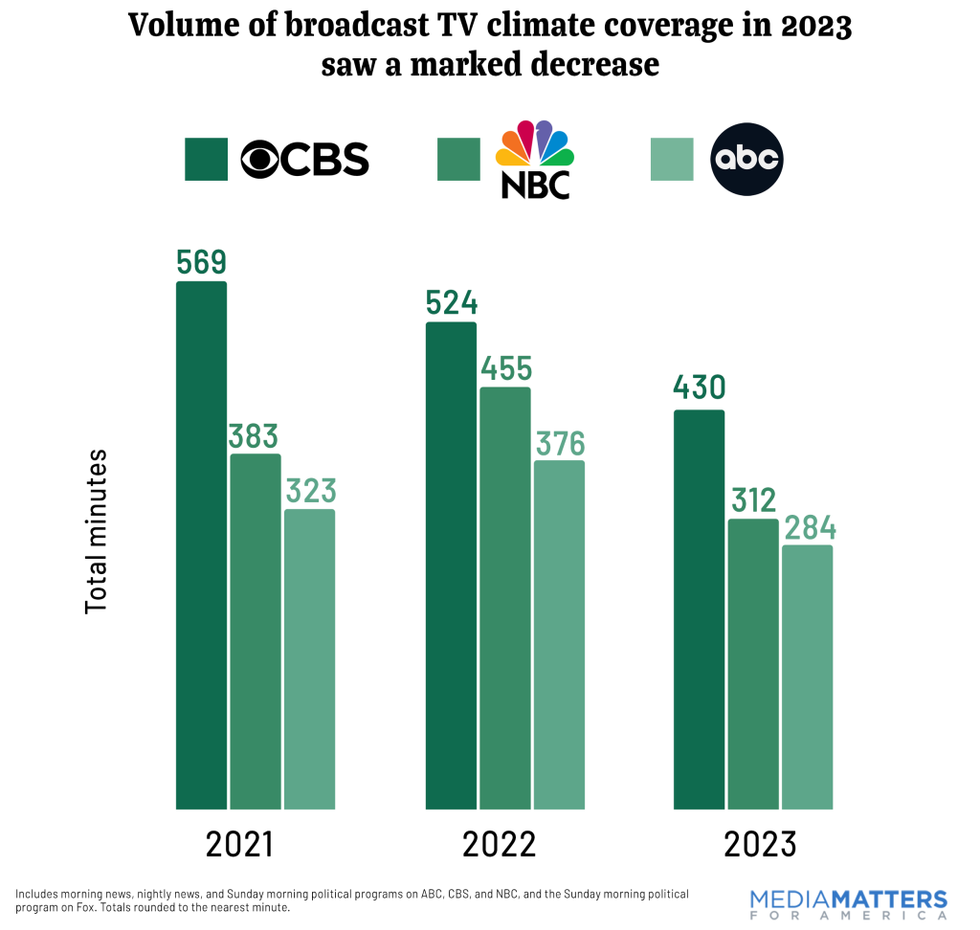
That amounts to less than 1% of all corporate broadcast coverage aired last year, notes the analysis authored by Media Matters senior writer Evlondo Cooper with contributions from Allison Fisher, director of the group's climate and energy program.
"Last year's extreme climate events further illustrated the need for consistent, substantive, and wide-ranging news coverage about all facets of climate change."
They wrote that "discussion of extreme weather events aired during 37% of coverage, or 160 out of 435 segments. June through September saw the most severe extreme weather events and accounted for just over 54% of total coverage."
"Only 12% of climate segments on corporate broadcast news, or 52 out of 435, mentioned 'fossil fuels,'" the pair pointed out. "This is a slight increase from 2022, when 'fossil fuels' were mentioned in only 8% of climate segments."
"Solutions or actions that may be taken in response to climate change were mentioned in 22% of climate segments," they highlighted. That ended an upward trend: 29% in 2020, 31% in 2021, and 35% in 2022.
Cooper and Fisher also noted that climate scientists made up 10% of featured guests, compared with just 4% in 2022; "white men dominated the demographics of guests featured in climate segments" for the seventh year straight; and discussions of climate justice appeared in only 5% of coverage, up from 3% the previous year.
Looking at only the "Big Three" of the television world—ABC, CBS, and NBC—they found that climate coverage dropped 23% for morning news programs and 36% for nightly shows. CBS aired 42% of all climate coverage while ABC had the least of the trio and NBC had the biggest decrease from 2022.
For the review of Sunday morning political shows, the researchers included Fox. They found that in 102 combined minutes of airtime across 26 segments, CBS again led the pack—it was the only network that increased coverage, from 20 minutes in 2022 to 66 minutes, or over half the total, in 2023.
The analysis recognizes a "significant decline" in coverage of the Biden administration's efforts to combat the climate emergency, explaining:
This reduction in corporate broadcast news attention occurred during a critical period for climate policy implementation, particularly of the Inflation Reduction Act, which continued to drive positive outcomes in the clean energy market, and new regulations announced during COP28 to curb methane emissions. Despite these significant actions, corporate broadcast networks' focus on the administration's climate initiatives was limited.
COP28, the United Nations' annual climate summit near the end of the year, also received "very limited" coverage from the networks, the report says. The conference—which scientists called "a tragedy for the planet" because its final agreement didn't demand a global fossil fuel phaseout—was mentioned in just 14 segments, accounting for 3% of climate coverage.
As Common Dreams has reported, the National Oceanic and Atmospheric Administration found that in addition to being the hottest year on record, 2023 also had 28 U.S. disasters that caused at least $1 billion in damage, which collectively cost at least $92.9 billion.
"Last year's extreme climate events further illustrated the need for consistent, substantive, and wide-ranging news coverage about all facets of climate change," Cooper and Fisher wrote. "Effective reporting should incorporate a wide range of voices during coverage of extreme weather events, major climate studies, and policy decisions; when applicable, coverage should expose systemic issues that contribute to disproportionate climate impacts; and climate coverage must consistently report not only the impacts of climate change but the drivers of global warming and the solutions that move us away from fossil fuel dependence."
In a social media post promoting the new analysis, Cooper concluded that "we need more climate journalism, not less."

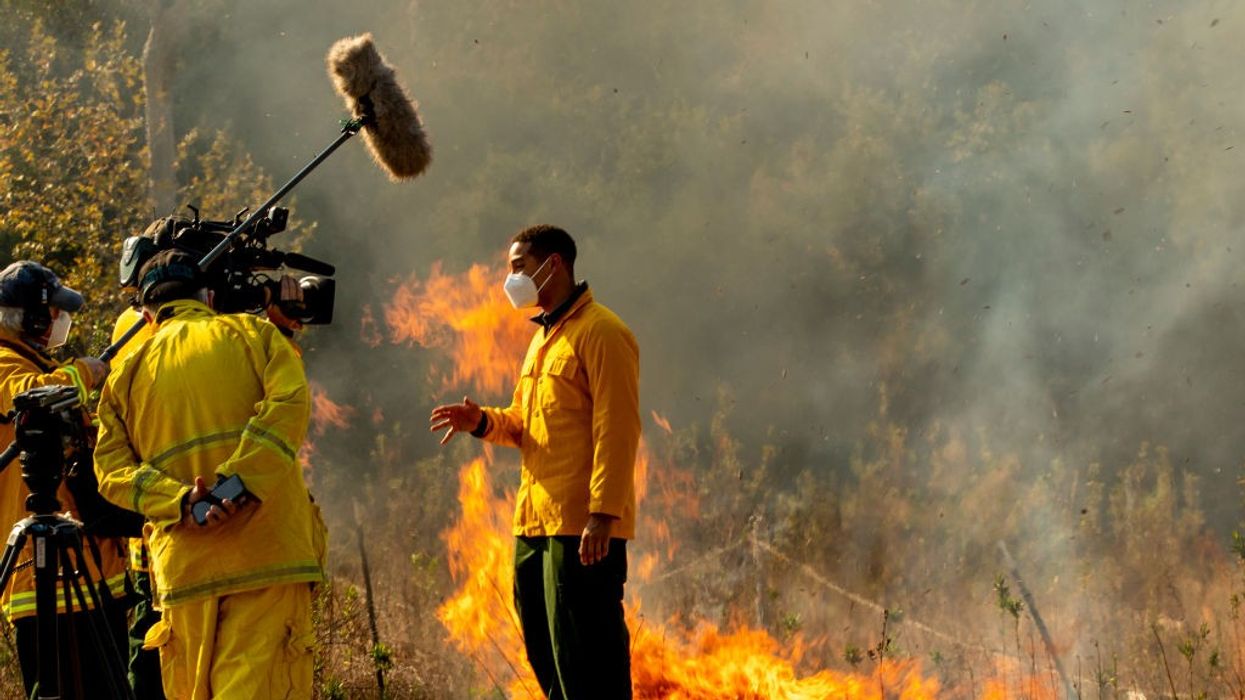
With a sepia hue and the smell of a campfire engulfing the East Coast, the immediate effects of human-caused climate change seemed as concrete as they had ever been.
Short-term exposure to fine particulate matter in wildfire smoke can cause nose, throat, and lung irritation, as well as worsening underlying conditions like asthma and heart disease. Over months or years, this exposure can increase chances of chronic bronchitis, as well as hospital admissions and deaths due to conditions like lung cancer and heart disease. In Delhi, India, which typically has the worst air quality in the world, pollution takes an average of nine years off residents’ life expectancy (Democracy Now!, 6/8/23).
With a sepia hue and the smell of a campfire engulfing the East Coast, the immediate effects of human-caused climate change seemed as concrete as they had ever been. But on U.S. TV news, viewers were more likely to hear climate denial than reporting that made the essential connection between fossil fuel consumption and worsening wildfires—if they heard mention of climate change at all.
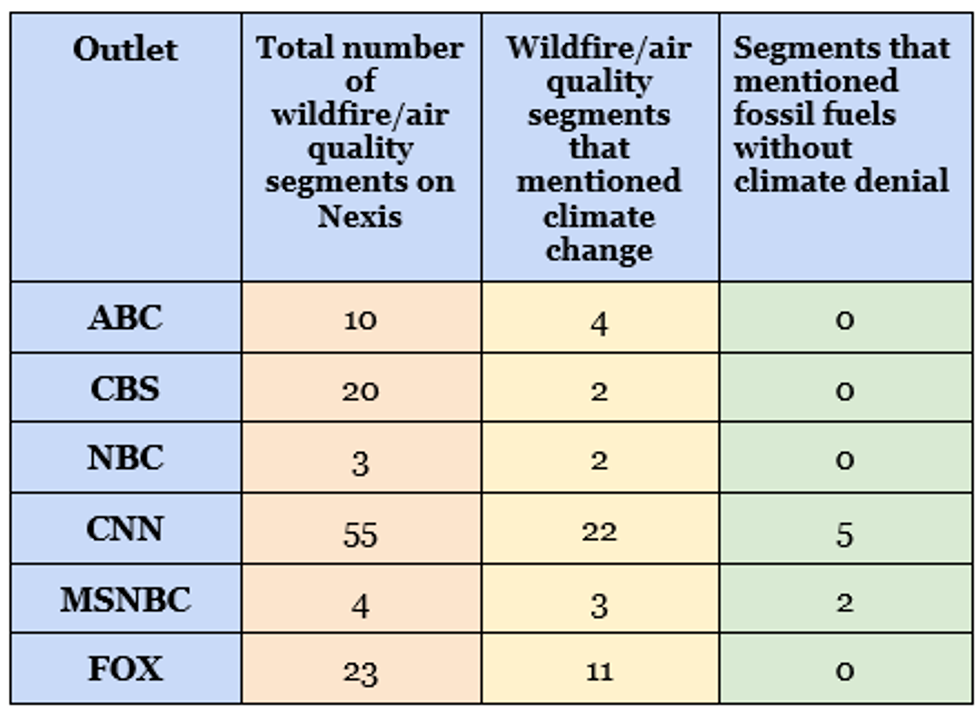
Searching the Nexis news database for transcripts from June 5–9 on ABC, CBS, NBC, CNN, Fox, and MSNBC, FAIR found 115 news segments that mentioned the forest fires and their effect on air quality. Of those 115 segments, only 44 (38%) mentioned climate change’s role.
(FAIR defined a “segment” as any portion of a news show that discussed the wildfire pollution. Brief top-of-show or pre-commercial mentions that previewed segments airing later in the show were counted as part of the segments they referred to. When shows included more than one segment covering wildfire pollution, each was counted separately.)
Outlets varied widely in attention to the wildfire pollution issue: The broadcast outlets ranged from 20 segments at CBS to 10 at ABC and three at NBC. Among cable outlets, CNN had 55 segments, Fox had 23, and MSNBC four. (Note: Nexis relies on outlets to submit content, and submission policies vary among outlets.)
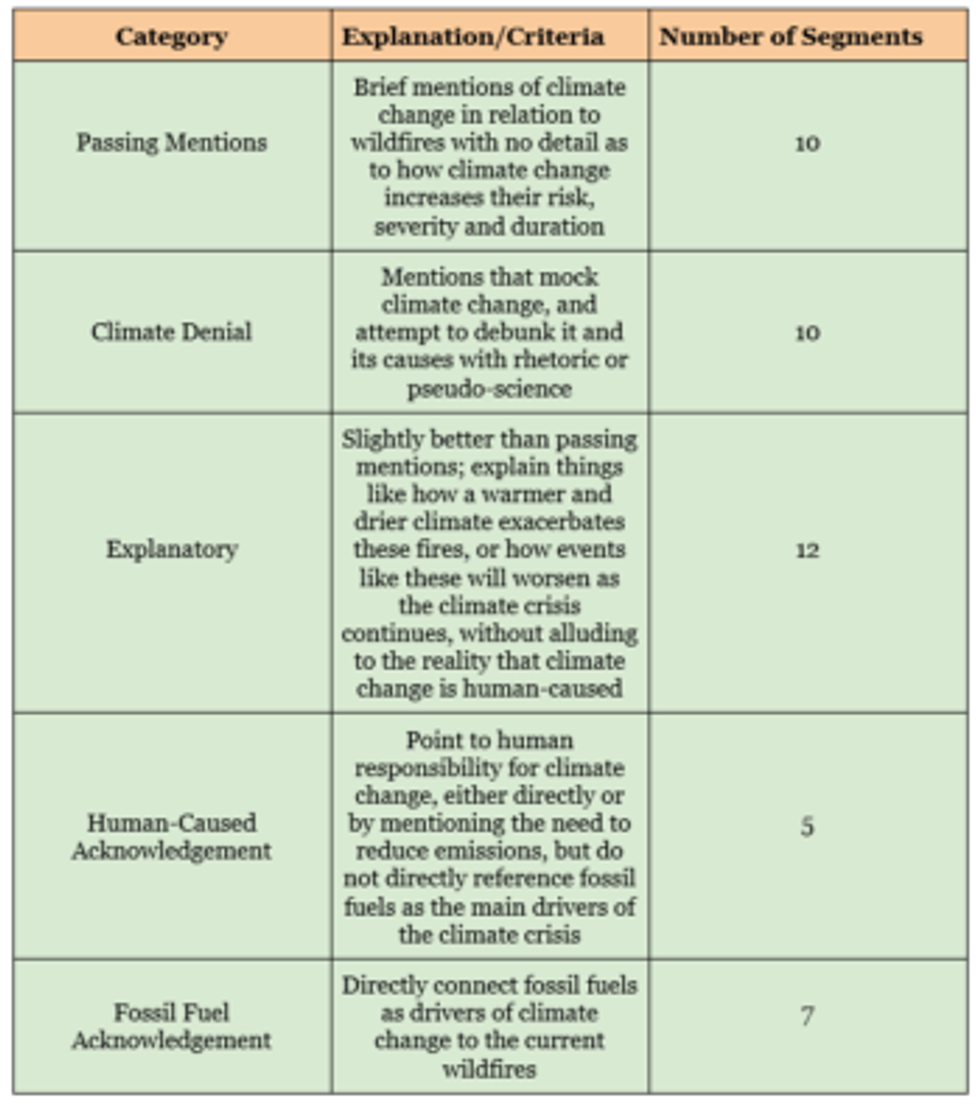
Only seven wildfire pollution segments (6% of all 115 segments) named or even alluded to fossil fuels—by far the largest contributor to climate change—in a way that did not engage in climate denial.
At MSNBC, it was mentioned in three out of four segments (75%), and in two out of three segments (67%) on NBC. Climate change was mentioned in 48% of segments at Fox, 40% at ABC and CNN, and 10% at CBS.
Even when outlets mentioned climate change, the detail and usefulness of the information varied greatly.
Only seven wildfire pollution segments (6% of all 115 segments) named or even alluded to fossil fuels—by far the largest contributor to climate change—in a way that did not engage in climate denial. By disconnecting climate change causes and consequences, media outlets shield the fossil fuel industry and the politicians who aid and abet them from accountability, and avoid discussions about urgently needed action.
Of the 44 segments that mentioned climate change in relation to wildfire pollution, 10 did so only in passing, with no detail as to how, exactly, climate change increases the risk, severity, and duration of such fires.
For instance, CNN Tonight (6/6/23) referred to the air quality in New York City as a “climate crisis,” but went no further into discussing how the broader climate crisis is exacerbating events like these.
CNN’s Poppy Harlow (This Morning, 6/8/23) remarked on how “important it is that we focus on climate change and all that is happening,” but said nothing else to direct the audience’s focus in that direction.
Though a passing mention is better than no mention at all, tossing in the term “climate change” does very little to help audiences understand how climate disruption exacerbates events like these, or to explain the human causes of the climate crisis.
ABC also had two passing mentions, as when World News Tonight (6/7/23) aired a soundbite from White House press secretary Karine Jean-Pierre describing the smoke as “yet another alarming example of the ways in which the climate crisis is disturbing our lives and our communities.” Then the segment ended.
Though a passing mention is better than no mention at all, tossing in the term “climate change” does very little to help audiences understand how climate disruption exacerbates events like these, or to explain the human causes of the climate crisis. This silence deprives viewers of any conversation about potential climate solutions or mitigations, leaving them only with confusion and fear.
Ten segments in the study period engaged in outright climate change denial, either mocking or attempting to debunk climate change with pseudo-science. These segments were less helpful than not mentioning climate change at all, actively discouraging people from taking action to ameliorate the climate catastrophe.
CNN aired an interview with Mike Pence (CNN Live Event, 6/7/23), who claimed climate change isn’t happening “as dramatically as the radical environmentalists like to present,” and that the solution is “expanding American energy and natural gas.” He faced no pushback for his scientifically illiterate response.
But Fox led in climate disinformation, with nine denialist segments. Jesse Watters (6/7/23) offered a typical example:
A liberal in Canada goes camping, starts a forest fire, smokes out America, and they tell us to pay Elon Musk. But, is manmade global warming causing Canadian forest fires? Why don’t you open a history book, and you’ll learn about New England’s Dark Day. It happened in 1780, long before the Industrial Revolution. Dark clouds stretched from Maine to New Jersey, blotting out the sun…. That dark cloud in 1780 was from Canadian wildfires, 240 years ago. Can’t blame that on climate change. Everybody was riding horses.
And you might be surprised to find out, over the last 100 years, there have been less wildfires, not more. The Wall Street Journal says in the early 1900s, about 4% of land worldwide burned every year. By 2021, that was down to 2.5%. So, instead of obsessing over climate change, they should take a look at forest management and making sure Canadian campers listen to Smokey the Bear.
The Wall Street Journal op-ed (10/27/21) Watters cited is by a climate denialist, and misleadingly only takes into account the metric of land burned, ignoring factors like the severity and frequency of more recent fires, and the likelihood of land burned trending back upward (WWF International, 2020). The World Resources Institute (8/17/22) found that forest fires burned nearly twice as much tree coverage globally in 2021 than they did in 2001.
Blaming fires solely on poor forest management despite clear links to climate change was a common tactic at Fox (The Five, 6/7/23; see Media Matters, 6/9/23). Laura Ingraham (Ingraham Angle, 6/9/23) argued that because forest fires are “so normal that Canada’s government website has a page… devoted to educating the public about them,” that concern over these out-of-control fires is “hysteria.”
In reality, Canada is having its worst-ever wildfire season (Bloomberg, 6/7/23). In early June, more than 200 wildfires burned across Canada, accompanied in some areas by record heat. More than half were out of control (Washington Post, 6/3/23).
If only centrist corporate outlets were as committed to offering climate crisis context as Fox is to promoting climate change denial.
Earlier in the week (6/7/23), Ingraham’s guest, Steve Milloy of the conservative, climate-denying Energy and Environment Legal Institute, claimed that “there’s no health risk” from wildfire smoke (not true), and that there are no public health emergencies in countries like India and China due to their low air quality. (Also a lie—air pollution was responsible for nearly 18% of deaths in India in 2019, and causes an estimated 2 million deaths in China per year.) He argued that wildfire smoke is “natural” and “not because of climate change.”
Fox also applied its typical red-scare tactics, saying climate concern is “about socialism” (Hannity, 6/7/23), and that “the climate crazies are trying to use a Canadian forest fire as yet another excuse to take your freedom, take your power and take your money” (Ingraham Angle, 6/7/23).
Meanwhile, Fox misled viewers that mainstream media coverage of the fires was rife with discussions about the climate crisis. On The Five (6/7/23), Greg Gutfeld complained: “So, already, the media is blaming climate change. ABC is connecting it to climate change. USA Today asked if the fires were actually caused by climate change.”
If only centrist corporate outlets were as committed to offering climate crisis context as Fox is to promoting climate change denial.
Twelve other segments that mentioned climate change offered slightly better than a passing mention, explaining things like how a warmer and drier climate exacerbates these fires, or how events like these will worsen as the climate crisis continues. But these segments did not allude to the reality that climate change is caused by people.
Some of these segments included the sparest of explanations, as when ABC’s Rob Marciano (World News Tonight, 6/7/23) briefly mentioned “climate change with the extra warmth” amplifying the fires, and potentially contributing to weather systems that kept the smoke hanging over the northeastern U.S.
Three mentions (The Lead, 6/8/23; Situation Room, 6/8/23; CNN Newsroom, 6/9/23) were of the same brief soundbite, from Daniel Westervelt, anti-pollution adviser to the U.S.. State Department, warning, “With increasing climate change and increasing warming, we can expect more and more of these kind of wildfires to continue.”
CNN climate correspondent Bill Weir (Erin Burnett Outfront, 6/7/23) offered perhaps the most thorough explanation of how the climate crisis worsens wildfires, demonstrating the connection to the melting ice in the Arctic:
The Arctic, the northern top of the planet, has been warming up four times faster than the rest of the planet. When I do those reports, I can almost hear the viewers’ eyes glazing over. Like, what do I care about what happens in the Arctic?
This is directly related to that. There was a heat anomaly in May over Canada, looked like a giant red blob of paint where they had temperatures in the high 90s, way sooner than is normal, that dries things out, one lightning strike sets that off like a tinderbox. And that’s why there’s over 100 fires burning in central Quebec.
And then the weather patterns connect us. Now, we’re breathing the results of a climate in crisis.
Weir went on to briefly mention the “cost of doing nothing”; however, he was referring entirely to the economic impact of people not being able to leave their homes on poor air quality days. While he thoroughly explained the connection between a warming planet and devastating wildfires, he did not elaborate on the human causes—nor the human solutions—to the climate crisis.
Five of the 44 segments that mentioned climate change did point to human responsibility for climate change, either directly or by mentioning the need to reduce emissions. But these segments did not reference fossil fuels, which are the main way humans are changing the climate and the major source of greenhouse gas emissions.
Thus Fox (Special Report, 6/7/23) aired a soundbite of New York City Mayor Eric Adams saying, “We must continue to draw down emissions,” without remarking on Adams’ comment.
On CNN Newsroom (6/9/23), climate scientist Zeke Hausefather said briefly, “I hope it will serve as a wake-up call that we need to cut emissions and reduce the impacts of this going forward.”
The fossil fuel distinction is important, especially because the industry has spent billions to confuse the public on its environmental impact.
Other segments that described or alluded to the climate crisis as human-caused without mentioning fossil fuels included CNN‘s Lead (6/7/23), MSNBC‘s All In (6/7/23) and CNN This Morning (6/8/23).
The fossil fuel distinction is important, especially because the industry has spent billions to confuse the public on its environmental impact. In the early 2000s, a PR firm for BP coined the term “carbon footprint,” diverting the blame of the climate crisis onto individual citizens and away from these greedy corporations. We can sip our iced coffee out of paper straws all we want, but unless the world’s economies immediately and drastically cut fossil fuels, the planet is headed to far exceed the 1.5°C rise scientists have warned about (Amnesty International, 3/20/23).
All of the segments that took the crucial next step of connecting the wildfires to fossil fuel emissions—seven in all—appeared on cable news networks.
On MSNBC’s The Reidout (6/7/23), host Joy Reid called out the world’s “unrelenting dependence on oil,” warning that
we will suffer the consequences, as the planet we live on and that our children and grandchildren will inherit becomes even more dangerous to live in.
Environmentalist Bill McKibben appeared on CNN Newsroom (6/8/23) to link the poor quality of New York’s air to the dire situations facing people across the world as a result of fossil fuel–driven pollution:
It’s terrible in New York right now, and we shouldn’t make light of it. But it’s precisely how most people across much of the world live every single day. That’s why nine million people a year—one death in five on this planet—comes from the effects of breathing fossil fuel combustion.
Beyond fear-mongering, McKibbon offered a solution:
The good news is we have an easy fix. We now live on a planet where the cheapest way to produce power is to point a sheet of glass at the sun. We should be in an all-out effort to move to renewable energy and to save energy so we don’t have to use as much of it.
In another segment that day, CNN Newsroom (6/8/23) discussed the American Lung Association’s report that stated 90,000 lives would be saved if the U.S. could electrify its vehicle fleet by 2050. “That doesn’t account for the prevalence of wildfire smoke now more common on a planet heated up by fossil fuels,” CNN chief climate correspondent Weir reported.
This data was mentioned in two other CNN segments (Anderson Cooper 360 Degrees, 6/7/23; CNN Newsroom, 6/8/23).
Elsewhere, Weir (This Morning, 6/8/23) attributed India’s poor air quality to coal burning, unchecked motor regulations, and the burning of agricultural fields.
And on his MSNBC show (Alex Wagner Tonight, 6/7/23), Alex Wagner called out Republican efforts to defend a household source of fossil fuel emissions even as the wildfires demonstrated the dire effects of unchecked climate disruption:
House Republicans had an agenda item on the topic of air quality, but it had nothing to do with combating climate change. They were taking a vote on protecting gas stoves.
When the best mainstream TV news outlets have to offer during an environmental and public health crisis is seven mentions of the key cause that needs to be urgently addressed, there’s little for the public to gain.
In a recent segment on Democracy Now! (6/30/23), Genevieve Guenther, author and director of End Climate Silence, emphasized the importance of these connections, advocating for all reporters to be educated on the climate crisis, regardless of the beat they cover. “You need to connect the dots from what you’re reporting to the climate crisis, and then through the climate crisis to the use of fossil fuels that is heating up our planet,” she said.
It is necessary to go beyond cursory headlines to name what is responsible, not to further fear and complicity, but because doing so allows us to offer solutions. We live in a time where, despite Big Oil’s tireless efforts to confuse the public, renewable energy is cheaper—and by many measures, more efficient—than fossil fuels (ASAP Science, 9/9/20).
A 2022 study shows that news framing that centers credible responses to climate problems were associated with confidence in one’s ability to make changes and more support for collective action (Environmental Communication, 11/11/22). If apocalyptic air enveloping major news headquarters hundreds of miles away from record-setting fires doesn’t prompt these necessary conversations, what will?