
SUBSCRIBE TO OUR FREE NEWSLETTER
Daily news & progressive opinion—funded by the people, not the corporations—delivered straight to your inbox.
5
#000000
#FFFFFF
To donate by check, phone, or other method, see our More Ways to Give page.


Daily news & progressive opinion—funded by the people, not the corporations—delivered straight to your inbox.
"As costs soar from Trump’s illegal war with Iran, any attempt by big corporations to jack up prices is unacceptable," said Rep. Jan Schakowsky.
Democratic lawmakers are warning corporate America to not use President Donald Trump's unconstitutional war with Iran as an excuse to jack up prices on US consumers.
US Sens. Elizabeth Warren (D-Mass.), Richard Blumenthal (D-Conn.), and Ed Markey (D-Mass.), along with Reps. Jan Schakowsky (D-Ill.) and Chris Deluzio (D-Pa.), sent a letter on Tuesday to the Federal Trade Commission demanding that it investigate and prosecute any unlawful price gouging by corporations during Trump's war, which has raised the cost of oil, gasoline, fertilizer, and other essential goods.
While the Democrats acknowledged that Trump's war created "broad supply chain disruptions and widespread uncertainty in the global economy," they warned that "big corporations may capitalize on this uncertainty to hike prices more than is warranted by actual input cost increases, price gouging everyday Americans while enriching executives and padding investors’ pockets."
The lawmakers accused big corporations in recent years of using assorted crises—including the global Covid-19 pandemic, the 2022 Russian invasion of Ukraine, and Trump's massive "Liberation Day" tariffs on foreign goods—to justify hiking prices beyond what could be warranted by input increases caused by external shocks.
The lawmakers also touted the Price Gouging Prevention Act that they introduced in July 2025 that would expand the authority of the FTC and state attorneys general to stop sellers from charging a "grossly excessive price, regardless of where the price gouging occurs in a supply chain or distribution network."
The proposed bill would also require public companies to "clearly disclose costs and pricing strategies" used to justify any price increases during periods of economic disruption.
In a social media post, Schakowsky said that "as costs soar from Trump’s illegal war with Iran, any attempt by big corporations to jack up prices is unacceptable," emphasizing that "we must crack down on price gouging and protect consumers."
The call to stop price gouging comes as concerns are mounting about the major economic damage that Trump's Iran war could produce.
Larry Fink, CEO of hedge fund BlackRock, predicted during an interview with BBC on Wednesday that there would be a "stark and steep recession" throughout the world if the war dragged on and the price of oil hit $150 per barrel, which he said would raise costs on products everywhere.
"Rising energy prices are a very regressive tax," Fink said. "It affects the poor more than the wealthy, because it's a larger component of their pocketbook."
CNBC reported on Wednesday that forecasters have been increasing their odds of a recession in the US economy this year, as the Iran war puts a strain on oil prices at a time when job growth in the country has already ground to a halt.
"Moody’s Analytics’ model has raised its recession outlook for the next 12 months to 48.6%," wrote CNBC. "Goldman Sachs boosted its estimate to 30%. Wilmington Trust has the odds at 45%, while EY Parthenon has it at 40%, with the caveat that 'those odds could rapidly rise in the event of a more prolonged or severe Middle East conflict.'"
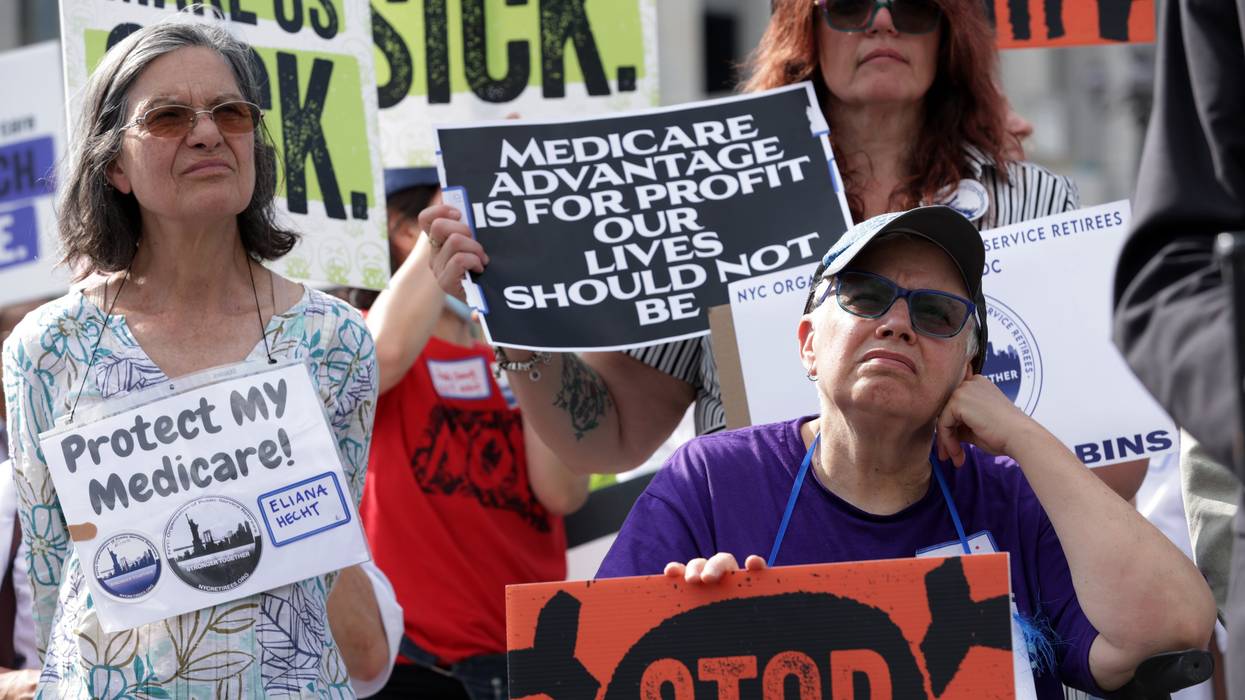
"We don't allow banks to call themselves the U.S. Treasury Investment Fund," said Rep. Mark Pocan. "We don't allow anyone to call themselves USPS Plus. So why allow insurance companies to call private insurance Medicare Advantage?"
A group of Democratic lawmakers on Wednesday reintroduced legislation aimed at reining in for-profit insurance companies who use the Medicare name to market their plans.
The "Save Medicare Act," being reintroduced by US Reps. Mark Pocan (D-Wis.), Ro Khanna (D-Calif.), and Jan Schakowsky (D-Ill.), bars private insurers from using the word "Medicare" in marketing their plans, imposing "significant fines" for any insurer that doesn't comply.
At issue, the lawmakers said, is that insurers are flooding the airwaves with ads for Medicare Advantage plans during open enrollment periods. The ads are deceiving Americans into thinking their plans are just variations of Medicare services offered by the federal government, they said.
"Let’s be clear: Medicare Advantage is not Medicare," said Schakowsky. "These private insurance plans use Medicare’s trusted name while too often denying medically necessary care, restricting providers, and overcharging taxpayers by billions. That is unacceptable. We have seen insurers exploit the system to boost profits at the expense of seniors."
Khanna noted that Medicare Advantage is "a private insurance program that too often boosts profits by limiting coverage," even as it "misleads seniors into thinking it's traditional Medicare."
"That's wrong," Khanna emphasized. "This legislation will stop private insurers from cashing in on the Medicare name. We should be working to protect and expand real Medicare instead."
Pocan declared that "only Medicare is Medicare," adding that Medicare Advantage plans "often leave patients without the benefits they need while overcharging the federal government for corporate profit."
"This bill makes clear what is—and what is not—Medicare," added Pocan, "and ensures this essential program will continue to serve seniors and other Americans for generations to come."
Pocan also posted a video on social media where he talked about his elderly mother being unable to see the physician that came to her assisted living home because she relied on Medicare Advantage and the doctor in question was out of network.
"She would have had to go all the way across town to get that care," Pocan explained. "The problem is, she wasn't very mobile and she never got the medical care."
We don't allow banks to call themselves the U.S. Treasury Investment Fund. We don't allow anyone to call themselves USPS Plus.
So why allow insurance companies to call private insurance Medicare Advantage?
I’m reintroducing the Save Medicare Act with @RepRoKhanna and… pic.twitter.com/c6dAXpEJqY
— Rep. Mark Pocan (@RepMarkPocan) March 4, 2026
"We don't allow banks to call themselves the U.S. Treasury Investment Fund," said Pocan. "We don't allow anyone to call themselves USPS Plus. So why allow insurance companies to call private insurance Medicare Advantage?"
Many progressive critics have for years pointed to Medicare Advantage as a legitimate example of wasteful spending by the federal government.
A report released in January by the Medicare Payment Advisory Commission (MedPAC), an independent congressional agency that advises lawmakers on Medicare, estimated that overpayments to Medicare Advantage plans could total $76 billion in 2026.
One major factor in the overpayments is that patients using Medicare Advantage plans tend to be healthier than patients on traditional Medicare, with the result being that private insurers charge the government more than is necessary to meet these patients' needs.
On Wednesday, Schakowsky said that the "crucial legislation" she joined Khanna and Pocan in introducing "will end deceptive marketing and ensure beneficiaries understand the difference between traditional Medicare and private insurance plans."
"Seniors deserve transparency, accountability, and the full benefits they have earned," she said.
Kat Abughazaleh said that her campaign had raised $200,000 in its first 24 hours because "people believe in our 'far-left' ideas like Existence Shouldn't Be So Difficult."
Progressive influencer Kat Abughazaleh on Monday launched a bid to run for Illinois' safely blue 9th Congressional District, a seat that is currently held by Democratic Rep. Jan Schakowsky.
U.S. President Donald Trump and his billionaire adviser Elon Musk "are dismantling our country piece by piece, and so many Democrats seem content to just sit back and let them, so I say it's time to drop the excuses and grow a fucking spine," Abughazaleh said in her campaign launch video.
Schakowsky, who is 80 and has held the seat since 1998, "has had a pretty great track record on her voting," Abughazaleh told Rolling Stone. "She's been a good congresswoman, but I want to be better."
A reporter with the local paper Evanston Now posted a statement from Schakowsky responding to Abughazaleh's campaign. "I have always encouraged more participation in the democratic process, and I'm glad to see new faces getting involved as we stand up against the Trump administration," Schakowsky wrote. Schakowsky has not said officially whether she plans on running for reelection, according to the reporter.
On Tuesday, Abughazaleh announced that her campaign had raised $200,000 in its first 24 hours because "people believe in our 'far-left' ideas like Existence Shouldn't Be So Difficult."
In her campaign launch video, Abughazaleh also foregrounded economic concerns, saying there's "no reason" Americans shouldn't be able to afford housing, groceries, and healthcare.
Abughazaleh, a 26-year-old, who was raised a Republican, previously worked for the left-leaning media monitoring organization Media Matters for America. In 2024, she and 11 other employees were laid off after Musk sued the organization.
Abughazaleh has risen to prominence on TikTok, amassing over 220,000 followers, by posting videos about the right-wing—for example, a multipart series on the white Christian nationalism and commentary on Fox News' coverage. She also covered the 2024 Democratic National Convention as a social media influencer.
Rolling Stone also noted that Abughazaleh is "a wildly successful, incisive communicator who is stepping up at a time when it is clear that the party is in desperate need of new messengers."
Her announcement comes as Democrats in Congress have gotten an earful at town halls, with many constituents showing up to demand Democrats do more to counter U.S. President Donald Trump and Elon Musk.
Illinois' 9th Congressional District includes parts of Chicago, Evanston, and Glenview. Abughazaleh moved to the Chicago area in July, according to Politico.
A 17-year-old plaintiff commended the federal lawmakers for "using their voices to weigh in on the importance of our rights to access justice and to a livable climate."
Dozens of members of Congress on Monday submitted an amicus brief to the U.S. Supreme Court supporting 21 youth plaintiffs who launched a historic constitutional climate case against the federal government nearly a decade ago.
Since Juliana v. United States was first filed in the District of Oregon in August 2015, the Obama, Trump, and Biden administrations have fought against it. Last May, a panel of three judges appointed to the 9th Circuit Court of Appeals by President-elect Donald Trump granted a request by President Joe Biden's Department of Justice to dismiss the case.
After the U.S. Supreme Court in November denied the youth plaintiffs' initial request for intervention regarding the panel's decision, their attorneys filed a different type of petition last month. As Our Children's Trust, which represents the 21 young people, explains on its website, they argued to the justices that federal courts are empowered by the U.S. Constitution and the Declaratory Judgment Act (DJA) "to resolve active disputes between citizens and their government when citizens are being personally injured by government policies, even if the relief is limited to a declaration of individual rights and government wrongs."
The Monday filing from seven U.S. senators and 36 members of the House of Representatives argues to the nation's top court that "the 9th Circuit's dismissal of the petitioners' constitutional suit for declaratory relief has no basis in law and threatens to undermine the Declaratory Judgment Act, one of the most consequential remedial statutes that Congress has ever enacted."
The Supreme Court "should grant the petition to clarify that declaratory relief under the DJA satisfies the Article III redressability requirement," wrote the federal lawmakers, led by Sen. Jeff Merkley (D-Ore.) and Rep. Jan Schakowsky (D-Ill.). "Doing so is necessary because Congress expressly authorized declaratory relief 'whether or not further relief is or could be sought.'"
"The 9th Circuit's jurisdictional holding, which prevented the district court from even reaching the question whether declaratory relief would be appropriate, conflicts with this court's holding that the DJA is constitutional," the lawmakers continued. "It also conflicts with this court's holding that Article III courts may not limit DJA relief to cases where an injunction would be appropriate."
In a Monday statement, Juliana's youngest plaintiff, 17-year-old Levi D., welcomed the support from the 43 members of Congress—including Sens. Ed Markey (D-Mass.) and Bernie Sanders (I-Vt.) as well as Reps. Pramila Jayapal (D-Wash.), Ro Khanna (D-Calif.), Alexandria Ocasio-Cortez (D-N.Y.), Ilhan Omar (D-Minn.), Jamie Raskin (D-Md.), and Rashida Tlaib (D-Mich.).
"After 10 years of delay, I have spent more than half of my life as a plaintiff fighting for my fundamental rights to a safe climate. Yet, the courthouse doors are still closed to us," said Levi. "Five years ago, members of Congress stood by me and my co-plaintiffs on the steps of the Supreme Court. Today, as the climate crisis worsens and hurricanes ravage my home state of Florida, they are still with us, using their voices to weigh in on the importance of our rights to access justice and to a livable climate."
"The recent win in Held v. State of Montana and historic settlement in Navahine v. Hawaii Department of Transportation showed the world that young people's voices, my voice, and legal action are not just symbolic, but they hold governments accountable to protect our constitutional rights," Levi added. "Now, it's our turn to be heard!"
The lawmakers weren't alone in formally supporting the young climate advocates on Monday. Public Justice and the Montana Trial Lawyers Association filed another brief that takes aim at the government's use of mandamus—a court order directing a lower entity to perform official duties—to deny the Juliana youth a trial.
"The government's sole argument to justify mandamus is the Department of Justice's past and anticipated future litigation expenses associated with going to trial. That argument is firmly foreclosed by precedent," the groups argued. "And even if it wasn't foreclosed by precedent, the argument trivializes the extraordinary nature of mandamus and would improperly circumvent the final judgment rule."
The organizations urged the high court to grant certiorari to uphold the mandamus standard set out in Cheney v. United States District Court for the District of Columbia in 2004. Plaintiff Miko V. said Monday that "I'm incredibly grateful to Public Justice and the Montana Trial Lawyers Association for standing with us in our fight for justice."
"We're not asking for special treatment; we're demanding the right to access justice, as our constitutional democracy guarantees," Miko stressed. "The recent victory in Held v. State of Montana demonstrates the power of youth-led legal action, and the urgent need for courts to recognize that our generation has the right to hold our government accountable. Every day that the government prevents us from presenting our case, we all lose more ground in the fight for a livable future. It's time for the judiciary to open the courthouse doors and allow us a fair trial."
The briefs came just a week before Big Oil-backed Trump's second inauguration and on the same day that the U.S. Supreme Court rejected attempts by fossil fuel giants to quash a Hawaiian municipality's lawsuit that aims to hold the climate polluters accountable, in line with justices' previous decisions. Dozens of U.S. state and local governments have filed similar suits.
"American workers should not be paying more in federal income taxes, in a given year, than profitable companies like Target, Amazon, and T-Mobile," said the senator.
U.S. Sen. Bernie Sanders and Congresswoman Jan Schakowsky on Wednesday introduced a bill that aims to close tax loopholes for corporations, end tax breaks for businesses that move jobs abroad, and stop companies from hiding profits in tax havens.
"At a time of massive wealth and income inequality and soaring corporate profits, it is an outrage that many large, profitable corporations continue to pay little to nothing in federal income taxes," Sanders (I-Vt.) said in a statement. "As working people struggle to pay rent and put food on the table, we have a corrupt and rigged tax code that is designed to benefit the wealthy and the powerful at the expense of working families."
"Meanwhile, Republicans would make a bad situation even worse by providing even more tax breaks to their corporate campaign contributors and the billionaire class while proposing massive cuts to Social Security, Medicare, and Medicaid," he noted, nodding to GOP budget plans for fiscal year 2025, which begins in October.
"That is unacceptable. We need to create an economy and a government that works for all of us, not just the top 1%," Sanders asserted. "And, one of the ways we can begin to do that is by making sure that large corporations pay their fair share of taxes. American workers should not be paying more in federal income taxes, in a given year, than profitable companies like Target, Amazon, and T-Mobile."
"We need to create an economy and a government that works for all of us, not just the top 1%."
The Corporate Tax Dodging Prevention Act, unveiled as Americans prepare for the federal income tax deadline on Monday, could raise over $1 trillion in revenue over a decade with the tax haven provision alone, according to the Joint Committee on Taxation.
"Thanks to President Joe Biden, we are growing the economy from the bottom up and the middle out, but we must go even further by passing the Corporate Tax Dodging Prevention Act to help put the interests of everyday Americans ahead of billionaires and transnational corporations," said Schakowsky. "I thank Sen. Sanders for devoting his career to tackling income inequality and am proud to partner with him on this important measure."
Biden's budget blueprint for the next fiscal year, released last month, includes proposals to hike taxes for corporations and ultrarich individuals—whose wealth is soaring to record heights. Such policies are not expected to pass the divided Congress, but they serve as a clear statement of the Democratic president's position just months away from the November election.
When then-President Donald Trump—now the presumptive Republican nominee to face Biden—signed the Tax Cuts and Jobs Act in December 2017, he infamously declared that "corporations are literally going wild over this, I think even beyond my expectations."
Many of that law's cuts are set to expire at the end of next year. During an exclusive Florida fundraiser at the home of a billionaire investor over the weekend, the former president urged his supporters to help him "turn our country around" by taking steps including "extending the Trump tax cuts."
"In the richest country in the history of the world, a secure and dignified retirement should be available to every American, not just the extremely wealthy."
A report published Wednesday by the U.S. Senate committee chaired by Independent Vermont Sen. Bernie Sanders exposed "the depth of the retirement crisis in America" while exploring "solutions that will allow all of our people to retire with dignity and security—not just the very wealthy."
The report—entitled A Secure Retirement for All—was released ahead of a Wednesday morning Senate Committee on Health, Education, Labor, and Pensions (HELP) hearing on the retirement crisis. The publication revealed that nearly half of Americans age 55 and older have no retirement savings. It also found that half of Americans age 65 and older are living on less than $30,000 per year, while 1 in people are fighting to survive on less than $15,000 annually.
Other key findings include:
"Given the enormous growth of the economy over the past several decades, one might expect that the outlook for retirees is improving," the report states. "Yet, today nearly half of all Americans are at risk of a financially insecure retirement."
"For many, retiring on Social Security alone means that some months you can afford to either keep the lights on or get your prescription refilled," the publication adds. "The cost of healthcare in retirement is an enormous cost driver, for which many find themselves unprepared."
The report offers two main solutions to the retirement crisis: expanding and strengthening Social Security—"the most successful government program in our nation's history"—and enacting "Retirement Security for All" legislation that ensures every worker can save for retirement via their paychecks and guarantees lifetime monthly payments.
Last year, Sanders—along with Sen. Elizabeth Warren (D-Mass.) and Reps. Jan Schakowsky (D-Ill.) and Val Hoyle (D-Ore.)—introduced the Social Security Expansion Act, which would increase monthly benefits by at least $200 and extend the program's solvency for decades by lifting the cap on the maximum amount of income subject to the Social Security payroll tax.
The Social Security Administration's chief actuary said that had the bill been signed into law last year, the program would be able to pay full benefits to every eligible American for 75 years, without any tax increase for 93% of U.S. workers earning less than $250,000 per year.
"In the richest country in the history of the world, a secure and dignified retirement should be available to every American, not just the extremely wealthy," Sanders said on Wednesday. "Right now, more than half of older Americans have no retirement savings. More than 50% of our nation’s seniors are trying to survive on an income of less than $30,000 a year. That is absurd. Congress must address the retirement crisis facing working-class Americans across our country."
"We cannot allow House Republicans to ram through their closed-door commission that is designed to fast-track cuts to the benefits hardworking Americans rely on," asserted Rep. Bill Pascrell Jr.
Decrying Republican plans for "ripping away Social Security from seniors behind closed doors" via a so-called fiscal commission, more than half of U.S. House Democrats on Thursday urged congressional leaders to scrap plans to fast-track the controversial panel.
Fiscal commission legislation being considered by the House Budget Committee "would create a process in which legislating would be done by a small group of individuals behind closed doors" to pass a law "that cuts benefits and calls for an up-or-down vote without hearings, and that is unamendable," 116 House Democrats led by Reps. John Larson (D-Conn.) and Jan Schakowsky (D-Ill.) wrote in a letter to House Speaker Mike Johnson (R-La.) and Minority Leader Hakeem Jeffries (D-N.Y.).
The lawmakers continued:
There is no shortage of legislation that will improve the fiscal standing of the United States while directly benefiting the public. Democratic proposals include legislation that would extend Social Security's solvency for another generation while expanding benefits the American people rely on—benefits that haven't been expanded in more than 50 years. It is Congress' responsibility to conduct the oversight and recommend enhancements to solvency or cuts, and it should be done in the open and not behind closed doors.
In a statement, Larson said that "we cannot allow House Republicans to ram through their closed-door commission that is designed to fast-track cuts to the benefits hardworking Americans rely on, like Social Security."
"If they want to have debates about policy that directly impacts the lives and livelihoods of Americans families, we should have these discussions out in the open for our constituents to see and be a part of," he added.
While House Republicans claim the purpose of the proposed fiscal commission is to control the $34 trillion national debt, Democrats have expressed skepticism regarding their true intentions, noting that GOP lawmakers have dramatically increased the debt via tax cuts for corporations and rich Americans in recent years.
In November, House Republicans proposed cuts to Internal Revenue Service funding that would slash federal revenue by $27 billion, according to the Congressional Budget Office. A 2023 analysis by the Center for American Progress found that tax cuts approved during the George W. Bush and Trump administration have added $10 trillion to the national debt this century.
Social Security, meanwhile, does not add to the long-term federal deficit because the program is required by law to pay benefits from an internal trust fund and is prohibited from borrowing.
"Republicans are not serious about the deficit. They are not even serious about governing. They are serious about only one thing, and that is ripping away Social Security from seniors behind closed doors," said Schakowsky. "A so-called fiscal commission would fast-track cuts to vital benefits Americans rely on."
"Social Security benefits are already modest—only about $21,384 a year, yet Republicans want to put these hard-earned benefits at risk," she added. "We must expand Social Security benefits, not cut them."
"Republicans are not serious about the deficit. They are not even serious about governing. They are serious about only one thing, and that is ripping away Social Security from seniors behind closed doors."
Republican presidential candidates have openly expressed willingness to slash Social Security, a stance still viewed as the deadly "third rail" of U.S. politics. While GOP front-runner and former President Donald Trump and Florida Gov. Ron DeSantis have attacked rival Nikki Haley, a former South Carolina governor and United Nations ambassador, for openly advocating slashing the program and raising the retirement age, Trump told the World Economic Forum in 2020 that he would consider cutting benefits "at some point," while DeSantis said he would "revamp" Social Security.
Rep. Bill Pascrell Jr. (D-N.J.), who signed the letter, called Social Security "one of America's great success stories."
"It stands as a monument to decency and dignity, and is a birthright of hardworking Americans, yet it has been under attack," Pascrell said on the House floor Wednesday night. "The Republican Study Committee proposed slashing Social Security benefits by $718 billion and the GOP leadership wants to create a so-called 'fiscal commission'—a wolf in sheep's clothing."
Other critics have likened Republicans' proposed fiscal commission to a "death panel." The proposal is deeply unpopular, with more than 80% of U.S. voters opposing cuts to Social Security and Medicare. Advocates applauded House Democrats for standing against the proposal.
"They recognize it for what it is—a scheme to slash Social Security behind closed doors," Nancy Altman, president of the advocacy group Social Security Works, told Common Dreams.
"Democratic leaders in both the House and Senate should make it clear that a commission is a poison pill, something they will never accept under any circumstances," Altman continued. "Social Security and Medicare are earned benefits. They should never be negotiating chips."
"Instead of a closed door commission, the House should hold an up or down vote on the Social Security 2100 Act," she added. "This legislation increases Social Security's modest benefits and ensures the expanded benefits can be paid in full and on time for decades to come."
Everett Kelley, president of the American Federation of Government Employees (AFGE)—the nation's largest federal workers' union—said in a statement that "a fiscal commission would give a small group of lawmakers and nonelected individuals enormous power to recommend cuts to Social Security and other popular programs without any ability for the public to weigh in."
"If Congress is serious about preserving Social Security, Medicare, and similar programs for future generations, then it needs to have an honest discussion about how to do that—not pawn off these decisions to a secret group behind closed doors," Kelley continued.
"With just a week before government funding runs out for various departments including Veterans Affairs, Agriculture, [Housing and Urban Development], and Transportation, Congress should focus on passing full-year funding for these and other government programs instead of trying to pawn off its tough decisions to an exclusive commission," he added.
"At today's hearing, Republicans made the true purpose of their 'fiscal commission' crystal clear: demolish Social Security and Medicare behind closed doors," said one campaigner.
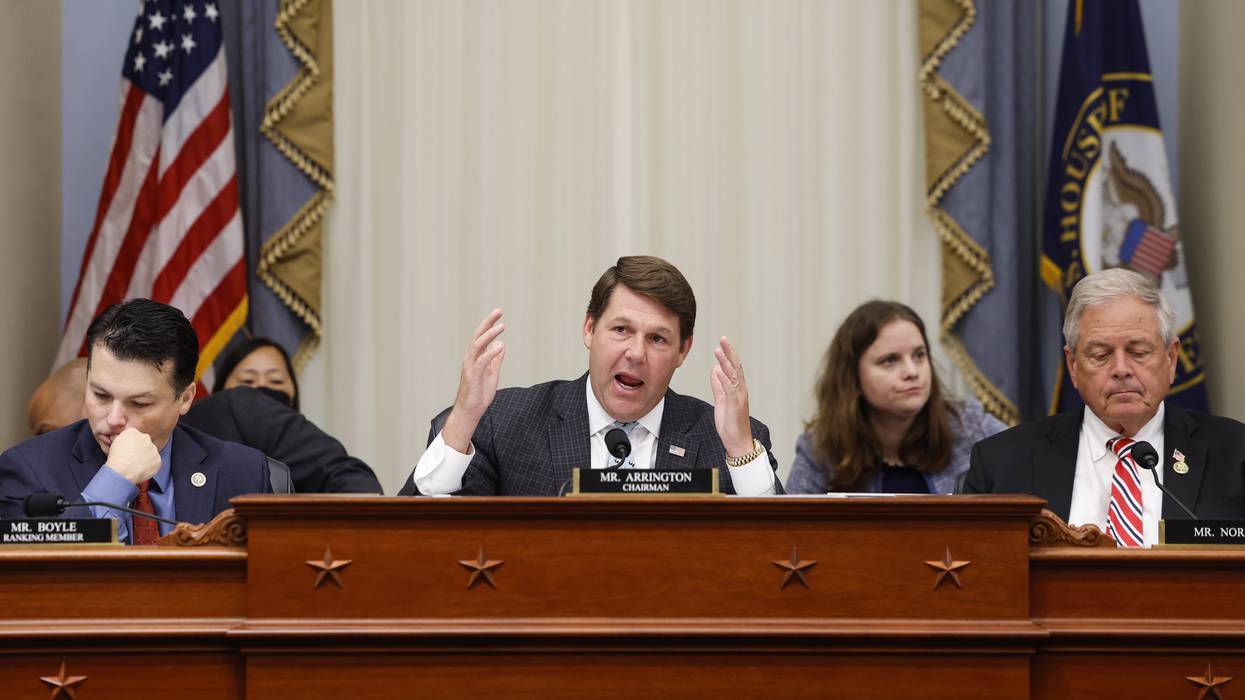
The Republican-led push to establish a fiscal commission for the U.S. debt was met with vocal opposition during a House Budget Committee hearing on Wednesday, with progressive advocates and Democratic lawmakers calling the proposal a thinly veiled ploy to further undermine and cut Social Security and Medicare.
Rep. Jim McGovern (D-Mass.), one of eight witnesses who testified at Wednesday's hearing, said he was "a little skeptical" that Republican lawmakers are now concerned about the national debt given that they have driven it up with tax cuts for the rich and large corporations in recent years—and are still trying to increase it.
According to one analysis, the series of tax cuts approved under former Presidents George W. Bush and Donald Trump have added $10 trillion to the debt since their enactment and are responsible for the bulk of the increase in the debt ratio since 2001.
Social Security, by contrast, is
not a driver of federal deficits.
"If we want to ensure long-term solvency [for Social Security], there are two choices: Some on the other side think we should cut benefits, I think we should ask the ultra-rich to pay their fair share. We don't need a commission to tell us that," McGovern said during his testimony. "And my fear is that a commission would be used by some as an excuse to slash Social Security, Medicare, Medicaid, and other federal anti-poverty programs."
Rep. Jan Schakowsky (D-Ill.), a member of the House Budget Committee who served on the infamous Bowles-Simpson commission that proposed deep cuts to Social Security, expressed similar concerns during Wednesday's hearing.
Schakowsky said she was "happy" the Bowles-Simpson proposals—which she vocally opposed at the time—weren't adopted and warned that a fiscal commission of the kind backed by Republicans and right-wing Democrats is "a way for members of Congress to get out from under having to take the blame for the kinds of cuts that may be presented."
In an op-ed for Common Dreams on Wednesday, Schakowsky wrote that "if Republicans cared about improving our fiscal position, they would demand the rich pay their fair share."
"If Republicans wanted to actually solve our budget challenges, they would robustly fund tax enforcement to ensure corporations are complying with laws already on the books," she added. "But Republicans aren't serious about the deficit. They aren't even serious about governing. They are serious about only one thing, and that's ripping away Social Security from seniors behind closed doors."
Wednesday's hearing examined three pieces of legislation put forth by bipartisan groups of lawmakers in the House and Senate.
A bill introduced earlier this month by Sens. Mitt Romney (R-Utah) and Joe Manchin (D-W.Va.)—both of whom testified at Wednesday's hearing—would form a 16-member bipartisan, bicameral fiscal commission comprised of 12 elected officials and four outside experts tasked with crafting legislation to "improve solvency of federal trust funds over a 75-year period."
If approved by the commission, the legislation would be put on a fast track in the House and Senate.
Romney insisted during his testimony Wednesday that he doesn't know of a single Republican or Democrat who wants to cut Social Security and said benefit reductions should be off the table.
But Social Security Works, a progressive advocacy group, pointed out that a proposal released earlier this year by the Republican Study Committee (RSC)—a panel comprised of 175 House Republicans—called for raising the Social Security retirement age, which would de facto cut benefits across the board.
Rep. Jodey Arrington (R-Texas), who presided over Wednesday's hearing, is a member of the RSC. During his opening remarks, Arrington described efforts to prevent what he called a "sovereign debt crisis" as "our generation's World War."
Alex Lawson, executive director of Social Security Works, told Common Dreams that "at today's hearing, Republicans made the true purpose of their 'fiscal commission' crystal clear: demolish Social Security and Medicare behind closed doors, while avoiding accountability from voters."
"Chairman Jodey Arrington referred to the commission's supporters as 'partners in crime,'" Lawson added. "That's exactly what they are: criminals who are plotting to reach into our pockets and steal our earned benefits."
"It should be a national scandal that middle- and working-class families have to pay Social Security taxes on all of their income but millionaires and billionaires do not."
Instead of taking the deeply unpopular step of slashing benefits, Democrats who spoke at the budget committee hearing argued that Congress should pass legislation requiring the rich to contribute more to Social Security. This year, because of the payroll tax cap, millionaires stopped paying into the program in late February.
"It should be a national scandal that middle- and working-class families have to pay Social Security taxes on all of their income but millionaires and billionaires do not," said McGovern.
Rep. Brendan Boyle (D-Pa.), the top Democrat on the House Budget Committee, said at Wednesday's hearing that Congress could extend Social Security's solvency through the end of the century by requiring the rich to pay more in taxes.
"I think that is fair. I think that is appropriate," said Boyle. "And for those who disagree, I would be very interested in seeing what their plan is and their alternative."
Following the hearing, Rep. Summer Lee (D-Pa.) delivered a speech on the House floor condemning Republicans for working to "establish a death panel commission to gut earned benefits" and described the effort as part of a "cycle" that must be opposed.
"First, Republicans pass tax handouts for their filthy rich donors, promising a trickle-down miracle that never has and will never happen—from Reaganomics to Trump's tax scam," said Lee. "Then, when their tax scam causes the economy to slow and deficits to grow, they refuse to correct their mistake. Instead they blame immigrants, poor folks, Black folks, and brown folks."
"Then they repeat the cycle," she continued, "hoping enough of us will forgive or forget their scheme to tear away Medicare and Social Security and believe their lie that they were 'only after' food assistance, healthcare, and housing for poor folks—not your earned benefits—when the truth is that they always were and always will be after it all."
House Speaker Mike Johnson knows how important Social Security is to hard-working Americans, so he has devised an accountability-free way to gut it.
Over a decade ago, I served on the National Commission on Fiscal Responsibility and Reform, better known as the Bowles-Simpson Commission. That commission failed, but not before its cochairs tried to make deep cuts to the American people’s hard-earned Social Security and Medicare benefits.
Now, House Speaker Mike Johnson (R-La.) is digging up the old playbook and wants to create a new commission modeled after Bowles-Simpson. This week, the House Budget Committee will hold its second hearing in two months on this idea.
Johnson is demanding a commission designed to slash the entire federal budget, including Social Security—even though Social Security doesn’t add even a penny to the deficit. It is legally excluded from the federal budget, self-funded, and can only pay benefits if it has sufficient revenue to cover the cost.
Republicans aren’t serious about the deficit. They aren’t even serious about governing. They are serious about only one thing, and that’s ripping away Social Security from seniors behind closed doors.
The White House has called the commission idea a death panel for Social Security. The AARP, AFL-CIO, Strengthen Social Security Coalition, National Organization for Women, and over 100 other organizations agree. What’s more, Speaker Johnson happily agrees. That’s why the commission that Johnson and the Budget Committee are considering would vote on final proposals, including gutting this incredibly popular program, the week after the 2024 election. The speaker knows how important Social Security is to hard-working Americans, so he has devised an accountability-free way to gut it.
Again, we don’t have to guess that this is what will happen, because Republicans have tried this before. During discussions on forming Bowles-Simpson in 2010, Senator Max Baucus (D-Mont.) astutely pointed out that “The Chairman and Ranking Republican Member of the Budget Committee have painted a big red bull’s eye on Social Security. Their commission is a Social Security-cutting machine.”
Sen. Baucus was right. The commission’s cochairs put forward a proposal which slashed Social Security. I strongly opposed this proposal and put forth my own alternative which would have reduced the deficit by $441 billion in 2015 without cutting essential programs. Thankfully, the cochairs’ recommendations failed to achieve the support needed to have them fast-tracked through Congress. After the failure of Bowles-Simpson, Republicans tried again to cut Social Security and Medicare behind closed doors through another fast-tracked process known as the Supercommittee. It was no more successful than Bowles-Simpson.
The bottom line is that a fiscal commission is political pandering, plain and simple. If Republicans were serious about addressing the deficit, they would use the reconciliation process, which is designed specifically to rein in federal spending. If Republicans cared about improving our fiscal position, they would demand the rich pay their fair share. If Republicans wanted to actually solve our budget challenges, they would robustly fund tax enforcement to ensure corporations are complying with laws already on the books.
But Republicans aren’t serious about the deficit. They aren’t even serious about governing. They are serious about only one thing, and that’s ripping away Social Security from seniors behind closed doors.
Democrats stand ready to prevent this from happening. President Joe Biden ran for office on a plan to protect and expand Social Security, and Members of Congress, including me, have introduced legislation that restores Social Security to long-range balance while expanding benefits with no cuts.
Instead of hiding behind a commission, Republicans should put their own plans for Social Security’s future on the table. When and if they do, I will debate both approaches in the light of day. I and my fellow Democrats stand ready to address our deficit and preserve the future of Social Security, and I invite Republicans to openly offer their proposals and give the American people a say.
"The damage is enormous," a former Bank of Israel governor told demonstrators in Tel Aviv as the Knesset gave final approval of a key component of the highly contentious judicial overhaul.
As an estimated 200,000 Israelis took to the streets of cities across the nation Saturday in protest, the country's parliament advanced a bill to weaken the Supreme Court—legislation condemned by opponents as a "judicial coup."
The far-right coalition in the Knesset—Israel's parliament—led by Prime Minister Benjamin Netanyahu voted for the third and final time to advance a key component of a proposed judicial overhaul package which would repeal the "reasonableness" standard used by the Israeli Supreme Court to overrule egregious government decisions. The vote clears the way for the legislation to be ratified into law on Monday.
"If the government does not come to its senses, the consequences will hit us hard."
For the 29th straight week, Israelis took part in large demonstrations against the bill. Israeli and international media report demonstrators blocked roads in and around Jerusalem and Tel Aviv. Police reportedly used horses and water cannons to disperse protesters.
"I'm very scared of what's happening in Israel now and I'm very worried about the future of my daughter," Jerusalem protester Lotem Pinchover, a 40-year-old academic, told CBS News.
Former Bank of Israel governor Jacob Frenkel told demonstrators in Tel Aviv that "if the government does not come to its senses, the consequences will hit us hard."
"We never experienced such destruction of values in such a short time, not by our external enemies, but by government policy," Frenkel added. "The damage is enormous."
Critics have accused Netanyahu—who faces multiple criminal corruption charges—of attempting to weaken the judiciary in a bid to boost his chances of dodging prosecution. Netanyahu is prohibited from personal involvement in the judiciary overhaul due to a conflict of interest related to the charges against him.
Repercussions of the advancing legislation mounted in recent days as Asaf Zalel, the director-general of Israel's Education Ministry, resigned on Friday and nearly half the country's air force reserve helicopter pilot instructors suspended their service in protest of the bill. Earlier this month, more than 1,100 Israeli air force reservists threatened to not report for duty over the judicial overhaul.
On Thursday, U.S. congressional Democrats led by Reps. Jan Schakowsky (Ill.) and Annie Kuster (N.H.) introduced a resolution supporting Israel's pro-democracy protests.
"The Netanyahu government's anti-democratic agenda not only threatens Israel's standing in the world, but also the very core of the special relationship between the United States and Israel," Schakowsky asserted. "I hope this resolution serves as a warning to the Netanyahu government to reverse course, and as a beacon of hope for the millions of Israelis protesting to save the foundation and future of their nation."