

SUBSCRIBE TO OUR FREE NEWSLETTER
Daily news & progressive opinion—funded by the people, not the corporations—delivered straight to your inbox.
5
#000000
#FFFFFF
To donate by check, phone, or other method, see our More Ways to Give page.
Daily news & progressive opinion—funded by the people, not the corporations—delivered straight to your inbox.
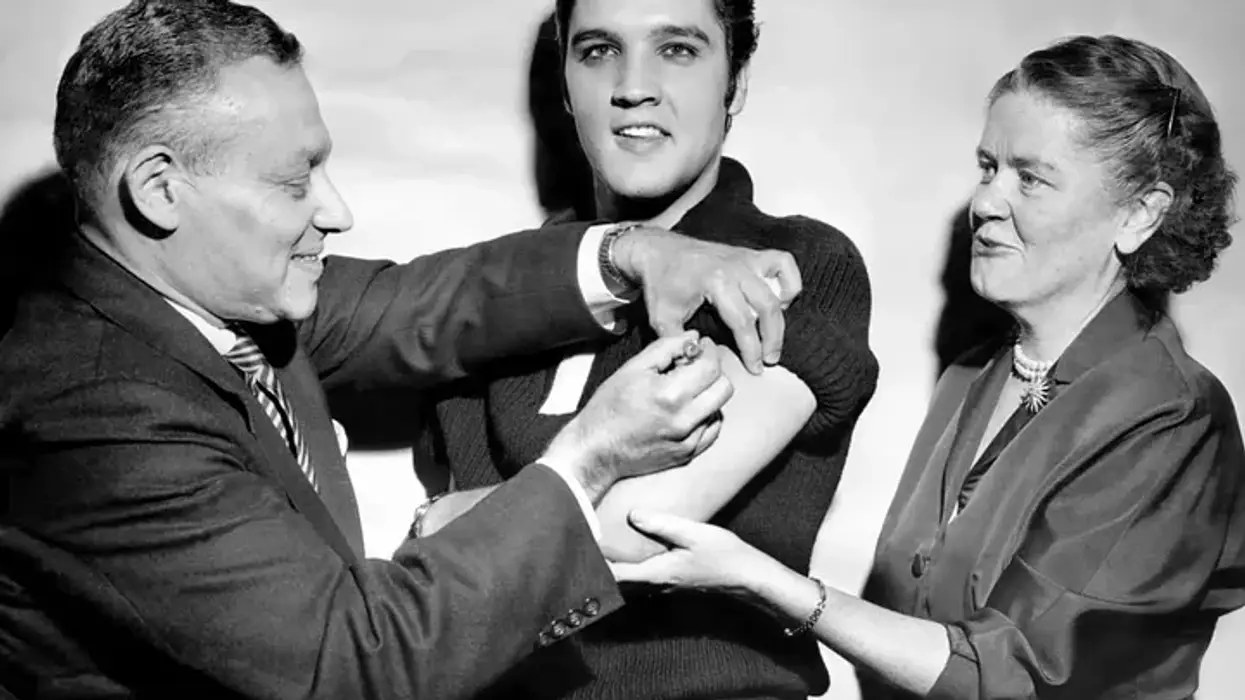
Those of us who lived through the polio era know something that is easy to forget today: Vaccines did not take freedom away, they restored it.
In recent conversations about vaccines, we often hear an argument framed around individual rights and personal choice. This perspective was echoed by Advisory Committee on Immunization Practices Chair Kirk Milhoan in his January 22 interview with STAT News, when he suggested that vaccine recommendations should place greater emphasis on individual autonomy and questioned whether longstanding vaccines, including polio, should continue to be viewed primarily through a public health lens.
As grandparents, we understand that instinct deeply. We raised children. We worried about their safety, questioned new information, and felt the weight of responsibility that comes with making decisions for someone you love more than yourself. Respect for individual liberty is not abstract to us, it is part of who we are as Americans.
But we also belong to a generation that remembers polio. And that memory changes how we see this debate.
Polio was not a distant or theoretical threat when we were children. It arrived quietly, spread easily, and struck without warning. One day a child was fine; the next, paralyzed. Parents kept their children out of swimming pools, movie theaters, and playgrounds. Summers were seasons of fear. Hospital wards filled with children in iron lungs, machines that breathed for bodies polio had left unable to do so.
Protecting public health does not mean erasing individual rights. It means recognizing that some choices carry consequences beyond ourselves.
Janice (Jan) Flood Nichols can attest to what life was like before vaccines. She and her twin brother Frankie were in first grade. It was fall, and they were excited to go trick-or-treating. A few days before Halloween, Frankie caught what seemed like a simple head cold, so their parents kept him home to rest. But the day before Halloween, he suddenly struggled to breathe. They rushed him to the communicable disease hospital in Syracuse.
Doctors performed a spinal tap and placed Frankie in an iron lung. By morning, the diagnosis was confirmed: polio. Jan was brought to the same hospital and given massive doses of gamma globulin, the only treatment doctors hoped might stop the disease.
Frankie’s condition worsened. Unable to control his breathing, doctors rushed him toward emergency surgery. He never made it. Frankie died on November 1, 1953, at 10:25 pm.
That same night, Jan developed symptoms of polio. Her condition deteriorated rapidly, and she was rushed back to the hospital where Frankie had died. Doctors told her parents they did not know if she would live or die. Jan did survive but spent months painfully rehabilitating and learning to walk again.
Jan’s story is why discussions about polio vaccination cannot be reduced to personal preference alone. Polio is not just a risk to one child or one family. It is a highly contagious virus that spreads silently, often through people who show no symptoms at all. That means individual decisions ripple outward, affecting newborns, pregnant women, immunocompromised individuals, and entire communities.
When we talk about rights, we must also talk about responsibility.
In America, freedom has never meant the absence of limits when others are placed in danger. We accept speed limits not because we distrust drivers, but because unchecked speed endangers everyone on the road. We require clean drinking water and food safety standards because one person’s contamination can harm thousands. Public health has always been a balance between individual liberty and collective protection.
Polio vaccination is no different.
Those of us who lived through the polio era know something that is easy to forget today: Vaccines did not take freedom away, they restored it. The widespread use of the polio vaccine didn’t just reduce disease; it gave families their lives back. Children returned to playgrounds and pools. Parents stopped holding their breath every summer. Communities could gather without fear that invisible danger lurked in everyday spaces.
It’s also important to say this clearly: Today’s parents are not reckless or uncaring. Vaccine hesitancy often grows from love, fear, and an overwhelming flood of conflicting information. Many parents have never seen the diseases vaccines prevent. That is a testament to how successful vaccination programs have been, but it also makes the risk feel abstract.
For grandparents, it is anything but abstract.
Many of us came together through Grandparents for Vaccines, a national grassroots organization formed to ensure that the hard-won lessons of the past are not forgotten. We speak not as politicians or policymakers, but as witnesses, people who saw firsthand what happens when diseases like polio are allowed to spread, and who now want to protect the children and grandchildren we love.
We remember classmates who never walked again. We remember neighbors who lived with lifelong disabilities. We remember funerals for children who should have grown old alongside us. These memories are not meant to frighten, they are meant to remind us what happens when a dangerous virus is allowed to spread unchecked.
Protecting public health does not mean erasing individual rights. It means recognizing that some choices carry consequences beyond ourselves. Infants cannot choose to be vaccinated yet. People undergoing cancer treatment cannot choose to have fully functioning immune systems. They rely on the rest of us to create a protective barrier around them.
That is not government overreach. It is community care.
As grandparents, our perspective is shaped by time. We have seen what happens before vaccines and after them. We have watched fear give way to relief, and tragedy replaced by prevention. When we advocate for polio vaccination, we are not dismissing freedom—we are defending a broader, deeper version of it.
The freedom for a child to grow up walking.
The freedom for families to trust public spaces.
The freedom for future generations to know polio only as a chapter in history books, not a living threat.
Our message is simple and heartfelt: We respect choice and we remember the cost of unchecked disease. Polio showed our generation that collective protection can increase freedom across an entire society. That lesson continues to matter for the health and well-being of our grandchildren.
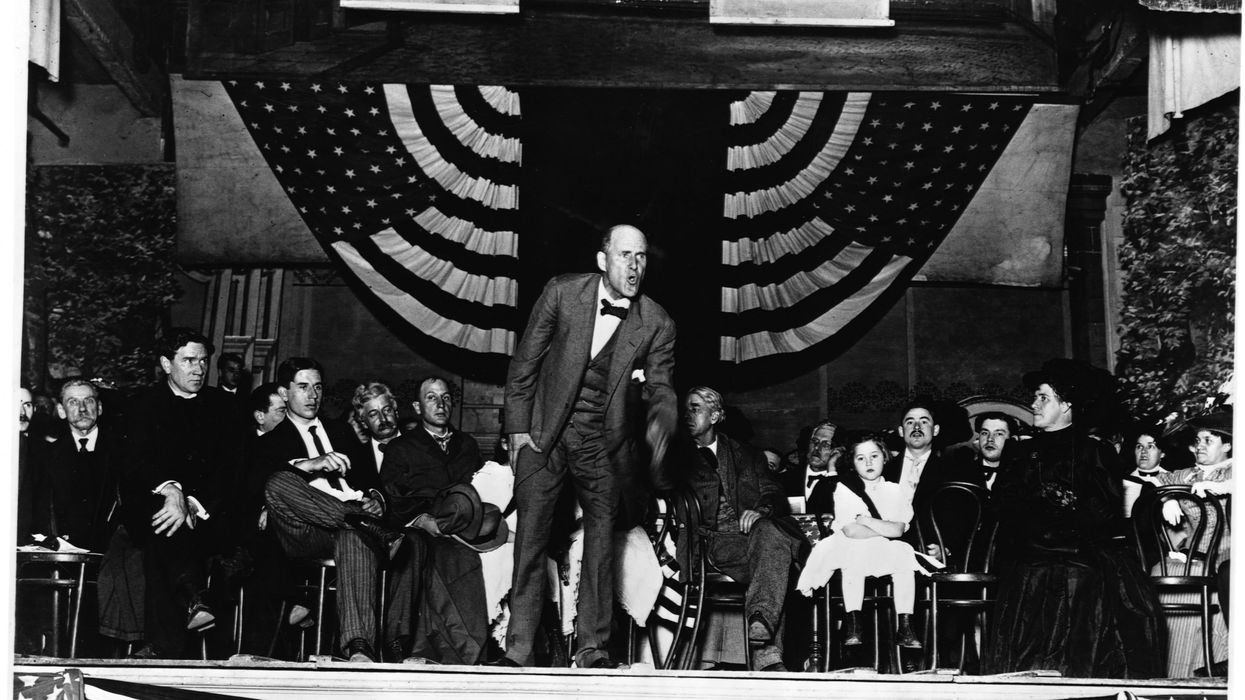
Released from jail on this day 130 years ago, the great socialist and labor leader delivered a speech we would do well to remember in these perilous times.
On November 22, 1895, Eugene V. Debs was released from Woodstock Jail, where he had been imprisoned for six months for his leadership of the 1894 Pullman strike. Later that day, before a large crowd of supporters at Battery D in Chicago, he spoke on the topic of “Liberty.”
Debs was a great orator, and “Liberty” is a brilliant speech, powerfully evoking both “the spirit of liberty” heralded by the Declaration of Independence, and the promise of a freedom yet to be redeemed by American workers in thrall to plutocratic government. As Nick Salvatore noted in his classic biography, Eugene V. Debs, Citizen and Socialist, this speech marked an important moment in the evolution of Debs from a radically republican labor activist to the country’s leading socialist.
Debs notes his own situation, “stripped of my constitutional rights as a freeman and shorn of the most sacred prerogatives of American citizenship.” He proceeds to defend the American Railway Union as a necessary and legitimate organization of workers, and the strike as a legitimate means of pursuing justice, which” threw down no gauntlet to courts or armies—it simply resisted the invasion of the rights of workingmen by corporations.”
An adamant defense of worker rights, the speech’s overriding theme is unmistakably the political theme of “liberty” and indeed democracy. This is clear from Debs’s opening words:
Manifestly the spirit of ’76 still survives. The fires of liberty and noble aspirations are not yet extinguished. I greet you tonight as lovers of liberty and as despisers of despotism. I comprehend the significance of this demonstration and appreciate the honor that makes it possible for me to be your guest on such an occasion. The vindication and glorification of American principles of government, as proclaimed to the world in the Declaration of Independence, is the high purpose of this convocation.
The entire first half of the speech centers on the theme of “personal liberty; or giving it its full height, depth, and breadth, American liberty, something that Americans have been accustomed to eulogize since the foundation of the Republic.” Paying tribute to the republic’s founding—"For the first time in the records of all the ages, the inalienable rights of man, ‘life, liberty and the pursuit of happiness,’ were proclaimed July 4, 1776”—Debs proceeds to wax poetically, for eight long paragraphs, about the enduring resonance of that 1776 proclamation, the indivisibility of liberty, and the “more than satanic crime of stealing the jewel of liberty from the crown of manhood and reducing the victim of the burglary to slavery or to prison.” It is for this crime that he morally indicts the railroad magnates and their federal government allies for breaking the strike and imprisoning its leaders.
Debs insists that it is the labor movement that most embodies “the spirit of ’76”:
To the unified hosts of American working men fate has committed the charge of rescuing American liberties from the grasp of the vandal horde that have placed them in peril, by seizing the ballot and wielding it to regain the priceless heritage and to preserve and transmit it without scar or blemish to the generations yet to come.
The ballot, Debs notes approvingly, “has been called a weapon that executes a free man’s will as lighting does the will of God.” Debs rhapsodizes in almost religious tones about the power of democratic elections:
There is nothing in our government it cannot remove or amend. It can make and unmake presidents and congresses and courts. It can abolish unjust laws and consign to eternal odium and oblivion unjust judges, strip from them their robes and gowns and send them forth unclean as lepers to bear the burden of merited obloquy as Cain with the mark of a murderer. It can sweep away trusts, syndicates, corporations, monopolies, and every other abnormal development of the money power designed to abridge the liberties of workingmen and enslave them by the degradation incident to poverty and enforced idleness, as cyclones scatter the leaves of the forest. The ballot can do all this and more. It can give our civilization its crowning glory—the cooperative commonwealth.
Debs appreciated the rhetorical and the inspirational power of the dissenting American political tradition that hearkened back to the Revolution and its “spirit of ’76,” a tradition that included his heroes Jefferson, Paine, Garrison, Phillips, Lincoln, and Anthony. And he firmly believed that civil liberties and regular democratic elections represented forms of genuine if precarious social progress whose defense and expansion offered real opportunities for the furtherance of social and economic justice. He was, in short, a democrat.
He ended his speech with the hope that “American lovers of liberty are setting in operation forces to rescue their constitutional liberties from the grasp of monopoly and its mercenary hirelings.” That hope was not in vain, even if the Pullman strike was suppressed and Debs twice found himself in prison for refusing to be silenced, in 1895 and then in 1918 when imprisoned for his famous “Canton address,” critiquing WWI. The labor movement he helped to lead played a crucial role in advancing many of the policies—from the 8-hour workday to occupational safety and health regulation to “social security” broadly understood—that most Americans today simply take for granted. Debs was indeed one of the 20th century’s true crusaders for civil liberties and democratic inclusion. And his distinctive vision of a democratic socialism established an enduring legacy whose most recent heir is New York City’s mayor-elect, Zohran Mamdani, who indeed quoted Debs in his victory speech.
At a time when the Trump administration is attacking liberty on a daily basis, targeting everyone on the left as a “radical lunatic” and “enemy from within,” and seeking to destroy the very possibility of political dissent and opposition, Debs’s paean to “Liberty” on November 22, 1895—and his commitment to its active promotion—has never been more relevant.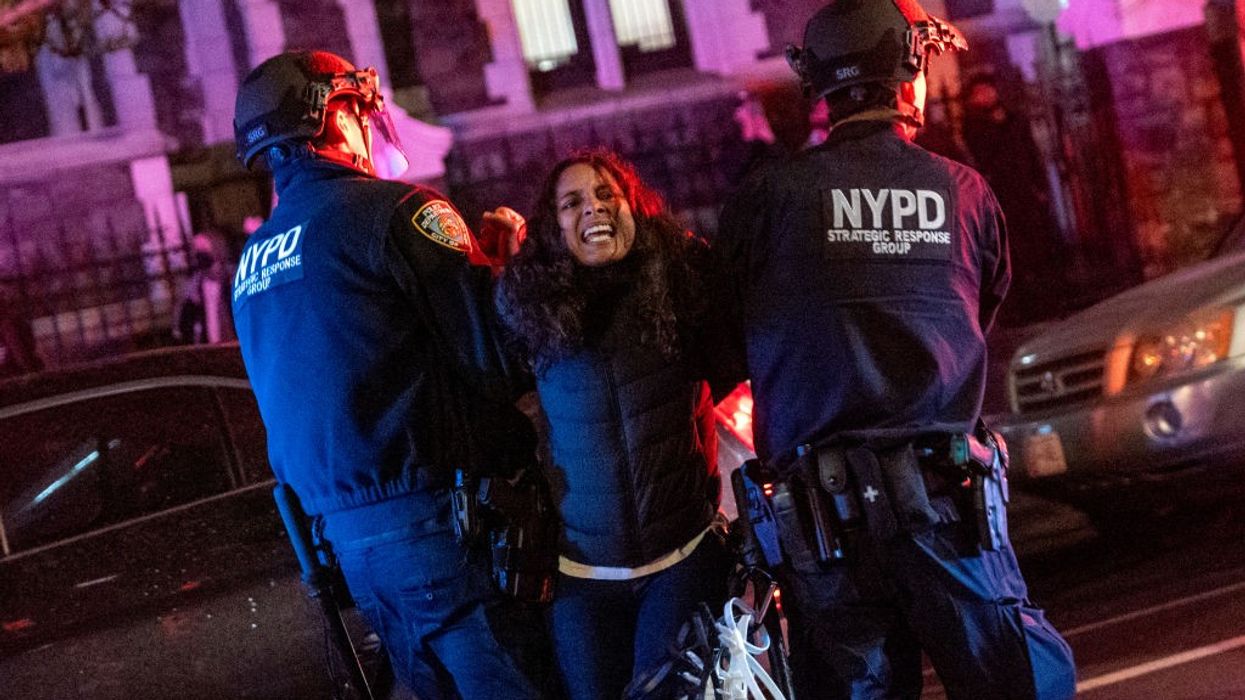
In the longstanding Western tradition that Trump epitomizes—free speech is the possession of some, meant to be used against others.
In The Dawn of Everything, David Graeber and David Wengrow note that the Western notion of freedom derives from the Roman legal tradition, in which freedom was conceived as “the power of the male household head in ancient Rome, who could do whatever he liked with his chattels and possessions, including his children and slaves.”
Because of this, “freedom was always defined—at least potentially—as something exercised to the cost of others.”
You have to understand this notion of freedom—that to be free, you have to make someone else less free—to make sense of the idea that Donald Trump is a champion of “free speech.”
Trump is still seen by many as a defender of free speech, because he sticks up for the free speech of people whose speech is supposed to matter.
This is, unfortunately, not a fringe idea. Last week, The New York Times (2/25/25) ran a long interview Ezra Klein did with Trump-supporting intellectual (and former CIA officer) Martin Gurri, who said his main reason for voting for Trump was that “I felt like he was for free speech.”
“Free speech is a right-wing cause,” Gurri claimed.
Trump is the “free speech” champion who said of a protester at one of his rallies during the 2016 campaign (Washington Post, 2/23/16): “I love the old days. You know what they used to do to guys like that…? They’d be carried out on a stretcher, folks.”
Trump sues news outlets when he doesn’t like how they edit interviews, or their polling results (New York Times, 2/7/25). Before the election, future Trump FBI Director Kash Patel (FAIR.org, 11/14/24) promised to “come after the people in the media who lied about American citizens, who helped Joe Biden rig presidential elections…. Whether it’s criminally or civilly, we’ll figure that out.” Trump’s FCC chair is considering yanking broadcast licenses from networks for “news distortion,” or for letting former Vice President Kamala Harris have a cameo on Saturday Night Live (FAIR.org, 2/26/25).
Nonetheless, Trump is still seen by many as a defender of free speech, because he sticks up for the free speech of people whose speech is supposed to matter—like right-wingers who weren’t allowed to post content that was deemed hate speech, disinformation, or incitement to violence on social media platforms. As the headline of a FAIR.org piece (11/4/22) by Ari Paul put it, “The Right Thinks Publishers Have No Right Not to Publish the Right.” Another key “free speech” issue for the right, and much of the center: people who have been “canceled” by being criticized too harshly on Twitter (FAIR.org, 8/1/20, 10/23/20).
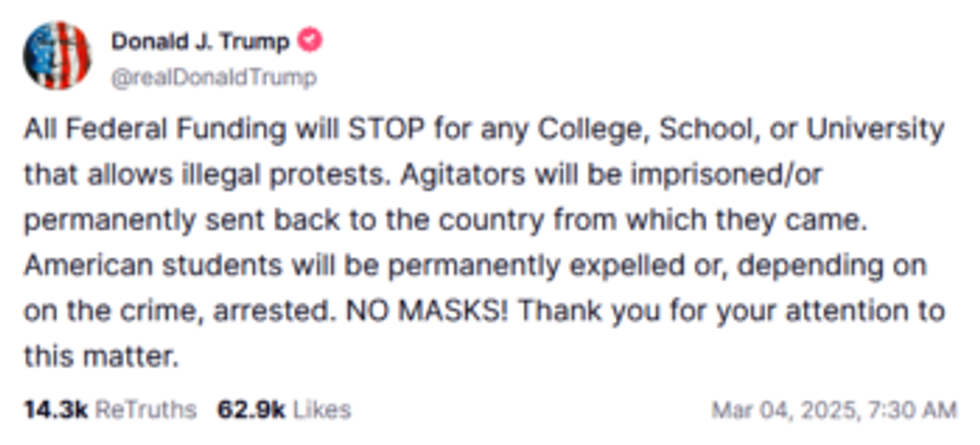
Now Trump (Truth Social, 3/4/25) has come out with a diktat threatening sanctions against any educational institution that tolerates forbidden demonstrations:
All Federal Funding will STOP for any College, School, or University that allows illegal protests. Agitators will be imprisoned or permanently sent back to the country from which they came. American students will be permanently expelled or, depending on the crime, arrested. NO MASKS!
The reference to banning masks is a reminder that, for the right, freedom is a commodity that belongs to some people and not to others. You have an inalienable right to defy mask mandates, not despite but mainly because you could potentially harm someone by spreading a contagious disease—just as you supposedly have a right to carry an AR-15 rifle. Whereas if you want to wear a mask to protect yourself from a deadly illness—or from police surveillance—sorry, there’s no right to do that.
But more critically, what’s an “illegal protest”? The context, of course, is the wave of campus protests against the genocidal violence unleashed by Israel against Palestinians following the October 7, 2023, attacks (though Trump’s repressive approach to protests certainly is not limited to pro-Palestinian ones).
No one is talking about cracking down on students who proclaim “I Stand With Israel,” on the grounds that they may intimidate Palestinian students—even though they are endorsing an actual, ongoing genocide.
On January 30, Trump promised to deport all international students who “joined in the pro-jihadist protests,” and to “cancel the student visas of all Hamas sympathizers on college campuses, which have been infested with radicalism like never before.” He ordered the Justice Department to “quell pro-Hamas vandalism and intimidation, and investigate and punish anti-Jewish racism in leftist, anti-American colleges and universities.”
A federal task force convened by Trump (CNN, 3/3/25) is threatening to pull $50 million in government contracts from New York’s Columbia University because of its (imaginary) “ongoing inaction in the face of relentless harassment of Jewish students,” which has been facilitated, according to Health and Human Services Secretary Robert Kennedy, by “the censorship and false narratives of woke cancel culture.”
So the expression of ideas—Palestinian solidarity, U.S. criticism, generic “radicalism”—has to be suppressed, because they lead to, if they do not themselves constitute, “harassment of Jewish students” (by which is meant pro-Israel students; Jewish student supporters of Palestinian rights are frequently targets of this suppression). Those ideas constitute “censorship,” and the way to combat this censorship is to ban those ideas.
No one is talking about cracking down on students who proclaim “I Stand With Israel,” on the grounds that they may intimidate Palestinian students—even though they are endorsing an actual, ongoing genocide (FAIR.org, 12/12/24). That’s because—in the longstanding Western tradition that Trump epitomizes—free speech is the possession of some, meant to be used against others.
When billionaires like Musk ally with political forces to dismantle public institutions, they're not just eliminating jobs—they're attempting to redefine freedom as nothing more than market choice.
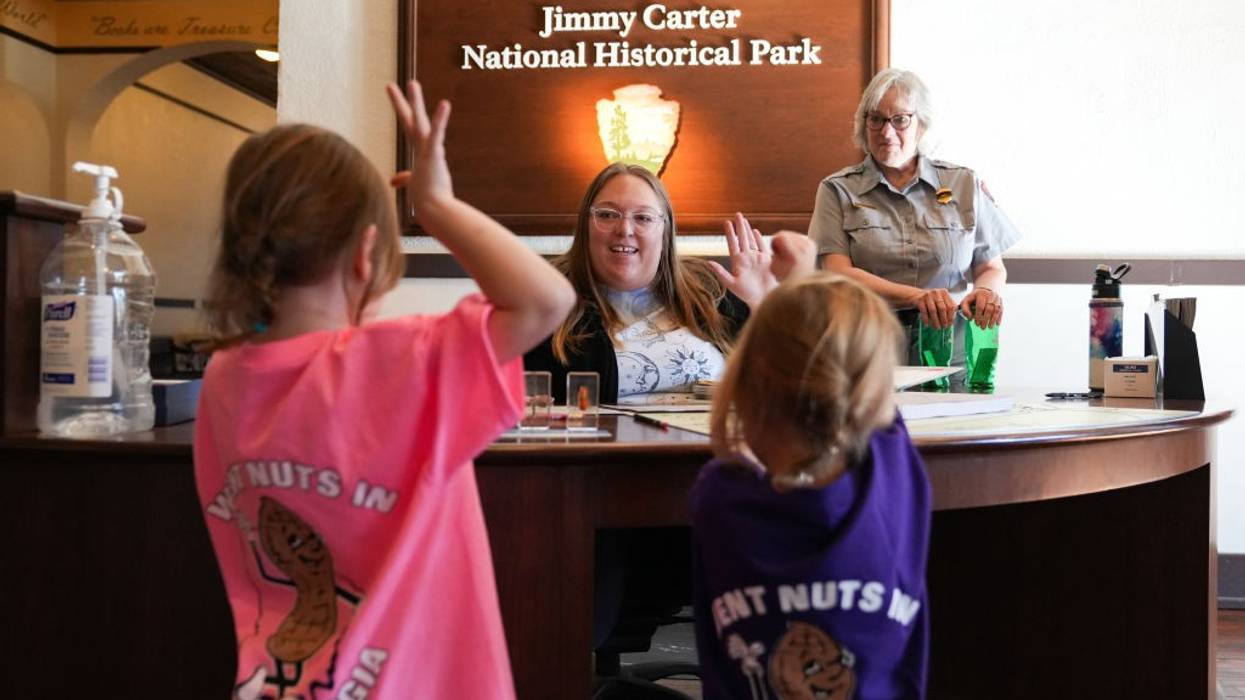
Last Friday, an estimated 14,000 federal workers were fired from their positions across multiple agencies. Among them was Brian Gibbs, a National Park Service ranger whose heartbreaking account of losing his "dream job" puts a human face on a crisis that threatens the very fabric of American life. "I am the smiling face that greets you at the front door," Gibbs wrote. "I am your family vacation planner... I am the Band-Aid for a skinned knee."
This generous offering of his words reveals an essential truth: Public service is not about bureaucracy—it's about the careful, often invisible, undervalued work of maintaining our society's fundamental freedoms.
These thoughtless mass firings represent more than a reduction in excess workforce. They are an assault on what sociologists call "connective labor"—the deep interpersonal work that underlies all public service. As researcher Allison Pugh explains, this represents a "layer of labor beneath the labor," the essential but often invisible work of building trust and maintaining human connections. When a park ranger comforts a lost child or a cybersecurity expert coordinates across agencies to protect our infrastructure, they're not just performing tasks listed in a job description—they're engaging in the profound work of caring for one another that makes our public institutions function.
Our collective survival depends on workers who prioritize public good over private profit.
This connective labor is the foundation of what we might call care infrastructure—the essential work of maintaining systems that make our daily lives possible and our shared spaces safe. From the Veterans Affairs data scientist developing machine-learning algorithms to serve veterans, to the Forest Service trail crews maintaining backcountry access for rural communities, to the USDA loan technicians supporting small-town development, these federal employees perform work that transcends mere employment. They create the web of trust and mutual recognition that holds our society together. They show up, they maintain a disciplined commitment to public service so that we can be free.
The implications are both immediate and far-reaching. As one ranger warned about the summer season in the National Parks, "There will be nobody to clean the bathrooms, nobody to manage parking, nobody to collect fees, nobody to issue permits, nobody to ensure mountaineers entering steep glaciated terrain have the requisite skills and equipment... nobody to rescue injured or lost hikers. People will die from incidents that would otherwise be just another Tuesday for us."
This crisis reveals a dangerous shift in how we value public service. When billionaires like Elon Musk pressure federal workers to abandon their posts for more lucrative private sector positions, and disturbingly compare federal workers to weeds that have to be eradicated by the root, they demonstrate a fundamental misunderstanding of what freedom means in America. True freedom isn't just about what we're against—whether that's fascism or authoritarianism—but also what we're for. Timothy Snyder argues freedom requires five essential elements: sovereignty (the ability to make meaningful choices about our lives), unpredictability (the power to act outside algorithmic control), mobility (the chance for people to grow beyond their circumstances), factuality (a grip on reality that enables us to challenge it), and solidarity (the recognition that these freedoms must be universal).
Our federal workers are not just employees—they are the guardians of these freedoms, but humble guardians who rarely seek the spotlight. You won't find them giving press conferences or cultivating personal brands. Instead, they show up day after day, maintaining the invisible infrastructure of democracy through quiet dedication rather than grandstanding. This humility isn't a weakness—it's their strength. It allows them to operate beyond political pressures and partisan loyalties, focused solely on their mission of public service.
These are the people who process veterans' benefits without fanfare, who conduct critical medical research at the National Institutes of Health without recognition, who maintain our nation's nuclear security without acclaim. When FEMA workers respond to natural disasters, when Centers for Disease Control and Prevention scientists track disease outbreaks, when Rural Development officers help fund vital infrastructure in small towns—they do so not for glory or profit, but because they believe in the promise of collective well-being. Through their steady, often unseen labor, they create the conditions that make genuine freedom possible. They build the foundation for what Snyder calls "sovereignty"—not the narrow nationalism of isolationists, but the creation of conditions where all individuals, regardless of their circumstances, can make meaningful choices about their lives.
These freedoms don't exist in a vacuum. They require maintenance, protection, and care—the very work being dismissed as "fat on the bone" by those orchestrating these firings. The Environmental Protection Agency scientist who monitors air quality in our cities, the Education Department specialist making education accessible for disabled students, the IRS worker ensuring corporations pay their fair share—these are not luxuries we can afford to lose. They are the essential guardians of our collective freedom.
The timing of these firings is particularly cruel, coming on Valentine's Day and affecting workers like Gibbs, whose wife is expecting a child, and others who have relocated across the country for their dream jobs. There are at least 14,000 stories of dreams destroyed in these 14,000 firings. But beyond the personal tragedies lies a broader threat to our collective democratic values. When we allow unelected billionaires to influence the dismantling of public services, we surrender a piece of our democratic control over the systems that maintain our quality of life.
During the pandemic, a crisis laid bare what had long been invisible: the essential infrastructure of care that sustains our society. We stood at our windows at 7:00 pm to applaud healthcare workers, celebrated delivery drivers as heroes, and finally saw the vital work of public health officials who tracked disease spread and coordinated emergency responses. That moment of recognition revealed a fundamental truth: Our collective survival depends on workers who prioritize public good over private profit.
Yet now, barely three years later, we're witnessing an orchestrated assault on the very concept of public service. This isn't merely about budget cuts or government efficiency—it's about a fundamental attack on the infrastructure of democracy itself. When billionaires like Musk ally with political forces to dismantle public institutions, they're not just eliminating jobs—they're attempting to redefine freedom as nothing more than market choice. This convergence of oligarchic wealth and authoritarian politics threatens not just our government services, but our very capacity to exist as a democratic society. Our freedom to thrive—to access public spaces, to trust our infrastructure, to rely on essential services—hangs in the balance.
The effects of these firings will ripple through our communities for months, perhaps years to come. When national parks become dangerous or inaccessible due to understaffing, when public utilities face increased vulnerability to cyber attacks, when basic government services break down, we'll all feel the impact. But by then, it may be too late to reverse the damage.
We must recognize this moment for what it is: a critical juncture in the fight for American democracy. The question isn't just about government jobs—it's about what kind of society we want to be. Do we want to live in a country where public service is devalued and dismantled, where the careful work of maintaining our shared spaces and systems is abandoned in favor of private profit? Or do we want to preserve and protect the essential care labor that makes our freedoms possible?
The answer to these questions will determine not just the fate of 14,000 federal workers, but the future of American democracy itself. As Ranger Gibbs reminded us, we must "stay present, don't avert your gaze." But what does it mean to truly stay present in this moment of crisis? Timothy Snyder, writing about tyranny in 2017, provided an answer: "Power wants your body softening in your chair and your emotions dissipating on a screen... Get outside. Put your body in unfamiliar places with unfamiliar people."
This is how we defend our freedoms—not through passive observation, but through active solidarity with those who maintain our democratic infrastructure. We must stand alongside the park rangers who protect our public lands, the cybersecurity experts who safeguard our systems, and all the federal workers whose invisibilized care labor has long been the bedrock of our democracy. Their fight is our fight. Their freedom is our freedom. The time to act is now. Not just to protest these firings, but to reaffirm our commitment to the very idea of public service—to recognize that our collective freedom depends on the careful, committed work of those who choose to serve their communities rather than chase private profit. In defending these workers, we defend the possibility of a democracy built on care, connection, and collective well-being.
Since the Modern Era, power has depended on virtual money. The more money, the more power.
Since the end of the last century, I have occasionally repeated five or six straightforward exercises in classrooms in different countries with students of different cultures, ages, and social classes―with the same result.
One (inspired in Africa) refers to the classification of geometric figures, where we always see the differences and never what they have in common. In another, in the United States, I draw a cube on the blackboard and, when asked what they see, they unanimously say that it is a cube. It is not a cube, but three rhombuses together. To the question of what colors the sky and the sun are, the answers have also been unanimous, for years. But the repetitive response is a question: “Professor, are you also going to tell us that the sky is not blue and the sun is not yellow?” After all, that’s how they are on flags, in children’s drawings, and in any other representation that is not modern art―that which made Hitler’s blood boil. Something that hasn’t changed much today. The sky is not always blue and the sun is never yellow. Not only is it white, but the dominant colors are blue and violet.
In any case, the examples show that we cannot see the objective world without passing it through the lens of our understanding, which is colored by the prejudices of a society, or a civilization. A more biological case lies in the perception of the nonexistent color yellow on TV screens, but it is still an illusion.
A real democracy is a zero-sum game.
The question “Why is the sun yellow?” inoculates the interlocutor with a false fact, distracting them with the search for the correct answer. The same occurs when faced with the question “Why did socialism die?” Even more decisive than in quantum and relativistic physics, in the human world the observer changes the reality that he observes, especially when he or she uses language full of ideolexics.
Today, a student asked me: “Why is Brazil on the verge of a dictatorship?” Why not Argentina or Ecuador? Why is the sun yellow? I remembered Elon Musk’s repeated attacks on President Luiz Inácio Lula da Silva of Brazil for his audacity to question the environmental effects of the tycoon’s fireworks company.
This discussion escalated with the investigation and order of a Brazilian prosecutor to block some accounts on X (Twitter), considering them “digital militias.” As commander in chief of the digital militias, Musk requested the resignation of the minister of the Supreme Federal Court of Brazil, Alexandre de Moraes, and repeated the speech about Freedom―carajo!
I am not going to go back to the mercenaries who have been deciding elections since the beginning of the century (like Team Jorge) and whose outpost in 2010s was in Ukraine, as specialists warned before the 2022 war. But I want to repeat that there is no democracy with an extreme concentration of capital and without transparency of the media, for which we proposed international committees of experts to monitor algorithms, etc.
“I am a free speech absolutist,” Musk repeated. The proof? In his networks, a humble teacher from Angola has the same possibility of publishing as him. He says nothing about the most obvious: every time he promotes his mercantilist ideology on X, the most political network in the world, it is automatically consumed by millions of people. It is the same concept of freedom as the slaveholders: by freedom, they meant their freedom, which is what guaranteed universal well-being.
The same day, Musk published a graph showing the drop in audience of the National Public Radio, celebrating that the only noncommercial network in the United States that survives is dying, thanks to the budget cuts of successive governments.
NPR is the only national radio network that still has journalistic programs with content and investigation, even though we disagree with many of its criteria when exposing some controversial topics. In their beginnings, and after decades of development, most radio stations in the United States were public or university stations, not commercial. Although the majority of the population was opposed, an aggressive lobby managed to privatize them in the 1930s and then created a new majority in their favor. Classic.
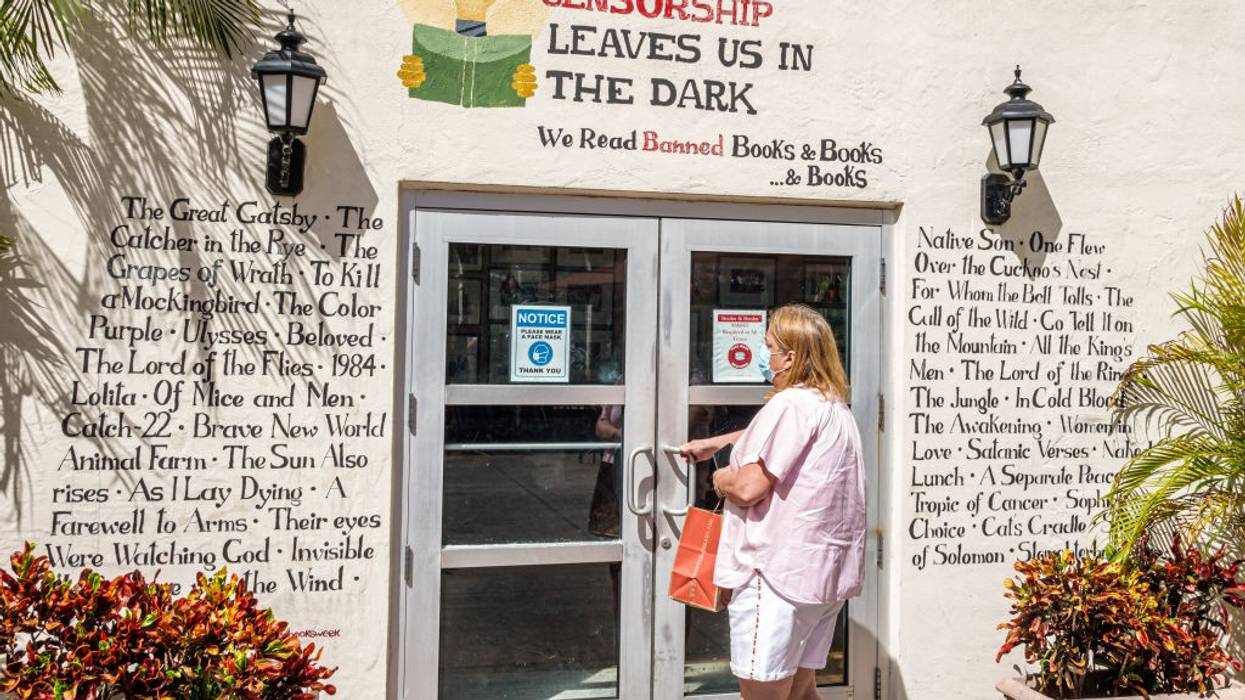
Let’s close with a synthetic reflection. The ideological and cultural model of the right is the economic model in which prosperity is not a zero-sum game. The prosperity of one dominant group could mean the lesser prosperity of other groups. The idea is reasonable: on a prosperous plantation in the 18th or 19th century, slaves were better fed than on one that was poorly managed or less cruel. But in both cases they were slaves, and freedom of expression was protected by the Constitution. Even the constitution of the slaveholding Confederacy included the protection of this freedom because it was welcome as long as it was a democratic decoration and not a real threat to the dominant power. When anti-slavery writings became a threat, slaveholders put a price on the writers’ heads and closed their newspapers. The libertarians of the 21st century do the same. In the United States, they have been banning more than 4,000 uncomfortable books, because their ideas began to be accepted by too many people.
Different, in a real democracy that model does not work, which is why dictatorships have been the preferred systems of capitalism, except when they could control democracies, as was the case of the vampire empires of the so called “Free World.”
A real democracy is a zero-sum game. The more power a group has, that power is at the expense of the power of others. Freedom depends on the power that a group or an individual has in a society. Since the Modern Era, power has depended on virtual money. The more money, the more power. The more power, the more your freedom and the less the freedom of others. Hence the discomfort of equal freedom, because it requires the distribution of power (political, economic, and social).
The Progressive Era in the United States was followed by a privatizing and kleptocratic orgy of millionaires in the 1920s, which ended with the Great Depression here and fascism in Europe. Then another wave of social democratic left to get out of the chaos, from the pre-war Franklin D. Roosevelt, the welfare states in post-war Europe, and the rebellion of the marginalized and colonized world in the 1950s. Until the dangerous years were stopped in the 1970s and imposed the dictatorship of “conservative freedom” of the 1980s. The freedom of the former slaveholder, the owner of the means and ends that we live today.
But beware. All of that also has an expiration date. The days of the end of the kleptocracy of Jeff Bezos, Elon Musk, and BlackRock are numbered. If it’s for the good way, the better. If not, it will be the hard way, as history teaches us it always happened, while the prophets of power are always in charge of denying and delaying.

How can we hope to empower ourselves when we are shackled by the false promises of deregulated capital and exploited by Wall Street greed?
The headline of this column makes a big claim, but I’ll go even further. Free-market mythology denies us not only political and economic freedom, but psychological liberty as well.
In his 1980 inaugural address, Ronald Reagan declared: “Government is not the solution to our problem: government is the problem.” Soon, in the Reagan White House, neckties sporting an image of 18th century philosopher Adam Smith—oft touted as the founding father of free market ideology—became all the rage.
Reagan’s message was clear: Lower taxes, minimize government regulation, cut social programs, and the outcome will be a strong economy with more jobs. With less government intrusion in our lives, we’ll all be free to do better.
Unfortunately, Smith’s insights were oversimplified to the point of distortion. His 1776 The Wealth of Nations was used to justify the premise that a society works best when we each act solely in our self-interest. What’s virtually never noted is Smith’s judgment that “subjects of every state ought to contribute towards the support of the government, as nearly as possible…in proportion to the revenue which they respectively enjoy under the protection of the state.”
Free-market mythology prepares the ground for polarization, often at the expense of those already struggling to stay afloat.
Contrary to the view that acting for self is only “natural,” Smith noted in The Theory of Moral Sentiments that it is the “precept of nature to love ourselves only as we love our neighbor.”
And today studies confirm that humans enjoy giving more than receiving.
Yet, blind allegiance to a myth that puts innate selfishness at our center still undergirds the almost sacred notion that unimpeded-market competition is not only superior, but natural. For believers in the free-market myth, public involvement in the market is a grievous sin.
The consequences are harsh.
For one, we are made to doubt the essential, positive role of democratic governance in enabling and protecting widespread economic prosperity, as well as in achieving many essential public goods—from healthcare and education to environmental protection.
Market mythology ignores the fact that all markets have rules, even if unwritten. In a capitalist market like ours, what is the unspoken “rule”? It’s simple: The more you have, the more you accrue. The pursuit of wealth thus becomes not merely a means to an end, but the end—the sole aim justifying personal enrichment at the expense of others.
The result is wealth inequality in the United States that does not comport with our self-image as a beacon of fairness. Of 200 countries ranked from the most extreme wealth inequality, we come in 28th from the worst, between Peru and El Salvador. Here, the top 1 percent control about a third of household wealth, the bottom 50 percent—over 165 million Americans—control a meager 2.5 percent.
Moreover, such a market ensures tightening corporate power, undermining the very competition touted as a prime goal. Between 1985 and 2017, yearly corporate mergers jumped almost sevenfold. So today the top five healthcare companies enjoy 99.4 percent of market revenue. Three companies control over 94 percent of carbonated soft drinks. Coca-Cola and PepsiCo alone account for 69 percent of the retail market.
The harms from such concentrated wealth show up in citizens unable to afford decent housing as well as in deprivation of essential public goods. No surprise, therefore, that in both access and outcomes, our healthcare ranks last among “high-income countries.”
Sadly, market mythology also leads to self-blame. Once swallowing the myth that—regardless of circumstance, anyone in America can make it if they work hard—self-doubt and shame become unavoidable.
And that’s a big problem for any society. Shame is among the most painful of human emotions, which we often fight by seeking others to blame. Maybe it’s immigrants who will take our jobs. Maybe it’s those liberals who want to reward the lazy. In any case, free-market mythology prepares the ground for polarization, often at the expense of those already struggling to stay afloat.
Thus, to build a strong democratic culture, let us challenge the pernicious mythology of a “free market” purporting fairness but thwarting opportunity.
How?
We can start by facing the sad truth that the United States ranks 60th among the world’s nations in political rights and civil liberties, between Panama and Samoa, according to Freedom House—co-founded by Eleanor Roosevelt. And, as we have in the past, we can create rules that break up monopoly power and strengthen the labor movement. We can expand social services to right the shortcomings of the “free market” and bring us closer to the standards of our peer nations.
Once debunking disempowering free-market myths, we are free to embrace our empowering, widely shared values—those putting human and environmental wellbeing first.

'Our legacy of resistance & building never ends'
Tens of thousands of Americans converged on Washington Saturday to commemorate the 60th anniversary of the March on Washington for Jobs and Freedom, a turning point in the 1960s U.S. civil rights movement at which Martin Luther King Jr gave his galvanizing "I have a dream" speech.
Organizers say today's march was not a commemoration but a continuation of the demands made in 1963.
Martin Luther King Jr.'s only grandchild Yolanda Renee King, 15, told the gathering that if she could speak to her grandfather today, she would say, "I am sorry we still have to be here to rededicate ourselves to finishing your work."
"Sixty years ago, Dr. King urged us to struggle against the triple evils of racism, poverty, and bigotry," she said. "Today, racism is still with us. Poverty is still with us. And now gun violence has come for our places of worship, our schools, and our shopping centers."
"When people say my generation is cynical, we say cynicism is a luxury we cannot afford," she said. "I believe that my generation will be defined by action, not apathy."
“We have made progress, over the last 60 years, since Dr. King led the March on Washington,” said Alphonso David, president and CEO of the Global Black Economic Forum. “Have we reached the mountaintop? Not by a longshot.”

These wasted lives should be written about, read about, and made into films. We need to ensure that their stories and their voices are not silenced.
Stories revolving around prison breaks, such as The Shawshank Redemption, The Great Escape, and Escape From Alcatraz, have long intrigued audiences with their adrenaline-fueled narratives and raw human emotions.
But few films have been able to capture Palestinian prisoners' sheer audacity, spotlighting their ongoing yearning for freedoms that have been taken away.
Palestinian Prison Break, a new documentary by the visionary filmmaker Mohammad Sawwaf, follows six attempts to escape from maximum-security Israeli prisons between 1987 and 2004, taking us on a journey that delves deep into the meaning of freedom for Palestinian prisoners. It explores the psyches of the imprisoned and imprisoner alike.
The prisoner's mind is like a whirlpool, turning and turning, trying to deal with one key dilemma: how to reclaim one's stolen freedom. As freed Palestinian prisoner Imad al-Din al-Saftawi, who was held in Israeli occupation jails for 18 years, said in the film, "To be imprisoned is the worst thing that could happen in your life."
The Israeli prison system has been using ever-more punitive measures to make its jails - which are located at remote, isolated sites —even more secure.
These include dogs trained to detect suspicious activity, surveillance equipment, and watchtowers. Given such tough measures, one might think escape sounds far-fetched. But do such strict conditions deter or break prisoners' wills? Unlikely.
Human spirit
At its heart, Palestinian Prison Break is a testament to the resilience of humans in their fight for freedom. The human spirit does not accept imprisonment. Likewise, Palestinian prisoners do not accept all the structural injustices that they endure.
The director weaves together personal stories, interviews, testimonials, and reenactments to create an authentic portrayal of their escape attempts.
Watching this film, I was immediately reminded of the brave Gilboa prison break, where six Palestinian political prisoners escaped in 2021, tunneling their way out of the prison with a spoon. It served as a stark reminder of the determination of those seeking freedom, even from seemingly impregnable confines.
The film explores the deprivation that the featured prisoners endured, which drove them on in their desire to escape. And these were not only material deprivations and restricted access to personal belongings and resources. Mohammad Abu Jamous, one of the ex-prisoners interviewed, perfectly summed it up: "I was deprived of my dad and mum, my family, my youth. My life was wasted in prison."
The film reminded me of these lines from a poem by Mahmoud Darwish, widely considered the national poet of Palestine:
My home has changed,
And when I eat
And the amount of tobacco has changed
And the color of my clothes, and my face, and my figure
And even the moon
This profound poem and the film both vividly capture the changes that suddenly occur in the lives of political prisoners, and the deprivation that they endure.
Remarkable luck
The six meticulously devised escape plans were diverse, creative, and used simple tools, the only ones accessible to the prisoners. One involved sawing through the steel bars of a window in the toilets with a smuggled hacksaw. Another saw prisoners cutting the metal bars of a prison gate during break time, taking advantage of temporary chaos in the facility due to ongoing construction work.
Other cases involved prisoners tunneling under a bed to the visiting room's toilet, while dressing as women so they could leave along with visiting families; or digging a tunnel with rudimentary tools, such as steel nails.
I was struck by how remarkable luck combined with the forces of nature helped prisoners navigate their way to freedom. Saftawi tells of how a dense fog suddenly descended on their escape day, blanketing the prison and momentarily distracting the guards.
"The moment I started climbing down [from a prison window to the ground], the guard dogs left at the same time," he said.
The escapees recognized all too well the risks they were taking; that they might be captured and their sentences lengthened, or that they could suffer additional punishments, such as restrictions on family visits. But the taste of freedom was worth it, and they would rather fight than surrender. They sacrificed much for their freedom.
In one case, Saftawi's hand was injured on a barbed-wire fence surrounding a prison facility in Gaza while he was escaping in 1987. He recalls: "That was the most painful moment. To be free, I would have dismembered my hand in the barbed wire."
Wasted lives
While incarcerated, the prisoners often found solace and support in one another during their relentless pursuit of freedom. If one prisoner hatched a plan, everyone would support it.
Those forced from their homes and families, locked up in hostile places, said they felt compelled to tell their stories.
"It is our duty to share these narratives in all media, not to entertain but to educate," Sawwaf told Middle East Eye.
At the film's end, the director highlights how the prisoners' wishes were reduced to only meeting their mothers, as both suffered the weight of longing and absence.
Tears fell down my cheeks as I watched a prisoner ask his mother not to die. His mother replied, "I am putting a sword by my hand, and if the angel of death comes, I will tell him not to take my soul before my son comes home."
I loved this film, and it's vital that more documentaries and films about Palestinian prisoners' experiences are made. This is the least we can do to honor their lives and struggles.
These wasted lives should be written about, read about, and made into films. We need to ensure that their stories and their voices are not silenced.
The views expressed in this article belong to the author and do not necessarily reflect the editorial policy of Middle East Eye.
Since left and right are still the most salient political categories, it is of utmost importance to be clear about their meanings.
Political discourse in the United States consists largely of lies and confusions. One of the greatest of lies and confusions, which I hope to help dispel in this article, is the common delimitation of the very concepts “left” and “right:” It is claimed that to be on the right is to value freedom above all—this is what “small government” is supposed to mean, for example—while to be on the left is to value equality, if necessary an equality enforced tyrannically by an enormous, Soviet-style government.
Nothing could be farther from the truth than this conventional wisdom. The opposite is closer to reality: To be on the right means, in effect, to advocate an enforced equality of nearly universal servitude and anti-democracy, while to be on the left means to value the greatest freedom for the greatest number. Since left and right are still the most salient political categories (notwithstanding the fantasies of some commentators that they’re obsolete concepts), it is of utmost importance to be clear about their meanings.
Underlying this debate about definitions and political commitments is an important strategic point: The left has to reclaim the language of freedom from the faux-libertarian right. We shouldn’t let conservatives get away with pretending they’re the ones who value free speech, for example. The only reason freedom of expression is (to some degree) protected today is because of centuries of left-wing activism.
You weren’t free if you had to work long hours in poor conditions for low wages, subject to the capricious tyranny of an employer because it was absolutely forbidden to form a union.
A couple of approaches to this subject are possible. One might expound the history of left and right, from the 17th century to the present, using it to illustrate the underlying values of the “radical” and the “conservative” traditions (with a congeries of milquetoast “centrists” always somewhere in between). Alternatively, one might analyze contemporary ideologies and policy positions, showing what their implications for freedom and human flourishing are. Both of these approaches would yield the same result: The left’s is a philosophy of emancipation and not mere insipid “equality”—unless it’s an equality of emancipation (freedom); the right’s is a philosophy of, to quote Corey Robin, defending hierarchy, or more specifically, of “having power, seeing it threatened, and trying to win it back.” The right’s is an authoritarian, not a libertarian, philosophy. There have, admittedly, been people and governments who have called themselves leftist—or socialist, democratic, or communist—who have been profoundly authoritarian, but they have always been attacked by more principled leftists, often anarchists or left-Marxists like Rosa Luxemburg, for their betrayal of libertarian values and having been corrupted by a love of power.
It was during the Cold War that the present political confusions became embedded in American culture. Before the 1940s, defenders of laissez-faire capitalism, from Social Darwinists like William Graham Sumner to anti-New Dealers like Herbert Hoover, had indeed insisted they were the true upholders of freedom, but labor organizers and socialists from Samuel Gompers to Eugene Debs had compellingly countered these claims.
Franklin Roosevelt was revered for identifying freedom with economic security: “I am not for a return to that definition of liberty,” he said in one of his fireside chats, “under which for many years a free people were being gradually regimented into the service of the privileged few. I prefer and I am sure you prefer that broader definition of liberty under which we are moving forward to greater freedom, to greater security for the average man…” This inclusion of security in the definition of freedom was common sense to most Americans: You weren’t free if you had to work long hours in poor conditions for low wages, subject to the capricious tyranny of an employer because it was absolutely forbidden to form a union, i.e., to cooperate with your coworkers for mutual uplift. Most people in the 1930s took it for granted that the “freedom” of conservatives was the freedom of the ruling class to dominate, exploit, and immiserate the majority.
By the late 1940s and 1950s, during and after the Second Red Scare, big business had successfully counterattacked and “sold free enterprise” to Americans as the epitome of freedom itself. This was an easier sell than it would have been had the Soviet Union not been there to tarnish the idea of socialism (or communism), which used to mean nothing but an extension of democracy into the economic sphere: ordinary people freely controlling their own work, in the form of worker cooperatives and democratic government coordination of large industry. Americans were now persuaded to believe something ridiculous: Whatever a government calls itself, it is in fact that thing. If, like the USSR, it calls itself socialist, communist, or left-wing, we have to take its word for it, because governments are always honest and trustworthy. (But then why didn’t we take the Soviets’ word for it when they called themselves a democracy, and thus conclude that the USSR had invalidated democracy just as it had supposedly invalidated socialism or communism? Could it be that we were simply victims of the West’s propaganda to defame an old anti-capitalist tradition?)
The history of the left was now forgotten, as, perversely, to be on the left ostensibly meant to be a totalitarian, a “collectivist,” who was willing to sacrifice freedom for the gray equality of a universal government bureaucracy. It was forgotten that the revolutionary left had always been at the forefront of the struggle for freedom. The words of the Declaration of Independence—“We hold these truths to be self-evident, that all men are created equal, that they are endowed by their Creator with certain unalienable rights, that among these are Life, Liberty, and the pursuit of Happiness” (note the alteration of John Locke’s original “life, liberty, and property”)—written in the context of mass struggle against illegitimate power, belonged to the tradition of the left. The abolitionist movement to emancipate the slaves was denounced for its radicalism by conservatives and centrists of the day. In the early 20th century, the Industrial Workers of the World courageously tested the limits of American democracy in their famous free speech fights. In the 1930s, the Communist Party helped organize the early stages of a long civil rights movement against lynching, the Jim Crow regime, and economic exploitation of Blacks in the South. The New Left of the 1960s expanded the realm of freedom further in its battles, anticipated in the Port Huron Statement, against the stultifyingly conformist, bureaucratic, right-wing Cold War establishment. And the counterculture, which conservatives so hated that it helped birth the New Right, had freedom as its watchword: free love, free access to drugs, free celebration of life and music and community.
In the meantime, conservatism was marshaling its forces for an all-out 50-year assault against the emancipatory legacy of the New Deal and the New Left. Characteristically, it disguised its real intentions in the language of liberty: Its economic philosophy it called libertarianism, although what it meant in practice was nothing but the tyranny of big business unconstrained by unions, government regulation, or the welfare state. This dystopian “free market” vision of the Mont Pelerin Society, significantly, was attractive to Southern white supremacists, who voted for Barry Goldwater, an early right-wing “libertarian,” in 1964 despite his being a Republican.
In desiring a weakened—in some respects—federal government, what both types of conservatives really want is unfettered power over a subordinate group, whether non-whites or workers.
Why this affinity between white supremacists and business supremacists? (One sees it today too, as white supremacists have notoriously supported Donald Trump, a business supremacist.) Because both groups worship power and hierarchy. In desiring a weakened—in some respects—federal government, what both types of conservatives really want is unfettered power over a subordinate group, whether non-whites or workers. With a smaller, weakened government, they can more easily wield this power unhindered by irksome federal laws and regulations that protect workers, minorities, public resources, and the natural environment.
In other words, however appealing the “small government” slogan might seem, or however grounded in classical liberalism, it is motivated today by values opposite to those of classical liberals like Wilhelm von Humboldt and Immanuel Kant. Humboldt argued that a human being “is born to inquire and create, and when a man or a child chooses to inquire or create out of his own free choice then he becomes in his own terms an artist rather than a tool of production or a well-trained parrot.” For Kant, “there is only one innate right: freedom (independence from being constrained by another’s choice), insofar as it can coexist with the freedom of every other in accordance with a universal law.” In a time before the colossal modern corporation, before the vast complexity of industrial capitalist society, it made perfect sense to arrive from these premises at the conclusion that the state ought to be very small.
But circumstances change. How far the libertarian, anarchistic sensibility of Humboldt and Kant is from modern conservatism is clear from, say, the famous Powell Memorandum of 1971, which plotted the counterattack of the New Right against the New Left. To restore the ideological and cultural hegemony of big business over American society, Lewis Powell advocated, for example, a “Big Brother”-style monitoring of all media and educational institutions—not by the state, it’s true, but by the Chamber of Commerce. “The national television networks should be monitored in the same way that textbooks should be kept under constant surveillance. This applies not merely to so-called educational programs…but to the daily ‘news analysis’ which so often includes the most insidious type of criticism of the enterprise system [i.e., capitalism]... [T]he result is the gradual erosion of confidence in ‘business’ and free enterprise.” It is necessary, then, to control what the public is allowed to see, hear, and read, so that confidence in capitalism is not eroded.
This waging of political war on behalf of the rich and powerful, so as to eliminate dissent against the system that has given them their power, is antithetical to classical liberalism. It has nothing in common with the desire for universal freedom.
Consistent leftists certainly have no love of “big government:” Just read the writings of anarchists in the last 180 years, from Bakunin through Alexander Berkman to David Graeber. (These are the real successors to classical liberalism.) Even Marxists are well aware that the state tends to crush individual freedom, which is why they look forward to a withering away of the state. They understand, however, that a social democratic government that guarantees people the right to healthcare, free education, expansive public resources, and a decent standard of living is at least preferable to a Milton Friedmanite laissez-faire capitalism that leaves people no recourse against total domination by super-concentrations of economic power (and the government they control).
The distinction is sometimes made between negative freedom and positive freedom: “Negatively, liberty is the absence of restraint; positively, it is the power to act and to enjoy,” to quote the liberal priest John Ryan (in his 1912 book A Living Wage). And it is claimed that conservatives value negative freedom while leftists value positive freedom. This, too, is false. For one thing, social conservatives are very comfortable restraining the liberty of others. Whatever one may think of abortion, same-sex marriage, and other social issues, it is evident that to legislate against them is to restrict the freedoms of women, gays, and other targeted groups. But economic conservatism, too, amounts to limiting people’s freedom, including their negative freedom. If strong labor laws, for instance, do not exist or are not enforced, employers can easily prevent workers from unionizing, which is an obvious infringement on their freedom. More generally, having to obey all the orders of a boss lest you be fired and left to the tender mercies of unemployment and (in many cases) a brutal job market is a clear “restraint” on your liberty. The philosophy of conservatism, therefore, is a philosophy of authoritarianism, precisely the opposite of what its exponents usually say.
In fairness, conservatives are often more honest when talking to each other. They can be quite open about their hatred of democracy (i.e., the freedom of everyone to participate in politics). In his presidential address in 1978 to the Mont Pelerin Society, for example, economist George Stigler suggested that victory in their privatization crusade might be achieved by “the restriction of the franchise to property owners, educated classes, employed persons or some such group.” As Nancy MacLean documents in Democracy in Chains, Stigler’s colleague James Buchanan, along with Murray Rothbard, Friedrich Hayek, and other “libertarian” authoritarians (who infamously supported Chile’s dictator Augusto Pinochet), were likewise very hostile to democracy, as conservatives have typically been. (It’s hardly a surprise that the Republican Party is currently trying to make it harder for certain groups of people, such as college students, to vote.) But this is perfectly natural if their ideology, as I’m arguing, is in its essence opposed to the freedom of everyone except the economic and political elite.
None of this is to say that all leftists are consistent, however. Woke cancel culture, which has been criticized by both leftists and conservatives, tends to restrict people’s freedom of expression, by implanting the fear in them that if they say something slightly outside the bounds of what is considered acceptable at that moment, they’ll suffer grievous consequences. If cancel culture could go as far as many of its practitioners would like it to go, very little dissent on matters of social significance would exist or be tolerated. A timidity and frigidity of thought would descend like a pall under a regime of soft totalitarianism. Cancel culture is hardly a new thing in history—conservatives and centrists have always practiced it to silence dissent, whether by excluding leftists from the dominant media, destroying their careers, imprisoning them, or killing them—but it is unseemly for leftists to participate in it.
In the end, the values of the left are those of the Enlightenment (in reaction against which conservatism was originally founded). “Enlightenment is man’s emergence from his self-imposed immaturity,” said Kant. “‘Have courage to use your own understanding!’—that is the motto of the Enlightenment.” Voltaire’s loathing of censorship, Rousseau’s love of freedom, Kant’s emphasis on the critical use of reason, Adam Smith’s moral philosophy of sympathy, Spinoza’s faith in democracy, Humboldt’s exaltation of individual creativity, Benjamin Rush’s philosophy of universal education, Condorcet’s belief in progress—these are the pillars of the left, the emancipatory tradition in politics. The “equality” that is valued is the equality of human rights, the equality of freedom, which presupposes a relative equality of economic security. Against the conservative love of unaccountable power and imposed inequality, the left believes in the universality of human dignity.
For at least the last four decades now, I feel like I've been living in Beached America: a nation that has lost its values, even as it writhes in violent agitation, inflicting its military on the vulnerable regions of the planet.
It does so in the name of those lost values: democracy, freedom, and equality. At this point, these are dead words, public relations blather, silently followed by a sigh: yada, yada, yada. Then we send in the drones.
This is the behavior of a nation that is spiritually beached. Ideas that could open up the future have long been gagged, mocked, and marginalized, locked in a closet somewhere. No way can they be allowed to have political influence. Thanks, mainstream media.
Here, for instance, is the Washington Post, holding forth on the death of Antonin Scalia and the looming congressional impasse over the appointment of his successor. Rather than dig for what's at stake, Post writer James Hohmann merely revels in the political gamesmanship of it all. Mitch McConnell's decision to use the Republican Senate majority to block the president's replacement choice is, he writes, "a bold and understandable gambit designed to prevent a leftward lurch in jurisprudence."
But: "Assuming the president picks a Hispanic, African American or Asian American -- bonus points if she's a woman -- this could be exactly what Democrats need to re-activate the Obama coalition that fueled his victories in 2008 and 2012."
I quote these words simply because they're typical of a media that has utterly divested its reportage of depth and value. They merrily describe the contours of the game of Big Politics to American news consumers. Bonus points if she's a woman!
Whatever once mattered -- civil rights, women's rights, or the denial thereof -- has morphed into some meaningless political post-modernism, lots of yada yada. Still, we all know that winning is the only thing that matters, and even that doesn't matter because it changes nothing. The profound reality in which we live cannot be touched.
This is Beached America.
It is in this context that I bring up Michael Moore's new documentary, Where To Invade Next, not because it's without flaws but because, my God, it rips back the surface of American politics and frees a fair number of imprisoned concepts -- like, oh, forgiveness, childhood creativity, the honest embrace of one's history -- and sets them loose in the present moment.
These concepts, or rather, this depth of possibility for a better, more compassionate world that they represent, had political momentum up through the '60s and early '70s, when various movements -- civil rights, of course, followed by the anti-war movement, feminism, gay rights, environmentalism -- shattered Jim Crow and crashed the American political scene, have been stalled and muted, banned from presidential politics, reduced to an obscenity called "political correctness," since Reagan, since Nixon.
This is Beached America.
This depth of possibility has made its presence felt in the 2016 presidential race. The media-corporate-military consensus that has claimed control over the national destiny for more than four decades is trembling. Possibility and human hope are coming back to life in the campaign for Bernie Sanders, who finally has begun putting his proposed social programs into the context of recklessly unchecked military spending: "When we went to war in Iraq, the trillions we spent there, not a problem," he said this week in Michigan, comparing this to the dearth of funding available to solve Flint's water crisis.
Also coming back to life in this campaign are the opposite of such ideas: the good old days of Jim Crow racism, blustering forth in the voice of Donald Trump, which has freed itself from political correctness.
Into these roiling waters paddles Michael Moore. The faux-premise of Where to Invade Next is that America's military leaders, beside themselves over the utter failure of their wars since the Big One, which ended in 1945, have asked for Moore's advice about what to do next. This sends him on a literal tour of eight European countries, plus Tunisia, searching for something the United States can grab abroad besides oil.
What resonates with the ideas he "steals" from these countries is their profound depth and social implications. They only make sense in a social context devoted to liberating human potential -- a conviction that that's the point of our social structure.
Some ideas are pretty simple: more paid vacation time for workers (Italy) and better lunches for schoolchildren (France). But they begin escalating in complexity -- and controversy -- as Moore forges across Europe.
In Norway, for instance, he looks at the prison system, which genuinely focuses on healing rather than punishment. In Norway's maximum security prisons, convicted murderers have the keys to their rooms, which look more like college dorms than medieval dungeons. At one point, Moore even interviews the father of a child murdered by Anders Breivik, the man who went on a racist, anti-immigrant rampage in that country in 2011, killing 77 people, most of them kids at a summer camp. Breivik was given a mere 21 years in prison. The dad talked about forgiveness.
Forgiveness! Is there a riskier concept to bring to the American public? The day after Breivik's rampage, Mayor Fabian Stang of Oslo said, "I don't think security can solve problems. We need to teach greater respect." Moore reanimates this idea in his movie and puts it forth as a value to embrace. Most reviews I've read can't mask their cynicism about it. But forgiveness isn't the simple act the cynics see it as. Forgiving a terrible wrong means transcending rather than perpetuating it. This takes commitment and courage beyond anything our political system asks of us, but, as Moore implies, this is what the future asks us.
In Germany, Moore visits an elementary school classroom in which the students have been asked to bring an item precious to them -- something they'd take with them if they were forced to leave their homes forever. Each child places his or her keepsake in a suitcase, which symbolizes the briefcase of a Holocaust victim. The teacher closes the suitcase.
The idea Moore is stealing here is as "simple" as forgiveness. Acknowledge your history. Acknowledge your sins. America doesn't acknowledge the genocide of Native Americans and shrugs off its legacy of slavery. At what cost?
What if such questions found their way into our national politics? Could actual values -- and their implications -- enter the debate? Could a spiritually beached nation see a course for itself beyond endless war?