

5
#000000
#FFFFFF
To donate by check, phone, or other method, see our More Ways to Give page.
Daily news & progressive opinion—funded by the people, not the corporations—delivered straight to your inbox.
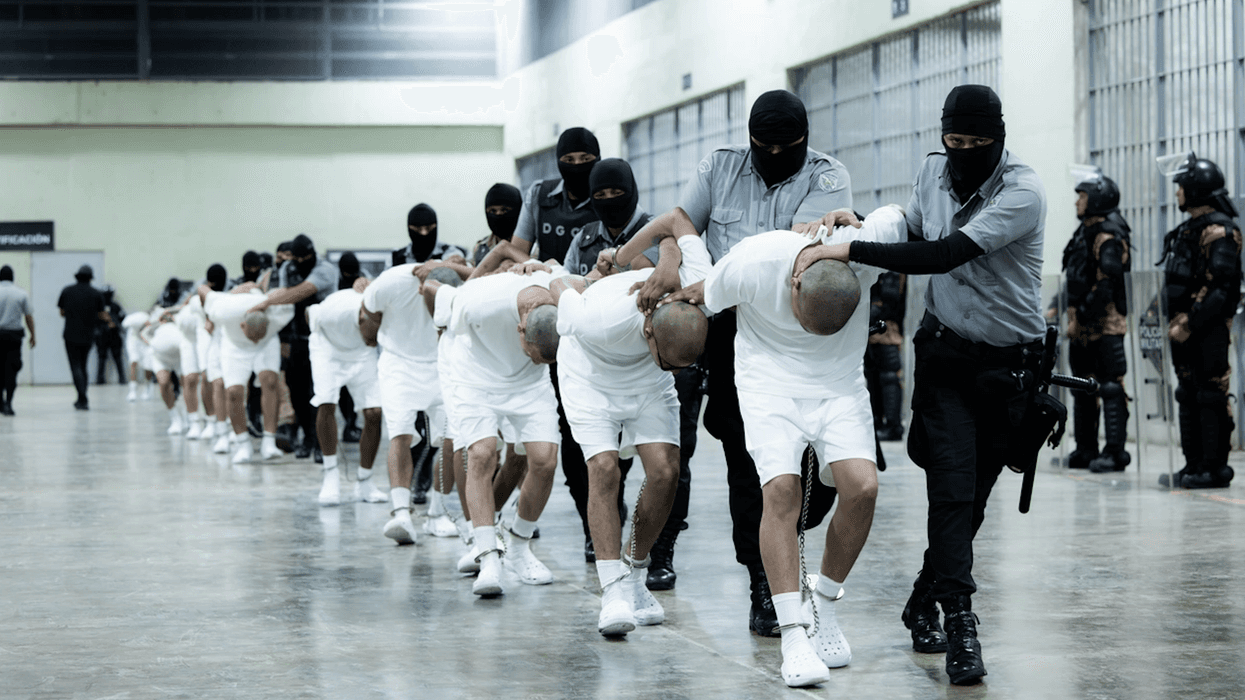
“The Trump administration knowingly and unlawfully locked up an innocent person for four months in a concentration camp-like prison," said one attorney for the plaintiff.
A Utah law firm said Tuesday that it plans to sue the US government for its allegedly unlawful detention and deportation of a Venezuelan immigrant who was sent to a maximum security prison in El Salvador known for its torture and abuse of inmates.
“Our client is a young Venezuelan man who came into the US legally to escape threats of violence by the Venezuelan government against his family for their opposition to the Maduro regime," said Brent Ward, an attorney at Parker & McConkie, referring to Venezuelan President Nicolás Maduro, who was kidnapped by US forces during a January invasion of his country.
Ward said that the client—identified by the pseudonym "Johnny Hernandez"—is seeking $56 million in damages and "has no criminal record either in the US or in Venezuela."
A man entered the U.S. legally, had no criminal record, and was still sent to one of the world's most dangerous prisons for four months. Parker & McConkie is pursuing $56 million in justice on his behalf.www.parkerandmcconkie.com/blog/parker-...#CivilRights #JusticeForJohnny #Immigration #CECOT
[image or embed]
— Parker & McConkie | Personal Injury Law (@parkermcconkie.bsky.social) March 31, 2026 at 2:40 PM
Hernandez was arrested by Immigration and Customs Enforcement (ICE) officers and subsequently deported to the Terrorism Confinement Center (CECOT) in Tecoluca, central El Salvador, where he allegedly suffered torture and other abuse.
“The Trump administration knowingly and unlawfully locked up an innocent person for four months in a concentration camp-like prison where he suffered torture, shooting, beatings, and solitary confinement," Ward stated. "When the US government knowingly and purposefully violates the law by detaining and deporting innocent individuals on false charges and is not held responsible, the individual rights of not just legal immigrants but all Americans are placed in jeopardy."
"Our client suffered catastrophic injuries in CECOT from which he will never fully recover," the lawyer said. "Failing to demand accountability now places all Americans in jeopardy in the future.”
The impending lawsuit comes as ICE proposes to literally warehouse up to 10,000 arrested immigrants in a "megacenter" in Salt Lake City, Utah. Opponents have compared the 833,000-square foot facility to a concentration camp akin to the Topaz War Relocation Center, a harsh, desolate desert prison where Japanese Americans and Japanese people living in the Western US were forcibly interned during World War II.
The case also follows last week's filing of a lawsuit by Neiyerver Adrián León Rengel, one of the Venezuelans sent to CECOT. Like Hernandez, León Rengel—who is seeking $1.3 million in damages—was in the US legally when he was arrested by federal immigration authorities.
Human Rights Watch (HRW) recently said on the one-year anniversary of President Donald Trump’s mass deportation of Salvadorans, Venezuelans, and others that, of the 9,000 Salvadorans expelled from the US since the beginning of last year, “only 10.5% had a conviction in the United States for a violent or potentially violent crime.”
The Salvadoran investigative journalism outlet El Faro—which, along with its staff, has been the target of sweeping government persecution—last year published a report on CECOT, citing one former prisoner who said that inmates are “committing suicide out of desperation.”
At least one deported Salvadoran—longtime Maryland resident Kilmar Ábrego García—was wrongfully expelled due to what the Trump administration called an “administrative error.”
The Trump administration deported hundreds of Venezuelans to CECOT under a multimillion-dollar agreement between the Trump administration and the government of Salvadoran President Nayib Bukele.
While Trump claimed—often without evidence—that the Venezuelan deportees were members of the Tren de Aragua gang, only about 3% of them had violent criminal convictions in the United States, and Department of Homeland Security records show that the Trump administration knew it.
In July 2025, El Salvador released 252 Venezuelans imprisoned at CECOT and sent them to Venezuela in a prisoner swap that saw Maduro's government free 10 US citizens and permanent residents whom it jailed. Many of the repatriated Venezuelans said they suffered torture, sexual assault, severe beatings, and other abuse at CECOT.
Last December, Judge James Boasberg of the US District Court for the District of Columbia ruled that the Trump administration broke the law by deporting the Venezuelans without due process.
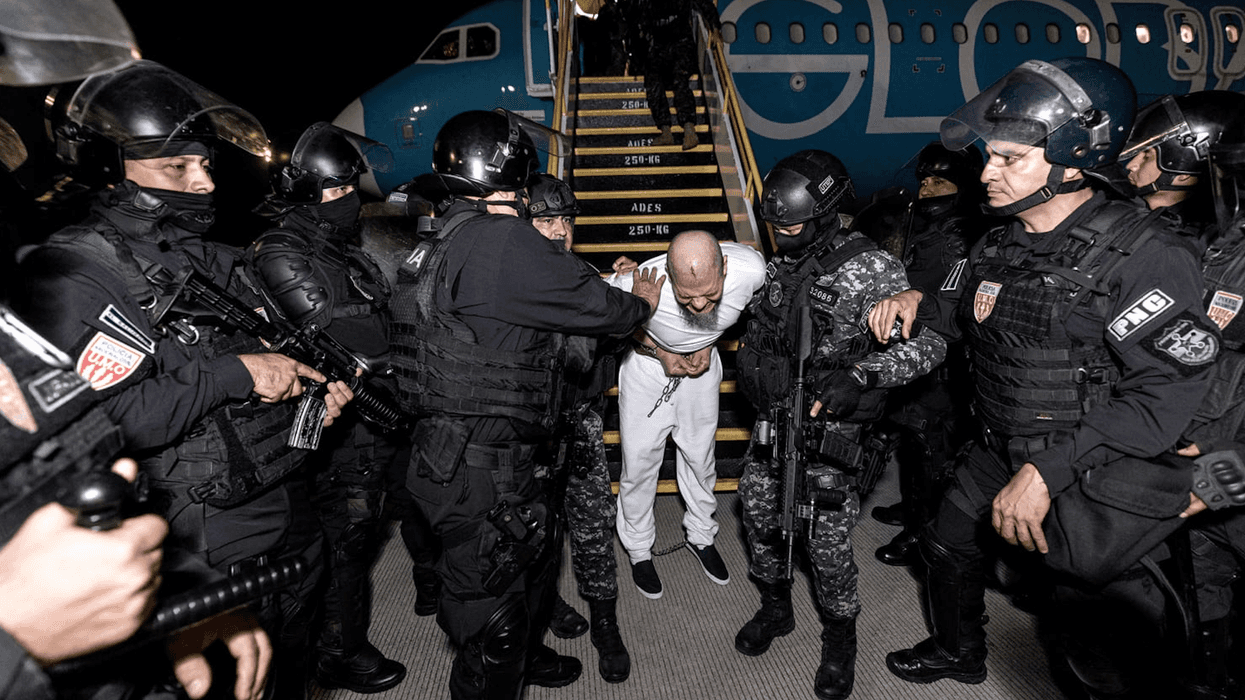
“The desperation of families to find disappeared loved ones evokes the darkest days of dictatorships in Latin America,” said one human rights campaigner.
The administration of right-wing Salvadoran President Nayib Bukele is arbitrarily detaining and forcibly disappearing Salvadorans deported from the United States, a leading rights group said Monday.
Human Rights Watch (HRW) said on the one-year anniversary of President Donald Trump's mass deportation of Salvadorans, Venezuelans, and others that, of the 9,000 Salvadorans expelled from the US since the beginning of last year, "only 10.5% had a conviction in the United States for a violent or potentially violent crime."
Yet according to HRW, these deportees—most of whom were illegally expelled without the requisite due process—were "immediately detained in El Salvador" upon arrival and "have not been allowed to communicate with their relatives or lawyers."
"None of the relatives or lawyers have had any indication from the authorities that the men have been brought before a judge since their arrival," HRW said. "Some have not been informed of where their loved ones are held, or why. In five cases, relatives learned about deportees’ whereabouts only though litigation at the Inter-American Commission on Human Rights (IACHR)."
HRW Americas director Juanita Goebertus said that "whatever the criminal history of these Salvadoran men, they have a right to due process, to be taken before a judge, and their relatives are entitled to know where they are being held and why."
"Deportation cannot mean enforced disappearance," Goebertus added.
Many of the deportees have been sent to the notorious Terrorism Confinement Center (CECOT) in Tecoluca in central El Salvador. HRW and others have documented a range of serious human rights abuses committed by staff at the megaprison, including torture, sexual violence, and brutal beatings.
The Salvadoran investigative journalism outlet El Faro—which, along with its staff, has been the target of sweeping government persecution—last year published a report on CECOT, citing one former prisoner who said that inmates are "committing suicide out of desperation."
While the Trump administration has alleged that many of those expelled are members of MS-13, a street gang founded in the 1980s by Salvadoran immigrants in Los Angeles, neither US nor Salvadoran authorities have provided much evidence to substantiate claims regarding many of the deportees.
At least one deported Salvadoran—longtime Maryland resident Kilmar Ábrego García—was wrongfully expelled due to what the Trump administration called an "administrative error." Abrego García said he was tortured at CECOT before a US federal judge ordered his release last December.
For its new report, HRW interviewed relatives of many of the Salvadoran deportees, one of whose sisters said she "kept calling the migrant shelter in El Salvador, but they never gave me any information."
"So I filed a complaint with the [Salvadoran] Human Rights Ombudsperson’s Office,” she said. “An official told me that my brother was deported on March 15 [but] because of the state of emergency they would not provide any information.”
The mother of another Salvadoran deportee told HRW that she struggled to find legal representation for her son.
“I started looking for lawyers in El Salvador, but several told me they could not take those cases because they feared government reprisals,” she said.
“I called several institutions, the attorney general’s office, the Ombudsperson’s Office, a migrant shelter, and government ministries in El Salvador, but they gave me no information," the woman added. "At the Ombudsperson’s Office, they told me that due to the state of emergency, they were not obligated to provide me with information. I feel abandoned.”
HRW Americas Program deputy director Juan Pappier told The Washington Post Sunday that “these people have been sent to a black hole, a court system with no due process."
Goebertus echoed Pappier's language, saying Monday: “The desperation of families to find disappeared loved ones evokes the darkest days of dictatorships in Latin America. The United States should stop casting people into the black hole of El Salvador’s prison system.”
While credited for dramatically reducing crime in what was not too long ago the world's murder capital, the state of emergency—officially the State of Exception—declared by Bukele in 2022 has been denounced by human rights defenders. It purportedly targets criminals, but others—including journalists, lawyers, human rights advocates, environmental activists, nonprofit workers, political critics, clergy, labor organizers, and community leaders—have been persecuted under the decree.
Originally authorized for 30 days, Bukele has repeatedly extended the State of Exception, fueling accusations of authoritarianism.
HRW noted Monday that Bukele's government has used the emergency decree "to suspend, among others, the rights to be informed promptly of the grounds for arrest, to remain silent, to legal representation, and the requirement to present any detainee before a judge within 72 hours of arrest."
In addition to Salvadorans, hundreds of Venezuelans were sent to CECOT under an agreement between the Trump and Bukele administrations. The US paid millions of dollars to El Salvador to accept the deportees, who Trump claimed—often without evidence—were members of the Tren de Aragua gang.
However, only about 3% of the deported Venezuelans had been convicted of violent criminal offenses in the United States—and the Trump administration knew it, according to Department of Homeland Security records.
Last July, El Salvador released 252 Venezuelans imprisoned at CECOT and sent them to Venezuela in a prisoner swap that saw the government of Venezuelan President Nicolás Maduro free 10 US citizens and permanent residents jailed in the South American nation.
Following their repatriation, many of the Venezuelans said they endured torture, sexual assault, severe beatings, and other abuse at CECOT.
Last December, Judge James Boasberg of the US District Court for the District of Columbia ruled that the Trump administration broke the law by deporting the Venezuelans without due process.
Last week, the International Group of Experts for the Investigation of Human Rights Violations Under the State of Exception in El Salvador (GIPES)—an independent panel of jurists established in 2024—published a report which found that "the serious human rights violations committed by the government of El Salvador during the state of emergency may indeed constitute crimes against humanity because of the widespread and systematic nature of the attacks, their commission against the civilian population, and their commission as part of a state policy or plan."
International Commission of Jurists general secretary Santiago Canton—a member of the panel—said that “the Bukele model is sustained by the dismantling of the rule of law to systematically violate human rights without institutional restraints."
"In the very short term, it may appear to improve security, but it inevitably weakens the very security it claims to protect," Canton added. "The danger is that this approach is increasingly being promoted across Latin America by authoritarian and unscrupulous political leaders as a solution to crime."
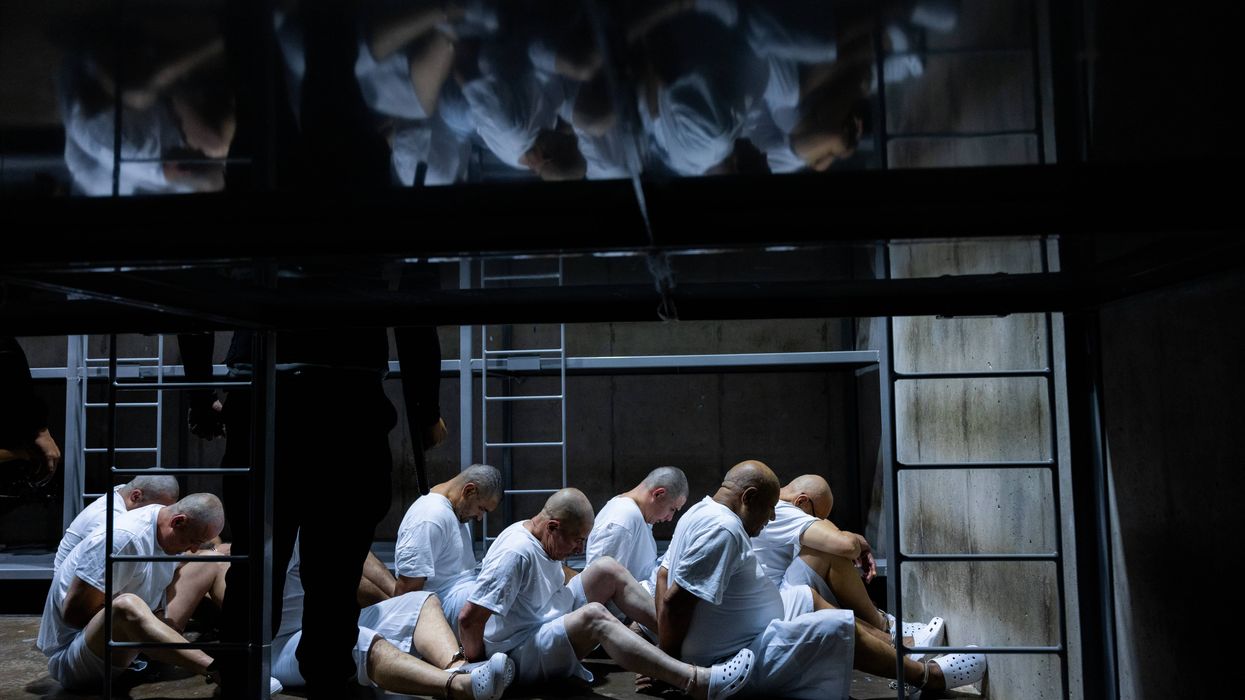
"This ruling makes clear the government can't just send people off to a brutal foreign prison with zero due process and simply walk away," said an ACLU lawyer representing the men.
A federal judge has ruled that the Trump administration acted illegally when it deported over 200 Venezuelan nationals to a notorious prison in El Salvador without due process earlier this year.
On Monday, Judge James Boasberg of the US District Court for the District of Columbia ordered the Trump administration to submit plans by January 5 for 137 men to contest their designation under the Alien Enemies Act of 1798, which allows foreign nationals from "hostile" nations to be removed without hearings.
In March, Trump invoked the Alien Enemies Act to deport two planeloads of Venezuelan nationals to El Salvador without any explanation or court hearing. They were sent to a mega-prison known as the Terrorism Confinement Center, or CECOT, which is known to subject inmates to torture and severe deprivation, with zero contact with the outside world.
The administration claimed the men were members of the Venezuelan gang Tren de Aragua, which the administration referred to as a "hybrid criminal state" invading the United States. In reality, only a few dozen of the 238 men sent to CECOT had any criminal charges against them. As part of the US Immigration and Customs Enforcement's (ICE) efforts to fast-track their deportations, many were rounded up based solely on the fact that they had tattoos.
“Plaintiffs should not have been removed in the manner that they were, with virtually no notice and no opportunity to contest the bases of their removal, in clear contravention of their due-process rights,” Boasberg wrote.
Boasberg is the same judge who launched criminal contempt proceedings against the Trump administration in April for "willful disregard" of his order to stop the flights to El Salvador. A pair of Trump-appointed judges later halted those proceedings.
In a "60 Minutes" special that was recently spiked by CBS News' Trump-friendly editor-in-chief, Bari Weiss, several inmates testified to the conditions they were subject to inside CECOT.
"The first thing they told us was that we would never see the light of day or night again," said college student Luis Muñoz Pinto, who came to the US from Venezuela in 2024 through the legal asylum process. He said the CECOT director told prisoners, "Welcome to hell. I'll make sure you never leave."
According to a report published by Human Rights Watch in November, inmates were beaten daily, subject to sexual violence by guards, deprived of basic food, medical treatment, and hygiene, and forced to participate in degrading torture rituals.
Pinto, who now lives in Colombia, has no criminal record. "I never even got a traffic ticket," he said.
While the Trump administration claimed it no longer had jurisdiction over the prisoners once they were in El Salvador, and therefore could not follow court orders to bring them back to the US, this was belied by filings from the government of the far-right Salvadoran President Nayib Bukele at the United Nations, which stated that "the jurisdiction and legal responsibility for these persons lie exclusively" with the US.
The men detained at CECOT were then transferred, mainly to Venezuela, in July as part of a prisoner exchange for 10 US nationals.
Boasberg says the US government "maintained constructive custody" of the men while they were interned in CECOT and that it violated their rights to due process by not allowing them to contest the accusations that they were gang members.
He said the Trump administration must give them a "meaningful opportunity to contest their designation," by allowing them to return to the US for a court hearing. He said the government "could also theoretically offer plaintiffs a hearing without returning them to the United States so long as such a hearing satisfied the requirements of due process."
"This ruling makes clear the government can't just send people off to a brutal foreign prison with zero due process and simply walk away," said Lee Gelernt, an attorney for the ACLU, who served as lead counsel for the plaintiffs.
The Trump administration will almost certainly appeal the ruling. And while many of the former CECOT inmates may seek to return for their day in court, some say the experience has left them traumatized and fearful of returning to the United States.
Jerce Reyes Barrios, a professional soccer player and youth coach, returned to Venezuela after being released in July. According to his attorney, he was falsely accused due to a tattoo that the government claimed was a gang symbol, but was actually based on the Real Madrid soccer logo.
"I've focused my time on taking care of my daughters, coaching young kids, all to avoid those thoughts. At night, I sometimes have nightmares, and I feel like I'm still in CECOT," Reyes Barrios told ABC News. "At this moment, I'm not ready to decide if I want to fight this case."