SUBSCRIBE TO OUR FREE NEWSLETTER
Daily news & progressive opinion—funded by the people, not the corporations—delivered straight to your inbox.
5
#000000
#FFFFFF
To donate by check, phone, or other method, see our More Ways to Give page.
Daily news & progressive opinion—funded by the people, not the corporations—delivered straight to your inbox.
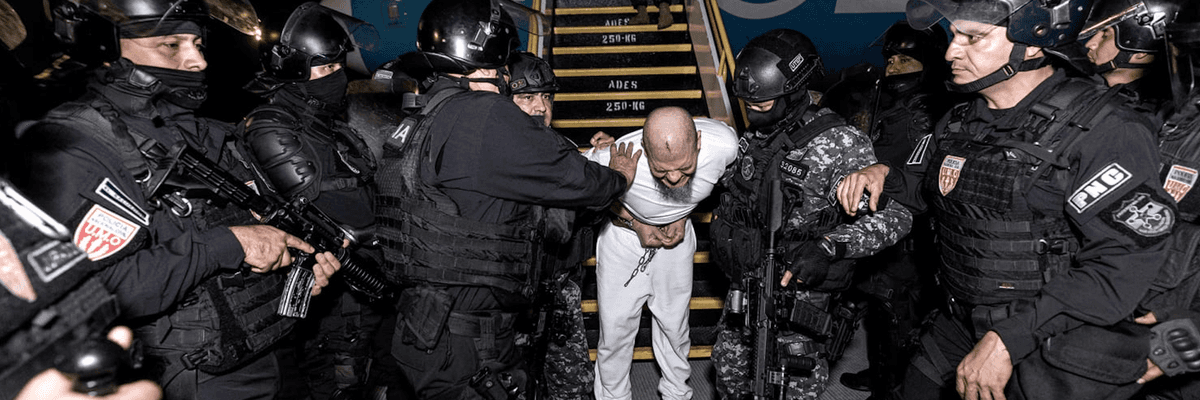
Salvadoran security forces remove a prisoners from a plane transporting deportees from the United States to San Salvador, El Salvador on March 16, 2025.
“The desperation of families to find disappeared loved ones evokes the darkest days of dictatorships in Latin America,” said one human rights campaigner.
The administration of right-wing Salvadoran President Nayib Bukele is arbitrarily detaining and forcibly disappearing Salvadorans deported from the United States, a leading rights group said Monday.
Human Rights Watch (HRW) said on the one-year anniversary of President Donald Trump's mass deportation of Salvadorans, Venezuelans, and others that, of the 9,000 Salvadorans expelled from the US since the beginning of last year, "only 10.5% had a conviction in the United States for a violent or potentially violent crime."
Yet according to HRW, these deportees—most of whom were illegally expelled without the requisite due process—were "immediately detained in El Salvador" upon arrival and "have not been allowed to communicate with their relatives or lawyers."
"None of the relatives or lawyers have had any indication from the authorities that the men have been brought before a judge since their arrival," HRW said. "Some have not been informed of where their loved ones are held, or why. In five cases, relatives learned about deportees’ whereabouts only though litigation at the Inter-American Commission on Human Rights (IACHR)."
HRW Americas director Juanita Goebertus said that "whatever the criminal history of these Salvadoran men, they have a right to due process, to be taken before a judge, and their relatives are entitled to know where they are being held and why."
"Deportation cannot mean enforced disappearance," Goebertus added.
Many of the deportees have been sent to the notorious Terrorism Confinement Center (CECOT) in Tecoluca in central El Salvador. HRW and others have documented a range of serious human rights abuses committed by staff at the megaprison, including torture, sexual violence, and brutal beatings.
The Salvadoran investigative journalism outlet El Faro—which, along with its staff, has been the target of sweeping government persecution—last year published a report on CECOT, citing one former prisoner who said that inmates are "committing suicide out of desperation."
While the Trump administration has alleged that many of those expelled are members of MS-13, a street gang founded in the 1980s by Salvadoran immigrants in Los Angeles, neither US nor Salvadoran authorities have provided much evidence to substantiate claims regarding many of the deportees.
At least one deported Salvadoran—longtime Maryland resident Kilmar Ábrego García—was wrongfully expelled due to what the Trump administration called an "administrative error." Abrego García said he was tortured at CECOT before a US federal judge ordered his release last December.
For its new report, HRW interviewed relatives of many of the Salvadoran deportees, one of whose sisters said she "kept calling the migrant shelter in El Salvador, but they never gave me any information."
"So I filed a complaint with the [Salvadoran] Human Rights Ombudsperson’s Office,” she said. “An official told me that my brother was deported on March 15 [but] because of the state of emergency they would not provide any information.”
The mother of another Salvadoran deportee told HRW that she struggled to find legal representation for her son.
“I started looking for lawyers in El Salvador, but several told me they could not take those cases because they feared government reprisals,” she said.
“I called several institutions, the attorney general’s office, the Ombudsperson’s Office, a migrant shelter, and government ministries in El Salvador, but they gave me no information," the woman added. "At the Ombudsperson’s Office, they told me that due to the state of emergency, they were not obligated to provide me with information. I feel abandoned.”
HRW Americas Program deputy director Juan Pappier told The Washington Post Sunday that “these people have been sent to a black hole, a court system with no due process."
Goebertus echoed Pappier's language, saying Monday: “The desperation of families to find disappeared loved ones evokes the darkest days of dictatorships in Latin America. The United States should stop casting people into the black hole of El Salvador’s prison system.”
While credited for dramatically reducing crime in what was not too long ago the world's murder capital, the state of emergency—officially the State of Exception—declared by Bukele in 2022 has been denounced by human rights defenders. It purportedly targets criminals, but others—including journalists, lawyers, human rights advocates, environmental activists, nonprofit workers, political critics, clergy, labor organizers, and community leaders—have been persecuted under the decree.
Originally authorized for 30 days, Bukele has repeatedly extended the State of Exception, fueling accusations of authoritarianism.
HRW noted Monday that Bukele's government has used the emergency decree "to suspend, among others, the rights to be informed promptly of the grounds for arrest, to remain silent, to legal representation, and the requirement to present any detainee before a judge within 72 hours of arrest."
In addition to Salvadorans, hundreds of Venezuelans were sent to CECOT under an agreement between the Trump and Bukele administrations. The US paid millions of dollars to El Salvador to accept the deportees, who Trump claimed—often without evidence—were members of the Tren de Aragua gang.
However, only about 3% of the deported Venezuelans had been convicted of violent criminal offenses in the United States—and the Trump administration knew it, according to Department of Homeland Security records.
Last July, El Salvador released 252 Venezuelans imprisoned at CECOT and sent them to Venezuela in a prisoner swap that saw the government of Venezuelan President Nicolás Maduro free 10 US citizens and permanent residents jailed in the South American nation.
Following their repatriation, many of the Venezuelans said they endured torture, sexual assault, severe beatings, and other abuse at CECOT.
Last December, Judge James Boasberg of the US District Court for the District of Columbia ruled that the Trump administration broke the law by deporting the Venezuelans without due process.
Last week, the International Group of Experts for the Investigation of Human Rights Violations Under the State of Exception in El Salvador (GIPES)—an independent panel of jurists established in 2024—published a report which found that "the serious human rights violations committed by the government of El Salvador during the state of emergency may indeed constitute crimes against humanity because of the widespread and systematic nature of the attacks, their commission against the civilian population, and their commission as part of a state policy or plan."
International Commission of Jurists general secretary Santiago Canton—a member of the panel—said that “the Bukele model is sustained by the dismantling of the rule of law to systematically violate human rights without institutional restraints."
"In the very short term, it may appear to improve security, but it inevitably weakens the very security it claims to protect," Canton added. "The danger is that this approach is increasingly being promoted across Latin America by authoritarian and unscrupulous political leaders as a solution to crime."
Dear Common Dreams reader, It’s been nearly 30 years since I co-founded Common Dreams with my late wife, Lina Newhouser. We had the radical notion that journalism should serve the public good, not corporate profits. It was clear to us from the outset what it would take to build such a project. No paid advertisements. No corporate sponsors. No millionaire publisher telling us what to think or do. Many people said we wouldn't last a year, but we proved those doubters wrong. Together with a tremendous team of journalists and dedicated staff, we built an independent media outlet free from the constraints of profits and corporate control. Our mission has always been simple: To inform. To inspire. To ignite change for the common good. Building Common Dreams was not easy. Our survival was never guaranteed. When you take on the most powerful forces—Wall Street greed, fossil fuel industry destruction, Big Tech lobbyists, and uber-rich oligarchs who have spent billions upon billions rigging the economy and democracy in their favor—the only bulwark you have is supporters who believe in your work. But here’s the urgent message from me today. It's never been this bad out there. And it's never been this hard to keep us going. At the very moment Common Dreams is most needed, the threats we face are intensifying. We need your support now more than ever. We don't accept corporate advertising and never will. We don't have a paywall because we don't think people should be blocked from critical news based on their ability to pay. Everything we do is funded by the donations of readers like you. When everyone does the little they can afford, we are strong. But if that support retreats or dries up, so do we. Will you donate now to make sure Common Dreams not only survives but thrives? —Craig Brown, Co-founder |
The administration of right-wing Salvadoran President Nayib Bukele is arbitrarily detaining and forcibly disappearing Salvadorans deported from the United States, a leading rights group said Monday.
Human Rights Watch (HRW) said on the one-year anniversary of President Donald Trump's mass deportation of Salvadorans, Venezuelans, and others that, of the 9,000 Salvadorans expelled from the US since the beginning of last year, "only 10.5% had a conviction in the United States for a violent or potentially violent crime."
Yet according to HRW, these deportees—most of whom were illegally expelled without the requisite due process—were "immediately detained in El Salvador" upon arrival and "have not been allowed to communicate with their relatives or lawyers."
"None of the relatives or lawyers have had any indication from the authorities that the men have been brought before a judge since their arrival," HRW said. "Some have not been informed of where their loved ones are held, or why. In five cases, relatives learned about deportees’ whereabouts only though litigation at the Inter-American Commission on Human Rights (IACHR)."
HRW Americas director Juanita Goebertus said that "whatever the criminal history of these Salvadoran men, they have a right to due process, to be taken before a judge, and their relatives are entitled to know where they are being held and why."
"Deportation cannot mean enforced disappearance," Goebertus added.
Many of the deportees have been sent to the notorious Terrorism Confinement Center (CECOT) in Tecoluca in central El Salvador. HRW and others have documented a range of serious human rights abuses committed by staff at the megaprison, including torture, sexual violence, and brutal beatings.
The Salvadoran investigative journalism outlet El Faro—which, along with its staff, has been the target of sweeping government persecution—last year published a report on CECOT, citing one former prisoner who said that inmates are "committing suicide out of desperation."
While the Trump administration has alleged that many of those expelled are members of MS-13, a street gang founded in the 1980s by Salvadoran immigrants in Los Angeles, neither US nor Salvadoran authorities have provided much evidence to substantiate claims regarding many of the deportees.
At least one deported Salvadoran—longtime Maryland resident Kilmar Ábrego García—was wrongfully expelled due to what the Trump administration called an "administrative error." Abrego García said he was tortured at CECOT before a US federal judge ordered his release last December.
For its new report, HRW interviewed relatives of many of the Salvadoran deportees, one of whose sisters said she "kept calling the migrant shelter in El Salvador, but they never gave me any information."
"So I filed a complaint with the [Salvadoran] Human Rights Ombudsperson’s Office,” she said. “An official told me that my brother was deported on March 15 [but] because of the state of emergency they would not provide any information.”
The mother of another Salvadoran deportee told HRW that she struggled to find legal representation for her son.
“I started looking for lawyers in El Salvador, but several told me they could not take those cases because they feared government reprisals,” she said.
“I called several institutions, the attorney general’s office, the Ombudsperson’s Office, a migrant shelter, and government ministries in El Salvador, but they gave me no information," the woman added. "At the Ombudsperson’s Office, they told me that due to the state of emergency, they were not obligated to provide me with information. I feel abandoned.”
HRW Americas Program deputy director Juan Pappier told The Washington Post Sunday that “these people have been sent to a black hole, a court system with no due process."
Goebertus echoed Pappier's language, saying Monday: “The desperation of families to find disappeared loved ones evokes the darkest days of dictatorships in Latin America. The United States should stop casting people into the black hole of El Salvador’s prison system.”
While credited for dramatically reducing crime in what was not too long ago the world's murder capital, the state of emergency—officially the State of Exception—declared by Bukele in 2022 has been denounced by human rights defenders. It purportedly targets criminals, but others—including journalists, lawyers, human rights advocates, environmental activists, nonprofit workers, political critics, clergy, labor organizers, and community leaders—have been persecuted under the decree.
Originally authorized for 30 days, Bukele has repeatedly extended the State of Exception, fueling accusations of authoritarianism.
HRW noted Monday that Bukele's government has used the emergency decree "to suspend, among others, the rights to be informed promptly of the grounds for arrest, to remain silent, to legal representation, and the requirement to present any detainee before a judge within 72 hours of arrest."
In addition to Salvadorans, hundreds of Venezuelans were sent to CECOT under an agreement between the Trump and Bukele administrations. The US paid millions of dollars to El Salvador to accept the deportees, who Trump claimed—often without evidence—were members of the Tren de Aragua gang.
However, only about 3% of the deported Venezuelans had been convicted of violent criminal offenses in the United States—and the Trump administration knew it, according to Department of Homeland Security records.
Last July, El Salvador released 252 Venezuelans imprisoned at CECOT and sent them to Venezuela in a prisoner swap that saw the government of Venezuelan President Nicolás Maduro free 10 US citizens and permanent residents jailed in the South American nation.
Following their repatriation, many of the Venezuelans said they endured torture, sexual assault, severe beatings, and other abuse at CECOT.
Last December, Judge James Boasberg of the US District Court for the District of Columbia ruled that the Trump administration broke the law by deporting the Venezuelans without due process.
Last week, the International Group of Experts for the Investigation of Human Rights Violations Under the State of Exception in El Salvador (GIPES)—an independent panel of jurists established in 2024—published a report which found that "the serious human rights violations committed by the government of El Salvador during the state of emergency may indeed constitute crimes against humanity because of the widespread and systematic nature of the attacks, their commission against the civilian population, and their commission as part of a state policy or plan."
International Commission of Jurists general secretary Santiago Canton—a member of the panel—said that “the Bukele model is sustained by the dismantling of the rule of law to systematically violate human rights without institutional restraints."
"In the very short term, it may appear to improve security, but it inevitably weakens the very security it claims to protect," Canton added. "The danger is that this approach is increasingly being promoted across Latin America by authoritarian and unscrupulous political leaders as a solution to crime."
The administration of right-wing Salvadoran President Nayib Bukele is arbitrarily detaining and forcibly disappearing Salvadorans deported from the United States, a leading rights group said Monday.
Human Rights Watch (HRW) said on the one-year anniversary of President Donald Trump's mass deportation of Salvadorans, Venezuelans, and others that, of the 9,000 Salvadorans expelled from the US since the beginning of last year, "only 10.5% had a conviction in the United States for a violent or potentially violent crime."
Yet according to HRW, these deportees—most of whom were illegally expelled without the requisite due process—were "immediately detained in El Salvador" upon arrival and "have not been allowed to communicate with their relatives or lawyers."
"None of the relatives or lawyers have had any indication from the authorities that the men have been brought before a judge since their arrival," HRW said. "Some have not been informed of where their loved ones are held, or why. In five cases, relatives learned about deportees’ whereabouts only though litigation at the Inter-American Commission on Human Rights (IACHR)."
HRW Americas director Juanita Goebertus said that "whatever the criminal history of these Salvadoran men, they have a right to due process, to be taken before a judge, and their relatives are entitled to know where they are being held and why."
"Deportation cannot mean enforced disappearance," Goebertus added.
Many of the deportees have been sent to the notorious Terrorism Confinement Center (CECOT) in Tecoluca in central El Salvador. HRW and others have documented a range of serious human rights abuses committed by staff at the megaprison, including torture, sexual violence, and brutal beatings.
The Salvadoran investigative journalism outlet El Faro—which, along with its staff, has been the target of sweeping government persecution—last year published a report on CECOT, citing one former prisoner who said that inmates are "committing suicide out of desperation."
While the Trump administration has alleged that many of those expelled are members of MS-13, a street gang founded in the 1980s by Salvadoran immigrants in Los Angeles, neither US nor Salvadoran authorities have provided much evidence to substantiate claims regarding many of the deportees.
At least one deported Salvadoran—longtime Maryland resident Kilmar Ábrego García—was wrongfully expelled due to what the Trump administration called an "administrative error." Abrego García said he was tortured at CECOT before a US federal judge ordered his release last December.
For its new report, HRW interviewed relatives of many of the Salvadoran deportees, one of whose sisters said she "kept calling the migrant shelter in El Salvador, but they never gave me any information."
"So I filed a complaint with the [Salvadoran] Human Rights Ombudsperson’s Office,” she said. “An official told me that my brother was deported on March 15 [but] because of the state of emergency they would not provide any information.”
The mother of another Salvadoran deportee told HRW that she struggled to find legal representation for her son.
“I started looking for lawyers in El Salvador, but several told me they could not take those cases because they feared government reprisals,” she said.
“I called several institutions, the attorney general’s office, the Ombudsperson’s Office, a migrant shelter, and government ministries in El Salvador, but they gave me no information," the woman added. "At the Ombudsperson’s Office, they told me that due to the state of emergency, they were not obligated to provide me with information. I feel abandoned.”
HRW Americas Program deputy director Juan Pappier told The Washington Post Sunday that “these people have been sent to a black hole, a court system with no due process."
Goebertus echoed Pappier's language, saying Monday: “The desperation of families to find disappeared loved ones evokes the darkest days of dictatorships in Latin America. The United States should stop casting people into the black hole of El Salvador’s prison system.”
While credited for dramatically reducing crime in what was not too long ago the world's murder capital, the state of emergency—officially the State of Exception—declared by Bukele in 2022 has been denounced by human rights defenders. It purportedly targets criminals, but others—including journalists, lawyers, human rights advocates, environmental activists, nonprofit workers, political critics, clergy, labor organizers, and community leaders—have been persecuted under the decree.
Originally authorized for 30 days, Bukele has repeatedly extended the State of Exception, fueling accusations of authoritarianism.
HRW noted Monday that Bukele's government has used the emergency decree "to suspend, among others, the rights to be informed promptly of the grounds for arrest, to remain silent, to legal representation, and the requirement to present any detainee before a judge within 72 hours of arrest."
In addition to Salvadorans, hundreds of Venezuelans were sent to CECOT under an agreement between the Trump and Bukele administrations. The US paid millions of dollars to El Salvador to accept the deportees, who Trump claimed—often without evidence—were members of the Tren de Aragua gang.
However, only about 3% of the deported Venezuelans had been convicted of violent criminal offenses in the United States—and the Trump administration knew it, according to Department of Homeland Security records.
Last July, El Salvador released 252 Venezuelans imprisoned at CECOT and sent them to Venezuela in a prisoner swap that saw the government of Venezuelan President Nicolás Maduro free 10 US citizens and permanent residents jailed in the South American nation.
Following their repatriation, many of the Venezuelans said they endured torture, sexual assault, severe beatings, and other abuse at CECOT.
Last December, Judge James Boasberg of the US District Court for the District of Columbia ruled that the Trump administration broke the law by deporting the Venezuelans without due process.
Last week, the International Group of Experts for the Investigation of Human Rights Violations Under the State of Exception in El Salvador (GIPES)—an independent panel of jurists established in 2024—published a report which found that "the serious human rights violations committed by the government of El Salvador during the state of emergency may indeed constitute crimes against humanity because of the widespread and systematic nature of the attacks, their commission against the civilian population, and their commission as part of a state policy or plan."
International Commission of Jurists general secretary Santiago Canton—a member of the panel—said that “the Bukele model is sustained by the dismantling of the rule of law to systematically violate human rights without institutional restraints."
"In the very short term, it may appear to improve security, but it inevitably weakens the very security it claims to protect," Canton added. "The danger is that this approach is increasingly being promoted across Latin America by authoritarian and unscrupulous political leaders as a solution to crime."