

SUBSCRIBE TO OUR FREE NEWSLETTER
Daily news & progressive opinion—funded by the people, not the corporations—delivered straight to your inbox.
5
#000000
#FFFFFF
To donate by check, phone, or other method, see our More Ways to Give page.
Daily news & progressive opinion—funded by the people, not the corporations—delivered straight to your inbox.
The staged photo op was actually a good reminder of the gap between the White House’s rhetoric and reality.
There is little doubt that most of the benefits of President Donald Trump’s One Big Beautiful Bill Act flow to the wealthy. But the White House has put considerable effort into promoting the idea that the law benefits working class people too, in particular those who earn tips.
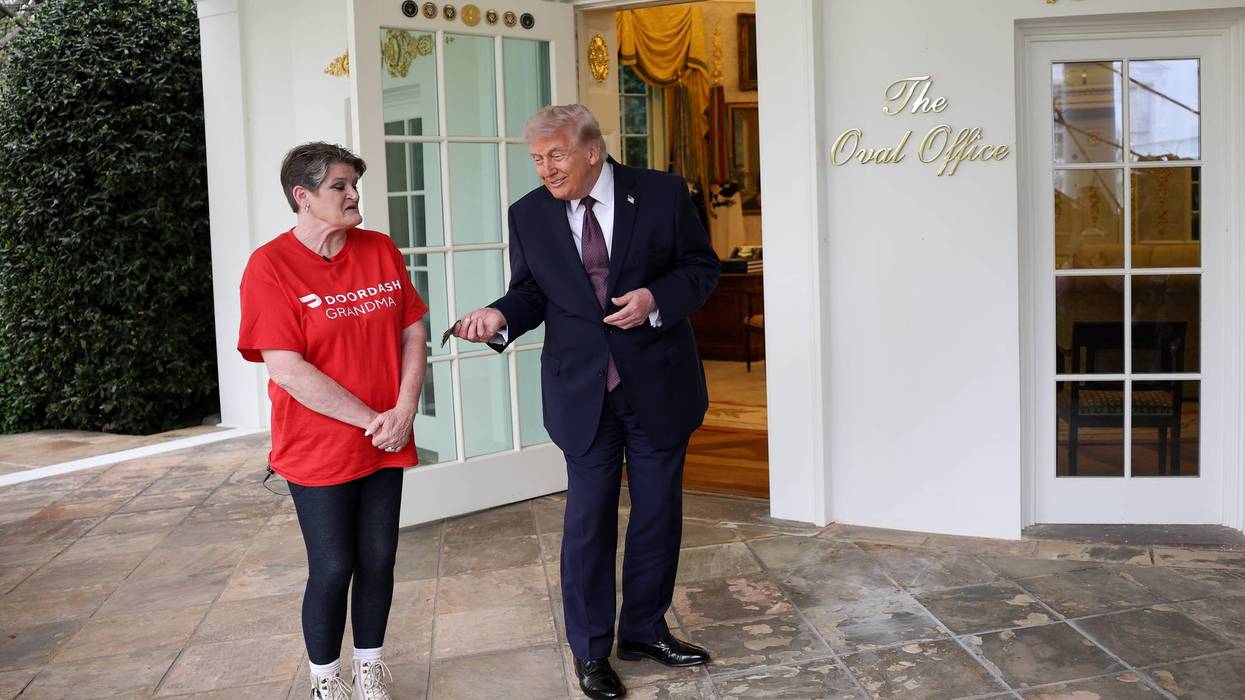
To drive that point home, they staged an April 13 photo op with a DoorDash delivery to the White House. But the stunt was actually a good reminder of the gap between the White House’s rhetoric and reality.
First, it helps to understand that the "no tax on tips" policy applies to very few workers; less than 3% of workers are tipped. And its effects are even narrower than that. The policy is actually a deduction (topping out at $25,000) that can be claimed by tipped workers to lower their taxable income. But many tipped workers—about 1 in 3, or possibly close to 40%—do not earn enough to file taxes, so this deduction does them no good.
Now on to the White House event. When DoorDash driver Sharon Simmons "delivered" his McDonald’s order, President Trump commented that she “picked up an extra $11,000” because of the new policy. As Paul Waldman (and others) noted, this was mathematically dubious, given the $25,000 cap on the deduction. Indeed, Simmons would later explain that she earned $11,000 in tips, not that she saved that amount of money on her taxes. How much she saved on her taxes is unclear; by one high-end estimate, if she were paying a 24% tax rate she would have saved just $2,640.
If the goal of these kinds of policies are to provide some relief for workers—especially those earning a low wage—there are plenty of other options that would apply more broadly. Raising the minimum wage, for example, or eliminating the subminimum "tipped" wage would put more money in more workers’ pockets.
Speaking just after the White House photo op—and at a different "no tax on tips" event—Trump said the photo op was “a little tacky.” Given that Simmons is making DoorDash deliveries to pay for her husband’s cancer treatments, and the fact that his signature tax cut bill slashes food assistance and will cause millions to lose their health insurance coverage, "tacky" is an understatement.
"The fact that a term like 'DoorDash grandma' exists should be a wake-up call," said the head of One Fair Wage. "It should never exist in the first place."
While "DoorDash Grandma" made the company's first food delivery to the White House on Monday to promote President Donald Trump's "no tax on tips" policy, the awkward encounter outside the Oval Office not only highlighted critiques of that provision of the GOP budget package but also sparked calls for a living wage and universal healthcare.
"A perfect image of the Trump era: A grandmother has to work at DoorDash in order to get by, while the president decorates his office in gold accent pieces," said Democratic strategist Max Burns, sharing a photo of the delivery on social media.
Saru Jayaraman, president of worker advocacy group One Fair Wage, told Common Dreams that "it's sad, and it's a sign of a failing society—not something to celebrate or turn into a photo op. We've normalized an economy where older people are pushed into gig work just to survive. The fact that a term like 'DoorDash grandma' exists should be a wake-up call. It should never exist in the first place."
"Corporations are paying poverty wages while policymakers offer Band-Aid solutions like 'no tax on tips' instead of paying a living wage," Jayaraman continued. "At the same time, cuts to Medicaid and food assistance are stripping away the safety net workers rely on to get by. This is all pushing people into greater dependence on tips and unstable income. Workers don't need gimmicks—they need living wages, corporate accountability, and real economic security."
Trump and then-Vice President Kamala Harris latched on to the no tax on tips policy during the 2024 campaign, despite warnings from economists and others that it is a "deceptive ploy," as the Economic Policy Institute's David Cooper and Nina Mast put it last year.
"It does nothing to address the low wages, income instability, wage theft, and abuse tipped workers already face," the pair reiterated in February. "Instead, it may undermine efforts to raise tipped minimum wages, push more workers into tipped jobs, increase workloads, and prompt customers to tip less if they believe tipped workers receive special tax treatment."
After related legislation passed the US Senate last year, Jayaraman said that "for all the bipartisan celebration, this bill is a distraction from the real fight... If Democrats want to offer a true alternative, they need to say it loud and clear: It's time to raise the minimum wage and end the subminimum wage once and for all."
A no tax on tips policy was ultimately included in Republicans' so-called One Big Beautiful Bill Act—which, as a recent Institute on Taxation and Economic Policy analysis details, featured tax breaks that primarily benefited wealthy individuals and corporations while cutting programs that serve working families, such as Medicaid and the Supplemental Nutrition Assistance Program.
Specifically, last year's GOP budget package established a temporary federal income tax deduction for tips, capped at $25,000 per year, through 2028. In a February report, the libertarian Cato Institute estimated that "the roughly 3% of tax returns projected to claim the tips deduction in 2026 will receive an average tax cut of about $1,370," and "as a share of after-tax income, the tips deduction broadly benefits those in the middle of the income distribution."
"These provisions also add to the already large number of tax deductions and credits that shield vastly uneven amounts of income from taxation based on family size and childcare arrangements," the Cato report notes. "In addition to the income limits, the tips deduction is only available to occupations that 'customarily and regularly received tips' before 2025."
Sharon Simmons, who wore a red shirt that read "DoorDash Grandma" while delivering McDonald's bags at the White House on Monday, told Trump that she benefited from the policy. In a statement, the company identified her as an Arkansas-based grandmother of 10 who "started dashing in 2022 to earn income while keeping control of her schedule."
During the delivery, the president asked Simmons whether she voted for him—"uh, maybe," she said—and about banning transgender women from competing in sports in line with their gender identity, on which she said she did not have an opinion.
Labor reporter Michael Sainato pointed out that Simmons previously lived in Nevada and advocated for the no tax on tips policy to the US House Ways and Means Committee last year. He also questioned her comments to Trump about having saved over $11,000 on her most recent tax bill.
The dasher claims "$11,000 in savings by not having to claim." You still have to claim tipsYou can only deduct up to $25k in tips, so $11k in savings off of one year didn't happenThe tax savings are actually minimal taxpolicycenter.org/fiscal-facts...
[image or embed]
— Michael Sainato (@msainato.bsky.social) April 13, 2026 at 3:39 PM
While Trump staff and congressional Republicans shared footage of Simmons' delivery to Trump to promote the budget package provision in the lead-up to tax day, US Rep. Dina Titus (D-Nev.) stressed on social media Monday that the president's "policy is severely limited and sunsets in 2028."
"We must make it permanent and increase the minimum wage to support our nontipped workers like childcare, fast food, and retail. We can do both by passing my LIFT Act," said Titus, whose Labor Income Fairness and Transparency Act is backed by One Fair Wage.
"Cutting taxes on tips might make for a good sound bite, but on its own, it's a hollow fix that ignores the real crisis: Wages so low that two-thirds of restaurant workers don't even earn enough to pay federal income taxes," Jayaraman said last year, when Titus introduced the bill. "In a time of skyrocketing costs, workers are drowning and need more than political gimmicks—they need a raise."
"Tips should be a bonus, not a substitute for a living wage," she argued. "By ending all subminimum wages and requiring that all workers be paid a full livable wage with tips on top, the LIFT Act addresses what working people need most: a fair wage, a level playing field, and the dignity that comes with being able to provide for their families."
Some observers on Monday also noted Simmons' appearance on Fox News, during which she acknowledged the financial burden of her husband's 2025 cancer diagnosis.
"Grandma shouldn't have to rely on DoorDash tips to make up for Republicans doubling the cost of healthcare," declared Democrats on the House Ways and Means Committee, sharing a clip of the interview on social media.
Melanie D'Arrigo, executive director of Campaign for New York Health, which advocates for universal, single-payer healthcare, emphasized that "'no tax on tips' does not make up for the fact that no one can afford healthcare."
Historian Timothy Snyder said, "So let’s have universal healthcare and help people live in dignity."
"Just one authoritarian thing after another."
US President Donald Trump's White House has reportedly created a scorecard that rates American corporations and trade groups based on how fervently they have promoted Trump's agenda, a move that critics described as part of the president's authoritarian approach to governing and dealing with private businesses.
Axios, which first reported on the White House scorecard Friday, explained that the document "rates 553 companies and trade associations on how hard they worked to support and promote President Trump's 'One Big Beautiful Bill,'" which includes massive corporate tax breaks and unprecedented cuts to safety net programs.
"Factors in the rating include social media posts, press releases, video testimonials, ads, attendance at White House events, and other engagement related to 'OB3,' as the megabill is known internally," the outlet reported. "The organizations' support is ranked as strong, moderate, or low. Axios has learned that 'examples of good partners' on the White House list include Uber, DoorDash, United, Delta, AT&T, Cisco, Airlines for America, and the Steel Manufacturers Association."
The spreadsheet is reportedly being circulated to senior White House staffers and is expected to evolve to gauge companies' support for other aspects of the president's agenda. Corporations that decline to praise Trump's policies—or dare to criticize them—could face government retribution.
"Just one authoritarian thing after another," Rachel Barnhart, a Democratic member of the Monroe County, New York Legislature, wrote in response to the Axios story.
News of the internal "loyalty rating" spreadsheet comes days after Trump reached an unprecedented deal with the chip giants Nvidia and Advanced Micro Devices that critics likened to a strongman-style "shakedown." The companies agreed to pay the US government 15% of their revenues from exports to China in exchange for obtaining export licenses.
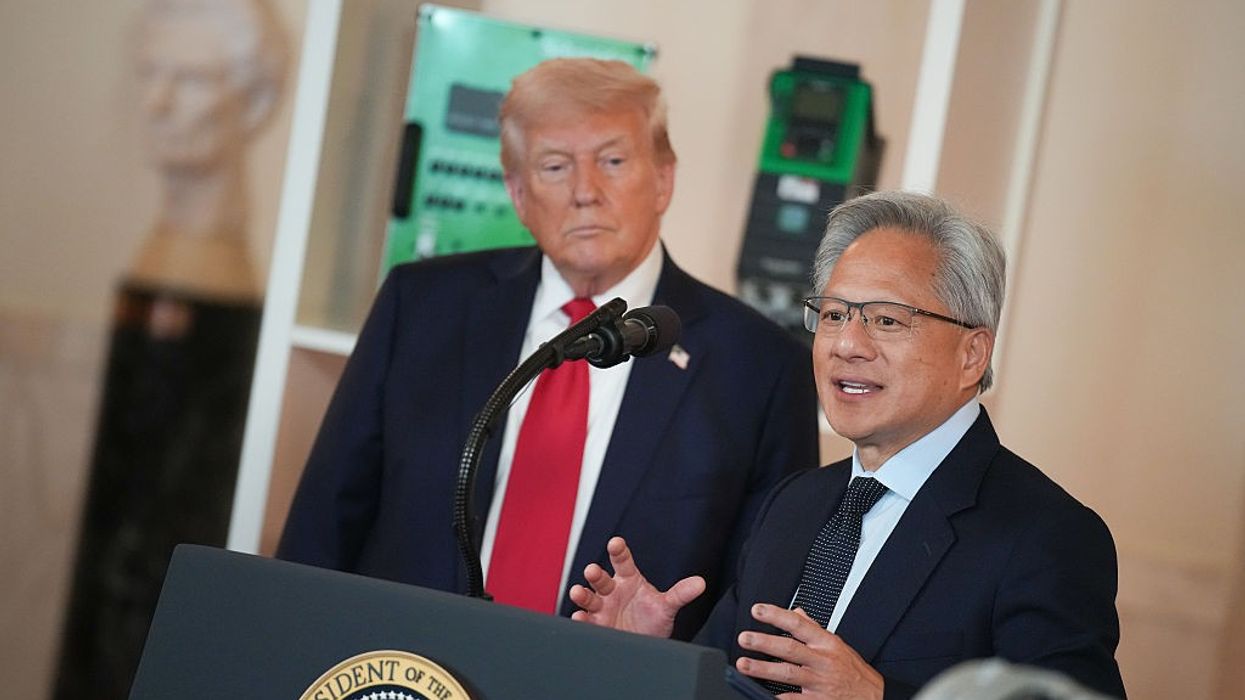
Trump, who has reported substantial holdings in Nvidia, has hosted company CEO Jensen Huang—one of the richest men in the world—at the White House at least twice this year. Huang has effusively praised the president, calling his policies "visionary."
That's just one example of how major CEOs have sought to flatter Trump, who has proven willing to publicly attack executives—and even demand their resignation.
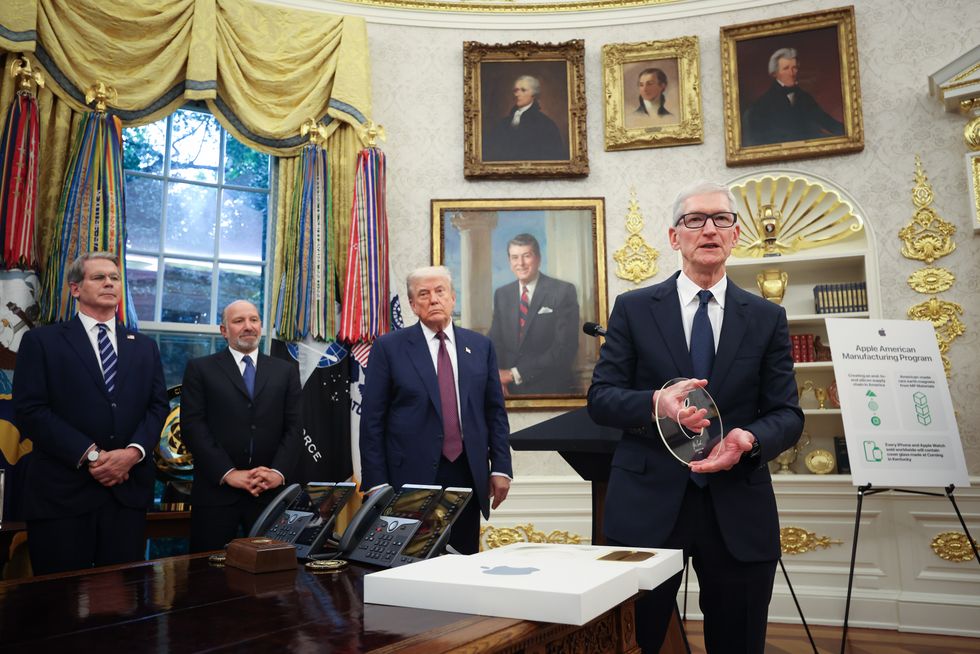
Fortune noted Wednesday that "Apple CEO Tim Cook gave Trump a customized glass plaque mounted on a 24-karat gold stand last week, when he announced his company’s $100 billion investment in domestic production."
Cook also donated $1 million to Trump's inaugural fund.
Companies that have worked to get in the president's good graces appear to be reaping significant rewards.
A Public Citizen analysis published earlier this week found that companies spending big in support of Trump are among the chief beneficiaries of his administration's deregulatory blitz and retreat from corporate crime enforcement.
"Tech corporations facing ongoing federal investigations and enforcement lawsuits that are at risk of being dropped or weakened following the industry's influence efforts include Amazon, Apple, ByteDance, Google, Meta, OpenAI, Snap, Uber, Zoom, and Musk-helmed corporations The Boring Company, Neuralink, SpaceX, Tesla, X, and xAI," the group said.
Business journalist Bill Saporito wrote in an op-ed for The New York Times earlier this week that "in ripping up numerous business regulations, Donald Trump seems intent on replacing them with himself."
"The recipient corporations don't necessarily want Mr. Trump's meddling, particularly given his fun house view of economics," Saporito added, "but they can't get away from it."
As the “gig” model has taken hold, many traditional, stable jobs have been put in jeopardy, and many of the hard-fought rights associated with them are being dismantled or watered down.
In his 1930 essay “ Economic Possibilities for Our Grandchildren”, the economist John Maynard Keynes predicted that future generations would someday work 15 hours a week. The theory was based on anticipated advances in technology and productivity. Keynes’ theory has a strange kind of prescience today (though not quite in the way he expected). What’s called the “gig economy”—a labor market that relies heavily on part-time, temporary, or freelance work—resembles his prediction in a backward sort of way, as numerous industries and occupations have moved away from fixed, stable employment toward short-term flexibility.
Conclusive data on the current size of the independent contractor workforce in the U.S. is difficult to find. Different sources disagree on the scale. In 2017, according to data from the Bureau of Labor Statistics, about 6.9% of workers in America were classified as independent contractors (lower than in 2005). However, the Covid-19 pandemic increased demand for delivery services and rideshare apps (Uber, Doordash, Instacart). A study published last year by the National Bureau of Economic Research found that independent contractors may be around 15% of all workers.
Gig workers are not a particularly large slice of our labor force, but they represent a microcosm of a larger trend—the effects of post-Fordism (post-industrialism). In the 1970s, America transitioned away from the Fordist model of labor, where people worked on assembly lines in the mass production of goods. As this was happening, wages began to stagnate, union membership declined, and the U.S. lost its domestic manufacturing base. The New Deal coalition was dissolved, and the working class became less and less associated with the Democratic Party.
Keeping people stuck in low-wage, part-time jobs in the service sector without security or benefits is a poor substitute for fair compensation, and companies cannot rely on it forever.
A major change has taken place in the economic organization of our society. As social safety nets and union membership have been eroded, job precarity has become a permanent state for many Americans. In the gig economy, your position and status are constantly in flux. Maybe you do your job online in a hybrid or work-from-home format. Maybe you move around between periods of unemployment and temporary or part-time employment. Under the Fordist model, a person could expect to work at the same place for their entire lives with rising standards of living. The gig economy, by contrast, is a fractured labor market where work is increasingly isolated, casualized, and digitized, and limited compensation and benefits are the norm. Gig work is particularly common among younger generations. Nearly 45% of millennial professionals do freelance work (many in addition to other jobs).
In 1997, Alan Greenspan, the then-Chairman of the Federal Reserve, testified before Congress, and he attributed the success of the economy to growing “worker insecurity.” Essentially, workers were too worried about keeping their jobs to ask for higher wages or benefits. They no longer had the same kind of job security, which meant they were in a weaker bargaining position. If you’re an employer, this kind of relationship is ideal. You keep labor costs low, and profits high.
Nowhere is this basic lack of fairness more evident than in gig positions. If you’re classified as an independent contractor, there are a whole host of legal rights that don’t apply to you. It varies by state, but in Massachusetts, for example, you don’t have a right to a minimum wage, overtime, or sick pay. You’re not eligible for unemployment benefits. You’ll almost certainly have a harder time finding health, dental, or vision insurance. Benefits such as retirement, worker’s compensation, and family leave are also generally not offered. You most likely won’t get paid time off for public holidays. Anti-discrimination laws don’t protect you, and you can’t legally sue your employer for wrongful termination (although there are exceptions if the employer has violated a written contract). Independent contractor status also severely limits the possibilities of labor organizing.
There are some benefits to independent contract work (it’s easier to set your own hours, work remotely), but in an ideal labor market, people would have a choice between flexibility and stability. They wouldn’t be forced into either category. For many people, this doesn’t seem to be the case.
In 2020, rideshare drivers in California fought a bitter fight to avoid being classified as independent contractors. The state had previously passed Assembly Bill 5, which required rideshare drivers to be classified as employees. Uber, Lyft, and other companies drafted and campaigned for Prop. 22 to exclude drivers from being classified as employees and spent more than $200 million supporting the measure, according to OpenSecrets. The U.S. Department of Labor and the National Labor Relations Board also supported the bill. In 2020, the measure passed.
As gig positions become more and more common, we can expect to see similar fights in other industries, with similar results. Companies can essentially rewrite labor laws in their favor, and poor and working people bear the brunt of this.
Alternatives to Uber have also suffered. A significant share of the market has been taken away from traditional cab companies. New York City’s taxi medallion system, for instance, has faced a collapse. The medallions (which are required to operate a yellow cab) once sold for up to $1 million, but have plummeted in value, now going for as little as $90,000. Many cab drivers have worked for years to earn these medallions, planning to lease them to new drivers to finance their retirement. These people have essentially had their savings wiped out.
In 2018, New York drivers experienced a string of suicides related to the increased difficulties of earning a living in these positions. In February, 2018, a livery driver named Doug Schifter committed suicide in front of City Hall. He had previously been the writer of a column in a trade publication about how app-based services were flooding his market. Later that year, a cab driver named Nicanor Ochisor hanged himself in his garage. His family publicly stated that ridesharing companies like Uber and Lyft had made it impossible for him to earn a living.
In other industries, such as academia, gig workers are being similarly squeezed. Adjunct or contract-renewable professors may make less than half what tenured professors make, and often have to string together work across multiple universities, sometimes supported with tutoring, test proctoring, and other side jobs. According to survey data released in 2022 by the American Federation of Teachers, “a quarter of adjunct faculty have an annual salary below the federal poverty line.” These professors often have limited or no benefits, and no guarantee of work past the current semester.
These are just a few examples. As the “gig” model has taken hold, many traditional, stable jobs have been put in jeopardy, and many of the hard-fought rights associated with them are being dismantled or watered down. We’ve entered the age of casualized work, but for the opposite reason Keynes predicted—not because we’re basking in leisure, but because we’re trapped in a state of precarity. Productivity has increased, but these gains have not been evenly distributed.
Aside from being unfair, this model is also unsustainable. Keeping people stuck in low-wage, part-time jobs in the service sector without security or benefits is a poor substitute for fair compensation, and companies cannot rely on it forever. The essential hollowness of this model is in plain view, and the subordination of workers to these demands will, sooner or later, collapse. It’s impossible to predict when exactly this will happen, or on what scale, but it can be predicted that it will happen eventually.
How can this be overcome? A sharp reversal of course is needed. Working conditions are unlikely to improve unless we can rebuild the popular institutions which guarantee our rights. Labor unions in particular can establish paths to long-term job security and multi-year contracts as industry standards. Additionally, peer countries have addressed the shortcomings of gig work by offering things like paid family leave, sick leave and universal healthcare to the population. The U.S. needs to encourage broad, expansive change to address these growing concerns, and re-write the terms of our social contract to create routes to economic security. If there is to be any kind of positive development in this area of the labor market, it will depend on these efforts.
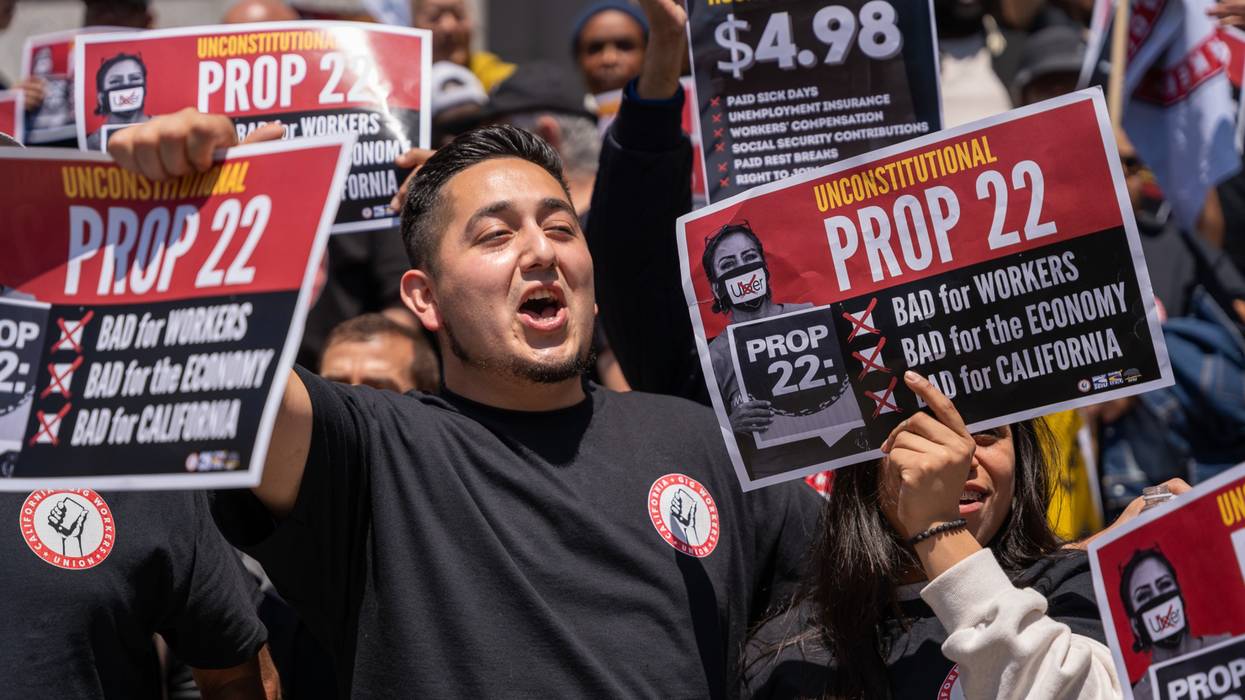
"Today's ruling only strengthens our demand for the right to join together in a union so that we can begin improving the gig economy for workers and our customers," the case plaintiff said.
Labor advocates on Thursday decried a ruling by the California Supreme Court upholding a lower court's affirmation of a state ballot measure allowing app-based ride and delivery companies to classify their drivers as independent contractors, limiting their worker rights.
The court's seven justices ruled unanimously in Castellanos v. State of California that Proposition 22, which was approved by 58% of California voters in 2020, complies with the state constitution. Prop 22—which was overturned in 2021 by an Alameda County Superior Court judge in 2021—was upheld in March 2023 by the state's 1st District Court of Appeals.
The business models of app-based companies including DoorDash, Instacart, Lyft, and Uber rely upon minimizing frontline worker compensation by categorizing drivers as independent contractors instead of employees. Independent contractors are not entitled to unemployment insurance, health insurance, or compensation for business expenses.
There are approximately 1.4 million app-based gig workers in California, according to industry estimates.
While DoorDash hailed Thursday's ruling as "not only a victory for Dashers, but also for democracy itself," gig worker advocates condemned the decision.
"Over the last three years, gig workers across California have experienced firsthand that Prop 22 is nothing more than a bait-and-switch meant to enrich global corporations at the expense of the Black, brown, and immigrant workers who power their earnings," plaintiff Hector Castellanos, who drives for Uber and Lyft, said in a statement.
"Prop 22 has allowed gig companies like Uber, Lyft, and DoorDash to deprive us of a living wage, access to workers compensation, paid sick leave, and meaningful healthcare coverage," Castellanos added. "Today's ruling only strengthens our demand for the right to join together in a union so that we can begin improving the gig economy for workers and our customers."
Lorena Gonzalez, president of the California Federation of Labor Unions, AFL-CIO, said that "we are deeply disappointed that the state Supreme Court has allowed tech corporations to buy their way out of basic labor laws despite Proposition 22's inconsistencies with our state constitution."
"These companies have upended our social contract, forcing workers and the public to take on the inherent risk created by this work, while they profit," she continued. "A.B. 5 granted virtually all California workers the right to be paid for all hours worked, health and safety standards, unemployment insurance, workers compensation, and the right to organize."
"Rideshare and delivery drivers deserve those rights as well," Gonzalez stressed.
The Gig Workers Rising campaign said on social media that "Uber and other app corporations spent $220 million to buy this law, and they did it by tricking Californians."
Prop 22's passage in November 2020 with nearly 59% of the vote was the culmination of what was by far the most expensive ballot measure in California history. App-based companies and their backers outspent labor and progressive groups by more than 10 to 1, with proponents pouring a staggering $204.5 million into the "yes" campaign's coffers against just $19 million for the "no" side.
"Voters were told the initiative would provide us with 'historic new benefits' and guaranteed earnings," said Gig Workers Rising. "But since it went into effect, drivers have seen our pay go down, learned the benefits are a sham, and have to accept unsafe rides because of the constant threat of being 'deactivated,' kicked off the app with little explanation or warning."
"If Uber really cared about good benefits and fair wages, it could make that happen tomorrow," the campaign added. "Instead, it has shown it would rather slash pay, bamboozle voters, and put drivers' lives and livelihoods in danger—all while promising $7 billion in stock buybacks to banks and billionaires."
Veena Dubal, a law professor at the University of California, Irvine who focuses on labor and inequality, told CalMatters that Thursday's ruling was "a really tragic outcome," but "it's not the end of the road."
Dubal's sentiment was echoed by some California state legislators, who said the ruling presents an opportunity to act.
"While this decision is frustrating, it must also be motivating," said state Senate Labor Committee Chair Lola Smallwood-Cuevas (D-28). "I'm more determined than ever to ensure that all workers—including our diverse and Black, Indigenous, and people of color-led gig workforce—have the basic protections of workers compensation, paid sick leave, family leave, disability insurance, and the right to form a union."
Prop 22 has served as a template for lawmakers in other states seeking to deny or limit basic worker rights, benefits, and protections.
In Massachusetts, app-based companies have been fighting for years to get a measure to classify drivers as contractors on the state ballot. In 2022, Lyft made the largest political donation in state history—$14.4 million—to a coalition funding one such proposal.
Last month, Uber and Lyft reached an agreement with the office of Massachusetts Attorney General Andrea Campbell, a Democrat, to pay $175 million to settle a lawsuit filed in 2020. As part of the deal, the companies also agreed to increase driver pay and provide paid sick leave, accident insurance, and some health benefits. The agreement does not address how app-based gig workers should be classified.
Why Seattle’s City Council should reject calls to repeal or weaken PAY UP! policies protecting app-based workers.
A mere two months after a series of new protections for certain app-based workers in Seattle took effect, corporations like DoorDash and Uber Eats that had opposed them are trying to destroy them another way: by charging new service fees in order to tank consumer demand and available work.
In doing so, these companies manipulate more than just the market. They orchestrate a political backlash in which they seek consumers and workers to join them in denouncing the law as the culprit and clamoring for its repeal. It’s a tactic from a well-worn playbook.
As Seattle’s City Council recently recognized in passing the minimum pay law, these corporations “often pay app-based workers subminimum wages despite the promise of good wages, flexibility, and accessibility.” Moreover, these digital labor platforms rely disproportionately on Black and Latinx workers to provide the services they offer. Again, the City Council astutely recognized that such workers “face unique barriers to economic security and disproportionately must accept low-wage, unsafe, and insecure working conditions.” Black and Latinx workers are “disproportionately deprived of core employee protections” because the corporations treat them as independent contractors.
The new policies did not require DoorDash, Uber Eats, or any other company to increase service fees instead of ensuring that their workers benefit.
The Seattle City Council wisely sought to tackle and reverse these unfair and inequitable conditions. It declared that: “the City intends to address the inequities of app-based work by ensuring that such workers earn at least the city’s minimum wage plus reasonable expenses, receive transparent information on job offers and pay, and exercise the flexibility promised by network companies.”
Policy changes take time to have impact. Yet the City Council is already facing pressure from these corporations to reverse policies that they committed to just recently.
That’s because these corporations have launched one of their favorite strategies: use their control of the apps to bamboozle consumers, workers, and even elected officials into thinking that workplace protections are too costly and unworkable. In New York City, for example, after a new pay standard for app-based delivery workers took effect, “the companies wasted no time in restricting workers’ access to their platforms and discouraging tips.” Such tactics are designed to undermine support for the new protections.
App-based delivery companies are imitating the corporate tactics Uber and Lyft have used against ridehail drivers. Although Seattle’s city laws can’t touch ridehail driver conditions after the corporations pushed through a problematic preemption policy, recent analysis of that industry shows the need to drill down on the true causes and impacts of price increases. Uber and Lyft raised fares substantially more in Chicago—a city without a pay standard for app-based drivers—than in New York City, which enacted a relatively robust pay standard. If corporate claims that pay increases necessarily make rides prohibitively expensive were true, New York’s riders would have seen the more drastic increases.
Given these predictable tactics, perhaps it is no surprise that Seattle’s app-based workers are still struggling, at the mercy of corporate greed and gamesmanship. They log on and make themselves available for work, only to find there is suddenly little work to be had. It’s easy to see why many would blame the new laws, but the new policies did not require DoorDash, Uber Eats, or any other company to increase service fees instead of ensuring that their workers benefit.
The likely culprit isn’t the new protections, and the City Council should not be fooled. Rather than caving to corporate demands that reduce pay for disproportionately Black and immigrant workers who can least afford it, the council should demand data from the corporations to conduct rigorous, neutral research on its true impacts. For their part, the corporations that insist that new protections are the problem should be eager to turn over the data that will prove their case. But their one-sided and self-interested claims about what their own corporate-backed research shows should be rejected. And without evidence, the council should not fall victim to this play.
All eyes are on Seattle. Elected officials must be clear eyed about what is happening and demand answers. Corporate-sponsored policies that give the companies even more control will only undermine and exacerbate the race and income inequalities that the council sought to address. Rather, councilmembers should look to the Minneapolis example, and reject corporate efforts to scapegoat policies at the expense of the populations those policies were designed to protect and benefit. Stay the course.
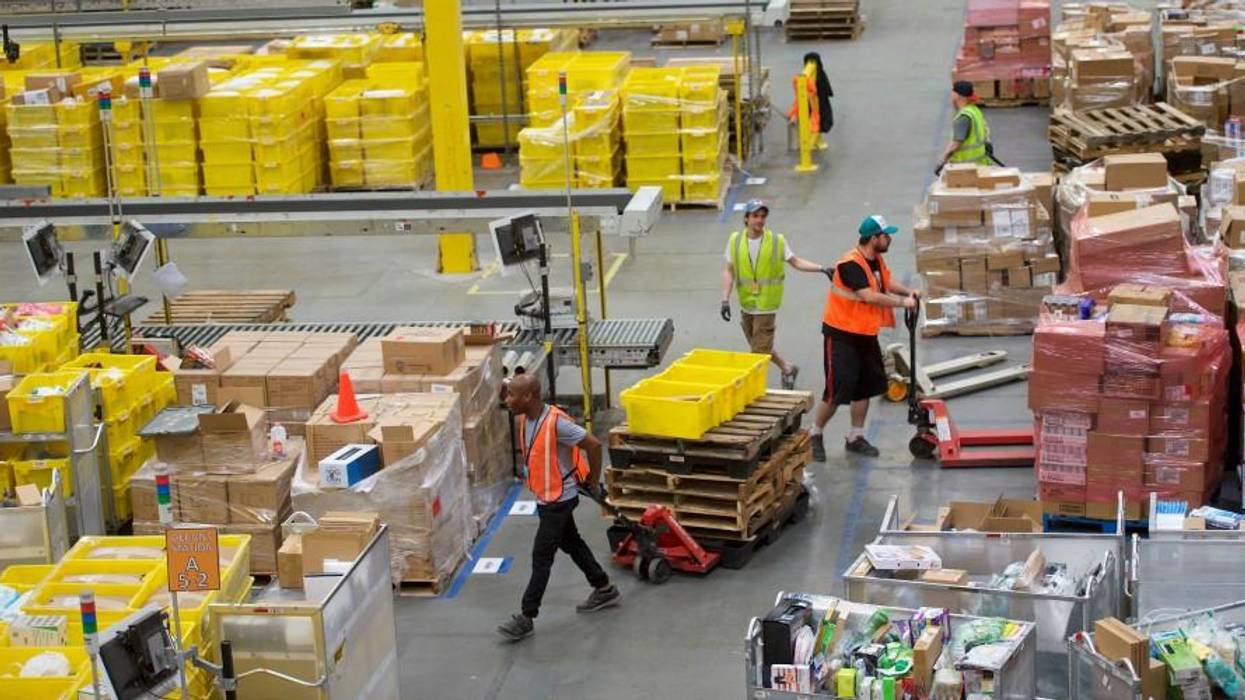
"I am extremely disturbed that workers in some of the world's most profitable companies—in one of the richest countries on earth—are struggling to afford to eat or pay their rent," the expert said.
A United Nations expert on human rights and poverty is concerned that three major U.S. companies systemically underpay their workers, and that the country's minimum wage and labor laws enable them.
U.N. special rapporteur on extreme poverty and human rights Olivier De Schutter sent letters to the CEOs of Amazon, DoorDash, and Walmart on August 31, asking them to respond within two months to allegations that they erroneously labeled employees as independent contractors and paid them so little that they were forced to rely on government benefits to make ends meet. He also sent a separate letter to the U.S. government asking how it intended to reduce working poverty in the nation. As of October 31—the 60 day deadline—only Amazon had responded.
"I am extremely disturbed that workers in some of the world's most profitable companies—in one of the richest countries on earth—are struggling to afford to eat or pay their rent," De Schutter said in a statement publicizing his efforts on Monday. "Multibillion-dollar companies should be setting the standard for working conditions and wages, not violating the human rights of their workers by failing to pay them a decent wage."
In letters to Amazon CEO Andy Jasey, DoorDash CEO Tony Xu, and Walmart CEO Doug McMillon, De Schutter wrote that it was alleged that the three companies did not pay their workers enough for them and their families to attain an "adequate standard of living."
He pointed to a 2020 U.S. Government Accountability Office (GAO) report finding that Amazon was one of the 25 employers with most workers enrolled in the Supplemental Nutrition Assistance Program (SNAP) in six of nine states studied.
"According to the report, more than 4,000 warehouse workers at Amazon depended on food stamps to make ends meet in nine states, and a shocking 70% of food stamp recipients studied work full-time," De Schutter wrote.
"What these companies do for the most part is not illegal. What they do is use the loopholes in the system."
He similarly cited a 2021 GAO report finding that Walmart was the leading employer in many states of employees who received government SNAP and Medicaid benefits.
In the letter to DoorDash, he recounted a report of one employee who had to live in his car and rely on SNAP for food despite dashing full time. He said that the company's practice of classifying workers as independent contractors, as well as its algorithms and tip policies, meant that workers were not guaranteed a minimum wage.
"Jobs are supposed to provide a pathway out of poverty, yet in all three companies the business model seems to be to shift operating costs onto the public by relying on government benefits to supplement miserably low wages," he said in a statement.
In addition, De Schutter asked Walmart and Amazon to respond to allegations that they violated workers' right to unionize. For example, Amazon has allegedly interfered in union elections, retaliated against employees for organizing, made employees sit through anti-union messaging, and changed policies to make organizing more difficult, such as not allowing employees to access work sites while off the clock. Walmart also has a widely-documented history of firing or laying off workers in retaliation for organizing attempts and making new employees sit through anti-union videos.
However, De Schutter said that many of the companies' actions were facilitated by U.S. policies.
"What these companies do for the most part is not illegal," he told The Guardian. "What they do is use the loopholes in the system—for example, misclassifying workers as independent contractors rather than employees. There are many loopholes in the system that the U.S. government is still responsible for, and I'm still expecting an answer from the Department of Labor."
In his letter to the U.S. government, De Schutter drew attention to the actions of the three companies specifically, but also said the U.S. was not doing enough to combat working poverty—defined by the U.S. Bureau of Labor Statistics as working or looking for work at least 27 weeks a year but earning less than $14,580. In 2020, 6.3 million people, or 4.1% of U.S. workers, qualified as "working poor."
"According to the information received, in-work poverty is directly linked to U.S. law and policy, including highly inadequate and inconsistent pay, systematic improper worker classification and a proliferation of gig work, paltry social protection, weak and unenforced labor law, widespread discrimination, and a lack of protection for workers at higher risk of poverty," De Schutter wrote in the letter to the government.
In the only full response to date, Amazon said Sunday that it had raised regular hourly pay to more than $20.50 per hour in 2023 and that all of its full-time employees received "great benefits." It said that it's starting pay of at least $17 an hour would disqualify most full-time employees from SNAP or Medicaid, but that some may be on benefits due to other household factors or may be transitioning off of benefits, since almost 50% of Amazon fulfillment center hires were previously unemployed. It also contended that it respected employees' rights to join a union. However, De Schutter told The Guardian that Amazon did not reply to all of his concerns.
DoorDash responded after the letters were made public, telling the Financial Times that employees made more than $25 an hour while delivering and that many worked other jobs as well. It further emailed De Schutter Monday saying it was "diligently preparing a response, which you will receive from us in the coming weeks."
In his reporting on the letters and the companies' response, Simon Mundy of the Financial Times noted that, "clearly, appeals from the U.N. won't be enough to change big companies' approach to their workers, especially the precarious 'gig workers' on whom they—and the wider economy—increasingly depend. Serious movement on that front will happen not through voluntary corporate action, but through change to the law."
In his letter to the U.S. government, De Schutter pointed to a low federal minimum wage, and the fact that exemptions for gig workers and tipped employees meant that some workers wouldn't even earn the minimum.
"Businesses have a responsibility to respect internationally recognized human rights, including the right to a living wage and to join a union without fear of reprisal," De Schutter said in Monday's statement. "The allegations against Amazon, DoorDash, and Walmart would constitute flagrant violations of these rights and it is time for these corporations, and the U.S. government, to be held accountable."

But "the oligarchs are dancing in the streets tonight," said one law professor as talk among worker advocates turned to a likely appeal before the state Supreme Court.
Labor advocates on Tuesday decried the California appellate court largely upholding Proposition 22, the industry-backed 2020 state ballot measure allowing app-based ride and delivery companies to classify their drivers as independent contractors—which is serving as a template for legislation to deny basic worker rights, benefits, and protections in other states.
The 1st District Court of Appeals on Monday rejected Alameda County Superior Court Judge Frank Roesch's 2021 ruling that Prop 22 was unconstitutional, a decision viewed at the time as a major blow to gig economy companies such as Uber, Lyft, DoorDash, and Instacart whose business models rely upon minimizing frontline worker compensation by categorizing drivers as independent contractors instead of employees. Independent contractors are not entitled to unemployment insurance, health insurance, or recompensation for business expenses.
"The oligarchs are dancing in the streets tonight," tweeted Veena Dubal, a professor at the University of California College of the Law, San Francisco.
David Huerta, president of the California branch of the Service Employees International Union (SEIU)—which led a 2021 lawsuit challenging Prop 22 and is expected to appeal Monday's decision to the California Supreme Court—said in a statement that "when gig companies can spend over $200 million to pass a law that violates our state's constitution instead of investing in workers, it's clear that California needs better safeguards for our democracy."
"And now, the fast food industry and oil industry are copying the gig industry's playbook—attempting to boost their profits by hijacking the ballot referendum process and overturning laws that give workers a voice on the job and protect the health of our communities," he added.
Meanwhile, Uber chief legal officer Tony West called the ruling "a victory for app-based workers and the millions of Californians who voted for Prop 22" and claimed that the law gives drivers and couriers "new benefits while preserving the unique flexibility of app-based work."
Prop 22's passage in November 2020 with nearly 59% of the vote was the culmination of what was by far the most expensive ballot measure in California history. App-based companies and their backers outspent labor and progressive groups by more than 10 to 1, with proponents pouring a staggering $204.5 million into the "yes" campaign's coffers against just $19 million for the "no" side.
Had voters rejected Prop 22, gig companies would have been compelled to pay drivers the state minimum wage, and provide healthcare, paid sick leave, overtime pay, and reimbursement for some of the work-related expenses that claim a significant share of drivers' income.
Instead, app-based companies are required to pay frontline workers 120% of the state minimum wage—currently $15.50 per hour—but only while driving and not during the waiting that constitutes a significant amount of their workday. The companies must also offer a health stipend to drivers who work more than 15 hours a week—again, only actual driving hours count—and cover the cost of workplace injuries.
The experience of Daryush Khodadadi-Mobarakeh—who drives 35-40 hours a week for Uber, Lyft, and DoorDash—is typical of many app-based drivers.
According to CalMatters labor reporter Grace Gedye:
Khodadadi-Mobarakeh, who is a leader with the California Gig Workers Union, said his pay has consistently decreased since he began working in 2014, including after Prop 22 went into effect. Now it takes him about 12 hours to make the same amount he used to earn in eight hours before Prop 22, he said. And he doesn't receive the health stipend; he didn't bother trying to sign up, he said, because he gets insurance through his wife and his understanding is that you need to be on your own insurance to get the reimbursement.
A May 2021 Instacart survey found that just 12% of its shoppers—the workers who fill and deliver customer orders—said they worked enough weekly hours to qualify for the health stipend, and of those people, only a quarter applied for and received the benefit.
Prop 22's passage inspired the introduction of similar legislation in other states. In Massachusetts, Lyft gave a record $14.4 million to a coalition established to fund a prospective 2022 state ballot measure to keep ride-hailing and delivery app drivers classified as independent contractors.
The Massachusetts Supreme Judiciary Court ultimately blocked the measure from appearing on the 2022 ballot, arguing that app-based companies went too far by including language meant to protect them from liability when their drivers get in accidents by classifying them as "not an employee or agent."