SUBSCRIBE TO OUR FREE NEWSLETTER
Daily news & progressive opinion—funded by the people, not the corporations—delivered straight to your inbox.
5
#000000
#FFFFFF
To donate by check, phone, or other method, see our More Ways to Give page.
Daily news & progressive opinion—funded by the people, not the corporations—delivered straight to your inbox.
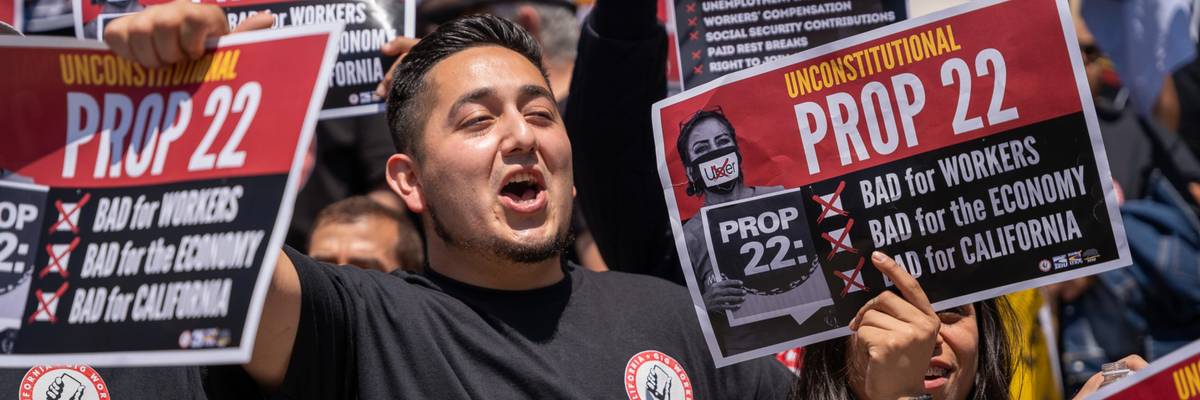
Uber, Lyft, DoorDash, and other members and allies of the California Gig Workers Union rally outside the California Supreme Court in San Francisco on May 24, 2024.
"Today's ruling only strengthens our demand for the right to join together in a union so that we can begin improving the gig economy for workers and our customers," the case plaintiff said.
Labor advocates on Thursday decried a ruling by the California Supreme Court upholding a lower court's affirmation of a state ballot measure allowing app-based ride and delivery companies to classify their drivers as independent contractors, limiting their worker rights.
The court's seven justices ruled unanimously in Castellanos v. State of California that Proposition 22, which was approved by 58% of California voters in 2020, complies with the state constitution. Prop 22—which was overturned in 2021 by an Alameda County Superior Court judge in 2021—was upheld in March 2023 by the state's 1st District Court of Appeals.
The business models of app-based companies including DoorDash, Instacart, Lyft, and Uber rely upon minimizing frontline worker compensation by categorizing drivers as independent contractors instead of employees. Independent contractors are not entitled to unemployment insurance, health insurance, or compensation for business expenses.
There are approximately 1.4 million app-based gig workers in California, according to industry estimates.
While DoorDash hailed Thursday's ruling as "not only a victory for Dashers, but also for democracy itself," gig worker advocates condemned the decision.
"Over the last three years, gig workers across California have experienced firsthand that Prop 22 is nothing more than a bait-and-switch meant to enrich global corporations at the expense of the Black, brown, and immigrant workers who power their earnings," plaintiff Hector Castellanos, who drives for Uber and Lyft, said in a statement.
"Prop 22 has allowed gig companies like Uber, Lyft, and DoorDash to deprive us of a living wage, access to workers compensation, paid sick leave, and meaningful healthcare coverage," Castellanos added. "Today's ruling only strengthens our demand for the right to join together in a union so that we can begin improving the gig economy for workers and our customers."
Lorena Gonzalez, president of the California Federation of Labor Unions, AFL-CIO, said that "we are deeply disappointed that the state Supreme Court has allowed tech corporations to buy their way out of basic labor laws despite Proposition 22's inconsistencies with our state constitution."
"These companies have upended our social contract, forcing workers and the public to take on the inherent risk created by this work, while they profit," she continued. "A.B. 5 granted virtually all California workers the right to be paid for all hours worked, health and safety standards, unemployment insurance, workers compensation, and the right to organize."
"Rideshare and delivery drivers deserve those rights as well," Gonzalez stressed.
The Gig Workers Rising campaign said on social media that "Uber and other app corporations spent $220 million to buy this law, and they did it by tricking Californians."
Prop 22's passage in November 2020 with nearly 59% of the vote was the culmination of what was by far the most expensive ballot measure in California history. App-based companies and their backers outspent labor and progressive groups by more than 10 to 1, with proponents pouring a staggering $204.5 million into the "yes" campaign's coffers against just $19 million for the "no" side.
"Voters were told the initiative would provide us with 'historic new benefits' and guaranteed earnings," said Gig Workers Rising. "But since it went into effect, drivers have seen our pay go down, learned the benefits are a sham, and have to accept unsafe rides because of the constant threat of being 'deactivated,' kicked off the app with little explanation or warning."
"If Uber really cared about good benefits and fair wages, it could make that happen tomorrow," the campaign added. "Instead, it has shown it would rather slash pay, bamboozle voters, and put drivers' lives and livelihoods in danger—all while promising $7 billion in stock buybacks to banks and billionaires."
Veena Dubal, a law professor at the University of California, Irvine who focuses on labor and inequality, told CalMatters that Thursday's ruling was "a really tragic outcome," but "it's not the end of the road."
Dubal's sentiment was echoed by some California state legislators, who said the ruling presents an opportunity to act.
"While this decision is frustrating, it must also be motivating," said state Senate Labor Committee Chair Lola Smallwood-Cuevas (D-28). "I'm more determined than ever to ensure that all workers—including our diverse and Black, Indigenous, and people of color-led gig workforce—have the basic protections of workers compensation, paid sick leave, family leave, disability insurance, and the right to form a union."
Prop 22 has served as a template for lawmakers in other states seeking to deny or limit basic worker rights, benefits, and protections.
In Massachusetts, app-based companies have been fighting for years to get a measure to classify drivers as contractors on the state ballot. In 2022, Lyft made the largest political donation in state history—$14.4 million—to a coalition funding one such proposal.
Last month, Uber and Lyft reached an agreement with the office of Massachusetts Attorney General Andrea Campbell, a Democrat, to pay $175 million to settle a lawsuit filed in 2020. As part of the deal, the companies also agreed to increase driver pay and provide paid sick leave, accident insurance, and some health benefits. The agreement does not address how app-based gig workers should be classified.
Dear Common Dreams reader, It’s been nearly 30 years since I co-founded Common Dreams with my late wife, Lina Newhouser. We had the radical notion that journalism should serve the public good, not corporate profits. It was clear to us from the outset what it would take to build such a project. No paid advertisements. No corporate sponsors. No millionaire publisher telling us what to think or do. Many people said we wouldn't last a year, but we proved those doubters wrong. Together with a tremendous team of journalists and dedicated staff, we built an independent media outlet free from the constraints of profits and corporate control. Our mission has always been simple: To inform. To inspire. To ignite change for the common good. Building Common Dreams was not easy. Our survival was never guaranteed. When you take on the most powerful forces—Wall Street greed, fossil fuel industry destruction, Big Tech lobbyists, and uber-rich oligarchs who have spent billions upon billions rigging the economy and democracy in their favor—the only bulwark you have is supporters who believe in your work. But here’s the urgent message from me today. It's never been this bad out there. And it's never been this hard to keep us going. At the very moment Common Dreams is most needed, the threats we face are intensifying. We need your support now more than ever. We don't accept corporate advertising and never will. We don't have a paywall because we don't think people should be blocked from critical news based on their ability to pay. Everything we do is funded by the donations of readers like you. When everyone does the little they can afford, we are strong. But if that support retreats or dries up, so do we. Will you donate now to make sure Common Dreams not only survives but thrives? —Craig Brown, Co-founder |
Labor advocates on Thursday decried a ruling by the California Supreme Court upholding a lower court's affirmation of a state ballot measure allowing app-based ride and delivery companies to classify their drivers as independent contractors, limiting their worker rights.
The court's seven justices ruled unanimously in Castellanos v. State of California that Proposition 22, which was approved by 58% of California voters in 2020, complies with the state constitution. Prop 22—which was overturned in 2021 by an Alameda County Superior Court judge in 2021—was upheld in March 2023 by the state's 1st District Court of Appeals.
The business models of app-based companies including DoorDash, Instacart, Lyft, and Uber rely upon minimizing frontline worker compensation by categorizing drivers as independent contractors instead of employees. Independent contractors are not entitled to unemployment insurance, health insurance, or compensation for business expenses.
There are approximately 1.4 million app-based gig workers in California, according to industry estimates.
While DoorDash hailed Thursday's ruling as "not only a victory for Dashers, but also for democracy itself," gig worker advocates condemned the decision.
"Over the last three years, gig workers across California have experienced firsthand that Prop 22 is nothing more than a bait-and-switch meant to enrich global corporations at the expense of the Black, brown, and immigrant workers who power their earnings," plaintiff Hector Castellanos, who drives for Uber and Lyft, said in a statement.
"Prop 22 has allowed gig companies like Uber, Lyft, and DoorDash to deprive us of a living wage, access to workers compensation, paid sick leave, and meaningful healthcare coverage," Castellanos added. "Today's ruling only strengthens our demand for the right to join together in a union so that we can begin improving the gig economy for workers and our customers."
Lorena Gonzalez, president of the California Federation of Labor Unions, AFL-CIO, said that "we are deeply disappointed that the state Supreme Court has allowed tech corporations to buy their way out of basic labor laws despite Proposition 22's inconsistencies with our state constitution."
"These companies have upended our social contract, forcing workers and the public to take on the inherent risk created by this work, while they profit," she continued. "A.B. 5 granted virtually all California workers the right to be paid for all hours worked, health and safety standards, unemployment insurance, workers compensation, and the right to organize."
"Rideshare and delivery drivers deserve those rights as well," Gonzalez stressed.
The Gig Workers Rising campaign said on social media that "Uber and other app corporations spent $220 million to buy this law, and they did it by tricking Californians."
Prop 22's passage in November 2020 with nearly 59% of the vote was the culmination of what was by far the most expensive ballot measure in California history. App-based companies and their backers outspent labor and progressive groups by more than 10 to 1, with proponents pouring a staggering $204.5 million into the "yes" campaign's coffers against just $19 million for the "no" side.
"Voters were told the initiative would provide us with 'historic new benefits' and guaranteed earnings," said Gig Workers Rising. "But since it went into effect, drivers have seen our pay go down, learned the benefits are a sham, and have to accept unsafe rides because of the constant threat of being 'deactivated,' kicked off the app with little explanation or warning."
"If Uber really cared about good benefits and fair wages, it could make that happen tomorrow," the campaign added. "Instead, it has shown it would rather slash pay, bamboozle voters, and put drivers' lives and livelihoods in danger—all while promising $7 billion in stock buybacks to banks and billionaires."
Veena Dubal, a law professor at the University of California, Irvine who focuses on labor and inequality, told CalMatters that Thursday's ruling was "a really tragic outcome," but "it's not the end of the road."
Dubal's sentiment was echoed by some California state legislators, who said the ruling presents an opportunity to act.
"While this decision is frustrating, it must also be motivating," said state Senate Labor Committee Chair Lola Smallwood-Cuevas (D-28). "I'm more determined than ever to ensure that all workers—including our diverse and Black, Indigenous, and people of color-led gig workforce—have the basic protections of workers compensation, paid sick leave, family leave, disability insurance, and the right to form a union."
Prop 22 has served as a template for lawmakers in other states seeking to deny or limit basic worker rights, benefits, and protections.
In Massachusetts, app-based companies have been fighting for years to get a measure to classify drivers as contractors on the state ballot. In 2022, Lyft made the largest political donation in state history—$14.4 million—to a coalition funding one such proposal.
Last month, Uber and Lyft reached an agreement with the office of Massachusetts Attorney General Andrea Campbell, a Democrat, to pay $175 million to settle a lawsuit filed in 2020. As part of the deal, the companies also agreed to increase driver pay and provide paid sick leave, accident insurance, and some health benefits. The agreement does not address how app-based gig workers should be classified.
Labor advocates on Thursday decried a ruling by the California Supreme Court upholding a lower court's affirmation of a state ballot measure allowing app-based ride and delivery companies to classify their drivers as independent contractors, limiting their worker rights.
The court's seven justices ruled unanimously in Castellanos v. State of California that Proposition 22, which was approved by 58% of California voters in 2020, complies with the state constitution. Prop 22—which was overturned in 2021 by an Alameda County Superior Court judge in 2021—was upheld in March 2023 by the state's 1st District Court of Appeals.
The business models of app-based companies including DoorDash, Instacart, Lyft, and Uber rely upon minimizing frontline worker compensation by categorizing drivers as independent contractors instead of employees. Independent contractors are not entitled to unemployment insurance, health insurance, or compensation for business expenses.
There are approximately 1.4 million app-based gig workers in California, according to industry estimates.
While DoorDash hailed Thursday's ruling as "not only a victory for Dashers, but also for democracy itself," gig worker advocates condemned the decision.
"Over the last three years, gig workers across California have experienced firsthand that Prop 22 is nothing more than a bait-and-switch meant to enrich global corporations at the expense of the Black, brown, and immigrant workers who power their earnings," plaintiff Hector Castellanos, who drives for Uber and Lyft, said in a statement.
"Prop 22 has allowed gig companies like Uber, Lyft, and DoorDash to deprive us of a living wage, access to workers compensation, paid sick leave, and meaningful healthcare coverage," Castellanos added. "Today's ruling only strengthens our demand for the right to join together in a union so that we can begin improving the gig economy for workers and our customers."
Lorena Gonzalez, president of the California Federation of Labor Unions, AFL-CIO, said that "we are deeply disappointed that the state Supreme Court has allowed tech corporations to buy their way out of basic labor laws despite Proposition 22's inconsistencies with our state constitution."
"These companies have upended our social contract, forcing workers and the public to take on the inherent risk created by this work, while they profit," she continued. "A.B. 5 granted virtually all California workers the right to be paid for all hours worked, health and safety standards, unemployment insurance, workers compensation, and the right to organize."
"Rideshare and delivery drivers deserve those rights as well," Gonzalez stressed.
The Gig Workers Rising campaign said on social media that "Uber and other app corporations spent $220 million to buy this law, and they did it by tricking Californians."
Prop 22's passage in November 2020 with nearly 59% of the vote was the culmination of what was by far the most expensive ballot measure in California history. App-based companies and their backers outspent labor and progressive groups by more than 10 to 1, with proponents pouring a staggering $204.5 million into the "yes" campaign's coffers against just $19 million for the "no" side.
"Voters were told the initiative would provide us with 'historic new benefits' and guaranteed earnings," said Gig Workers Rising. "But since it went into effect, drivers have seen our pay go down, learned the benefits are a sham, and have to accept unsafe rides because of the constant threat of being 'deactivated,' kicked off the app with little explanation or warning."
"If Uber really cared about good benefits and fair wages, it could make that happen tomorrow," the campaign added. "Instead, it has shown it would rather slash pay, bamboozle voters, and put drivers' lives and livelihoods in danger—all while promising $7 billion in stock buybacks to banks and billionaires."
Veena Dubal, a law professor at the University of California, Irvine who focuses on labor and inequality, told CalMatters that Thursday's ruling was "a really tragic outcome," but "it's not the end of the road."
Dubal's sentiment was echoed by some California state legislators, who said the ruling presents an opportunity to act.
"While this decision is frustrating, it must also be motivating," said state Senate Labor Committee Chair Lola Smallwood-Cuevas (D-28). "I'm more determined than ever to ensure that all workers—including our diverse and Black, Indigenous, and people of color-led gig workforce—have the basic protections of workers compensation, paid sick leave, family leave, disability insurance, and the right to form a union."
Prop 22 has served as a template for lawmakers in other states seeking to deny or limit basic worker rights, benefits, and protections.
In Massachusetts, app-based companies have been fighting for years to get a measure to classify drivers as contractors on the state ballot. In 2022, Lyft made the largest political donation in state history—$14.4 million—to a coalition funding one such proposal.
Last month, Uber and Lyft reached an agreement with the office of Massachusetts Attorney General Andrea Campbell, a Democrat, to pay $175 million to settle a lawsuit filed in 2020. As part of the deal, the companies also agreed to increase driver pay and provide paid sick leave, accident insurance, and some health benefits. The agreement does not address how app-based gig workers should be classified.