

SUBSCRIBE TO OUR FREE NEWSLETTER
Daily news & progressive opinion—funded by the people, not the corporations—delivered straight to your inbox.
5
#000000
#FFFFFF
To donate by check, phone, or other method, see our More Ways to Give page.
Daily news & progressive opinion—funded by the people, not the corporations—delivered straight to your inbox.

"This decision will wipe out the availability of release through bond for tens of thousands of people," one critic noted.
A divided federal appellate panel ruled Friday in favor of the Trump administration's policy of locking up most undocumented immigrants without bond, a decision that legal experts called a serious blow to due process.
A three-judge panel of the right-wing 5th US Circuit Court of Appeals in New Orleans ruled 2-1 that President Donald Trump's reversal of three decades of practice by previous administrations is legally sound under the Illegal Immigration Reform and Immigrant Responsibility Act of 1996 (IIRIRA). The ruling reverses two lower court orders.
"The text [of the IIRIRA] says what it says, regardless of the decisions of prior administrations," Judge Edith Jones—an appointee of former President Ronald Reagan—wrote for the majority. "That prior administrations decided to use less than their full enforcement authority... does not mean they lacked the authority to do more."
Writing in dissent, Judge Dana M. Douglas, who was appointed by former President Joe Biden, asserted that "the Congress that passed IIRIRA would be surprised to learn it had also required the detention without bond of two million people. For almost 30 years there was no sign anyone thought it had done so, and nothing in the congressional record or the history of the statute’s enforcement suggests that it did."
This is a very, very bad decision from one of the two Reagan judges left on the Fifth Circuit, joined by one of the two most extreme Trump appointees on the court.And, it is about the issue I walked through at Law Dork earlier this week, in the context of Minnesota: www.lawdork.com/i/186796727/...
[image or embed]
— Chris Geidner (@chrisgeidner.bsky.social) February 6, 2026 at 6:50 PM
"Nonetheless, the government today asserts the authority and mandate to detain millions of noncitizens in the interior, some of them present here for decades, on the same terms as if they were apprehended at the border," Douglas added. "No matter that this newly discovered mandate arrives without historical precedent, and in the teeth of one of the core distinctions of immigration law. The overwhelming majority elsewhere have recognized that the government’s position is totally unsupported."
Past administration generally allowed unauthorized immigrants who had lived in the United States for years to attend bond hearings, at which they had a chance to argue before immigration judges that they posed no flight risk and should be permitted to contest their deportation without detention.
Mandatory detention by US Immigration and Customs Enforcement (ICE) was generally reserved for convicted criminals or people who recently entered the country illegally.
However, the Trump administration contends that anyone who entered the United States without authorization at any time can be detained pending deportation, with limited discretionary exceptions for humanitarian or public interest cases. As a result, immigrants who have lived in the US for years or even decades are being detained indefinitely, even if they have no criminal records.
According to a POLITICO analysis, more than 360 judges across the country—including dozens of Trump appointees—have rejected the administration's interpretation of ICE's detention power, while just 26 sided with the administration.
While US Attorney General Pam Bondi hailed Friday's ruling as a "significant blow against activist judges who have been undermining our efforts to make America safe again at every turn," some legal experts said the decision erodes constitutional rights.
"AWFUL news for due process," American Immigration Council senior fellow Aaron Reichlin-Melnick said on social media in response to Friday's ruling. "This decision will wipe out the availability of release through bond for tens of thousands of people detained in or transported to Texas, Louisiana, and Mississippi by ICE."
While Friday's ruling only applies to those three states, which fall under the 5th Circuit Court's jurisdiction, there are numerous legal challenges to the administration's detention policy in courts across the country.
One attorney in the case called the ruling "a powerful rebuke to the government's attempt to hurry people away to a gulag-type prison in El Salvador."
For the second time in less than a month, the U.S. Supreme Court on Friday ruled against the Trump administration's dubious use of an 18th century law to deport immigrants including at least one person with protected status without due process.
In a 7-2 ruling—with far-right Justices Clarence Thomas and Samuel A. Alito dissenting—the high court found that President Donald Trump violated Venezuelan migrants' right to due process as a class by trying to fast-track their deportation to the notorious Terrorism Confinement Center (CECOT) prison in El Salvador by invoking the 1798 Alien Enemies Act during peacetime.
The ruling is not a repudiation of Alien Enemies Act deportations and focuses solely on migrants' due process rights.
"Notice roughly 24 hours before removal, devoid of information about how to exercise due process rights to contest that removal, surely does not pass muster."
"The detainees' interests at stake are accordingly particularly weighty," the court's opinion states. "Under these circumstances, notice roughly 24 hours before removal, devoid of information about how to exercise due process rights to contest that removal, surely does not pass muster."
"But it is not optimal for this court, far removed from the circumstances on the ground, to determine in the first instance the precise process necessary to satisfy the Constitution in this case," the court continued and, referring to the federal appellate court that "erred in dismissing the detainees' appeal for lack of jurisdiction," said that "we remand the case to the 5th Circuit for that purpose."
Lee Gelernt, deputy director of the ACLU's Immigrants' Rights Project and lead counsel in the case, said Friday that "the court's decision to stay removals is a powerful rebuke to the government's attempt to hurry people away to a gulag-type prison in El Salvador."
"The use of a wartime authority during peacetime, without even affording due process, raises issues of profound importance," Gelernt added.
The Supreme Court opinion noted the case of Kilmar Abrego García, a Maryland man with protected status who was wrongfully deported to CECOT in March. Last month, the high court unanimously ruled that Trump must facilitate Abrego García's return to the United States. The Trump administration has resisted the order, despite the president proclaiming that "if the Supreme Court said, 'Bring somebody back,' I would do that."
Steve Vadeck, a professor at Georgetown Law Center, told CNN Friday that "because lower courts have blocked use of the [Alien Enemies Act] in every other district in which the president has sought to invoke it, that means it's effectively pausing all removals under the act until the 5th Circuit—and, presumably, the Supreme Court itself—conclusively resolves whether they're legal and how much process is due if so."
On Tuesday, U.S. District Judge Stephanie Haines—who was appointed by Trump—issued the first court ruling supporting Alien Enemies Act deportations.
"Today, seven members of the Supreme Court followed the law and did not capitulate to special interests like the NRA, and our streets will be safer for it," said one Democratic senator.
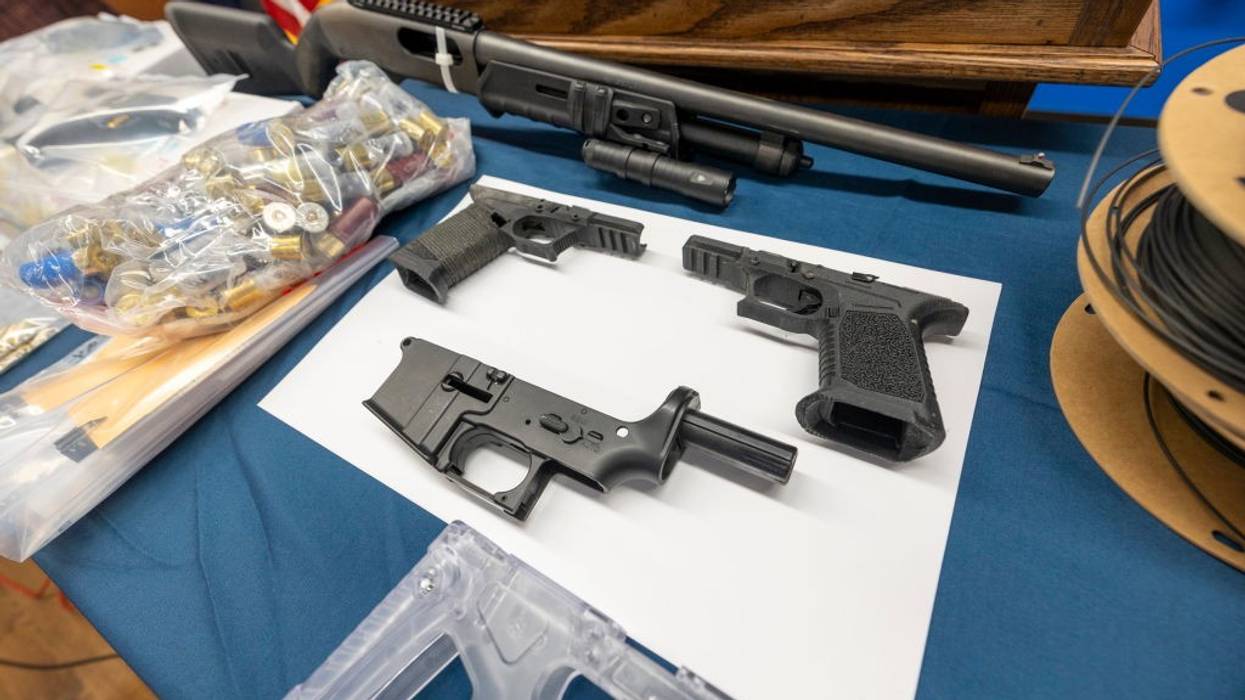
In what one gun control group hailed as "a BIG win for public safety," the U.S. Supreme Court on Wednesday upheld a Biden-era rule regulating ghost guns, which can be made using 3D printers, obtained without background checks, and smuggled into high-security locations.
The high court ruled 7-2—with Justices Samuel Alito and Clarence Thomas dissenting—in Bondi v. Vanderstock that ghost guns, which are virtually untraceable, are firearms subject to regulation by the U.S. Bureau of Alcohol, Tobacco, Firearms, and Explosives (ATF).
NEW: The Supreme Court just upheld ATF’s critical ghost gun rule 👏👏👏 They ruled that ghost gun kits are legally firearms, meaning they must have serial numbers and can only be sold by licensed sellers after a background check. This is a BIG win for public safety.
[image or embed]
— GIFFORDS ( @giffords.org) March 26, 2025 at 7:57 AM
In 2022, the Biden administration enacted rules including a licensing requirement for companies making and selling ghost gun parts, mandating serial numbers for such components, and subjecting buyers to background checks. Ghost gun component manufacturers and Second Amendment advocates sued the government, claiming that ghost guns are not firearms as defined by the landmark Gun Control Act of 1968.
The 5th U.S. Circuit Court of Appeals sided with the plaintiffs in a 2023 decision striking down the ATF ghost gun rules.
However, while conceding that some ghost gun kits may not qualify as firearms under the law, Justice Neil Gorsuch wrote for the majority that others "'contain all components necessary' for 'a complete pistol' and can be completed in perhaps half an hour using commonly available tools."
"But even as sold, the kit comes with all necessary components, and its intended function as instrument of combat is obvious," Gorsuch added. "Really, the kit's name says it all: 'Buy Build Shoot.'"
Today's decision is a pretty major smackdown for the 5th Circuit, which angrily rejected the ghost gun regulations as an egregiously unlawful assault on the rights of at-home gunsmiths. Gorsuch's opinion says the 5th Circuit badly misapplied the law in a number of ways. When you've lost Gorsuch...
— Mark Joseph Stern ( @mjsdc.bsky.social) March 26, 2025 at 7:16 AM
Responding to the ruling, David Pucino, the legal director and deputy chief counsel at the Giffords Law Center, said: "Ghost guns are the gun industry's way of skirting commonsense gun laws and arming dangerous people without background checks. We are thrilled that the Supreme Court has upheld the ATF rule that treats ghost guns as what they are: guns."
"We've seen how the rise in ghost guns has contributed to increases in crime and gun deaths in communities across the United States," Pucino added. "The Supreme Court's ruling is a huge win for public safety."
The legal division of Everytown for Gun Safety also hailed what it called the court's "lifesaving decision."
"We applaud the Supreme Court for doing the right thing by upholding a lawful and critical rule that protects public safety, and by rejecting the gun lobby's extreme legal agenda," Everytown Law executive director Eric Tirschwell said. "The ATF ghost gun rule has broad support from state and federal law enforcement, who have all affirmed it is crucial to keeping our communities safe—and data shows it is reducing the number of ghost guns recovered at crime scenes nationwide. We look forward to seeing this downward trend continue."
As Everytown noted, "early data indicates a drop in ghost gun recoveries at crime scenes since the ATF's rule went into effect," and "New York City, Baltimore, Boston, Los Angeles, San Francisco, Philadelphia, Oakland, and other cities reported declines in ghost gun recoveries" in 2023.
Great news coming out of the Supreme Court! In a 7-2 decision, Justices have upheld the ban on ghost guns. These untraceable weapons have no legitimate use and are the perfect firearms for use in crime. This is a victory for public safety!
— Team ENOUGH ( @teamenough.org) March 26, 2025 at 7:16 AM
"At 17, my son, Guy, was badly wounded when he was shot with a ghost gun by a minor too young to legally purchase a pistol. No one should have to go through the trauma of learning that your child has been shot and may not survive," Denise Wieck, a volunteer with the gun control advocacy group Moms Demand Action, said following Wednesday's ruling.
"Though Guy suffers the consequences of the gunshot wound to this day—including an epilepsy diagnosis, anxiety, and the loss of an eye—we have both turned our grief into power through education and advocacy," Wieck added. "We are deeply relieved by today's ruling, which will help ensure that a tragedy like ours never happens again."
Democratic lawmakers also welcomed Wednesday's ruling.
"Ghost guns have been a terror on our streets, haunting our communities, and taking lives," Senate Minority Leader Chuck Schumer (D-N.Y.) said in a statement. "For years, I have been warning of the dangers of these untraceable guns, and I strongly supported the Biden administration's rule to crack down on these treacherous kits."
"Today, seven members of the Supreme Court followed the law and did not capitulate to special interests like the NRA, and our streets will be safer for it," Schumer added, referring to the National Rifle Association. "Senate Democrats will continue to push Republicans to take commonsense actions to keep ghost guns off the streets."
"With this historic decision the court has moved decisively to ensure the constitutionally protected speech of authors, booksellers, publishers, and readers," said plaintiffs.
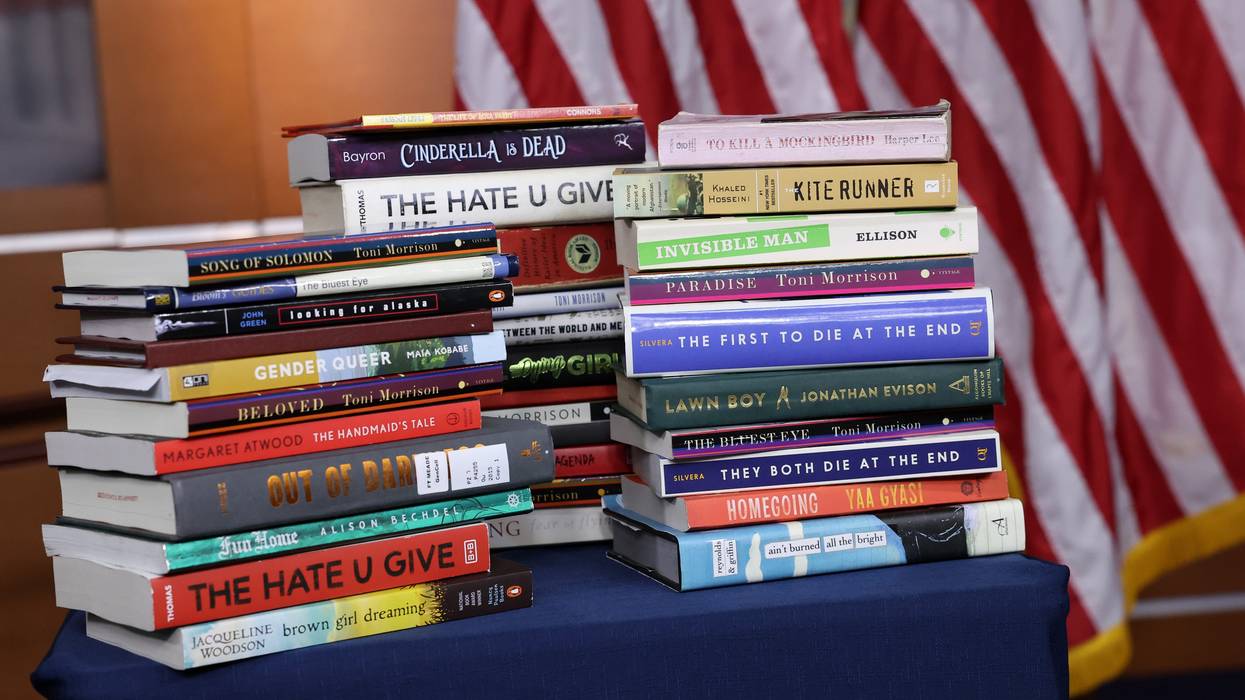
Texas bookstores, national trade associations, and other critics of book bans celebrated on Wednesday after a panel from an ultraconservative U.S. appeals court affirmed a decision to temporarily block part of a new state law intended to restrict what's allowed in public school libraries.
House Bill 900, or the Restricting Explicit and Adult-Designated Educational Resources (READER) Act, was signed last June by Republican Gov. Greg Abbott. This case focuses on the section of the law requiring book vendors that sell to schools to submit ratings about sexual content to the Texas Education Agency (TEA) and provide annual updates.
The contested law requires booksellers to label all material as "sexually explicit," "sexually relevant," or "no rating." Sexually explicit books must be removed from school library shelves and cannot be sold to districts, while sexually relevant material cannot be checked out without parental consent. The TEA can make changes to vendors' ratings.
"Our kids deserve the freedom to read, and their local schools and libraries are no place for censorious adults to push their religious and political agendas."
A pair of bookstores—Houston's Blue Willow and BookPeople in Austin—joined with the Association of American Publishers, American Booksellers Association, Authors Guild, and Comic Book Legal Defense Fund to challenge the law, arguing that it violates free speech rights and would subject plaintiffs to "irreparable personal and economic injury."
Judge Alan Albright of the U.S. District Court for the Western District of Texas, an appointee of GOP former President Donald Trump, temporarily blocked the book-rating policy in September. The New Orleans-based 5th U.S. Circuit Court of Appeals panel unanimously agreed in a Wednesday opinion penned by Trump-appointed Judge Don Willett.
"The question presented is narrow: Are plaintiffs likely to succeed on their claims that READER violates their First Amendment rights? Controlling precedent suggests the answer is yes," wrote Willett, joined by Judges Jacques Wiener and Dana Douglas, appointees of former President George H.W. Bush and President Joe Biden, respectively.
While welcoming that the opinion does not apply to newly adopted standards for school library collection development, Texas Rep. Jared Patterson (R-106), who authored H.B. 900, expressed disappointment with the decision and urged Republican state Attorney General Ken Paxton to appeal to the U.S. Supreme Court.
Unless Paxton appeals to the high court, the case will return to the district level for full arguments. While there is still a fight ahead, plaintiffs in the case and other critics of the law still celebrated on Wednesday.
"We are grateful for the 5th Circuit Court of Appeals' decisive action in striking down this unconstitutional law," the plaintiffs said in joint a statement. "With this historic decision the court has moved decisively to ensure the constitutionally protected speech of authors, booksellers, publishers, and readers, and prevent the state government from unlawfully compelling speech on the part of private citizens."
"The court's decision also shields Texas businesses from the imposition of impossibly onerous conditions, protects the basic constitutional rights of the plaintiffs, and lets Texas parents make decisions for their own children without government interference or control," they added. "This is a good day for bookstores, readers, and free expression."
As the Austin-American Statesman reported:
The decision was great news for Charley Rejsek, CEO of BookPeople.
"They recognized that this law as it's written would force us to divert time and effort away from our regular business," Rejsek said. "This was not good for any business."
Rejsek added that rating books by the April 1 deadline "was completely impossible to do."
Texas Republicans are among GOP policymakers across the country who have embraced right-wing efforts to ban books at the state and local levels in recent years, initiatives that have often focused on content related to sex, gender identity, and race.
During the 2022-23 school year, PEN America tracked 3,362 instances of book bans in U.S. public school classrooms and libraries cutting off students from 1,557 unique titles. The group noted that this represented a significant increase from figures the previous year and targeted authors were "most frequently female, people of color, and/or LGBTQ+ individuals."
Texas Freedom Network organizing director Seneca Savoie said in a statement Wednesday that "the courts should exist to protect and defend the rights of everyone in our communities, including our children. We applaud the 5th Circuit for upholding Judge Albright's initial ruling, rather than aiding our state's leaders in their endless culture wars and attacks on LGBTQIA+ Texans and our basic freedoms."
"Our kids deserve the freedom to read, and their local schools and libraries are no place for censorious adults to push their religious and political agendas," Savoie added. "While we were deeply disheartened that the 5th Circuit previously allowed this unconstitutional law to go into effect knowing that it violates the rights of Texas kids and their families, justice has finally been served."
As Willett noted in the Wednesday opinion, previously, "a different panel of this court granted the administrative stay."

"Today's decision is a likely first step toward a massive blow to reproductive rights in the United States—and a stark reminder that our courts have been hijacked by Republican extremists," said one abortion rights advocate.
A federal appellate court on Wednesday upheld portions of a ruling restricting access to the abortion pill mifepristone, although the drug will remain available pending the outcome of ongoing litigation.
A three-judge panel of the right-wing 5th U.S. Circuit Court of Appeals ruled that mifepristone can remain on the market, while finding that the Food and Drug Administration's (FDA) 2016 move to allow the pill to be taken later in pregnancy, mailed directly to patients, and prescribed by healthcare professionals other than doctors was likely illegal.
The ruling—which the Department of Justice (DOJ) said it will appeal to the U.S. Supreme Court—was condemned by abortion rights advocates.
"Ignoring the facts and the expert scientific judgment of the country's top doctors is judicial activism of the highest order."
"This entirely illegitimate decision could cost lives all across the country," Rachel O'Leary Carmona, executive director of Women's March, said in a statement. "The conservative three-judge panel that is the 5th Circuit Court is just another agent in extremist Republicans' plan to enact a full nationwide abortion ban and to cut back access to critical reproductive healthcare."
"To be clear: Mifepristone is an FDA-approved medication that has been proven safe and effective for women in all walks of life for over two decades," she added. "It has a safety record of over 99%—more than that of Tylenol or Viagra."
Following the Supreme Court's cancellation last year of half a century of constitutional abortion rights in Dobbs v. Jackson Women's Health Organization, U.S. District Judge Matthew Kacsmaryk in Texas ruled this April in Alliance for Hippocratic Medicine v. FDA that the agency's approval of mifepristone in 2000 was illegal.
The DOJ subsequently appealed Kacsmaryk's decision to the 5th Circuit. Later in April, the Supreme Court granted a request by the Biden administration to continue allowing widespread access to mifepristone pending the outcome of the 5th Circuit case.
"Today's decision by the 5th Circuit to partially reaffirm Judge Kacsmaryk's ruling attempting to yank mifepristone off the shelves is an outrageous attack on the reproductive freedom and bodily autonomy of women and pregnant people in the United States," Catholics for Choice president Jamie Manson said in a statement.
"A mountain of scientific evidence demonstrates that mifepristone—which, when taken in combination with misoprostol, accounts for most of the abortions in the United States—is a safe and highly effective method of terminating an early pregnancy," Manson added. "Ignoring the facts and the expert scientific judgment of the country's top doctors is judicial activism of the highest order."
Nicole Regalado, vice president of campaigns at UltraViolet, warned that "if the Supreme Court refuses to take this case, or affirms the 5th Circuit's decision, it will severely restrict access to mifepristone nationwide."
"Today's decision is a likely first step toward a massive blow to reproductive rights in the United States—and a stark reminder that our courts have been hijacked by Republican extremists who will stop at nothing to advance their sexist agenda," she continued.
"In times like these, every single one of us must make a choice: Will we stand by and let extremist judges impose their sexist agendas on millions of people, or step up to protect the rights of women and pregnant people to make decisions about their bodies?" Regalado added. "History will remember which side we choose."
"Mississippi stands as an outlier among its sister states, bucking a clear national trend in our nation against permanent disenfranchisement."
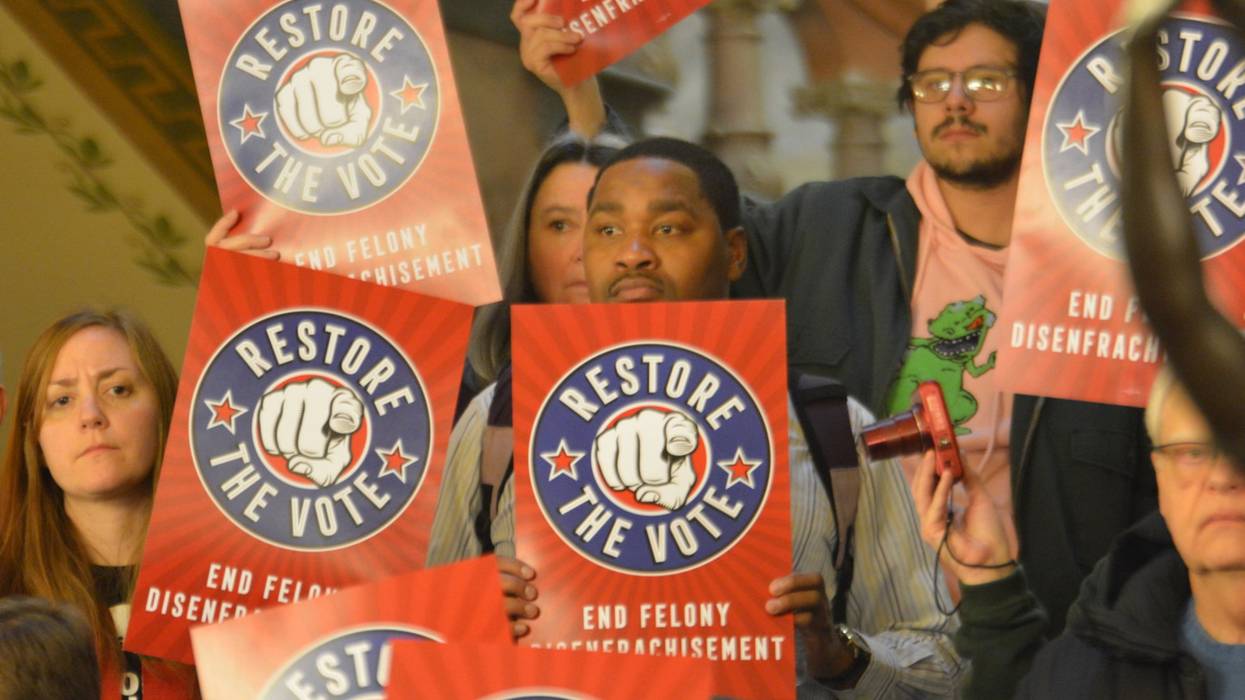
A U.S. federal appellate court on Friday ruled that a Jim Crow-era Mississippi law permanently disenfranchising people with certain felony convictions is unconstitutional.
In a decision that can be appealed to the full U.S. 5th Circuit Court of Appeals, a three-judge panel of the tribunal ruled 2-1 that Section 241 of Mississippi's 1890 Constitution "violates the Eighth Amendment's prohibition on cruel and unusual punishment and the 14th Amendment's guarantee of equal protection under the law."
Last August, the 5th Circuit affirmed Section 241 ,with dissenting Judge James E. Graves Jr., a Black Mississippian, lamenting that when his colleagues were "handed an opportunity to right a 130-year-old wrong, the majority instead upholds it."
The U.S. Supreme Court declined to hear an appeal of the ruling, prompting a scathing dissent from liberal Justice Ketanji Brown Jackson.
"In the last 50 years, a national consensus has emerged among the state legislatures against permanently disenfranchising those who have satisfied their judicially imposed sentences and thus repaid their debts to society," Friday's ruling states. "Mississippi stands as an outlier among its sister states, bucking a clear national trend in our nation against permanent disenfranchisement."
Friday's ruling is the result of a 2018 lawsuit filed by the Southern Poverty Law Center and ACLU on behalf of plaintiffs including Dennis Hopkins, who has been disenfranchised since 1998 due to a grand larceny conviction.
"In school, they teach our kids that everybody's vote counts, but no matter how I've lived for the past 20 years, I don't count, not my values or my experience," Hopkins said when the suit was filed. "I have paid Mississippi what I owe it in full, but I still can't cast my vote for my children's future."
Section 241 "mandates permanent, lifetime disenfranchisement of a person convicted of a crime of any one of 'murder, rape, bribery, theft, arson, obtaining money or goods under false pretense, perjury, forgery, embezzlement, or bigamy,'" according to the ruling.
As the NAACP Legal Defense Fund (LDF) notes, "Section 241 permanently disenfranchises people convicted of 10 specific crimes, eight of which were chosen by all-white delegates in 1890 and based on their belief that Black people were more likely than white people to be convicted of those crimes."
There are currently more than 20 crimes that disenfranchise Mississippians from voting. The state—which according to the Sentencing Project is one of only 12 with lifetime disenfranchisement—added 11 more offenses to the ban list in 2005.
In contrast, everyone age 18 and up—including currently incarcerated individuals—has the right to vote in Maine and Vermont.
While Black Mississippians are 36% of Mississippi's voting-age population, they make up 59% of its disenfranchised people.
"Section 241 is Jim Crow law, which created a deliberate and invidious scheme to disenfranchise Black people," said LDF assistant counsel Patricia Okonta.
"Today, Black Mississippians continue to be disproportionately harmed by this provision," Okonta added. "While the state is home to the highest percentage of Black Americans of any state in the country, it has not elected a Black person to statewide office since 1890."
According to the Felony Murder Elimination Project, a California-based advocacy group:
Over 215,000 people in Mississippi were disenfranchised as of 2019, representing almost 10% of the entire state population. Of this total, only 7% are incarcerated. The remaining 93% are living in the community either under probation or parole supervision, or have completed their criminal sentence. The number of African American residents disenfranchised in Mississippi numbered 127,130 in 2016 or nearly 16% of the Black electorate.
"No one disputes that Mississippi's felon disenfranchisement law was enacted more than 100 years ago for the announced purpose of maintaining white supremacy and blocking Black citizens from voting," ACLU national legal director David Cole said in a statement.
"Racially motivated laws don't become valid over time," Cole added. "It's just as unconstitutional today as it was when it was enacted. That such a law remains on the books today is a stain on the state's law books, and plainly unconstitutional."

"This stay is the bare minimum," said one reproductive rights campaigner. "The imminent threat to access to mifepristone and abortion care remains."
"Mifepristone remains safe, effective, and AVAILABLE."
However, access to medication abortion remains at "severe risk." That was the message Friday from reproductive rights advocates after the United States Supreme Court temporarily blocked a ruling by a Texas federal judge that would effectively end access to abortion pills.
Justice Samuel Alitoissued a short order on the high court's "shadow docket" staying until next Wednesday last week's decision by U.S. 5th Circuit Judge Matthew Kacsmaryk, an appointee of former President Donald Trump who ruled that the U.S. Food and Drug Administration's 2000 approval of mifepristone—one of two drugs typically used in tandem to induce abortion—was illegal.
Alito, who wrote the majority opinion in Dobbs v. Jackson Women's Health Organization—the ruling that canceled half a century of federal abortion rights—is assigned to the 5th U.S. Circuit Court of Appeals.
"While medication abortion remains accessible for now, this case should never have been heard in the first place," NARAL Pro-Choice America president Minni Timmaraju said in a statement. "Nothing about the rulings from the lower courts' Trump-appointed judges had any basis in medical science–both are steeped in reckless disinformation and total disregard for the law. As this case continues, safe and effective medication abortion in all 50 states is at severe risk."
Jenny Ma, senior counsel at the Center for Reproductive Rights, said Friday that "mifepristone will remain available as it has for the last 23 years, for at least five more days."
"This week has created whiplash for healthcare providers and patients—and this order provides cold comfort for a brief few days," Ma added. "But this case is far from over. The Supreme Court must take action next week to stop the chaos unleashed by these extreme decisions."
On Wednesday, a three-judge panel of the 5th Circuit Court temporarily blocked the part of Kacsmaryk's ruling that would have invalidated the FDA's approval of mifepristone. Nancy Northup, president and CEO of the Center for Reproductive Rights, called Wednesday's ruling "a wolf in sheep's clothing."
"The court rightly found that some claims were filed too late," Northup added, "but that should not distract from the radical assault on the FDA's decision-making authority and the fact that it will wreak havoc on the provision of medication abortion if it stands."
The full Supreme Court next week is expected to consider granting a longer stay of Kacsmaryk's decision.
According to the Center for Reproductive Rights, healthcare providers "have been thrown into chaos repeatedly this week, with the accessibility of mifepristone volleying between two federal district courts and a circuit court."
After Friday's stay, NARAL Pro-Choice America asserted:
The people hurt most by these bans and restrictions are those who already face barriers to accessing abortion care—including women; Black, Latina/x, Asian American, Native Hawaiian, Pacific Islander, and Indigenous people; those working to make ends meet; the LGBTQ+ community; immigrants; young people; those living in rural communities; people with disabilities, and other historically oppressed communities.
Rachel O'Leary Carmona, executive director at Women's March, said in a statement that "had the Supreme Court refused to act today, the restrictions imposed by the 5th Circuit would have taken effect across the nation. This stay is the bare minimum. The imminent threat to access to mifepristone and abortion care remains."
"Mifepristone has been safe and effective and proven that way for more than 20 years," O'Leary Carmona continued. "There is no doubt about the FDA's authority to regulate it, or that the drug helps save lives."
"This case should be a clarion call to defenders of democracy to take action," she asserted. "If we don't act now, our courts and democracy itself will be eroded beyond repair."
"That's why Women's March is turning out in D.C. and cities across the country this weekend," she added, referring to nationwide protests planned for Saturday. "Together, we can protect the right to safe, legal abortion care and ensure that everyone has the freedom to make decisions about their own bodies and lives."

"There is no real doubt that the 5th Circuit's decision is going to lead to more abusers murdering their wives and girlfriends," said one gun control advocate. "It will also increase mass shootings."
The right-wing 5th U.S. Circuit Court of Appeals on Thursday struck down a federal law barring people with domestic violence restraining orders from owning firearms, a ruling that gun control advocates said will cost lives.
A three-judge panel of the New Orleans-based appellate court said in its decision that the overturned law is an unconstitutional impediment to the right to bear arms. The judges based their ruling on New York State Rifle & Pistol Association v. Bruen, a June 2022 U.S. Supreme Court decision that struck down that state's limits on carrying concealed guns in public.
The judges—who were all appointed by Republican presidents—wrote that under Bruen, the law prohibiting people with domestic violence restraining orders from owning guns "fails to pass constitutional muster," and that the ban is an outlier "that our ancestors never would have accepted."
Responding to the ruling, Shannon Watts, founder of the gun control advocacy group Moms Demand Action, tweeted, "Given that domestic violence is often a precursor to gun violence, this ruling is a death sentence for women and families in the U.S."
"When someone is able to secure a restraining order, we must do everything possible to keep them and their families safe—not empower the abuser with easy access to firearms," Watts added. "This dangerous and deadly ruling cannot stand and must quickly be overturned."
Slate senior writer Mark Joseph Stern warned via Twitter that "there is no real doubt that the 5th Circuit's decision is going to lead to more abusers murdering their wives and girlfriends. It will also increase mass shootings."
Stern noted that the U.S. Supreme Court "held that gun restrictions are only constitutional if they have historical analogs from 1791 or 1868. But domestic violence was widely accepted in those eras. So, the 5th Circuit says, the government can't disarm alleged domestic abusers today."
"To be clear—the reason there weren't laws disarming domestic abusers in 1791 or 1868 is because women were not equal citizens and domestic violence was not deemed a criminal offense by the men who made and enforced the laws," Stern added.
According to the National Coalition Against Domestic Violence, the presence of a firearm in a domestic violence situation increases the risk of homicide by 500%. Each year, more than 600 U.S. women are shot to death by their intimate partners. That's one killing every 14 hours.