SUBSCRIBE TO OUR FREE NEWSLETTER
Daily news & progressive opinion—funded by the people, not the corporations—delivered straight to your inbox.
5
#000000
#FFFFFF
To donate by check, phone, or other method, see our More Ways to Give page.
Daily news & progressive opinion—funded by the people, not the corporations—delivered straight to your inbox.
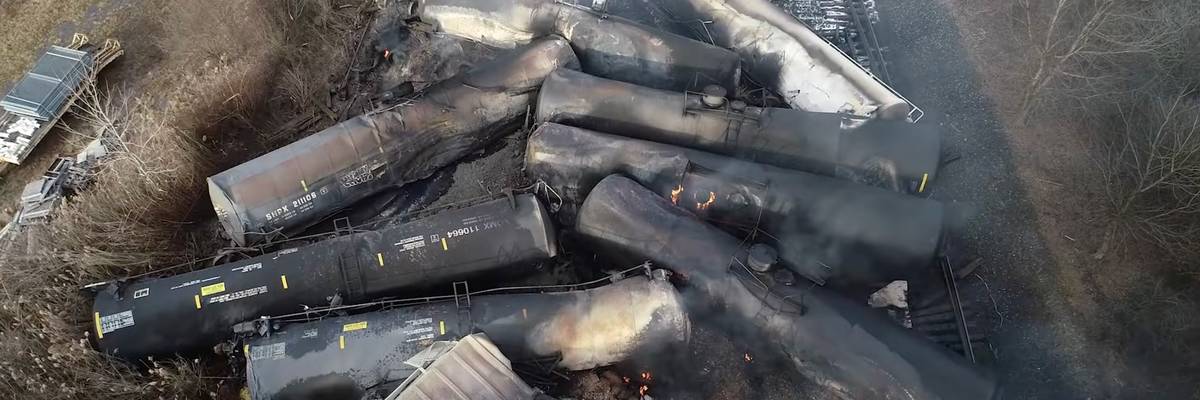
The Norfolk Southern derailment in East Palestine, Ohio was one instance in which whistleblower protections for government contractors would have been essential.
If the Expanding Whistleblower Protections for Contractors Act is passed, more contractors could feel empowered to stand up for what is right with crucial information.
With the recent presidential election, violence in the Middle East, and intense natural disasters prominent in the current news cycle, it’s understandable that major legislation is getting overlooked. However, there is one bill in particular that the public should keep its eyes on due to its potential impact on all aspects of our politics, like government accountability, immigration, and even public health: S. 1524, the Expanding Whistleblower Protections for Contractors Act.
Although there is existing legislation aimed at protecting government contractors, it is lackluster at best. Contractors can still face roadblocks on the way to truth-telling, such as limited jury trials, blacklisting, retaliation, and even a dearth of protections for refusing to violate the law. However, the Expanding Whistleblower Protections for Contractors Act increases protections for jobs funded by taxpayer dollars and closes these loopholes for federal contractors to build greater transparency in our government.
To find a case study on the importance of this legislation, one needs to look no further than the February 3, 2023 Norfolk Southern train derailment in East Palestine, Ohio, which sent forever chemicals and combustible materials, such as vinyl chloride (a toxic flammable gas), across the community and temporarily displaced 1,500 to 2,000 people. Three days later, authorities burned 116,000 gallons of vinyl chloride and other highly toxic chemicals from five tankers, sending a dense black toxic cloud over the entire region that could be seen from space. It was recently determined that the toxic fallout of materials from the derailment and burn have been detected in 16 states.
Less than a day after the derailment, the Environmental Protection Agency (EPA) failed to follow procedures to fly its Airborne Spectral Photometric Environmental Collection Technology (ASPECT) plane for data collection of chemical levels in the area. Had it done so, the agency could have determined that the chemicals in the unexploded tanks were cooling and no longer posed a threat of explosion, making the so-called “control burn” unnecessary and its fallout avoidable. In fact, the ASPECT plane remained grounded for five days until the toxic cloud had dissipated. In the aftermath of the derailment, Dr. Robert Kroutil, an EPA contractor with Kalman & Company and a key developer in the ASPECT program, was concerned about the inordinate and unnecessary delays.
With improved and stronger whistleblower protections, Dr. Kroutil would most likely not have been forced into retirement because of the threats. He could have stood his ground while still on the job.
When he finally received data to analyze, he was shocked that the plane only collected data for seven minutes when more typical flights would collect hundreds of minutes of data. He also learned that the sensors were turned off when the plane flew over creeks, waterways, and the crash site itself. He and his fellow scientists reported that the presence of contamination was inconclusive. A few weeks later, the EPA used this report to conclude that the data collection was a success, and it was safe for residents to return to their homes when in fact the reason the results were inconclusive was because the EPA failed to collect the necessary data. Dr. Kroutil was so upset about what was happening, he filed a Freedom of Information request for documents such as back-dated flight plans. When he was threatened with termination unless he withdrew his requests, he decided to retire and go public with his revelations. He had no faith in the current, inadequate legal protections. The EPA retaliated by calling his claims “false” within minutes of hearing about them. The Office of Inspector General has determined, however, that a full investigation of his concerns is warranted, supported by many other whistleblowers.
With improved and stronger whistleblower protections, Dr. Kroutil would most likely not have been forced into retirement because of the threats. He could have stood his ground while still on the job. Unfortunately, similar events have already occurred surrounding the failure to deploy the ASPECT aircraft.
Since his disclosure of EPA’s mismanagement, two train derailments in Illinois and North Dakota have resulted in the spill of hazardous chemicals and mirror problems with the response to the derailment in East Palestine. In both incidents, the EPA failed to deploy its ASPECT chemical sensing aircraft to collect data. Instead, ASPECT at the time of the derailments was performing a nonemergency assessment near Buffalo, New York, collecting data on a legacy contamination issue from World War II.
With thousands of government contractors working tough jobs for our protection—from ensuring our food is safe to eat and defending us from foreign attacks to mitigating the impact of disasters like the derailment in East Palestine—it’s time we start protecting them too. The laws aimed at allowing contractors to speak truth to power must be modernized and repaired to make whistleblowers less vulnerable to retaliation. That is why we should pay attention to the Expanding Whistleblower Protections for Contractors Act of 2023, first introduced by Sens. Gary Peters (D-Mich) and Michael Braun (R-Ind.) and passed out of committee on a bipartisan basis, which would address the shortcomings in the current law.
Government contractors like these have a long history of saving thousands of taxpayer dollars, exposing our government’s wrongdoing, and, as in this case, saving countless lives; to be effective, laws that protect whistleblowers must encourage employees of conscience to speak up and deter employers from retaliating against them for doing so. If the Expanding Whistleblower Protections for Contractors Act is passed, more contractors could feel empowered to stand up for what is right with crucial information. Government Accountability Project is committed to continuing advocacy for greater whistleblower protections for government contractors and a more fair and transparent government.
Dear Common Dreams reader, It’s been nearly 30 years since I co-founded Common Dreams with my late wife, Lina Newhouser. We had the radical notion that journalism should serve the public good, not corporate profits. It was clear to us from the outset what it would take to build such a project. No paid advertisements. No corporate sponsors. No millionaire publisher telling us what to think or do. Many people said we wouldn't last a year, but we proved those doubters wrong. Together with a tremendous team of journalists and dedicated staff, we built an independent media outlet free from the constraints of profits and corporate control. Our mission has always been simple: To inform. To inspire. To ignite change for the common good. Building Common Dreams was not easy. Our survival was never guaranteed. When you take on the most powerful forces—Wall Street greed, fossil fuel industry destruction, Big Tech lobbyists, and uber-rich oligarchs who have spent billions upon billions rigging the economy and democracy in their favor—the only bulwark you have is supporters who believe in your work. But here’s the urgent message from me today. It's never been this bad out there. And it's never been this hard to keep us going. At the very moment Common Dreams is most needed, the threats we face are intensifying. We need your support now more than ever. We don't accept corporate advertising and never will. We don't have a paywall because we don't think people should be blocked from critical news based on their ability to pay. Everything we do is funded by the donations of readers like you. When everyone does the little they can afford, we are strong. But if that support retreats or dries up, so do we. Will you donate now to make sure Common Dreams not only survives but thrives? —Craig Brown, Co-founder |
With the recent presidential election, violence in the Middle East, and intense natural disasters prominent in the current news cycle, it’s understandable that major legislation is getting overlooked. However, there is one bill in particular that the public should keep its eyes on due to its potential impact on all aspects of our politics, like government accountability, immigration, and even public health: S. 1524, the Expanding Whistleblower Protections for Contractors Act.
Although there is existing legislation aimed at protecting government contractors, it is lackluster at best. Contractors can still face roadblocks on the way to truth-telling, such as limited jury trials, blacklisting, retaliation, and even a dearth of protections for refusing to violate the law. However, the Expanding Whistleblower Protections for Contractors Act increases protections for jobs funded by taxpayer dollars and closes these loopholes for federal contractors to build greater transparency in our government.
To find a case study on the importance of this legislation, one needs to look no further than the February 3, 2023 Norfolk Southern train derailment in East Palestine, Ohio, which sent forever chemicals and combustible materials, such as vinyl chloride (a toxic flammable gas), across the community and temporarily displaced 1,500 to 2,000 people. Three days later, authorities burned 116,000 gallons of vinyl chloride and other highly toxic chemicals from five tankers, sending a dense black toxic cloud over the entire region that could be seen from space. It was recently determined that the toxic fallout of materials from the derailment and burn have been detected in 16 states.
Less than a day after the derailment, the Environmental Protection Agency (EPA) failed to follow procedures to fly its Airborne Spectral Photometric Environmental Collection Technology (ASPECT) plane for data collection of chemical levels in the area. Had it done so, the agency could have determined that the chemicals in the unexploded tanks were cooling and no longer posed a threat of explosion, making the so-called “control burn” unnecessary and its fallout avoidable. In fact, the ASPECT plane remained grounded for five days until the toxic cloud had dissipated. In the aftermath of the derailment, Dr. Robert Kroutil, an EPA contractor with Kalman & Company and a key developer in the ASPECT program, was concerned about the inordinate and unnecessary delays.
With improved and stronger whistleblower protections, Dr. Kroutil would most likely not have been forced into retirement because of the threats. He could have stood his ground while still on the job.
When he finally received data to analyze, he was shocked that the plane only collected data for seven minutes when more typical flights would collect hundreds of minutes of data. He also learned that the sensors were turned off when the plane flew over creeks, waterways, and the crash site itself. He and his fellow scientists reported that the presence of contamination was inconclusive. A few weeks later, the EPA used this report to conclude that the data collection was a success, and it was safe for residents to return to their homes when in fact the reason the results were inconclusive was because the EPA failed to collect the necessary data. Dr. Kroutil was so upset about what was happening, he filed a Freedom of Information request for documents such as back-dated flight plans. When he was threatened with termination unless he withdrew his requests, he decided to retire and go public with his revelations. He had no faith in the current, inadequate legal protections. The EPA retaliated by calling his claims “false” within minutes of hearing about them. The Office of Inspector General has determined, however, that a full investigation of his concerns is warranted, supported by many other whistleblowers.
With improved and stronger whistleblower protections, Dr. Kroutil would most likely not have been forced into retirement because of the threats. He could have stood his ground while still on the job. Unfortunately, similar events have already occurred surrounding the failure to deploy the ASPECT aircraft.
Since his disclosure of EPA’s mismanagement, two train derailments in Illinois and North Dakota have resulted in the spill of hazardous chemicals and mirror problems with the response to the derailment in East Palestine. In both incidents, the EPA failed to deploy its ASPECT chemical sensing aircraft to collect data. Instead, ASPECT at the time of the derailments was performing a nonemergency assessment near Buffalo, New York, collecting data on a legacy contamination issue from World War II.
With thousands of government contractors working tough jobs for our protection—from ensuring our food is safe to eat and defending us from foreign attacks to mitigating the impact of disasters like the derailment in East Palestine—it’s time we start protecting them too. The laws aimed at allowing contractors to speak truth to power must be modernized and repaired to make whistleblowers less vulnerable to retaliation. That is why we should pay attention to the Expanding Whistleblower Protections for Contractors Act of 2023, first introduced by Sens. Gary Peters (D-Mich) and Michael Braun (R-Ind.) and passed out of committee on a bipartisan basis, which would address the shortcomings in the current law.
Government contractors like these have a long history of saving thousands of taxpayer dollars, exposing our government’s wrongdoing, and, as in this case, saving countless lives; to be effective, laws that protect whistleblowers must encourage employees of conscience to speak up and deter employers from retaliating against them for doing so. If the Expanding Whistleblower Protections for Contractors Act is passed, more contractors could feel empowered to stand up for what is right with crucial information. Government Accountability Project is committed to continuing advocacy for greater whistleblower protections for government contractors and a more fair and transparent government.
With the recent presidential election, violence in the Middle East, and intense natural disasters prominent in the current news cycle, it’s understandable that major legislation is getting overlooked. However, there is one bill in particular that the public should keep its eyes on due to its potential impact on all aspects of our politics, like government accountability, immigration, and even public health: S. 1524, the Expanding Whistleblower Protections for Contractors Act.
Although there is existing legislation aimed at protecting government contractors, it is lackluster at best. Contractors can still face roadblocks on the way to truth-telling, such as limited jury trials, blacklisting, retaliation, and even a dearth of protections for refusing to violate the law. However, the Expanding Whistleblower Protections for Contractors Act increases protections for jobs funded by taxpayer dollars and closes these loopholes for federal contractors to build greater transparency in our government.
To find a case study on the importance of this legislation, one needs to look no further than the February 3, 2023 Norfolk Southern train derailment in East Palestine, Ohio, which sent forever chemicals and combustible materials, such as vinyl chloride (a toxic flammable gas), across the community and temporarily displaced 1,500 to 2,000 people. Three days later, authorities burned 116,000 gallons of vinyl chloride and other highly toxic chemicals from five tankers, sending a dense black toxic cloud over the entire region that could be seen from space. It was recently determined that the toxic fallout of materials from the derailment and burn have been detected in 16 states.
Less than a day after the derailment, the Environmental Protection Agency (EPA) failed to follow procedures to fly its Airborne Spectral Photometric Environmental Collection Technology (ASPECT) plane for data collection of chemical levels in the area. Had it done so, the agency could have determined that the chemicals in the unexploded tanks were cooling and no longer posed a threat of explosion, making the so-called “control burn” unnecessary and its fallout avoidable. In fact, the ASPECT plane remained grounded for five days until the toxic cloud had dissipated. In the aftermath of the derailment, Dr. Robert Kroutil, an EPA contractor with Kalman & Company and a key developer in the ASPECT program, was concerned about the inordinate and unnecessary delays.
With improved and stronger whistleblower protections, Dr. Kroutil would most likely not have been forced into retirement because of the threats. He could have stood his ground while still on the job.
When he finally received data to analyze, he was shocked that the plane only collected data for seven minutes when more typical flights would collect hundreds of minutes of data. He also learned that the sensors were turned off when the plane flew over creeks, waterways, and the crash site itself. He and his fellow scientists reported that the presence of contamination was inconclusive. A few weeks later, the EPA used this report to conclude that the data collection was a success, and it was safe for residents to return to their homes when in fact the reason the results were inconclusive was because the EPA failed to collect the necessary data. Dr. Kroutil was so upset about what was happening, he filed a Freedom of Information request for documents such as back-dated flight plans. When he was threatened with termination unless he withdrew his requests, he decided to retire and go public with his revelations. He had no faith in the current, inadequate legal protections. The EPA retaliated by calling his claims “false” within minutes of hearing about them. The Office of Inspector General has determined, however, that a full investigation of his concerns is warranted, supported by many other whistleblowers.
With improved and stronger whistleblower protections, Dr. Kroutil would most likely not have been forced into retirement because of the threats. He could have stood his ground while still on the job. Unfortunately, similar events have already occurred surrounding the failure to deploy the ASPECT aircraft.
Since his disclosure of EPA’s mismanagement, two train derailments in Illinois and North Dakota have resulted in the spill of hazardous chemicals and mirror problems with the response to the derailment in East Palestine. In both incidents, the EPA failed to deploy its ASPECT chemical sensing aircraft to collect data. Instead, ASPECT at the time of the derailments was performing a nonemergency assessment near Buffalo, New York, collecting data on a legacy contamination issue from World War II.
With thousands of government contractors working tough jobs for our protection—from ensuring our food is safe to eat and defending us from foreign attacks to mitigating the impact of disasters like the derailment in East Palestine—it’s time we start protecting them too. The laws aimed at allowing contractors to speak truth to power must be modernized and repaired to make whistleblowers less vulnerable to retaliation. That is why we should pay attention to the Expanding Whistleblower Protections for Contractors Act of 2023, first introduced by Sens. Gary Peters (D-Mich) and Michael Braun (R-Ind.) and passed out of committee on a bipartisan basis, which would address the shortcomings in the current law.
Government contractors like these have a long history of saving thousands of taxpayer dollars, exposing our government’s wrongdoing, and, as in this case, saving countless lives; to be effective, laws that protect whistleblowers must encourage employees of conscience to speak up and deter employers from retaliating against them for doing so. If the Expanding Whistleblower Protections for Contractors Act is passed, more contractors could feel empowered to stand up for what is right with crucial information. Government Accountability Project is committed to continuing advocacy for greater whistleblower protections for government contractors and a more fair and transparent government.