SUBSCRIBE TO OUR FREE NEWSLETTER
Daily news & progressive opinion—funded by the people, not the corporations—delivered straight to your inbox.
5
#000000
#FFFFFF
To donate by check, phone, or other method, see our More Ways to Give page.
Daily news & progressive opinion—funded by the people, not the corporations—delivered straight to your inbox.
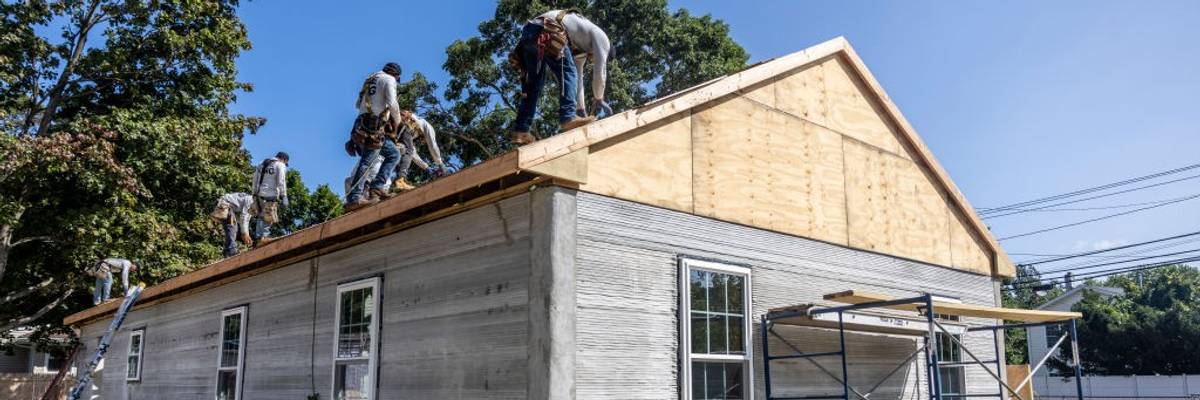
Volunteers with Habitat for Humanity of Long Island work on the roof installation at its first 3D-printed home in Brentwood, New York on Aug. 21, 2024.
And how a new social housing bill introduced Rep. Alexandria Ocasio-Cortez and Sen. Tina Smith aims to address the crisis harming families and communities nationwide.
In its most recent year-end letter, the private equity firm Blackstone gave its stockholders a seemingly counterintuitive assurance: the lack of new housing stock was reason for optimism.
Why does a stagnant growth in new living spaces benefit Blackstone? Because it is the nation’s largest corporate landlord. For the firm and its investors, chronic housing shortages mean more power to set prices and more leverage to extract wealth from vulnerable working-class tenants.
Blackstone’s letter reveals the malevolent and distortionary role private equity plays in our residential real estate market and underscores the fundamental problem with housing commodification writ large.
Our market-based system simply does not give the private sector incentives to meet the public’s demand for high-quality, permanently affordable housing. Providing it would be against the sector’s economic interests since new supply would bring down prices and negatively impact profitability.
Social housing will make certain that housing is treated as a public good that satisfies a social need, not a financial asset to profit off of.
The negative effects of housing commodification are all around us. For-profit investors are snatching up properties at an alarming rate – 1 in 6 of all residential homes in the second quarter of this year – giving them the power to charge residents junk fees on top of rent increases.
As a result, a record number of renter households – 22.4 million individuals and families, half of all renters – are now paying more than 30 percent of their income on rent and other housing-related expenses. This places a significant strain on household budgets and contributes to a range of problems related to mental health including anxiety and depression.
Tenant unions and working-class institutions across the country have spent years fighting back against the financialization of housing, organizing their communities against speculators in favor of greater tenant protections and fighting for housing to be a human right.
A promising step in this direction was taken last week when Senator Tina Smith (D-MN) and Congresswoman Alexandria Ocasio-Cortez (D-NY) introduced new legislation designed to solve our acute affordability crisis.
The Homes Act would invest in the construction of new social housing while dedicating resources to rehabilitate the existing stock. The bill proposes to establish a Housing Development Authority, authorizing $300 billion over the next ten years for the new department to finance and develop permanently affordable housing. It would also repeal the obsolete Faircloth Amendment, a provision that effectively limits the availability of public housing, removing structural barriers to the construction of new public units.
Rents would be capped at 25 percent of a household’s income for tenants, greatly easing the burden of housing for them.
Perhaps the most innovative aspect of the bill is the importance it places on equity and democracy. The new units will be built by union workers; priority will be given to protect underserved communities of color from displacement; a significant share of the affordable housing stock will be earmarked for households with low incomes; and many of the new homes will be placed under democratic and community control when transferred to eligible entities like community land trusts and tenant-owned cooperatives.
The emphasis on permanence in the provision of social housing is critical for understanding housing struggles today. Permanent affordability will not only begin the process of decommodification, but it will also protect buildings from private equity firms who see affordable housing as another sector they can plunder.
Affordable housing already accounts for eight percent of Blackstone’s BREIT portfolio, but there is no genuine commitment to providing reasonably priced homes to working-class households. The firm has opened its coffers more than once to defeat rent control ballot initiatives and it exploits programs like the Low-Income Housing Tax Credit (LIHTC) to secure the tax benefits that come with investing in affordable housing. Yet Blackstone still raises rents, evicts tenants, and underinvests in maintenance.
The permanence of affordability is the cornerstone of social housing. Social housing will make certain that housing is treated as a public good that satisfies a social need, not a financial asset to profit off of. Only when speculators and concentrated wealth are reined in will we solve the housing crisis and guarantee safe, healthy, affordable, and dignified homes for all.
Dear Common Dreams reader, It’s been nearly 30 years since I co-founded Common Dreams with my late wife, Lina Newhouser. We had the radical notion that journalism should serve the public good, not corporate profits. It was clear to us from the outset what it would take to build such a project. No paid advertisements. No corporate sponsors. No millionaire publisher telling us what to think or do. Many people said we wouldn't last a year, but we proved those doubters wrong. Together with a tremendous team of journalists and dedicated staff, we built an independent media outlet free from the constraints of profits and corporate control. Our mission has always been simple: To inform. To inspire. To ignite change for the common good. Building Common Dreams was not easy. Our survival was never guaranteed. When you take on the most powerful forces—Wall Street greed, fossil fuel industry destruction, Big Tech lobbyists, and uber-rich oligarchs who have spent billions upon billions rigging the economy and democracy in their favor—the only bulwark you have is supporters who believe in your work. But here’s the urgent message from me today. It's never been this bad out there. And it's never been this hard to keep us going. At the very moment Common Dreams is most needed, the threats we face are intensifying. We need your support now more than ever. We don't accept corporate advertising and never will. We don't have a paywall because we don't think people should be blocked from critical news based on their ability to pay. Everything we do is funded by the donations of readers like you. When everyone does the little they can afford, we are strong. But if that support retreats or dries up, so do we. Will you donate now to make sure Common Dreams not only survives but thrives? —Craig Brown, Co-founder |
In its most recent year-end letter, the private equity firm Blackstone gave its stockholders a seemingly counterintuitive assurance: the lack of new housing stock was reason for optimism.
Why does a stagnant growth in new living spaces benefit Blackstone? Because it is the nation’s largest corporate landlord. For the firm and its investors, chronic housing shortages mean more power to set prices and more leverage to extract wealth from vulnerable working-class tenants.
Blackstone’s letter reveals the malevolent and distortionary role private equity plays in our residential real estate market and underscores the fundamental problem with housing commodification writ large.
Our market-based system simply does not give the private sector incentives to meet the public’s demand for high-quality, permanently affordable housing. Providing it would be against the sector’s economic interests since new supply would bring down prices and negatively impact profitability.
Social housing will make certain that housing is treated as a public good that satisfies a social need, not a financial asset to profit off of.
The negative effects of housing commodification are all around us. For-profit investors are snatching up properties at an alarming rate – 1 in 6 of all residential homes in the second quarter of this year – giving them the power to charge residents junk fees on top of rent increases.
As a result, a record number of renter households – 22.4 million individuals and families, half of all renters – are now paying more than 30 percent of their income on rent and other housing-related expenses. This places a significant strain on household budgets and contributes to a range of problems related to mental health including anxiety and depression.
Tenant unions and working-class institutions across the country have spent years fighting back against the financialization of housing, organizing their communities against speculators in favor of greater tenant protections and fighting for housing to be a human right.
A promising step in this direction was taken last week when Senator Tina Smith (D-MN) and Congresswoman Alexandria Ocasio-Cortez (D-NY) introduced new legislation designed to solve our acute affordability crisis.
The Homes Act would invest in the construction of new social housing while dedicating resources to rehabilitate the existing stock. The bill proposes to establish a Housing Development Authority, authorizing $300 billion over the next ten years for the new department to finance and develop permanently affordable housing. It would also repeal the obsolete Faircloth Amendment, a provision that effectively limits the availability of public housing, removing structural barriers to the construction of new public units.
Rents would be capped at 25 percent of a household’s income for tenants, greatly easing the burden of housing for them.
Perhaps the most innovative aspect of the bill is the importance it places on equity and democracy. The new units will be built by union workers; priority will be given to protect underserved communities of color from displacement; a significant share of the affordable housing stock will be earmarked for households with low incomes; and many of the new homes will be placed under democratic and community control when transferred to eligible entities like community land trusts and tenant-owned cooperatives.
The emphasis on permanence in the provision of social housing is critical for understanding housing struggles today. Permanent affordability will not only begin the process of decommodification, but it will also protect buildings from private equity firms who see affordable housing as another sector they can plunder.
Affordable housing already accounts for eight percent of Blackstone’s BREIT portfolio, but there is no genuine commitment to providing reasonably priced homes to working-class households. The firm has opened its coffers more than once to defeat rent control ballot initiatives and it exploits programs like the Low-Income Housing Tax Credit (LIHTC) to secure the tax benefits that come with investing in affordable housing. Yet Blackstone still raises rents, evicts tenants, and underinvests in maintenance.
The permanence of affordability is the cornerstone of social housing. Social housing will make certain that housing is treated as a public good that satisfies a social need, not a financial asset to profit off of. Only when speculators and concentrated wealth are reined in will we solve the housing crisis and guarantee safe, healthy, affordable, and dignified homes for all.
In its most recent year-end letter, the private equity firm Blackstone gave its stockholders a seemingly counterintuitive assurance: the lack of new housing stock was reason for optimism.
Why does a stagnant growth in new living spaces benefit Blackstone? Because it is the nation’s largest corporate landlord. For the firm and its investors, chronic housing shortages mean more power to set prices and more leverage to extract wealth from vulnerable working-class tenants.
Blackstone’s letter reveals the malevolent and distortionary role private equity plays in our residential real estate market and underscores the fundamental problem with housing commodification writ large.
Our market-based system simply does not give the private sector incentives to meet the public’s demand for high-quality, permanently affordable housing. Providing it would be against the sector’s economic interests since new supply would bring down prices and negatively impact profitability.
Social housing will make certain that housing is treated as a public good that satisfies a social need, not a financial asset to profit off of.
The negative effects of housing commodification are all around us. For-profit investors are snatching up properties at an alarming rate – 1 in 6 of all residential homes in the second quarter of this year – giving them the power to charge residents junk fees on top of rent increases.
As a result, a record number of renter households – 22.4 million individuals and families, half of all renters – are now paying more than 30 percent of their income on rent and other housing-related expenses. This places a significant strain on household budgets and contributes to a range of problems related to mental health including anxiety and depression.
Tenant unions and working-class institutions across the country have spent years fighting back against the financialization of housing, organizing their communities against speculators in favor of greater tenant protections and fighting for housing to be a human right.
A promising step in this direction was taken last week when Senator Tina Smith (D-MN) and Congresswoman Alexandria Ocasio-Cortez (D-NY) introduced new legislation designed to solve our acute affordability crisis.
The Homes Act would invest in the construction of new social housing while dedicating resources to rehabilitate the existing stock. The bill proposes to establish a Housing Development Authority, authorizing $300 billion over the next ten years for the new department to finance and develop permanently affordable housing. It would also repeal the obsolete Faircloth Amendment, a provision that effectively limits the availability of public housing, removing structural barriers to the construction of new public units.
Rents would be capped at 25 percent of a household’s income for tenants, greatly easing the burden of housing for them.
Perhaps the most innovative aspect of the bill is the importance it places on equity and democracy. The new units will be built by union workers; priority will be given to protect underserved communities of color from displacement; a significant share of the affordable housing stock will be earmarked for households with low incomes; and many of the new homes will be placed under democratic and community control when transferred to eligible entities like community land trusts and tenant-owned cooperatives.
The emphasis on permanence in the provision of social housing is critical for understanding housing struggles today. Permanent affordability will not only begin the process of decommodification, but it will also protect buildings from private equity firms who see affordable housing as another sector they can plunder.
Affordable housing already accounts for eight percent of Blackstone’s BREIT portfolio, but there is no genuine commitment to providing reasonably priced homes to working-class households. The firm has opened its coffers more than once to defeat rent control ballot initiatives and it exploits programs like the Low-Income Housing Tax Credit (LIHTC) to secure the tax benefits that come with investing in affordable housing. Yet Blackstone still raises rents, evicts tenants, and underinvests in maintenance.
The permanence of affordability is the cornerstone of social housing. Social housing will make certain that housing is treated as a public good that satisfies a social need, not a financial asset to profit off of. Only when speculators and concentrated wealth are reined in will we solve the housing crisis and guarantee safe, healthy, affordable, and dignified homes for all.