SUBSCRIBE TO OUR FREE NEWSLETTER
Daily news & progressive opinion—funded by the people, not the corporations—delivered straight to your inbox.
5
#000000
#FFFFFF
To donate by check, phone, or other method, see our More Ways to Give page.
Daily news & progressive opinion—funded by the people, not the corporations—delivered straight to your inbox.
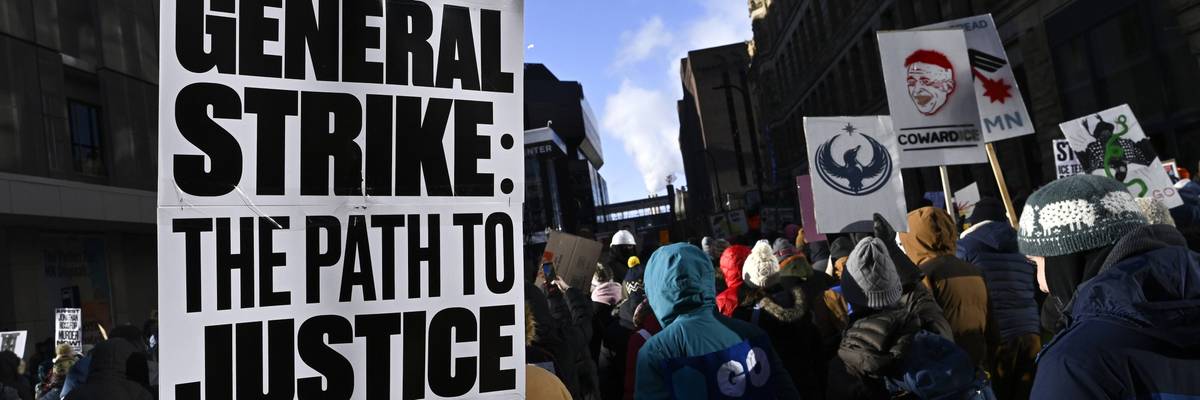
Demonstrators participate in a rally and march during an "ICE Out” day of protest on January 23, 2026 in Minneapolis, Minnesota.
History teaches us that, when unions fight to defend democracy and win, they position themselves for periods of explosive growth and increased worker power.
The US labor movement, like the nation at large, stands at a crossroads. The next few years might well determine whether the United States fully descends into an era of electoral autocracy, where democracy has withered and authoritarianism becomes the political norm. This period is also likely to set the future trajectory of the union movement’s power and influence, as the state of democracy and organized labor have long been deeply intertwined.
For decades, the right-wing forces set on steadily eroding our democracy have worked in tandem with a pro-corporate movement that has increasingly marginalized organized labor, creating a ballooning crisis for the working class. Yet this politically hazardous moment also represents an opportunity to overcome deep-seated institutional inertia, drawing elements of a cautious labor movement out of their defensive crouch, and helping unions devise forms of struggle that might both revive the labor movement and renew American democracy.
President Donald Trump’s second term has, in a way, broken a spell. For years, the pre-Trump status quo kept labor locked in a pattern of slow decline even as democracy was increasingly stifled and abridged by voter suppression, gerrymandering, filibusters, and the overweening power of organized money. But the decades-old dysfunctional status quo that gave rise to Trumpism is now crumbling under the weight of the most lawless, antidemocratic, rights-trampling administration this country has seen since the 19th century.
History suggests that fighting to defend and revive democracy in its moment of maximum peril can create a window of opportunity for labor. Past experience—in the United States and other nations—teaches us that, when unions fight to defend democracy and win, they position themselves for periods of explosive growth and increased worker power. It is imperative that the US labor movement grasp this lesson and seize the window of opportunity before it’s too late.
It’s clear that the crisis facing US democracy is deepening. Over the past year, immigrants and the neighbors and coworkers who stood in solidarity with them endured murderous paramilitary occupations in Minneapolis, Chicago, and other cities across the country. The nation has been plunged into war in Iran without prior input from Congress. The president has even suggested the federal government should seize control of the upcoming midterm elections from the states.
This all comes on top of the Supreme Court’s relentless assault on workers’ rights and a worsening affordability crisis that has undermined the stability of working-class families, leading them to wonder whether the system is irretrievably broken.
As important as the coming elections are, unions should firmly reject the comforting delusion that they can recover through the ballot box what power they’ve lost in the workplace.
While our democracy’s crisis deepens, the national labor movement has yet to play a leading role in the resistance against ascendant authoritarianism. By seizing the opportunity to play such a role in the year ahead, labor has the opportunity to reverse its decades-long slide toward irrelevancy by taking up an indispensable role in preserving, expanding, and deepening rights-based democracy.
By fighting to reconstruct our democracy in the face of the mortal threat it now faces, labor could transform itself from a fading force—whose structure and outlook still bear the imprint of the 19th- and 20th-century struggles that birthed it—into a rejuvenated movement ambitious enough to give workers the powerful voice they deserve in the 21st century.
That transformation is only possible, though, if the labor movement moves beyond the magical thinking that if unions can just survive the Trump era then they can help restore a kind of pre-Trump normalcy afterward. The prevailing sentiment among labor’s leaders seems to be that, if they can just help their allies regain control of Congress later this year, they will be able to contain the damage Trump has wrought and coalesce behind an alternative in 2028 that can roll back Trumpism.
As important as the coming elections are, unions should firmly reject the comforting delusion that they can recover through the ballot box what power they’ve lost in the workplace. For if such electoral victories are unaccompanied by a revived, reorganized labor movement, they will leave workers and unions in a situation no different from the one they faced prior to Trump’s rise.
If the labor movement is to have a viable future, unions must not merely survive but capitalize on Trump’s disruption of longstanding norms, assumptions, and institutions, many of which no longer operate to labor’s benefit—if they ever did. That is the path to advance a bold 21st-century vision of inclusive solidarity, equality, rights, and democracy.
How labor might take advantage of Trumpism’s authoritarian excesses to advance such a vision was put on display in Minnesota this winter, where local labor organizations drew on years of experience to play a central role in the resistance to Trump’s Immigration and Customs Enforcement (ICE) invasion. Unions of janitors, teachers, healthcare workers, and others helped coalesce a resistance that included workers centers, faith communities and clergy, community organizations, immigrants’ rights groups, small businesses, and caring neighbors.
Protesters turned out by the tens of thousands in subzero temperatures, religious leaders endured arrest in acts of civil disobedience, and witnesses turned their cell phones into tools to document ICE malfeasance and protect their neighbors. That resistance was built on a shared common good analysis of power and a recognition of the increasingly baneful influence of billionaires over our political system and economy. Protesters targeted not only ICE but corporations such as Target and Hilton that have either remained silent or openly abetted and profited from Trump’s authoritarian power grab.
Make no mistake: The formal end of Operation Metro Surge in Minneapolis scarcely indicates a waning of this administration’s authoritarian ambitions. Unresolved issues regarding the limits of ICE’s legal authority will likely continue to elicit protest and resistance in the streets. In the meantime, new fronts are already opening as the president disregards all restraints on his power to deploy military force abroad and pushes an effort to nationalize the midterm elections at home. As labor movement leaders contemplate the conflicts that might emerge, they should consider lessons from what happened in Minnesota as well as other cities like Chicago and Los Angeles, where local unions played important roles in mobilizing resistance. They should also learn from the experiences of unions in other nations that successfully resisted authoritarian regimes.
Defeating Trump and his allies at the polls will be a Pyrrhic victory if the corporations fueling the right-wing’s anti-worker agenda maintain their influence over our government.
The stories of Brazil, South Korea, and South Africa are cases in point. In these countries, labor movements joined and helped lead the struggles against dictatorship, authoritarianism, and apartheid. In each case, when democracy won out, unions saw massive increases in membership. During Brazil’s transition to democracy in the mid-1980s, work stoppages jumped tenfold, and Brazil’s labor federation, Central Única dos Trabalhadores (CUT), founded during this period, grew to represent more than 15 million people by 1990.
When South Korea’s dictatorship fell in 1987, a period of militant worker struggle ensued as the number of strikes jumped and union membership surged. In South Africa, the labor movement played a key role in the fight against apartheid, and trade union membership grew dramatically, up from 1.4 million workers and 18% density in 1985 to 3.8 million and 51% by 1998. What’s more, these growth spurts boosted worker power and helped erect union bulwarks to help prevent backsliding into authoritarianism in subsequent years.
In Brazil, labor rallied to defeat President Jair Bolsonaro at the polls in 2022, then opposed his post-defeat coup attempt and supported his successful prosecution. Similarly, South Korean unions played a vital role in defeating an attempted coup in 2024 by threatening a general strike.
As these examples suggest, and as scholars have long noted, labor movements—no matter their national context—tend to expand not in linear fashion but by quantum leaps. The British labor historian Eric J. Hobsbawm described these episodes as “discontinuous” and “explosive” bursts that occur when circumstances force “qualitative innovations in the movement.”
Resisting authoritarians has required such innovations in countries across the globe, which have in turn helped unions to grow. When worker-led movements aligned with pro-democracy forces and succeeded in undermining authoritarian regimes, their victories allowed workers to witness and feel their collective power. Confrontations with authoritarianism in the streets translated into militancy, collective action, and increased organization in the workplace.
The US labor movement’s history also bears out that pattern. While people in the United States have never witnessed a battle with authoritarianism quite like the ones that erupted in South Africa, Brazil, and South Korea, an analogous incubation of explosive growth took place during periods when the US labor movement aligned itself with struggles to defend democracy against what were perceived as existential threats.
The Civil War, waged to defeat the Confederacy and preserve the Union in the 1860s, triggered what W.E.B. Du Bois called a vast “general strike” in which the enslaved transferred their labor “from the Confederate planter to the Northern invader” even as that war fueled the expansion of the national trade unions that would later form the American Federation of Labor (AFL).
The effort to make the world “safe for democracy,” as President Woodrow Wilson pledged during World War I, likewise provided the setting for experimentation with industrial unionism that paved the way for the later formation of the Congress of Industrial Organizations (CIO). And the forging of a US “arsenal of democracy” against fascism during World War II helped lead to the high-water mark of US unionism in the 1950s.
The kind of quantum leaps in union growth that have occurred when the US labor movement has linked its fortunes to the future of democracy can happen again. In the growing resistance to Trumpism, we are already seeing glimmers of how this could happen in our time. Unions and allied labor and community organizations provided the backbone of the resistance in Minnesota; employees in the largest and most influential technology labs are confronting bosses who are selling their technology to the government for domestic surveillance and global war; higher education unions are challenging attacks on free speech on university campuses.
Flashes of resistance like these are multiplying. Yet such sparks will not fuel a major breakthrough unless unions at every level—from locals to internationals—embrace the fight against Trump’s authoritarian, billionaire-serving regime and defend democracy by challenging the corporations and Silicon Valley technofascists that are shaping and profiting from Trump’s policies.
Such opposition must go beyond an electoral strategy for 2026 and 2028. Defeating Trump and his allies at the polls will be a Pyrrhic victory if the corporations fueling the right-wing’s anti-worker agenda maintain their influence over our government. Should Democrats regain control of Congress and the White House, the same corporations that have aligned with Trump will be working to sabotage pro-labor policies while doubling down on their AI-obsessed, job-threatening, antidemocratic campaign of economic destruction.
There is no doubt that democracy and workers’ rights are facing down an existential threat. Yet that very threat and the sense of urgency it has spawned have created an opportunity we could not have engineered on our own.
As the experience of other nations and the failure of our own post-Civil War Reconstruction remind us, elites and economic structures that benefit from authoritarian power don’t vanish when antidemocratic regimes crumble; they regroup. We cannot allow such a regrouping to occur post-Trump, for as we have seen over the past 50 years of labor decline under Democratic and Republican administrations alike, a return to the pre-Trump status quo offers no hope for workers or labor.
Naming and challenging the economic actors aligned with Trump is therefore critical if we are to weaken their post-Trump grip on power.
Although their critics have often suggested that US unions have tied their fortunes too closely to politics, in truth, US labor has been reluctant to take up the kind of big political issues that have historically helped push workers into the streets and built workers’ movements in other democracies. We should not be surprised if many national unions hesitate to act decisively. Nor should we expect their leaders to be at the forefront, for despite critics’ endless talk of labor bosses, the movement has never functioned effectively as a top-down, command-and-control institution.
Rather, the national union movement has tended to respond opportunistically to openings that it lacked the institutional will or unity of purpose to create. In the present crisis, local unions in cities around the country—through the common good alliances they’re building to fight ICE, support beleaguered federal workers, and demand billionaires begin paying their fair share—are beginning to create the kind of openings that could conceivably pull the larger movement into the fight.
Evidence on the ground in places like Minnesota already suggests that well-conceived actions by forward-leaning coalitions of the willing can open windows of opportunity and create permission structures capable of drawing more cautious mainstream organizations into the fight. The Minnesota AFL-CIO did not initiate the remarkable “Day of Truth & Freedom,” which triggered a virtual economic shutdown of Minneapolis on January 23, as tens of thousands of residents stayed away from work, school,and shopping. Yet the organizing and alignment-building that preceded that event won the state federation’s support in the days before the action, generating a much larger impact than its initial organizers had expected.
Forward-thinking unions and their allies can replicate this effect in other settings by constructing campaigns that unmask the corporations colluding with the Trump administration’s authoritarian push. Focusing on key sectors and geographies, and engaging in calculated acts of disruption and nonviolent resistance, can not only erect defenses against the administration’s aggression but set the stage for a post-Trump organizing surge.
As longtime veterans of the labor movement, we see three elements as crucial to this strategy. The first is defining our targets expansively and attacking the financial roots of their power. We need a shared analysis of who has power in our communities and nationally, including the key Big Tech titans who openly advocate rolling back democracy and expanding an all-seeing surveillance state.
Having identified these present-day “malefactors of great wealth,” as they were called in the Progressive Era, we need to demand that worker pension funds (state and local government workers’ pension assets alone top $6 trillion) cease investing in these corporations and their anti-worker, antidemocratic agenda. We also need to articulate a platform and visionary policy agenda that focuses on breaking up and limiting their economic and political power. We must find ways to tax their hoarded wealth, reinvesting the revenues in our struggling austerity-starved communities.
A second element involves moving the labor movement into a fighting posture. The past half-century has taken a debilitating toll on the movement’s willingness and capacity to engage in collective action. In 1955, the year the AFL-CIO was formed, the equivalent of 12.1% of union members engaged in a major work stoppage. That level of union militancy vanished long ago in the United States. During the past 25 years, the annual average of participants in major work stoppages has been equal to only 1% of US union members. (The high point of militancy in that period came during the 2018 #RedForEd teacher walkout upheaval, when the equivalent of 3.3% of union members went on strike, a mere fraction of 1950s-level militancy.)
If it’s difficult to imagine a revival of organized labor without a revival of worker militancy, it’s even harder to envision an effective opposition to authoritarianism without it. Political scientist Erica Chenoweth, of Harvard’s John F. Kennedy School of Government, has theorized that, to succeed, a civil resistance movement requires 3.5% of a population to actively join it. If we are to reach that threshold, then labor will need to massively overperform. Labor can play this role only if it begins to rebuild its badly atrophied capacity for collective action. Unions can begin to recover that capacity by aligning contract dates and strikes; crafting common good bargaining demands that enlist public support for those struggles; and planning national “no work, no school, no shopping” efforts like the one Minnesotans pulled off January 23, and as the May Day Strong campaign recently promoted.
Finally, we need community-labor organizing committees, like those that emerged in Minnesota, to lead large-scale drives in crucial sectors while linking these efforts to the goal of breaking up the big companies that are increasingly dominating our economy and politics alike. As we confront the most aggressive consolidation of capital and economic power this nation has ever seen, our goal cannot be only to unionize the behemoths that are reorganizing our society; we must demand their vast monopoly power be diminished and made accountable to the public good.
There is no doubt that democracy and workers’ rights are facing down an existential threat. Yet that very threat and the sense of urgency it has spawned have created an opportunity we could not have engineered on our own. It has roused growing numbers to the defense of democracy, glaringly exposed the dangers of unchecked corporate power, and catalyzed actions within pockets of the labor movement that have a potential to spread and become transformative.
In the years ahead, if more unions begin to follow the example set by organizers in Minnesota to seize this moment by embracing social movement unionism, they will not only play an indispensable role in defeating Trumpist authoritarianism.
They could also help trigger a 21st-century revival of the US labor movement.
Dear Common Dreams reader, It’s been nearly 30 years since I co-founded Common Dreams with my late wife, Lina Newhouser. We had the radical notion that journalism should serve the public good, not corporate profits. It was clear to us from the outset what it would take to build such a project. No paid advertisements. No corporate sponsors. No millionaire publisher telling us what to think or do. Many people said we wouldn't last a year, but we proved those doubters wrong. Together with a tremendous team of journalists and dedicated staff, we built an independent media outlet free from the constraints of profits and corporate control. Our mission has always been simple: To inform. To inspire. To ignite change for the common good. Building Common Dreams was not easy. Our survival was never guaranteed. When you take on the most powerful forces—Wall Street greed, fossil fuel industry destruction, Big Tech lobbyists, and uber-rich oligarchs who have spent billions upon billions rigging the economy and democracy in their favor—the only bulwark you have is supporters who believe in your work. But here’s the urgent message from me today. It's never been this bad out there. And it's never been this hard to keep us going. At the very moment Common Dreams is most needed, the threats we face are intensifying. We need your support now more than ever. We don't accept corporate advertising and never will. We don't have a paywall because we don't think people should be blocked from critical news based on their ability to pay. Everything we do is funded by the donations of readers like you. When everyone does the little they can afford, we are strong. But if that support retreats or dries up, so do we. Will you donate now to make sure Common Dreams not only survives but thrives? —Craig Brown, Co-founder |
The US labor movement, like the nation at large, stands at a crossroads. The next few years might well determine whether the United States fully descends into an era of electoral autocracy, where democracy has withered and authoritarianism becomes the political norm. This period is also likely to set the future trajectory of the union movement’s power and influence, as the state of democracy and organized labor have long been deeply intertwined.
For decades, the right-wing forces set on steadily eroding our democracy have worked in tandem with a pro-corporate movement that has increasingly marginalized organized labor, creating a ballooning crisis for the working class. Yet this politically hazardous moment also represents an opportunity to overcome deep-seated institutional inertia, drawing elements of a cautious labor movement out of their defensive crouch, and helping unions devise forms of struggle that might both revive the labor movement and renew American democracy.
President Donald Trump’s second term has, in a way, broken a spell. For years, the pre-Trump status quo kept labor locked in a pattern of slow decline even as democracy was increasingly stifled and abridged by voter suppression, gerrymandering, filibusters, and the overweening power of organized money. But the decades-old dysfunctional status quo that gave rise to Trumpism is now crumbling under the weight of the most lawless, antidemocratic, rights-trampling administration this country has seen since the 19th century.
History suggests that fighting to defend and revive democracy in its moment of maximum peril can create a window of opportunity for labor. Past experience—in the United States and other nations—teaches us that, when unions fight to defend democracy and win, they position themselves for periods of explosive growth and increased worker power. It is imperative that the US labor movement grasp this lesson and seize the window of opportunity before it’s too late.
It’s clear that the crisis facing US democracy is deepening. Over the past year, immigrants and the neighbors and coworkers who stood in solidarity with them endured murderous paramilitary occupations in Minneapolis, Chicago, and other cities across the country. The nation has been plunged into war in Iran without prior input from Congress. The president has even suggested the federal government should seize control of the upcoming midterm elections from the states.
This all comes on top of the Supreme Court’s relentless assault on workers’ rights and a worsening affordability crisis that has undermined the stability of working-class families, leading them to wonder whether the system is irretrievably broken.
As important as the coming elections are, unions should firmly reject the comforting delusion that they can recover through the ballot box what power they’ve lost in the workplace.
While our democracy’s crisis deepens, the national labor movement has yet to play a leading role in the resistance against ascendant authoritarianism. By seizing the opportunity to play such a role in the year ahead, labor has the opportunity to reverse its decades-long slide toward irrelevancy by taking up an indispensable role in preserving, expanding, and deepening rights-based democracy.
By fighting to reconstruct our democracy in the face of the mortal threat it now faces, labor could transform itself from a fading force—whose structure and outlook still bear the imprint of the 19th- and 20th-century struggles that birthed it—into a rejuvenated movement ambitious enough to give workers the powerful voice they deserve in the 21st century.
That transformation is only possible, though, if the labor movement moves beyond the magical thinking that if unions can just survive the Trump era then they can help restore a kind of pre-Trump normalcy afterward. The prevailing sentiment among labor’s leaders seems to be that, if they can just help their allies regain control of Congress later this year, they will be able to contain the damage Trump has wrought and coalesce behind an alternative in 2028 that can roll back Trumpism.
As important as the coming elections are, unions should firmly reject the comforting delusion that they can recover through the ballot box what power they’ve lost in the workplace. For if such electoral victories are unaccompanied by a revived, reorganized labor movement, they will leave workers and unions in a situation no different from the one they faced prior to Trump’s rise.
If the labor movement is to have a viable future, unions must not merely survive but capitalize on Trump’s disruption of longstanding norms, assumptions, and institutions, many of which no longer operate to labor’s benefit—if they ever did. That is the path to advance a bold 21st-century vision of inclusive solidarity, equality, rights, and democracy.
How labor might take advantage of Trumpism’s authoritarian excesses to advance such a vision was put on display in Minnesota this winter, where local labor organizations drew on years of experience to play a central role in the resistance to Trump’s Immigration and Customs Enforcement (ICE) invasion. Unions of janitors, teachers, healthcare workers, and others helped coalesce a resistance that included workers centers, faith communities and clergy, community organizations, immigrants’ rights groups, small businesses, and caring neighbors.
Protesters turned out by the tens of thousands in subzero temperatures, religious leaders endured arrest in acts of civil disobedience, and witnesses turned their cell phones into tools to document ICE malfeasance and protect their neighbors. That resistance was built on a shared common good analysis of power and a recognition of the increasingly baneful influence of billionaires over our political system and economy. Protesters targeted not only ICE but corporations such as Target and Hilton that have either remained silent or openly abetted and profited from Trump’s authoritarian power grab.
Make no mistake: The formal end of Operation Metro Surge in Minneapolis scarcely indicates a waning of this administration’s authoritarian ambitions. Unresolved issues regarding the limits of ICE’s legal authority will likely continue to elicit protest and resistance in the streets. In the meantime, new fronts are already opening as the president disregards all restraints on his power to deploy military force abroad and pushes an effort to nationalize the midterm elections at home. As labor movement leaders contemplate the conflicts that might emerge, they should consider lessons from what happened in Minnesota as well as other cities like Chicago and Los Angeles, where local unions played important roles in mobilizing resistance. They should also learn from the experiences of unions in other nations that successfully resisted authoritarian regimes.
Defeating Trump and his allies at the polls will be a Pyrrhic victory if the corporations fueling the right-wing’s anti-worker agenda maintain their influence over our government.
The stories of Brazil, South Korea, and South Africa are cases in point. In these countries, labor movements joined and helped lead the struggles against dictatorship, authoritarianism, and apartheid. In each case, when democracy won out, unions saw massive increases in membership. During Brazil’s transition to democracy in the mid-1980s, work stoppages jumped tenfold, and Brazil’s labor federation, Central Única dos Trabalhadores (CUT), founded during this period, grew to represent more than 15 million people by 1990.
When South Korea’s dictatorship fell in 1987, a period of militant worker struggle ensued as the number of strikes jumped and union membership surged. In South Africa, the labor movement played a key role in the fight against apartheid, and trade union membership grew dramatically, up from 1.4 million workers and 18% density in 1985 to 3.8 million and 51% by 1998. What’s more, these growth spurts boosted worker power and helped erect union bulwarks to help prevent backsliding into authoritarianism in subsequent years.
In Brazil, labor rallied to defeat President Jair Bolsonaro at the polls in 2022, then opposed his post-defeat coup attempt and supported his successful prosecution. Similarly, South Korean unions played a vital role in defeating an attempted coup in 2024 by threatening a general strike.
As these examples suggest, and as scholars have long noted, labor movements—no matter their national context—tend to expand not in linear fashion but by quantum leaps. The British labor historian Eric J. Hobsbawm described these episodes as “discontinuous” and “explosive” bursts that occur when circumstances force “qualitative innovations in the movement.”
Resisting authoritarians has required such innovations in countries across the globe, which have in turn helped unions to grow. When worker-led movements aligned with pro-democracy forces and succeeded in undermining authoritarian regimes, their victories allowed workers to witness and feel their collective power. Confrontations with authoritarianism in the streets translated into militancy, collective action, and increased organization in the workplace.
The US labor movement’s history also bears out that pattern. While people in the United States have never witnessed a battle with authoritarianism quite like the ones that erupted in South Africa, Brazil, and South Korea, an analogous incubation of explosive growth took place during periods when the US labor movement aligned itself with struggles to defend democracy against what were perceived as existential threats.
The Civil War, waged to defeat the Confederacy and preserve the Union in the 1860s, triggered what W.E.B. Du Bois called a vast “general strike” in which the enslaved transferred their labor “from the Confederate planter to the Northern invader” even as that war fueled the expansion of the national trade unions that would later form the American Federation of Labor (AFL).
The effort to make the world “safe for democracy,” as President Woodrow Wilson pledged during World War I, likewise provided the setting for experimentation with industrial unionism that paved the way for the later formation of the Congress of Industrial Organizations (CIO). And the forging of a US “arsenal of democracy” against fascism during World War II helped lead to the high-water mark of US unionism in the 1950s.
The kind of quantum leaps in union growth that have occurred when the US labor movement has linked its fortunes to the future of democracy can happen again. In the growing resistance to Trumpism, we are already seeing glimmers of how this could happen in our time. Unions and allied labor and community organizations provided the backbone of the resistance in Minnesota; employees in the largest and most influential technology labs are confronting bosses who are selling their technology to the government for domestic surveillance and global war; higher education unions are challenging attacks on free speech on university campuses.
Flashes of resistance like these are multiplying. Yet such sparks will not fuel a major breakthrough unless unions at every level—from locals to internationals—embrace the fight against Trump’s authoritarian, billionaire-serving regime and defend democracy by challenging the corporations and Silicon Valley technofascists that are shaping and profiting from Trump’s policies.
Such opposition must go beyond an electoral strategy for 2026 and 2028. Defeating Trump and his allies at the polls will be a Pyrrhic victory if the corporations fueling the right-wing’s anti-worker agenda maintain their influence over our government. Should Democrats regain control of Congress and the White House, the same corporations that have aligned with Trump will be working to sabotage pro-labor policies while doubling down on their AI-obsessed, job-threatening, antidemocratic campaign of economic destruction.
There is no doubt that democracy and workers’ rights are facing down an existential threat. Yet that very threat and the sense of urgency it has spawned have created an opportunity we could not have engineered on our own.
As the experience of other nations and the failure of our own post-Civil War Reconstruction remind us, elites and economic structures that benefit from authoritarian power don’t vanish when antidemocratic regimes crumble; they regroup. We cannot allow such a regrouping to occur post-Trump, for as we have seen over the past 50 years of labor decline under Democratic and Republican administrations alike, a return to the pre-Trump status quo offers no hope for workers or labor.
Naming and challenging the economic actors aligned with Trump is therefore critical if we are to weaken their post-Trump grip on power.
Although their critics have often suggested that US unions have tied their fortunes too closely to politics, in truth, US labor has been reluctant to take up the kind of big political issues that have historically helped push workers into the streets and built workers’ movements in other democracies. We should not be surprised if many national unions hesitate to act decisively. Nor should we expect their leaders to be at the forefront, for despite critics’ endless talk of labor bosses, the movement has never functioned effectively as a top-down, command-and-control institution.
Rather, the national union movement has tended to respond opportunistically to openings that it lacked the institutional will or unity of purpose to create. In the present crisis, local unions in cities around the country—through the common good alliances they’re building to fight ICE, support beleaguered federal workers, and demand billionaires begin paying their fair share—are beginning to create the kind of openings that could conceivably pull the larger movement into the fight.
Evidence on the ground in places like Minnesota already suggests that well-conceived actions by forward-leaning coalitions of the willing can open windows of opportunity and create permission structures capable of drawing more cautious mainstream organizations into the fight. The Minnesota AFL-CIO did not initiate the remarkable “Day of Truth & Freedom,” which triggered a virtual economic shutdown of Minneapolis on January 23, as tens of thousands of residents stayed away from work, school,and shopping. Yet the organizing and alignment-building that preceded that event won the state federation’s support in the days before the action, generating a much larger impact than its initial organizers had expected.
Forward-thinking unions and their allies can replicate this effect in other settings by constructing campaigns that unmask the corporations colluding with the Trump administration’s authoritarian push. Focusing on key sectors and geographies, and engaging in calculated acts of disruption and nonviolent resistance, can not only erect defenses against the administration’s aggression but set the stage for a post-Trump organizing surge.
As longtime veterans of the labor movement, we see three elements as crucial to this strategy. The first is defining our targets expansively and attacking the financial roots of their power. We need a shared analysis of who has power in our communities and nationally, including the key Big Tech titans who openly advocate rolling back democracy and expanding an all-seeing surveillance state.
Having identified these present-day “malefactors of great wealth,” as they were called in the Progressive Era, we need to demand that worker pension funds (state and local government workers’ pension assets alone top $6 trillion) cease investing in these corporations and their anti-worker, antidemocratic agenda. We also need to articulate a platform and visionary policy agenda that focuses on breaking up and limiting their economic and political power. We must find ways to tax their hoarded wealth, reinvesting the revenues in our struggling austerity-starved communities.
A second element involves moving the labor movement into a fighting posture. The past half-century has taken a debilitating toll on the movement’s willingness and capacity to engage in collective action. In 1955, the year the AFL-CIO was formed, the equivalent of 12.1% of union members engaged in a major work stoppage. That level of union militancy vanished long ago in the United States. During the past 25 years, the annual average of participants in major work stoppages has been equal to only 1% of US union members. (The high point of militancy in that period came during the 2018 #RedForEd teacher walkout upheaval, when the equivalent of 3.3% of union members went on strike, a mere fraction of 1950s-level militancy.)
If it’s difficult to imagine a revival of organized labor without a revival of worker militancy, it’s even harder to envision an effective opposition to authoritarianism without it. Political scientist Erica Chenoweth, of Harvard’s John F. Kennedy School of Government, has theorized that, to succeed, a civil resistance movement requires 3.5% of a population to actively join it. If we are to reach that threshold, then labor will need to massively overperform. Labor can play this role only if it begins to rebuild its badly atrophied capacity for collective action. Unions can begin to recover that capacity by aligning contract dates and strikes; crafting common good bargaining demands that enlist public support for those struggles; and planning national “no work, no school, no shopping” efforts like the one Minnesotans pulled off January 23, and as the May Day Strong campaign recently promoted.
Finally, we need community-labor organizing committees, like those that emerged in Minnesota, to lead large-scale drives in crucial sectors while linking these efforts to the goal of breaking up the big companies that are increasingly dominating our economy and politics alike. As we confront the most aggressive consolidation of capital and economic power this nation has ever seen, our goal cannot be only to unionize the behemoths that are reorganizing our society; we must demand their vast monopoly power be diminished and made accountable to the public good.
There is no doubt that democracy and workers’ rights are facing down an existential threat. Yet that very threat and the sense of urgency it has spawned have created an opportunity we could not have engineered on our own. It has roused growing numbers to the defense of democracy, glaringly exposed the dangers of unchecked corporate power, and catalyzed actions within pockets of the labor movement that have a potential to spread and become transformative.
In the years ahead, if more unions begin to follow the example set by organizers in Minnesota to seize this moment by embracing social movement unionism, they will not only play an indispensable role in defeating Trumpist authoritarianism.
They could also help trigger a 21st-century revival of the US labor movement.
The US labor movement, like the nation at large, stands at a crossroads. The next few years might well determine whether the United States fully descends into an era of electoral autocracy, where democracy has withered and authoritarianism becomes the political norm. This period is also likely to set the future trajectory of the union movement’s power and influence, as the state of democracy and organized labor have long been deeply intertwined.
For decades, the right-wing forces set on steadily eroding our democracy have worked in tandem with a pro-corporate movement that has increasingly marginalized organized labor, creating a ballooning crisis for the working class. Yet this politically hazardous moment also represents an opportunity to overcome deep-seated institutional inertia, drawing elements of a cautious labor movement out of their defensive crouch, and helping unions devise forms of struggle that might both revive the labor movement and renew American democracy.
President Donald Trump’s second term has, in a way, broken a spell. For years, the pre-Trump status quo kept labor locked in a pattern of slow decline even as democracy was increasingly stifled and abridged by voter suppression, gerrymandering, filibusters, and the overweening power of organized money. But the decades-old dysfunctional status quo that gave rise to Trumpism is now crumbling under the weight of the most lawless, antidemocratic, rights-trampling administration this country has seen since the 19th century.
History suggests that fighting to defend and revive democracy in its moment of maximum peril can create a window of opportunity for labor. Past experience—in the United States and other nations—teaches us that, when unions fight to defend democracy and win, they position themselves for periods of explosive growth and increased worker power. It is imperative that the US labor movement grasp this lesson and seize the window of opportunity before it’s too late.
It’s clear that the crisis facing US democracy is deepening. Over the past year, immigrants and the neighbors and coworkers who stood in solidarity with them endured murderous paramilitary occupations in Minneapolis, Chicago, and other cities across the country. The nation has been plunged into war in Iran without prior input from Congress. The president has even suggested the federal government should seize control of the upcoming midterm elections from the states.
This all comes on top of the Supreme Court’s relentless assault on workers’ rights and a worsening affordability crisis that has undermined the stability of working-class families, leading them to wonder whether the system is irretrievably broken.
As important as the coming elections are, unions should firmly reject the comforting delusion that they can recover through the ballot box what power they’ve lost in the workplace.
While our democracy’s crisis deepens, the national labor movement has yet to play a leading role in the resistance against ascendant authoritarianism. By seizing the opportunity to play such a role in the year ahead, labor has the opportunity to reverse its decades-long slide toward irrelevancy by taking up an indispensable role in preserving, expanding, and deepening rights-based democracy.
By fighting to reconstruct our democracy in the face of the mortal threat it now faces, labor could transform itself from a fading force—whose structure and outlook still bear the imprint of the 19th- and 20th-century struggles that birthed it—into a rejuvenated movement ambitious enough to give workers the powerful voice they deserve in the 21st century.
That transformation is only possible, though, if the labor movement moves beyond the magical thinking that if unions can just survive the Trump era then they can help restore a kind of pre-Trump normalcy afterward. The prevailing sentiment among labor’s leaders seems to be that, if they can just help their allies regain control of Congress later this year, they will be able to contain the damage Trump has wrought and coalesce behind an alternative in 2028 that can roll back Trumpism.
As important as the coming elections are, unions should firmly reject the comforting delusion that they can recover through the ballot box what power they’ve lost in the workplace. For if such electoral victories are unaccompanied by a revived, reorganized labor movement, they will leave workers and unions in a situation no different from the one they faced prior to Trump’s rise.
If the labor movement is to have a viable future, unions must not merely survive but capitalize on Trump’s disruption of longstanding norms, assumptions, and institutions, many of which no longer operate to labor’s benefit—if they ever did. That is the path to advance a bold 21st-century vision of inclusive solidarity, equality, rights, and democracy.
How labor might take advantage of Trumpism’s authoritarian excesses to advance such a vision was put on display in Minnesota this winter, where local labor organizations drew on years of experience to play a central role in the resistance to Trump’s Immigration and Customs Enforcement (ICE) invasion. Unions of janitors, teachers, healthcare workers, and others helped coalesce a resistance that included workers centers, faith communities and clergy, community organizations, immigrants’ rights groups, small businesses, and caring neighbors.
Protesters turned out by the tens of thousands in subzero temperatures, religious leaders endured arrest in acts of civil disobedience, and witnesses turned their cell phones into tools to document ICE malfeasance and protect their neighbors. That resistance was built on a shared common good analysis of power and a recognition of the increasingly baneful influence of billionaires over our political system and economy. Protesters targeted not only ICE but corporations such as Target and Hilton that have either remained silent or openly abetted and profited from Trump’s authoritarian power grab.
Make no mistake: The formal end of Operation Metro Surge in Minneapolis scarcely indicates a waning of this administration’s authoritarian ambitions. Unresolved issues regarding the limits of ICE’s legal authority will likely continue to elicit protest and resistance in the streets. In the meantime, new fronts are already opening as the president disregards all restraints on his power to deploy military force abroad and pushes an effort to nationalize the midterm elections at home. As labor movement leaders contemplate the conflicts that might emerge, they should consider lessons from what happened in Minnesota as well as other cities like Chicago and Los Angeles, where local unions played important roles in mobilizing resistance. They should also learn from the experiences of unions in other nations that successfully resisted authoritarian regimes.
Defeating Trump and his allies at the polls will be a Pyrrhic victory if the corporations fueling the right-wing’s anti-worker agenda maintain their influence over our government.
The stories of Brazil, South Korea, and South Africa are cases in point. In these countries, labor movements joined and helped lead the struggles against dictatorship, authoritarianism, and apartheid. In each case, when democracy won out, unions saw massive increases in membership. During Brazil’s transition to democracy in the mid-1980s, work stoppages jumped tenfold, and Brazil’s labor federation, Central Única dos Trabalhadores (CUT), founded during this period, grew to represent more than 15 million people by 1990.
When South Korea’s dictatorship fell in 1987, a period of militant worker struggle ensued as the number of strikes jumped and union membership surged. In South Africa, the labor movement played a key role in the fight against apartheid, and trade union membership grew dramatically, up from 1.4 million workers and 18% density in 1985 to 3.8 million and 51% by 1998. What’s more, these growth spurts boosted worker power and helped erect union bulwarks to help prevent backsliding into authoritarianism in subsequent years.
In Brazil, labor rallied to defeat President Jair Bolsonaro at the polls in 2022, then opposed his post-defeat coup attempt and supported his successful prosecution. Similarly, South Korean unions played a vital role in defeating an attempted coup in 2024 by threatening a general strike.
As these examples suggest, and as scholars have long noted, labor movements—no matter their national context—tend to expand not in linear fashion but by quantum leaps. The British labor historian Eric J. Hobsbawm described these episodes as “discontinuous” and “explosive” bursts that occur when circumstances force “qualitative innovations in the movement.”
Resisting authoritarians has required such innovations in countries across the globe, which have in turn helped unions to grow. When worker-led movements aligned with pro-democracy forces and succeeded in undermining authoritarian regimes, their victories allowed workers to witness and feel their collective power. Confrontations with authoritarianism in the streets translated into militancy, collective action, and increased organization in the workplace.
The US labor movement’s history also bears out that pattern. While people in the United States have never witnessed a battle with authoritarianism quite like the ones that erupted in South Africa, Brazil, and South Korea, an analogous incubation of explosive growth took place during periods when the US labor movement aligned itself with struggles to defend democracy against what were perceived as existential threats.
The Civil War, waged to defeat the Confederacy and preserve the Union in the 1860s, triggered what W.E.B. Du Bois called a vast “general strike” in which the enslaved transferred their labor “from the Confederate planter to the Northern invader” even as that war fueled the expansion of the national trade unions that would later form the American Federation of Labor (AFL).
The effort to make the world “safe for democracy,” as President Woodrow Wilson pledged during World War I, likewise provided the setting for experimentation with industrial unionism that paved the way for the later formation of the Congress of Industrial Organizations (CIO). And the forging of a US “arsenal of democracy” against fascism during World War II helped lead to the high-water mark of US unionism in the 1950s.
The kind of quantum leaps in union growth that have occurred when the US labor movement has linked its fortunes to the future of democracy can happen again. In the growing resistance to Trumpism, we are already seeing glimmers of how this could happen in our time. Unions and allied labor and community organizations provided the backbone of the resistance in Minnesota; employees in the largest and most influential technology labs are confronting bosses who are selling their technology to the government for domestic surveillance and global war; higher education unions are challenging attacks on free speech on university campuses.
Flashes of resistance like these are multiplying. Yet such sparks will not fuel a major breakthrough unless unions at every level—from locals to internationals—embrace the fight against Trump’s authoritarian, billionaire-serving regime and defend democracy by challenging the corporations and Silicon Valley technofascists that are shaping and profiting from Trump’s policies.
Such opposition must go beyond an electoral strategy for 2026 and 2028. Defeating Trump and his allies at the polls will be a Pyrrhic victory if the corporations fueling the right-wing’s anti-worker agenda maintain their influence over our government. Should Democrats regain control of Congress and the White House, the same corporations that have aligned with Trump will be working to sabotage pro-labor policies while doubling down on their AI-obsessed, job-threatening, antidemocratic campaign of economic destruction.
There is no doubt that democracy and workers’ rights are facing down an existential threat. Yet that very threat and the sense of urgency it has spawned have created an opportunity we could not have engineered on our own.
As the experience of other nations and the failure of our own post-Civil War Reconstruction remind us, elites and economic structures that benefit from authoritarian power don’t vanish when antidemocratic regimes crumble; they regroup. We cannot allow such a regrouping to occur post-Trump, for as we have seen over the past 50 years of labor decline under Democratic and Republican administrations alike, a return to the pre-Trump status quo offers no hope for workers or labor.
Naming and challenging the economic actors aligned with Trump is therefore critical if we are to weaken their post-Trump grip on power.
Although their critics have often suggested that US unions have tied their fortunes too closely to politics, in truth, US labor has been reluctant to take up the kind of big political issues that have historically helped push workers into the streets and built workers’ movements in other democracies. We should not be surprised if many national unions hesitate to act decisively. Nor should we expect their leaders to be at the forefront, for despite critics’ endless talk of labor bosses, the movement has never functioned effectively as a top-down, command-and-control institution.
Rather, the national union movement has tended to respond opportunistically to openings that it lacked the institutional will or unity of purpose to create. In the present crisis, local unions in cities around the country—through the common good alliances they’re building to fight ICE, support beleaguered federal workers, and demand billionaires begin paying their fair share—are beginning to create the kind of openings that could conceivably pull the larger movement into the fight.
Evidence on the ground in places like Minnesota already suggests that well-conceived actions by forward-leaning coalitions of the willing can open windows of opportunity and create permission structures capable of drawing more cautious mainstream organizations into the fight. The Minnesota AFL-CIO did not initiate the remarkable “Day of Truth & Freedom,” which triggered a virtual economic shutdown of Minneapolis on January 23, as tens of thousands of residents stayed away from work, school,and shopping. Yet the organizing and alignment-building that preceded that event won the state federation’s support in the days before the action, generating a much larger impact than its initial organizers had expected.
Forward-thinking unions and their allies can replicate this effect in other settings by constructing campaigns that unmask the corporations colluding with the Trump administration’s authoritarian push. Focusing on key sectors and geographies, and engaging in calculated acts of disruption and nonviolent resistance, can not only erect defenses against the administration’s aggression but set the stage for a post-Trump organizing surge.
As longtime veterans of the labor movement, we see three elements as crucial to this strategy. The first is defining our targets expansively and attacking the financial roots of their power. We need a shared analysis of who has power in our communities and nationally, including the key Big Tech titans who openly advocate rolling back democracy and expanding an all-seeing surveillance state.
Having identified these present-day “malefactors of great wealth,” as they were called in the Progressive Era, we need to demand that worker pension funds (state and local government workers’ pension assets alone top $6 trillion) cease investing in these corporations and their anti-worker, antidemocratic agenda. We also need to articulate a platform and visionary policy agenda that focuses on breaking up and limiting their economic and political power. We must find ways to tax their hoarded wealth, reinvesting the revenues in our struggling austerity-starved communities.
A second element involves moving the labor movement into a fighting posture. The past half-century has taken a debilitating toll on the movement’s willingness and capacity to engage in collective action. In 1955, the year the AFL-CIO was formed, the equivalent of 12.1% of union members engaged in a major work stoppage. That level of union militancy vanished long ago in the United States. During the past 25 years, the annual average of participants in major work stoppages has been equal to only 1% of US union members. (The high point of militancy in that period came during the 2018 #RedForEd teacher walkout upheaval, when the equivalent of 3.3% of union members went on strike, a mere fraction of 1950s-level militancy.)
If it’s difficult to imagine a revival of organized labor without a revival of worker militancy, it’s even harder to envision an effective opposition to authoritarianism without it. Political scientist Erica Chenoweth, of Harvard’s John F. Kennedy School of Government, has theorized that, to succeed, a civil resistance movement requires 3.5% of a population to actively join it. If we are to reach that threshold, then labor will need to massively overperform. Labor can play this role only if it begins to rebuild its badly atrophied capacity for collective action. Unions can begin to recover that capacity by aligning contract dates and strikes; crafting common good bargaining demands that enlist public support for those struggles; and planning national “no work, no school, no shopping” efforts like the one Minnesotans pulled off January 23, and as the May Day Strong campaign recently promoted.
Finally, we need community-labor organizing committees, like those that emerged in Minnesota, to lead large-scale drives in crucial sectors while linking these efforts to the goal of breaking up the big companies that are increasingly dominating our economy and politics alike. As we confront the most aggressive consolidation of capital and economic power this nation has ever seen, our goal cannot be only to unionize the behemoths that are reorganizing our society; we must demand their vast monopoly power be diminished and made accountable to the public good.
There is no doubt that democracy and workers’ rights are facing down an existential threat. Yet that very threat and the sense of urgency it has spawned have created an opportunity we could not have engineered on our own. It has roused growing numbers to the defense of democracy, glaringly exposed the dangers of unchecked corporate power, and catalyzed actions within pockets of the labor movement that have a potential to spread and become transformative.
In the years ahead, if more unions begin to follow the example set by organizers in Minnesota to seize this moment by embracing social movement unionism, they will not only play an indispensable role in defeating Trumpist authoritarianism.
They could also help trigger a 21st-century revival of the US labor movement.