5
#000000
#FFFFFF
To donate by check, phone, or other method, see our More Ways to Give page.
Daily news & progressive opinion—funded by the people, not the corporations—delivered straight to your inbox.
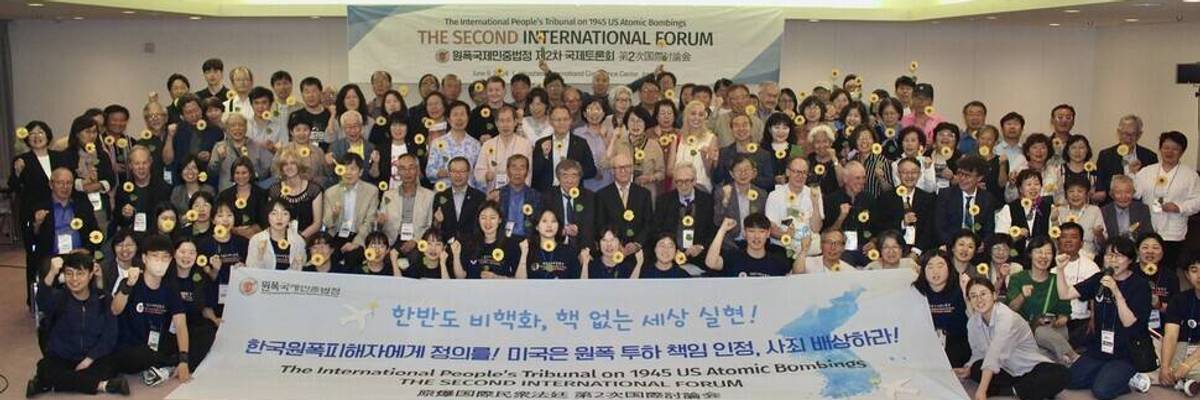
Attendees pose at the Second International Forum of the International People's Tribunal on 1945 US Atomic Bombings.
Over 70,000 Koreans were exposed to the two atomic bombs incinerating Hiroshima and Nagasaki, people forcibly removed from their homeland by the Japanese and sent to work in these cities.
On the right corner of my desk, next to my laptop and always in eyeshot, sits a metal model of an atom bomb I assembled from a kit, a model of “Little Boy,” the bomb the US dropped on Hiroshima. The model is made from aluminum alloy parts and is a one-twelfth scale of the original atom bomb, about nine inches long. The ad for the bomb contained a video with dramatic music showing the model spinning through the air as it falls toward its imagined target.
“Perfect for collectors,” the ad boasted. “A must-have for history enthusiasts. Very enjoyable assembly process.”
Toward the bottom of the ad, perhaps as an afterthought, perhaps recognizing the implications of marketing such a murderous model, was the following: “By assembling this model, you can understand the history and moral issues of nuclear weapons and trigger thoughts about the future of the world.”
The kit came with a tiny screwdriver, two dozen tiny screws, a sanding rod, glue, and decals. The aluminum alloy parts were in molded plates. The model even had a metal cart to assemble that the bomb sits on so it can be pulled around your desk, pretending you’re getting ready to load it onto the Enola Gay and extinguish a city in a flash.
The bomb wages war against the future.
On the morning of August 6, 1945, the real “Little Boy” exploded with a flash 2,000 feet above the city of Hiroshima, which sits on the Ota River delta on Hiroshima Bay. The Ota River has six channels splitting Hiroshima into islets. Bomb victims staggered toward these channels to throw themselves into the water hoping to extinguish their burning bodies. The channels became so clogged with bodies that others couldn’t squeeze in. Some people, closer to the hypocenter, were vaporized, reduced to shadows seared into stone. Temperatures on the ground reached 4,000°C.
As we once again approach that fateful day of August 6, it is important to recognize that not just the US and Japan are intertwined in a nuclear nightmare that has lasted over 80 years, but also 70,000 Koreans who were exposed to the two atomic bombs incinerating Hiroshima and Nagasaki, people forcibly removed from their homeland by the Japanese and sent to work in these cities. Japan colonized Korea in 1910 and for decades used Koreans as they saw fit, from Comfort Women to slave labor. The Koreans then became atomic bomb victims, despite their country not being at war with the United States. They are among the unintended victims, the forgotten victims.
This November in Seoul, South Korea, the surviving Korean bomb victims will testify at a People’s Tribunal holding the US accountable for war crimes. Lawyers from around the world have been preparing legal briefs and will argue the case. The US government is invited to appear as the defendant at the tribunal. The Republic of South Korea has also been asked to appear as a witness.
Once let loose, an atomic bomb keeps on killing, generation after generation, the cancers passed down to those not even born when the bombs first exploded. The Korean atomic bomb victims, as well as the Japanese, have horrific stories testifying to this. Children of the bomb. Atomic maladies. The bomb wages war against the future.
The second atomic bomb that was dropped on August 9, incinerating another Japanese city, had a different nickname. That bomb had an even bigger belly and used plutonium rather than uranium. They called it “Fat Man.” The same ad for the model of the “Little Boy” atom bomb had a second ad inducing you to buy “Fat Man.” It is another one-twelfth scale model of the original, this one weighing 6.2 pounds when completed. I declined the offer to buy and build it. One was repellent enough.
The US currently has 5,277 nuclear warheads. Russia has 5,449. China, approximately 600. France and the UK have about 250 each and Israel has about 90. India, Pakistan, and North Korea bring up the rear with a few nukes each. In total there are over 12,300 nuclear warheads spanning the globe. The Korean atomic bomb victims stand as ready reminders of what happens when these things are unleashed.
Dear Common Dreams reader, It’s been nearly 30 years since I co-founded Common Dreams with my late wife, Lina Newhouser. We had the radical notion that journalism should serve the public good, not corporate profits. It was clear to us from the outset what it would take to build such a project. No paid advertisements. No corporate sponsors. No millionaire publisher telling us what to think or do. Many people said we wouldn't last a year, but we proved those doubters wrong. Together with a tremendous team of journalists and dedicated staff, we built an independent media outlet free from the constraints of profits and corporate control. Our mission has always been simple: To inform. To inspire. To ignite change for the common good. Building Common Dreams was not easy. Our survival was never guaranteed. When you take on the most powerful forces—Wall Street greed, fossil fuel industry destruction, Big Tech lobbyists, and uber-rich oligarchs who have spent billions upon billions rigging the economy and democracy in their favor—the only bulwark you have is supporters who believe in your work. But here’s the urgent message from me today. It's never been this bad out there. And it's never been this hard to keep us going. At the very moment Common Dreams is most needed, the threats we face are intensifying. We need your support now more than ever. We don't accept corporate advertising and never will. We don't have a paywall because we don't think people should be blocked from critical news based on their ability to pay. Everything we do is funded by the donations of readers like you. When everyone does the little they can afford, we are strong. But if that support retreats or dries up, so do we. Will you donate now to make sure Common Dreams not only survives but thrives? —Craig Brown, Co-founder |
On the right corner of my desk, next to my laptop and always in eyeshot, sits a metal model of an atom bomb I assembled from a kit, a model of “Little Boy,” the bomb the US dropped on Hiroshima. The model is made from aluminum alloy parts and is a one-twelfth scale of the original atom bomb, about nine inches long. The ad for the bomb contained a video with dramatic music showing the model spinning through the air as it falls toward its imagined target.
“Perfect for collectors,” the ad boasted. “A must-have for history enthusiasts. Very enjoyable assembly process.”
Toward the bottom of the ad, perhaps as an afterthought, perhaps recognizing the implications of marketing such a murderous model, was the following: “By assembling this model, you can understand the history and moral issues of nuclear weapons and trigger thoughts about the future of the world.”
The kit came with a tiny screwdriver, two dozen tiny screws, a sanding rod, glue, and decals. The aluminum alloy parts were in molded plates. The model even had a metal cart to assemble that the bomb sits on so it can be pulled around your desk, pretending you’re getting ready to load it onto the Enola Gay and extinguish a city in a flash.
The bomb wages war against the future.
On the morning of August 6, 1945, the real “Little Boy” exploded with a flash 2,000 feet above the city of Hiroshima, which sits on the Ota River delta on Hiroshima Bay. The Ota River has six channels splitting Hiroshima into islets. Bomb victims staggered toward these channels to throw themselves into the water hoping to extinguish their burning bodies. The channels became so clogged with bodies that others couldn’t squeeze in. Some people, closer to the hypocenter, were vaporized, reduced to shadows seared into stone. Temperatures on the ground reached 4,000°C.
As we once again approach that fateful day of August 6, it is important to recognize that not just the US and Japan are intertwined in a nuclear nightmare that has lasted over 80 years, but also 70,000 Koreans who were exposed to the two atomic bombs incinerating Hiroshima and Nagasaki, people forcibly removed from their homeland by the Japanese and sent to work in these cities. Japan colonized Korea in 1910 and for decades used Koreans as they saw fit, from Comfort Women to slave labor. The Koreans then became atomic bomb victims, despite their country not being at war with the United States. They are among the unintended victims, the forgotten victims.
This November in Seoul, South Korea, the surviving Korean bomb victims will testify at a People’s Tribunal holding the US accountable for war crimes. Lawyers from around the world have been preparing legal briefs and will argue the case. The US government is invited to appear as the defendant at the tribunal. The Republic of South Korea has also been asked to appear as a witness.
Once let loose, an atomic bomb keeps on killing, generation after generation, the cancers passed down to those not even born when the bombs first exploded. The Korean atomic bomb victims, as well as the Japanese, have horrific stories testifying to this. Children of the bomb. Atomic maladies. The bomb wages war against the future.
The second atomic bomb that was dropped on August 9, incinerating another Japanese city, had a different nickname. That bomb had an even bigger belly and used plutonium rather than uranium. They called it “Fat Man.” The same ad for the model of the “Little Boy” atom bomb had a second ad inducing you to buy “Fat Man.” It is another one-twelfth scale model of the original, this one weighing 6.2 pounds when completed. I declined the offer to buy and build it. One was repellent enough.
The US currently has 5,277 nuclear warheads. Russia has 5,449. China, approximately 600. France and the UK have about 250 each and Israel has about 90. India, Pakistan, and North Korea bring up the rear with a few nukes each. In total there are over 12,300 nuclear warheads spanning the globe. The Korean atomic bomb victims stand as ready reminders of what happens when these things are unleashed.
On the right corner of my desk, next to my laptop and always in eyeshot, sits a metal model of an atom bomb I assembled from a kit, a model of “Little Boy,” the bomb the US dropped on Hiroshima. The model is made from aluminum alloy parts and is a one-twelfth scale of the original atom bomb, about nine inches long. The ad for the bomb contained a video with dramatic music showing the model spinning through the air as it falls toward its imagined target.
“Perfect for collectors,” the ad boasted. “A must-have for history enthusiasts. Very enjoyable assembly process.”
Toward the bottom of the ad, perhaps as an afterthought, perhaps recognizing the implications of marketing such a murderous model, was the following: “By assembling this model, you can understand the history and moral issues of nuclear weapons and trigger thoughts about the future of the world.”
The kit came with a tiny screwdriver, two dozen tiny screws, a sanding rod, glue, and decals. The aluminum alloy parts were in molded plates. The model even had a metal cart to assemble that the bomb sits on so it can be pulled around your desk, pretending you’re getting ready to load it onto the Enola Gay and extinguish a city in a flash.
The bomb wages war against the future.
On the morning of August 6, 1945, the real “Little Boy” exploded with a flash 2,000 feet above the city of Hiroshima, which sits on the Ota River delta on Hiroshima Bay. The Ota River has six channels splitting Hiroshima into islets. Bomb victims staggered toward these channels to throw themselves into the water hoping to extinguish their burning bodies. The channels became so clogged with bodies that others couldn’t squeeze in. Some people, closer to the hypocenter, were vaporized, reduced to shadows seared into stone. Temperatures on the ground reached 4,000°C.
As we once again approach that fateful day of August 6, it is important to recognize that not just the US and Japan are intertwined in a nuclear nightmare that has lasted over 80 years, but also 70,000 Koreans who were exposed to the two atomic bombs incinerating Hiroshima and Nagasaki, people forcibly removed from their homeland by the Japanese and sent to work in these cities. Japan colonized Korea in 1910 and for decades used Koreans as they saw fit, from Comfort Women to slave labor. The Koreans then became atomic bomb victims, despite their country not being at war with the United States. They are among the unintended victims, the forgotten victims.
This November in Seoul, South Korea, the surviving Korean bomb victims will testify at a People’s Tribunal holding the US accountable for war crimes. Lawyers from around the world have been preparing legal briefs and will argue the case. The US government is invited to appear as the defendant at the tribunal. The Republic of South Korea has also been asked to appear as a witness.
Once let loose, an atomic bomb keeps on killing, generation after generation, the cancers passed down to those not even born when the bombs first exploded. The Korean atomic bomb victims, as well as the Japanese, have horrific stories testifying to this. Children of the bomb. Atomic maladies. The bomb wages war against the future.
The second atomic bomb that was dropped on August 9, incinerating another Japanese city, had a different nickname. That bomb had an even bigger belly and used plutonium rather than uranium. They called it “Fat Man.” The same ad for the model of the “Little Boy” atom bomb had a second ad inducing you to buy “Fat Man.” It is another one-twelfth scale model of the original, this one weighing 6.2 pounds when completed. I declined the offer to buy and build it. One was repellent enough.
The US currently has 5,277 nuclear warheads. Russia has 5,449. China, approximately 600. France and the UK have about 250 each and Israel has about 90. India, Pakistan, and North Korea bring up the rear with a few nukes each. In total there are over 12,300 nuclear warheads spanning the globe. The Korean atomic bomb victims stand as ready reminders of what happens when these things are unleashed.