
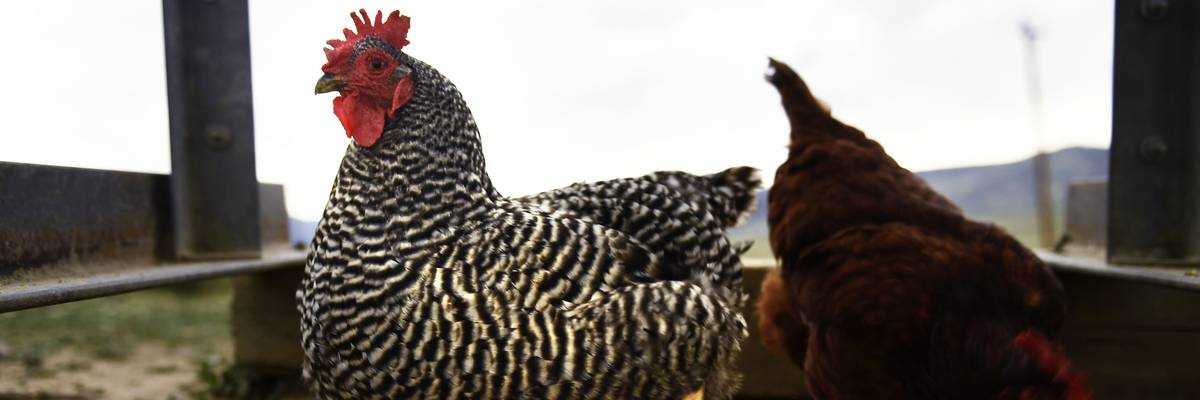
Free ranging chickens are seen on the farm of Chef Eric Skokan, owner of two restaurants in Boulder, the Black Cat and Bramble & Hare, that are farm to table from the families Certified Organic Black Cat Farm in Longmont, on May 8, 2017 in Longmont, Colorado.
Stock Buybacks over Cage-free Commitment: What Unilever’s Greed Is Costing Animals
Unilever’s buyback strategy undermines all three pillars of the triple bottom line: weakening long-term economic resilience, harming workers and consumers, and perpetuating avoidable animal suffering.
Fresh off its expensive World Cup advertisement spend, which included covering the referee time board with its deodorant name, Unilever recently announced more stock buybacks. At a time when Unilever, one of the world’s largest packaged goods companies, has billions at its disposal to reinvest in its supply chain and animal welfare commitments, the company chose to pour the money into self-enriching stock buybacks. The result is a widening gap between what Unilever says it values and where it is actually putting its resources.
Recently, in June 2026, Unilever’s €1.5 billion share buyback program announced in February 2026 was completed. Unilever plans to support a total of €6 billion of share buybacks between 2026 and 2029.
Once considered a stock manipulation practice that was banned in the US until the mid 1980s, these corporate buybacks benefit those who hold the stock—primarily C-suite executives and shareholders. In fact, Unilever’s own board members purchased substantial sums of stock in May and June 2026, just before the formal announcement of a four-year six billion euro stock buyback program in its recent quarterly report.
This continuous caging is one of the worst forms of animal cruelty, yet by enriching itself through corporate buybacks, Unilever is choosing to profit from caged hens.
Unilever ought to tread lightly. In a special report, Reuters showcased Hewlett-Packard as one of the clearest cases where massive buybacks enriched shareholders in the short term but arguably undermined the company's long-term competitiveness, leading to massive layoffs and reduced innovation.
Moreover, this buyback program hurts the rank-and-file employees who keep Unilever, and its army of subsidiaries, running. Share buybacks can also reduce expenditure on research and development, skill development for jobs of the future, decent pay for staff and suppliers, and lower energy and consumer prices, which would reduce inflation and increase citizens’ purchasing power.
In fact, in 2024, Unilever announced they were eliminating 7,500 jobs. Coincidentally, in Unilever’s most recent quarterly results presentation, Srinivas Phatak celebrated the “€800-million-euro productivity programme" that improved overheads "together with continued simplification and cost discipline."
By choosing to reward shareholders, the company is neglecting to reinvest in its workforce. The consequences also extend to the animals who remain in cages, consumers who are fed empty promises and given less ethical choices, and the company itself, which becomes weakened when it chooses short-term gains over long-term responsibility.
Earlier in 2026, the Open Wing Alliance (OWA), a global coalition of nearly 90 organizations across more than 70 countries, united by a shared mission: to end the abuse of hens worldwide, launched a campaign against Unilever for its broken cage-free promise. Despite earning praise and positive media coverage for its voluntary commitment to free hens in their supply chain from cages by 2025, the company has euphemistically claimed to “end its commitment” along with eliminating its corporate sustainability officer position.
Unilever once committed to sourcing 100% cage-free eggs globally—and achieved this in Europe and North America. But the company abandoned the global aspect of its policy, breaking the promise it made to hens and consumers worldwide, as well as its own “responsible marketing” guidelines (page 30).
This rollback has created a two-tiered animal welfare system: one for Western markets, and another where extreme cruelty remains acceptable. By walking away from its original commitment and spending lavishly on marketing, Unilever is sending a troubling message—that animal welfare and their word matter in some regions, but not in others.
In its code of conduct, Unilever proclaims: to “demonstrate ethical business conduct” and “lead with integrity.” Even in its Sustainable Agriculture Principles 2026, Unilever proclaims to “ensure good animal welfare and promote the health of livestock.” The continued confinement of egg-laying hens in cages directly contradicts its purported business values and agricultural principles. The hens in cages in Unilever’s supply chain have about the space of an iPad to move. In this intense confinement, they are unable to flap their wings or dust bathe, all while standing on cage wires. This continuous caging is one of the worst forms of animal cruelty, yet by enriching itself through corporate buybacks, Unilever is choosing to profit from caged hens.
The world is moving past cages. Ninety-two percent of corporate cage-free commitments due by 2024 have already been fulfilled. Additionally, many countries, including the UK, where Unilever is headquartered, have banned cages entirely or are advancing bans currently, leading to hundreds of millions of hens no longer suffering in cages and eroding the legitimacy of Unilever’s supply excuse. In select geographic locations where cage-free supply is limited, Unilever is not without responsible options aligned with their global commitment. More responsible businesses opt to purchase cage-free credits to fulfill their global cage-free promises. A company that can pay 50,000 influencers around a sporting event yet claims to not be able to navigate supply chain challenges is not being entirely truthful.
Unilever’s spending on buybacks is out of alignment with its stated values and longstanding promises, prioritizing short-term financial gains over long-term economic resilience, worker and consumer trust, and basic animal welfare.
While executives and shareholders may benefit in the near term, the long-term costs are clear: weakened credibility, lost talent and customers, and years of unnecessary suffering for millions of hens. True leadership means investing in people, ethical supply chains, and lasting value, not financial engineering that comes at a profound moral and social cost.
We are at a crossroads
This country and this world are at a monumental crossroads. In a few short weeks, US voters will have an opportunity to beat back the forces of fascism and confront the billionaires who are rigging the economy, our media system, and our democracy, making it increasingly impossible for ordinary people to get by. We’re not just talking about the election. We’re talking about what must be done once these fascist elements are vanquished from power. We need a bolder set of solutions than what either major party has so far been willing to offer and a working-class movement ready to fight like hell for it. Trump didn't emerge from nowhere. The conditions that fueled MAGA authoritarianism were created by decades of radical neoliberal economic policies and a corrupt political system dominated by corporate interests. They slashed taxes on the super-rich, promising that the benefits would trickle down. They said giveaways to the corporate titans would make life more affordable for the rest of us. It was all bullshit. And when a bitter, betrayed populace searches for someone to blame, right-wing demagogues have little trouble finding scapegoats. People know when they're being lied to, but you won't hear any of this from the corporate media. Only independent journalism—powered and funded by people who believe in building a better world—can deliver truly trustworthy daily news. Our Fall Campaign is underway, and we need your help. To power our newsroom through the rest of the year, we need to raise $125,000 by midnight on October 31. So if you share our vision, please contribute whatever you can to sustain our work. |
Fresh off its expensive World Cup advertisement spend, which included covering the referee time board with its deodorant name, Unilever recently announced more stock buybacks. At a time when Unilever, one of the world’s largest packaged goods companies, has billions at its disposal to reinvest in its supply chain and animal welfare commitments, the company chose to pour the money into self-enriching stock buybacks. The result is a widening gap between what Unilever says it values and where it is actually putting its resources.
Recently, in June 2026, Unilever’s €1.5 billion share buyback program announced in February 2026 was completed. Unilever plans to support a total of €6 billion of share buybacks between 2026 and 2029.
Once considered a stock manipulation practice that was banned in the US until the mid 1980s, these corporate buybacks benefit those who hold the stock—primarily C-suite executives and shareholders. In fact, Unilever’s own board members purchased substantial sums of stock in May and June 2026, just before the formal announcement of a four-year six billion euro stock buyback program in its recent quarterly report.
This continuous caging is one of the worst forms of animal cruelty, yet by enriching itself through corporate buybacks, Unilever is choosing to profit from caged hens.
Unilever ought to tread lightly. In a special report, Reuters showcased Hewlett-Packard as one of the clearest cases where massive buybacks enriched shareholders in the short term but arguably undermined the company's long-term competitiveness, leading to massive layoffs and reduced innovation.
Moreover, this buyback program hurts the rank-and-file employees who keep Unilever, and its army of subsidiaries, running. Share buybacks can also reduce expenditure on research and development, skill development for jobs of the future, decent pay for staff and suppliers, and lower energy and consumer prices, which would reduce inflation and increase citizens’ purchasing power.
In fact, in 2024, Unilever announced they were eliminating 7,500 jobs. Coincidentally, in Unilever’s most recent quarterly results presentation, Srinivas Phatak celebrated the “€800-million-euro productivity programme" that improved overheads "together with continued simplification and cost discipline."
By choosing to reward shareholders, the company is neglecting to reinvest in its workforce. The consequences also extend to the animals who remain in cages, consumers who are fed empty promises and given less ethical choices, and the company itself, which becomes weakened when it chooses short-term gains over long-term responsibility.
Earlier in 2026, the Open Wing Alliance (OWA), a global coalition of nearly 90 organizations across more than 70 countries, united by a shared mission: to end the abuse of hens worldwide, launched a campaign against Unilever for its broken cage-free promise. Despite earning praise and positive media coverage for its voluntary commitment to free hens in their supply chain from cages by 2025, the company has euphemistically claimed to “end its commitment” along with eliminating its corporate sustainability officer position.
Unilever once committed to sourcing 100% cage-free eggs globally—and achieved this in Europe and North America. But the company abandoned the global aspect of its policy, breaking the promise it made to hens and consumers worldwide, as well as its own “responsible marketing” guidelines (page 30).
This rollback has created a two-tiered animal welfare system: one for Western markets, and another where extreme cruelty remains acceptable. By walking away from its original commitment and spending lavishly on marketing, Unilever is sending a troubling message—that animal welfare and their word matter in some regions, but not in others.
In its code of conduct, Unilever proclaims: to “demonstrate ethical business conduct” and “lead with integrity.” Even in its Sustainable Agriculture Principles 2026, Unilever proclaims to “ensure good animal welfare and promote the health of livestock.” The continued confinement of egg-laying hens in cages directly contradicts its purported business values and agricultural principles. The hens in cages in Unilever’s supply chain have about the space of an iPad to move. In this intense confinement, they are unable to flap their wings or dust bathe, all while standing on cage wires. This continuous caging is one of the worst forms of animal cruelty, yet by enriching itself through corporate buybacks, Unilever is choosing to profit from caged hens.
The world is moving past cages. Ninety-two percent of corporate cage-free commitments due by 2024 have already been fulfilled. Additionally, many countries, including the UK, where Unilever is headquartered, have banned cages entirely or are advancing bans currently, leading to hundreds of millions of hens no longer suffering in cages and eroding the legitimacy of Unilever’s supply excuse. In select geographic locations where cage-free supply is limited, Unilever is not without responsible options aligned with their global commitment. More responsible businesses opt to purchase cage-free credits to fulfill their global cage-free promises. A company that can pay 50,000 influencers around a sporting event yet claims to not be able to navigate supply chain challenges is not being entirely truthful.
Unilever’s spending on buybacks is out of alignment with its stated values and longstanding promises, prioritizing short-term financial gains over long-term economic resilience, worker and consumer trust, and basic animal welfare.
While executives and shareholders may benefit in the near term, the long-term costs are clear: weakened credibility, lost talent and customers, and years of unnecessary suffering for millions of hens. True leadership means investing in people, ethical supply chains, and lasting value, not financial engineering that comes at a profound moral and social cost.