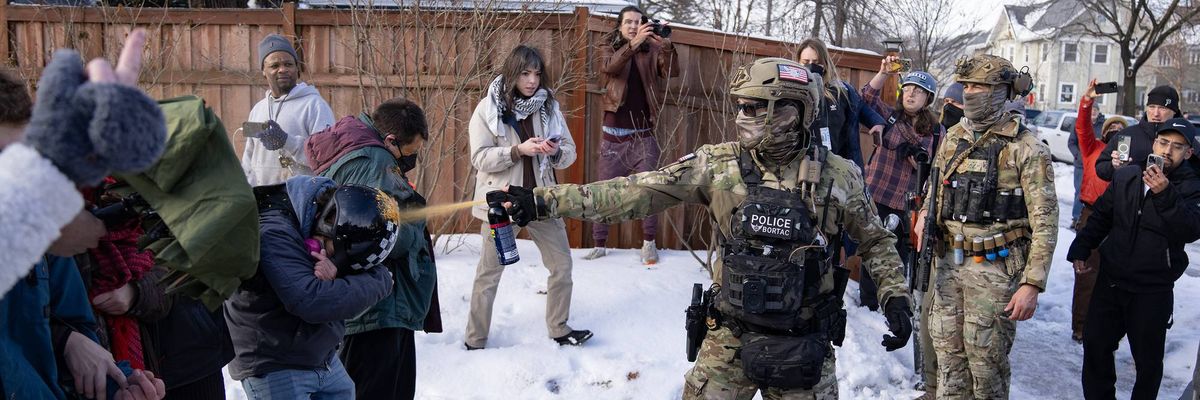
A Border Patrol Tactical Unit agent sprays pepper spray into the face of a protester attempting to block an immigration officer vehicle from leaving the scene where a woman was shot and killed by a federal agent earlier, in Minneapolis, Minnesota on Wednesday, January 7, 2026.
The Nation Responds to a 'Truly Terrifying' Week
2026 began with the emergence of a new American colonial empire abroad and the deadly escalation of Trump’s cruel, racist anti-immigrant program at home.
“Truly terrifying.” That was how National Nurses United executive director Puneet Maharaj described this week in a group text exchange in the aftermath of the brazen murder of Renee Nicole Good by Immigration and Custom Enforcement agent Jonathan Ross in Minneapolis on January 7. A day later there was another shooting, some 1,700 miles away in Portland, Oregon, of Luis David Nico Moncada and Yorlenys Betzabeth Zambrano-Contreras by border patrol agents. And just a week after Keith Porter was shot and killed while celebrating on New Year’s Eve by an off-duty ICE agent in Northridge, California, a Los Angeles suburb.
All three acts of violence capped a year in which the draconian anti-immigrant drive launched by President Donald Trump and campaign architect Stephen Miller has terrorized immigrant communities and sparked protests across the nation. A year in which at least 32 people have also died in ICE custody, the agency’s most deadly year in decades, according to the Detention Watch Network. Some were long-time residents, some recent abductees in ICE raids. “They died of seizure and heart failure, stroke, respiratory failure, tuberculosis or suicide,” or reported neglect, notes the Guardian.
The shootings reflect the broad portrait of US residents–Good, a white, 37-year old mother of three; Porter, a Black 43-year-old father of two; Moncada and Zambrano-Contreras, Venezuelan. And, in familiar tones, the Trump administration has been quick to demonize all four.
Department of Homeland Security (DHS) Secretary Kristi Noem rushed to defend shooter Ross insisting it was an “act of domestic terrorism” by Good. Vice President JD Vance called Ross a “deranged leftist.” Moncada and Zambrano-Contreras were immediately labeled as affiliated with the Tren De Aragua gang, though Portland officials voiced distrust in ICE characterizations. A DHS spokesperson claimed Porter was an “active shooter” and the off-duty agent was “protecting his community,” contentions that infuriated Porter’s friends.
It was a solemn beginning to the new year, an exclamation point on the past 12 months.
The administration wants to control the Good investigation even as Minnesota officials say the federal government is impeding a state investigation. Vance claims agent Ross has “absolute immunity,” a point refuted by Harvard legal scholar Lawrence Tribe on MSNow with Lawrence O’Donnell. “State laws of assault continue to apply, even to a federal officer,” he noted. Outraged Minnesotans are calling for state prosecution as was done, with a conviction, for the police officer who killed George Floyd a short distance from where Good was murdered. Gov. Tim Walz says he wants the state to do a “full investigation.”
Porter’s friends are pushing for justice for Porter. Los Angeles County is “reviewing Porter’s killing,” though, the Los Angeles Times adds, “it sometimes takes years for the agency to determine if a deadly use of force constitutes a crime.” While Los Angeles is a “sanctuary city,” the LA Police Department is notorious for supporting and defending ICE and other federal immigration agents and constraining community protesters instead.
Venezuela, of course, was the other high-profile calamity of the week. Trump’s January 3 military invasion of Venezuela, kidnapping President Nicolas Maduro and his wife Cilia Flores. Up to 100 people, including civilians were killed, Venezuelan officials report. The US also bombed a medical warehouse, science labs, and an apartment complex, along with other sites in Caracas.
The long-planned assault followed months of extrajudicial bombings of boats in the Caribbean and Eastern Pacific that have executed at least 115 people since September—like the invasion, in violation of international and US law, and without congressional authorization.
It was a solemn beginning to the new year, an exclamation point on the past 12 months. The Trump administration has carried out the most sustained assault on constitutional norms, dispatching of troops to threaten Americans in numerous cities, weaponization of the Justice Department and programs to punish political enemies and entire Democratic-run states, shredding of decades of healthcare standards that have saved millions of lives, and so much more.
It’s hard to even get more appalled. But the convergence of the emergence of a new American colonial empire abroad with the deadly escalation of Trump’s cruel, racist anti-immigrant program, is what made the week “truly terrifying.”
Many people on social media searched for analogs in recent US history. For this aging lefty who lived through and participated in frequent protests against the Vietnam war, President Ronald Reagan’s sponsoring of military coups and mercenary armies in Latin America and the Caribbean, and the disastrous invasions of Afghanistan and Iraq, I dredged up one comparison.
On April 28, 1970, President Richard Nixon invaded Cambodia with combat troops, an enormous widening of the Southeast Asia war he had pledged to end. A week later on May 4, following days of protests, the Ohio National Guard fired 67 rounds in 13 seconds at student protesters at Kent State University in Ohio, killing four students and wounding nine more. I huddled around the radio listening to the accounts on Pacifica’s KPFA-FM with three roommates, thinking the world had dramatically changed in our lives. Then I rushed off to join a raucous protest at Sonoma State University where I was enrolled.
Trump’s stranglehold on Republican members of Congress is weakening.
Many parallels to that time with this moment exist. There had been years of rallies and marches protesting Nixon and President Lyndon Johnson’s war before him. Nixon was elected promising a secret plan to conclude the long Vietnam War while covertly sabotaging a long-delayed Johnson plan to initiate new peace talks. Trump campaigned as a “peace” advocate, pledging to end “forever wars,” and begging for a Nobel Peace Prize before launching the most unchecked expansion of US colonialism in more than a century.
The arrogant Nixon was, arguably, the most lawless president in US history to that point, before being finally forced to resign. Trump has proven to be far worse, engaging in monarchical dictates and policies, running roughshod over Congress, defying the courts, staging an insurrection at the US Capitol attempting to overturn the 2020 election, and now scheming how to subvert the 2026 and 2028 elections.
On the two arenas of the past week, Trump and his cabal are promising more. Trump has openly threatened to expand military operations to Cuba, Colombia, Mexico, and Greenland. “I don’t need international law,” Trump told the New York Times. He will only be constrained, he said, by his “own morality.”
Vance has intensified his increasingly desperate rhetoric to defend the murder of Good; the administration recognizes they have lost public support, as millions have viewed the damning video evidence. Going on the attack, as Trump always requires when challenged, Vance boasts the administration has doubled its Gestapo-style police force to over 22,000, and plans to send ICE agents “door to door,” in coming months, mimicking the odious practices of past dictatorships. Trump has also threatened, again, to invoke the Insurrection Act to send the military to American cities to combat protesters.
Both Nixon and Trump met massive opposition. Anti-Vietnam War marches mushroomed, with over half a million people joining a November 1969 march on Washington. I remember driving overnight from Los Angeles to San Francisco to march with 250,000 others across the city that same day. The repeated mobilizations, augmenting battlefield defeats in Vietnam, ultimately coerced the US to end its war.
Trump has faced similar growing resistance. Up to 8 million Americans joined “No Kings” rallies and marches in June and October last year. And in the two days since the Minneapolis murder, thousands have turned out in spontaneous protests in many cities and smaller communities including Asheville, North Carolina, Boston, Buffalo, Atlanta, Chicago, Cincinnati, Cleveland, Colorado Springs. Colorado, Columbus, Ohio, Dallas, Dayton, Ohio, Denver, Durham, North Carolina, Los Angeles, Merrimack, New Hampshire, New Orleans, New York, Philadelphia, Phoenix, Providence, Rhode Island, Seattle, San Antonio, San Diego, San Francisco, Washington, DC, and repeatedly in Minneapolis.
Trump’s stranglehold on Republican members of Congress is weakening. Trump lost two significant votes in Congress on January 7. Overriding House GOP leaders, 17 Republicans joined Democrats in the House to pass legislation to extend Affordable Care Act subsidies for three years as millions of Americans are facing calamitous increases in healthcare coverage due to GOP obstruction in the fall.
In the Senate, five Republicans joined in a “rare bipartisan rebuke of the White House” to set up a War Powers Resolution vote to require congressional approval for Trump’s militarism in Venezuela and elsewhere. Incensed by the defiance, Trump called for the defeat of the five Republicans. Both actions face a difficult outcome, but the votes are significant. It shows Republicans are worried about the approaching midterm elections in November, following sweeping losses last year.
A wounded Trump, inclined to step up his callous attacks and lawlessness, is “truly terrifying” as National Nurse United’s Maharaj noted. Responding, NNU lobbied for the ACA subsidy vote, condemned the Venezuela invasion and Good’s murder, and had members at the San Francisco protests. Nurses are among the rapidly expanding mass movement needed to protect democracy, human rights, and all who live here.
We are at a crossroads
This country and this world are at a monumental crossroads. In a few short weeks, US voters will have an opportunity to beat back the forces of fascism and confront the billionaires who are rigging the economy, our media system, and our democracy, making it increasingly impossible for ordinary people to get by. We’re not just talking about the election. We’re talking about what must be done once these fascist elements are vanquished from power. We need a bolder set of solutions than what either major party has so far been willing to offer and a working-class movement ready to fight like hell for it. Trump didn't emerge from nowhere. The conditions that fueled MAGA authoritarianism were created by decades of radical neoliberal economic policies and a corrupt political system dominated by corporate interests. They slashed taxes on the super-rich, promising that the benefits would trickle down. They said giveaways to the corporate titans would make life more affordable for the rest of us. It was all bullshit. And when a bitter, betrayed populace searches for someone to blame, right-wing demagogues have little trouble finding scapegoats. People know when they're being lied to, but you won't hear any of this from the corporate media. Only independent journalism—powered and funded by people who believe in building a better world—can deliver truly trustworthy daily news. Our Fall Campaign is underway, and we need your help. To power our newsroom through the rest of the year, we need to raise $125,000 by midnight on October 31. So if you share our vision, please contribute whatever you can to sustain our work. |
“Truly terrifying.” That was how National Nurses United executive director Puneet Maharaj described this week in a group text exchange in the aftermath of the brazen murder of Renee Nicole Good by Immigration and Custom Enforcement agent Jonathan Ross in Minneapolis on January 7. A day later there was another shooting, some 1,700 miles away in Portland, Oregon, of Luis David Nico Moncada and Yorlenys Betzabeth Zambrano-Contreras by border patrol agents. And just a week after Keith Porter was shot and killed while celebrating on New Year’s Eve by an off-duty ICE agent in Northridge, California, a Los Angeles suburb.
All three acts of violence capped a year in which the draconian anti-immigrant drive launched by President Donald Trump and campaign architect Stephen Miller has terrorized immigrant communities and sparked protests across the nation. A year in which at least 32 people have also died in ICE custody, the agency’s most deadly year in decades, according to the Detention Watch Network. Some were long-time residents, some recent abductees in ICE raids. “They died of seizure and heart failure, stroke, respiratory failure, tuberculosis or suicide,” or reported neglect, notes the Guardian.
The shootings reflect the broad portrait of US residents–Good, a white, 37-year old mother of three; Porter, a Black 43-year-old father of two; Moncada and Zambrano-Contreras, Venezuelan. And, in familiar tones, the Trump administration has been quick to demonize all four.
Department of Homeland Security (DHS) Secretary Kristi Noem rushed to defend shooter Ross insisting it was an “act of domestic terrorism” by Good. Vice President JD Vance called Ross a “deranged leftist.” Moncada and Zambrano-Contreras were immediately labeled as affiliated with the Tren De Aragua gang, though Portland officials voiced distrust in ICE characterizations. A DHS spokesperson claimed Porter was an “active shooter” and the off-duty agent was “protecting his community,” contentions that infuriated Porter’s friends.
It was a solemn beginning to the new year, an exclamation point on the past 12 months.
The administration wants to control the Good investigation even as Minnesota officials say the federal government is impeding a state investigation. Vance claims agent Ross has “absolute immunity,” a point refuted by Harvard legal scholar Lawrence Tribe on MSNow with Lawrence O’Donnell. “State laws of assault continue to apply, even to a federal officer,” he noted. Outraged Minnesotans are calling for state prosecution as was done, with a conviction, for the police officer who killed George Floyd a short distance from where Good was murdered. Gov. Tim Walz says he wants the state to do a “full investigation.”
Porter’s friends are pushing for justice for Porter. Los Angeles County is “reviewing Porter’s killing,” though, the Los Angeles Times adds, “it sometimes takes years for the agency to determine if a deadly use of force constitutes a crime.” While Los Angeles is a “sanctuary city,” the LA Police Department is notorious for supporting and defending ICE and other federal immigration agents and constraining community protesters instead.
Venezuela, of course, was the other high-profile calamity of the week. Trump’s January 3 military invasion of Venezuela, kidnapping President Nicolas Maduro and his wife Cilia Flores. Up to 100 people, including civilians were killed, Venezuelan officials report. The US also bombed a medical warehouse, science labs, and an apartment complex, along with other sites in Caracas.
The long-planned assault followed months of extrajudicial bombings of boats in the Caribbean and Eastern Pacific that have executed at least 115 people since September—like the invasion, in violation of international and US law, and without congressional authorization.
It was a solemn beginning to the new year, an exclamation point on the past 12 months. The Trump administration has carried out the most sustained assault on constitutional norms, dispatching of troops to threaten Americans in numerous cities, weaponization of the Justice Department and programs to punish political enemies and entire Democratic-run states, shredding of decades of healthcare standards that have saved millions of lives, and so much more.
It’s hard to even get more appalled. But the convergence of the emergence of a new American colonial empire abroad with the deadly escalation of Trump’s cruel, racist anti-immigrant program, is what made the week “truly terrifying.”
Many people on social media searched for analogs in recent US history. For this aging lefty who lived through and participated in frequent protests against the Vietnam war, President Ronald Reagan’s sponsoring of military coups and mercenary armies in Latin America and the Caribbean, and the disastrous invasions of Afghanistan and Iraq, I dredged up one comparison.
On April 28, 1970, President Richard Nixon invaded Cambodia with combat troops, an enormous widening of the Southeast Asia war he had pledged to end. A week later on May 4, following days of protests, the Ohio National Guard fired 67 rounds in 13 seconds at student protesters at Kent State University in Ohio, killing four students and wounding nine more. I huddled around the radio listening to the accounts on Pacifica’s KPFA-FM with three roommates, thinking the world had dramatically changed in our lives. Then I rushed off to join a raucous protest at Sonoma State University where I was enrolled.
Trump’s stranglehold on Republican members of Congress is weakening.
Many parallels to that time with this moment exist. There had been years of rallies and marches protesting Nixon and President Lyndon Johnson’s war before him. Nixon was elected promising a secret plan to conclude the long Vietnam War while covertly sabotaging a long-delayed Johnson plan to initiate new peace talks. Trump campaigned as a “peace” advocate, pledging to end “forever wars,” and begging for a Nobel Peace Prize before launching the most unchecked expansion of US colonialism in more than a century.
The arrogant Nixon was, arguably, the most lawless president in US history to that point, before being finally forced to resign. Trump has proven to be far worse, engaging in monarchical dictates and policies, running roughshod over Congress, defying the courts, staging an insurrection at the US Capitol attempting to overturn the 2020 election, and now scheming how to subvert the 2026 and 2028 elections.
On the two arenas of the past week, Trump and his cabal are promising more. Trump has openly threatened to expand military operations to Cuba, Colombia, Mexico, and Greenland. “I don’t need international law,” Trump told the New York Times. He will only be constrained, he said, by his “own morality.”
Vance has intensified his increasingly desperate rhetoric to defend the murder of Good; the administration recognizes they have lost public support, as millions have viewed the damning video evidence. Going on the attack, as Trump always requires when challenged, Vance boasts the administration has doubled its Gestapo-style police force to over 22,000, and plans to send ICE agents “door to door,” in coming months, mimicking the odious practices of past dictatorships. Trump has also threatened, again, to invoke the Insurrection Act to send the military to American cities to combat protesters.
Both Nixon and Trump met massive opposition. Anti-Vietnam War marches mushroomed, with over half a million people joining a November 1969 march on Washington. I remember driving overnight from Los Angeles to San Francisco to march with 250,000 others across the city that same day. The repeated mobilizations, augmenting battlefield defeats in Vietnam, ultimately coerced the US to end its war.
Trump has faced similar growing resistance. Up to 8 million Americans joined “No Kings” rallies and marches in June and October last year. And in the two days since the Minneapolis murder, thousands have turned out in spontaneous protests in many cities and smaller communities including Asheville, North Carolina, Boston, Buffalo, Atlanta, Chicago, Cincinnati, Cleveland, Colorado Springs. Colorado, Columbus, Ohio, Dallas, Dayton, Ohio, Denver, Durham, North Carolina, Los Angeles, Merrimack, New Hampshire, New Orleans, New York, Philadelphia, Phoenix, Providence, Rhode Island, Seattle, San Antonio, San Diego, San Francisco, Washington, DC, and repeatedly in Minneapolis.
Trump’s stranglehold on Republican members of Congress is weakening. Trump lost two significant votes in Congress on January 7. Overriding House GOP leaders, 17 Republicans joined Democrats in the House to pass legislation to extend Affordable Care Act subsidies for three years as millions of Americans are facing calamitous increases in healthcare coverage due to GOP obstruction in the fall.
In the Senate, five Republicans joined in a “rare bipartisan rebuke of the White House” to set up a War Powers Resolution vote to require congressional approval for Trump’s militarism in Venezuela and elsewhere. Incensed by the defiance, Trump called for the defeat of the five Republicans. Both actions face a difficult outcome, but the votes are significant. It shows Republicans are worried about the approaching midterm elections in November, following sweeping losses last year.
A wounded Trump, inclined to step up his callous attacks and lawlessness, is “truly terrifying” as National Nurse United’s Maharaj noted. Responding, NNU lobbied for the ACA subsidy vote, condemned the Venezuela invasion and Good’s murder, and had members at the San Francisco protests. Nurses are among the rapidly expanding mass movement needed to protect democracy, human rights, and all who live here.
“Truly terrifying.” That was how National Nurses United executive director Puneet Maharaj described this week in a group text exchange in the aftermath of the brazen murder of Renee Nicole Good by Immigration and Custom Enforcement agent Jonathan Ross in Minneapolis on January 7. A day later there was another shooting, some 1,700 miles away in Portland, Oregon, of Luis David Nico Moncada and Yorlenys Betzabeth Zambrano-Contreras by border patrol agents. And just a week after Keith Porter was shot and killed while celebrating on New Year’s Eve by an off-duty ICE agent in Northridge, California, a Los Angeles suburb.
All three acts of violence capped a year in which the draconian anti-immigrant drive launched by President Donald Trump and campaign architect Stephen Miller has terrorized immigrant communities and sparked protests across the nation. A year in which at least 32 people have also died in ICE custody, the agency’s most deadly year in decades, according to the Detention Watch Network. Some were long-time residents, some recent abductees in ICE raids. “They died of seizure and heart failure, stroke, respiratory failure, tuberculosis or suicide,” or reported neglect, notes the Guardian.
The shootings reflect the broad portrait of US residents–Good, a white, 37-year old mother of three; Porter, a Black 43-year-old father of two; Moncada and Zambrano-Contreras, Venezuelan. And, in familiar tones, the Trump administration has been quick to demonize all four.
Department of Homeland Security (DHS) Secretary Kristi Noem rushed to defend shooter Ross insisting it was an “act of domestic terrorism” by Good. Vice President JD Vance called Ross a “deranged leftist.” Moncada and Zambrano-Contreras were immediately labeled as affiliated with the Tren De Aragua gang, though Portland officials voiced distrust in ICE characterizations. A DHS spokesperson claimed Porter was an “active shooter” and the off-duty agent was “protecting his community,” contentions that infuriated Porter’s friends.
It was a solemn beginning to the new year, an exclamation point on the past 12 months.
The administration wants to control the Good investigation even as Minnesota officials say the federal government is impeding a state investigation. Vance claims agent Ross has “absolute immunity,” a point refuted by Harvard legal scholar Lawrence Tribe on MSNow with Lawrence O’Donnell. “State laws of assault continue to apply, even to a federal officer,” he noted. Outraged Minnesotans are calling for state prosecution as was done, with a conviction, for the police officer who killed George Floyd a short distance from where Good was murdered. Gov. Tim Walz says he wants the state to do a “full investigation.”
Porter’s friends are pushing for justice for Porter. Los Angeles County is “reviewing Porter’s killing,” though, the Los Angeles Times adds, “it sometimes takes years for the agency to determine if a deadly use of force constitutes a crime.” While Los Angeles is a “sanctuary city,” the LA Police Department is notorious for supporting and defending ICE and other federal immigration agents and constraining community protesters instead.
Venezuela, of course, was the other high-profile calamity of the week. Trump’s January 3 military invasion of Venezuela, kidnapping President Nicolas Maduro and his wife Cilia Flores. Up to 100 people, including civilians were killed, Venezuelan officials report. The US also bombed a medical warehouse, science labs, and an apartment complex, along with other sites in Caracas.
The long-planned assault followed months of extrajudicial bombings of boats in the Caribbean and Eastern Pacific that have executed at least 115 people since September—like the invasion, in violation of international and US law, and without congressional authorization.
It was a solemn beginning to the new year, an exclamation point on the past 12 months. The Trump administration has carried out the most sustained assault on constitutional norms, dispatching of troops to threaten Americans in numerous cities, weaponization of the Justice Department and programs to punish political enemies and entire Democratic-run states, shredding of decades of healthcare standards that have saved millions of lives, and so much more.
It’s hard to even get more appalled. But the convergence of the emergence of a new American colonial empire abroad with the deadly escalation of Trump’s cruel, racist anti-immigrant program, is what made the week “truly terrifying.”
Many people on social media searched for analogs in recent US history. For this aging lefty who lived through and participated in frequent protests against the Vietnam war, President Ronald Reagan’s sponsoring of military coups and mercenary armies in Latin America and the Caribbean, and the disastrous invasions of Afghanistan and Iraq, I dredged up one comparison.
On April 28, 1970, President Richard Nixon invaded Cambodia with combat troops, an enormous widening of the Southeast Asia war he had pledged to end. A week later on May 4, following days of protests, the Ohio National Guard fired 67 rounds in 13 seconds at student protesters at Kent State University in Ohio, killing four students and wounding nine more. I huddled around the radio listening to the accounts on Pacifica’s KPFA-FM with three roommates, thinking the world had dramatically changed in our lives. Then I rushed off to join a raucous protest at Sonoma State University where I was enrolled.
Trump’s stranglehold on Republican members of Congress is weakening.
Many parallels to that time with this moment exist. There had been years of rallies and marches protesting Nixon and President Lyndon Johnson’s war before him. Nixon was elected promising a secret plan to conclude the long Vietnam War while covertly sabotaging a long-delayed Johnson plan to initiate new peace talks. Trump campaigned as a “peace” advocate, pledging to end “forever wars,” and begging for a Nobel Peace Prize before launching the most unchecked expansion of US colonialism in more than a century.
The arrogant Nixon was, arguably, the most lawless president in US history to that point, before being finally forced to resign. Trump has proven to be far worse, engaging in monarchical dictates and policies, running roughshod over Congress, defying the courts, staging an insurrection at the US Capitol attempting to overturn the 2020 election, and now scheming how to subvert the 2026 and 2028 elections.
On the two arenas of the past week, Trump and his cabal are promising more. Trump has openly threatened to expand military operations to Cuba, Colombia, Mexico, and Greenland. “I don’t need international law,” Trump told the New York Times. He will only be constrained, he said, by his “own morality.”
Vance has intensified his increasingly desperate rhetoric to defend the murder of Good; the administration recognizes they have lost public support, as millions have viewed the damning video evidence. Going on the attack, as Trump always requires when challenged, Vance boasts the administration has doubled its Gestapo-style police force to over 22,000, and plans to send ICE agents “door to door,” in coming months, mimicking the odious practices of past dictatorships. Trump has also threatened, again, to invoke the Insurrection Act to send the military to American cities to combat protesters.
Both Nixon and Trump met massive opposition. Anti-Vietnam War marches mushroomed, with over half a million people joining a November 1969 march on Washington. I remember driving overnight from Los Angeles to San Francisco to march with 250,000 others across the city that same day. The repeated mobilizations, augmenting battlefield defeats in Vietnam, ultimately coerced the US to end its war.
Trump has faced similar growing resistance. Up to 8 million Americans joined “No Kings” rallies and marches in June and October last year. And in the two days since the Minneapolis murder, thousands have turned out in spontaneous protests in many cities and smaller communities including Asheville, North Carolina, Boston, Buffalo, Atlanta, Chicago, Cincinnati, Cleveland, Colorado Springs. Colorado, Columbus, Ohio, Dallas, Dayton, Ohio, Denver, Durham, North Carolina, Los Angeles, Merrimack, New Hampshire, New Orleans, New York, Philadelphia, Phoenix, Providence, Rhode Island, Seattle, San Antonio, San Diego, San Francisco, Washington, DC, and repeatedly in Minneapolis.
Trump’s stranglehold on Republican members of Congress is weakening. Trump lost two significant votes in Congress on January 7. Overriding House GOP leaders, 17 Republicans joined Democrats in the House to pass legislation to extend Affordable Care Act subsidies for three years as millions of Americans are facing calamitous increases in healthcare coverage due to GOP obstruction in the fall.
In the Senate, five Republicans joined in a “rare bipartisan rebuke of the White House” to set up a War Powers Resolution vote to require congressional approval for Trump’s militarism in Venezuela and elsewhere. Incensed by the defiance, Trump called for the defeat of the five Republicans. Both actions face a difficult outcome, but the votes are significant. It shows Republicans are worried about the approaching midterm elections in November, following sweeping losses last year.
A wounded Trump, inclined to step up his callous attacks and lawlessness, is “truly terrifying” as National Nurse United’s Maharaj noted. Responding, NNU lobbied for the ACA subsidy vote, condemned the Venezuela invasion and Good’s murder, and had members at the San Francisco protests. Nurses are among the rapidly expanding mass movement needed to protect democracy, human rights, and all who live here.