SUBSCRIBE TO OUR FREE NEWSLETTER
Daily news & progressive opinion—funded by the people, not the corporations—delivered straight to your inbox.
5
#000000
#FFFFFF
To donate by check, phone, or other method, see our More Ways to Give page.
Daily news & progressive opinion—funded by the people, not the corporations—delivered straight to your inbox.
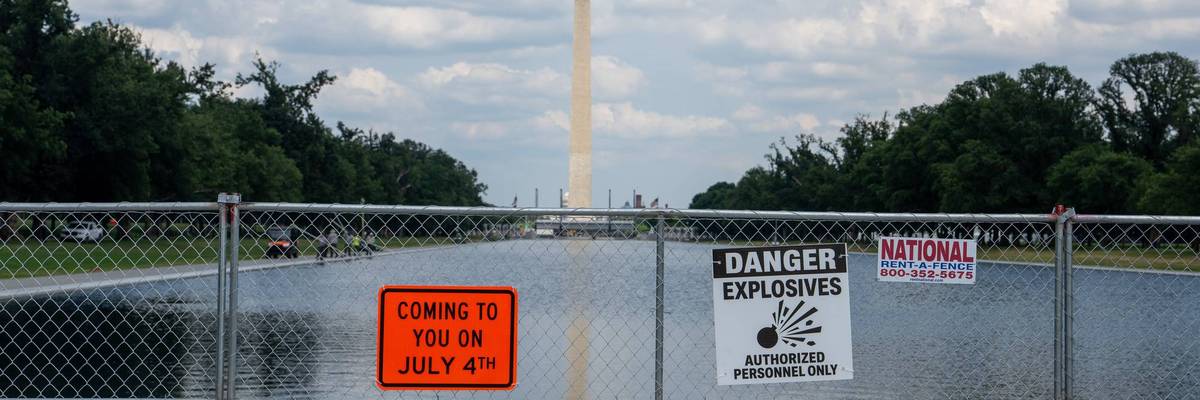
A fence surrounds the Lincoln Memorial Reflecting Pool on June 26, 2026 in Washington, DC. An increased law enforcement presence has been around the area after claims made by President Trump that vandalism was the cause of the damage.
A republic cannot be run on impulse, grievance, or magical promises.
As I get older, I understand impatience better than I used to.
Time feels less theoretical. Work we meant to do someday starts asking why it has not arrived. Impatience can clarify. It can push us to repair what can still be repaired, say what needs to be said, and act before the chance disappears.
But impatience can also corrupt judgment. It can turn urgency into recklessness. It can convince us that fast means right.
That matters because Americans have grown dangerously impatient with government. We want problems solved now. We want leaders who promise to cut through the noise, ignore the process, and deliver immediate results. Some frustration is warranted. Government can move too slowly. Bureaucracy can be maddening. In the face of fires, floods, pandemics, wars, economic collapse, and constitutional threats, government must act quickly.
But the American system was not designed primarily for speed. It was designed for friction.
Yes, friction sounds like failure, but in a constitutional democracy, friction can be protective. The founders built separated powers, checks and balances, courts, federalism, staggered elections, and constitutional limits. These were restraints, not efficiency tools.
James Madison put it plainly in Federalist No. 51: “Ambition must be made to counteract ambition.” The founders did not trust leaders to remain wise or restrained. They designed a system in which power would be checked by other power. The system was never meant to satisfy impatience. It was meant to survive it.
Donald Trump did not create American impatience, but he has weaponized it. His appeal rests, in part, on the promise that complex problems are simple, experts are unnecessary, delay signals weakness, and only he can deliver immediate results.
He said COVID-19 would “disappear,” even as scientists warned that the virus required testing, mitigation, vaccines, public communication, and time. He repeatedly promised to end Russia’s war against Ukraine quickly, saying he could do so in 24 hours, even before taking office. He claimed drug prices would fall by 1,200, 1,300, 1,400, even 1,500 percent, a mathematical absurdity. He promised prices would come down on “day one.” He said he could make Chicago safe in “one month.”
The pattern matters more than any single claim. Promise the impossible. Set expectations that no serious policy process can meet. When reality intrudes, blame rivals, judges, bureaucrats, governors, Democrats, immigrants, journalists, scientists, or an invented enemy within.
The same impatience appears in governance. The rushed, no-bid contract for the Reflecting Pool episode offers a cautionary example. Trump and his allies initially pointed to vandalism after the newly renovated Lincoln Memorial Reflecting Pool began peeling and turning green. A man was indicted. Yet prosecutors later sought to dismiss the case after new information indicated the damage stemmed from flawed or rushed contractor work, not vandalism. What evidence was presented before a citizen was charged? What evidence was missing?
The episode illustrates how the politics of speed can operate: rush the project, bypass safeguards, blame an enemy, and only later confront the facts. No-bid contracts may be justified in emergencies. But when used for vanity projects or politically favored priorities, they bypass the friction meant to protect taxpayers, expert review, and public trust.
This damages civic life. When leaders tell people that hard problems have instant solutions, they train the public to distrust any institution that moves cautiously. Courts become corrupt if they do not rule correctly immediately. Congress becomes useless if it debates. Scientists become suspect if they revise conclusions as evidence changes. Civil servants become saboteurs if they insist on law, data, procedure, or competence.
That cycle breeds anger, then apathy, and sometimes violence. People are promised salvation, only to be forced to live with disappointment when those promises collapse. Some give up on government. Others conclude the system has been stolen from them. A politics of impatience becomes a politics of grievance.
Science suffers because it rarely moves at the pace of political appetite. The scientific method requires hypotheses, evidence, peer review, replication, correction, and humility. Sometimes science moves fast, as vaccine development did during COVID. Even then, speed depended on decades of prior research, sustained investment, global collaboration, and careful testing.
The renewed vilification of Dr. Anthony Fauci follows the same pattern. Fauci’s record, like the country’s COVID response, can and should be scrutinized. But scrutiny is not the same as ritualized blame. Science advances through uncertainty, correction, and argument. A politics addicted to instant answers treats those virtues as evidence of deceit.
None of this excuses slow government when speed is required. Delay can be deadly. Leaders who hide behind process because they lack courage deserve criticism. But democratic slowness is not always dysfunction. Sometimes it is deliberation: hearing competing arguments, weighing evidence, protecting minority rights, identifying unintended consequences, and asking whether today’s satisfying answer will become tomorrow’s disaster.
We live in a culture shaped by technology’s impatience. Meta’s Mark Zuckerberg once celebrated the motto “Move fast and break things.” In business, that mindset can drive innovation. In government, the stakes are higher. When government breaks something, people may lose health care, rights, homes, jobs, legal protections, or even their lives.
Impatience asks, “Why is this taking so long?”
Democracy asks, “What happens if power moves too quickly?”
As citizens, we need a longer horizon. A republic cannot be run on impulse, grievance, or magical promises. Some things must be done quickly, but when rights, law, science, power, and the public good are at stake, the better standard is not speed. It is judgment.
Dear Common Dreams reader, It’s been nearly 30 years since I co-founded Common Dreams with my late wife, Lina Newhouser. We had the radical notion that journalism should serve the public good, not corporate profits. It was clear to us from the outset what it would take to build such a project. No paid advertisements. No corporate sponsors. No millionaire publisher telling us what to think or do. Many people said we wouldn't last a year, but we proved those doubters wrong. Together with a tremendous team of journalists and dedicated staff, we built an independent media outlet free from the constraints of profits and corporate control. Our mission has always been simple: To inform. To inspire. To ignite change for the common good. Building Common Dreams was not easy. Our survival was never guaranteed. When you take on the most powerful forces—Wall Street greed, fossil fuel industry destruction, Big Tech lobbyists, and uber-rich oligarchs who have spent billions upon billions rigging the economy and democracy in their favor—the only bulwark you have is supporters who believe in your work. But here’s the urgent message from me today. It's never been this bad out there. And it's never been this hard to keep us going. At the very moment Common Dreams is most needed, the threats we face are intensifying. We need your support now more than ever. We don't accept corporate advertising and never will. We don't have a paywall because we don't think people should be blocked from critical news based on their ability to pay. Everything we do is funded by the donations of readers like you. When everyone does the little they can afford, we are strong. But if that support retreats or dries up, so do we. Will you donate now to make sure Common Dreams not only survives but thrives? —Craig Brown, Co-founder |
As I get older, I understand impatience better than I used to.
Time feels less theoretical. Work we meant to do someday starts asking why it has not arrived. Impatience can clarify. It can push us to repair what can still be repaired, say what needs to be said, and act before the chance disappears.
But impatience can also corrupt judgment. It can turn urgency into recklessness. It can convince us that fast means right.
That matters because Americans have grown dangerously impatient with government. We want problems solved now. We want leaders who promise to cut through the noise, ignore the process, and deliver immediate results. Some frustration is warranted. Government can move too slowly. Bureaucracy can be maddening. In the face of fires, floods, pandemics, wars, economic collapse, and constitutional threats, government must act quickly.
But the American system was not designed primarily for speed. It was designed for friction.
Yes, friction sounds like failure, but in a constitutional democracy, friction can be protective. The founders built separated powers, checks and balances, courts, federalism, staggered elections, and constitutional limits. These were restraints, not efficiency tools.
James Madison put it plainly in Federalist No. 51: “Ambition must be made to counteract ambition.” The founders did not trust leaders to remain wise or restrained. They designed a system in which power would be checked by other power. The system was never meant to satisfy impatience. It was meant to survive it.
Donald Trump did not create American impatience, but he has weaponized it. His appeal rests, in part, on the promise that complex problems are simple, experts are unnecessary, delay signals weakness, and only he can deliver immediate results.
He said COVID-19 would “disappear,” even as scientists warned that the virus required testing, mitigation, vaccines, public communication, and time. He repeatedly promised to end Russia’s war against Ukraine quickly, saying he could do so in 24 hours, even before taking office. He claimed drug prices would fall by 1,200, 1,300, 1,400, even 1,500 percent, a mathematical absurdity. He promised prices would come down on “day one.” He said he could make Chicago safe in “one month.”
The pattern matters more than any single claim. Promise the impossible. Set expectations that no serious policy process can meet. When reality intrudes, blame rivals, judges, bureaucrats, governors, Democrats, immigrants, journalists, scientists, or an invented enemy within.
The same impatience appears in governance. The rushed, no-bid contract for the Reflecting Pool episode offers a cautionary example. Trump and his allies initially pointed to vandalism after the newly renovated Lincoln Memorial Reflecting Pool began peeling and turning green. A man was indicted. Yet prosecutors later sought to dismiss the case after new information indicated the damage stemmed from flawed or rushed contractor work, not vandalism. What evidence was presented before a citizen was charged? What evidence was missing?
The episode illustrates how the politics of speed can operate: rush the project, bypass safeguards, blame an enemy, and only later confront the facts. No-bid contracts may be justified in emergencies. But when used for vanity projects or politically favored priorities, they bypass the friction meant to protect taxpayers, expert review, and public trust.
This damages civic life. When leaders tell people that hard problems have instant solutions, they train the public to distrust any institution that moves cautiously. Courts become corrupt if they do not rule correctly immediately. Congress becomes useless if it debates. Scientists become suspect if they revise conclusions as evidence changes. Civil servants become saboteurs if they insist on law, data, procedure, or competence.
That cycle breeds anger, then apathy, and sometimes violence. People are promised salvation, only to be forced to live with disappointment when those promises collapse. Some give up on government. Others conclude the system has been stolen from them. A politics of impatience becomes a politics of grievance.
Science suffers because it rarely moves at the pace of political appetite. The scientific method requires hypotheses, evidence, peer review, replication, correction, and humility. Sometimes science moves fast, as vaccine development did during COVID. Even then, speed depended on decades of prior research, sustained investment, global collaboration, and careful testing.
The renewed vilification of Dr. Anthony Fauci follows the same pattern. Fauci’s record, like the country’s COVID response, can and should be scrutinized. But scrutiny is not the same as ritualized blame. Science advances through uncertainty, correction, and argument. A politics addicted to instant answers treats those virtues as evidence of deceit.
None of this excuses slow government when speed is required. Delay can be deadly. Leaders who hide behind process because they lack courage deserve criticism. But democratic slowness is not always dysfunction. Sometimes it is deliberation: hearing competing arguments, weighing evidence, protecting minority rights, identifying unintended consequences, and asking whether today’s satisfying answer will become tomorrow’s disaster.
We live in a culture shaped by technology’s impatience. Meta’s Mark Zuckerberg once celebrated the motto “Move fast and break things.” In business, that mindset can drive innovation. In government, the stakes are higher. When government breaks something, people may lose health care, rights, homes, jobs, legal protections, or even their lives.
Impatience asks, “Why is this taking so long?”
Democracy asks, “What happens if power moves too quickly?”
As citizens, we need a longer horizon. A republic cannot be run on impulse, grievance, or magical promises. Some things must be done quickly, but when rights, law, science, power, and the public good are at stake, the better standard is not speed. It is judgment.
As I get older, I understand impatience better than I used to.
Time feels less theoretical. Work we meant to do someday starts asking why it has not arrived. Impatience can clarify. It can push us to repair what can still be repaired, say what needs to be said, and act before the chance disappears.
But impatience can also corrupt judgment. It can turn urgency into recklessness. It can convince us that fast means right.
That matters because Americans have grown dangerously impatient with government. We want problems solved now. We want leaders who promise to cut through the noise, ignore the process, and deliver immediate results. Some frustration is warranted. Government can move too slowly. Bureaucracy can be maddening. In the face of fires, floods, pandemics, wars, economic collapse, and constitutional threats, government must act quickly.
But the American system was not designed primarily for speed. It was designed for friction.
Yes, friction sounds like failure, but in a constitutional democracy, friction can be protective. The founders built separated powers, checks and balances, courts, federalism, staggered elections, and constitutional limits. These were restraints, not efficiency tools.
James Madison put it plainly in Federalist No. 51: “Ambition must be made to counteract ambition.” The founders did not trust leaders to remain wise or restrained. They designed a system in which power would be checked by other power. The system was never meant to satisfy impatience. It was meant to survive it.
Donald Trump did not create American impatience, but he has weaponized it. His appeal rests, in part, on the promise that complex problems are simple, experts are unnecessary, delay signals weakness, and only he can deliver immediate results.
He said COVID-19 would “disappear,” even as scientists warned that the virus required testing, mitigation, vaccines, public communication, and time. He repeatedly promised to end Russia’s war against Ukraine quickly, saying he could do so in 24 hours, even before taking office. He claimed drug prices would fall by 1,200, 1,300, 1,400, even 1,500 percent, a mathematical absurdity. He promised prices would come down on “day one.” He said he could make Chicago safe in “one month.”
The pattern matters more than any single claim. Promise the impossible. Set expectations that no serious policy process can meet. When reality intrudes, blame rivals, judges, bureaucrats, governors, Democrats, immigrants, journalists, scientists, or an invented enemy within.
The same impatience appears in governance. The rushed, no-bid contract for the Reflecting Pool episode offers a cautionary example. Trump and his allies initially pointed to vandalism after the newly renovated Lincoln Memorial Reflecting Pool began peeling and turning green. A man was indicted. Yet prosecutors later sought to dismiss the case after new information indicated the damage stemmed from flawed or rushed contractor work, not vandalism. What evidence was presented before a citizen was charged? What evidence was missing?
The episode illustrates how the politics of speed can operate: rush the project, bypass safeguards, blame an enemy, and only later confront the facts. No-bid contracts may be justified in emergencies. But when used for vanity projects or politically favored priorities, they bypass the friction meant to protect taxpayers, expert review, and public trust.
This damages civic life. When leaders tell people that hard problems have instant solutions, they train the public to distrust any institution that moves cautiously. Courts become corrupt if they do not rule correctly immediately. Congress becomes useless if it debates. Scientists become suspect if they revise conclusions as evidence changes. Civil servants become saboteurs if they insist on law, data, procedure, or competence.
That cycle breeds anger, then apathy, and sometimes violence. People are promised salvation, only to be forced to live with disappointment when those promises collapse. Some give up on government. Others conclude the system has been stolen from them. A politics of impatience becomes a politics of grievance.
Science suffers because it rarely moves at the pace of political appetite. The scientific method requires hypotheses, evidence, peer review, replication, correction, and humility. Sometimes science moves fast, as vaccine development did during COVID. Even then, speed depended on decades of prior research, sustained investment, global collaboration, and careful testing.
The renewed vilification of Dr. Anthony Fauci follows the same pattern. Fauci’s record, like the country’s COVID response, can and should be scrutinized. But scrutiny is not the same as ritualized blame. Science advances through uncertainty, correction, and argument. A politics addicted to instant answers treats those virtues as evidence of deceit.
None of this excuses slow government when speed is required. Delay can be deadly. Leaders who hide behind process because they lack courage deserve criticism. But democratic slowness is not always dysfunction. Sometimes it is deliberation: hearing competing arguments, weighing evidence, protecting minority rights, identifying unintended consequences, and asking whether today’s satisfying answer will become tomorrow’s disaster.
We live in a culture shaped by technology’s impatience. Meta’s Mark Zuckerberg once celebrated the motto “Move fast and break things.” In business, that mindset can drive innovation. In government, the stakes are higher. When government breaks something, people may lose health care, rights, homes, jobs, legal protections, or even their lives.
Impatience asks, “Why is this taking so long?”
Democracy asks, “What happens if power moves too quickly?”
As citizens, we need a longer horizon. A republic cannot be run on impulse, grievance, or magical promises. Some things must be done quickly, but when rights, law, science, power, and the public good are at stake, the better standard is not speed. It is judgment.