SUBSCRIBE TO OUR FREE NEWSLETTER
Daily news & progressive opinion—funded by the people, not the corporations—delivered straight to your inbox.
5
#000000
#FFFFFF
To donate by check, phone, or other method, see our More Ways to Give page.
Daily news & progressive opinion—funded by the people, not the corporations—delivered straight to your inbox.
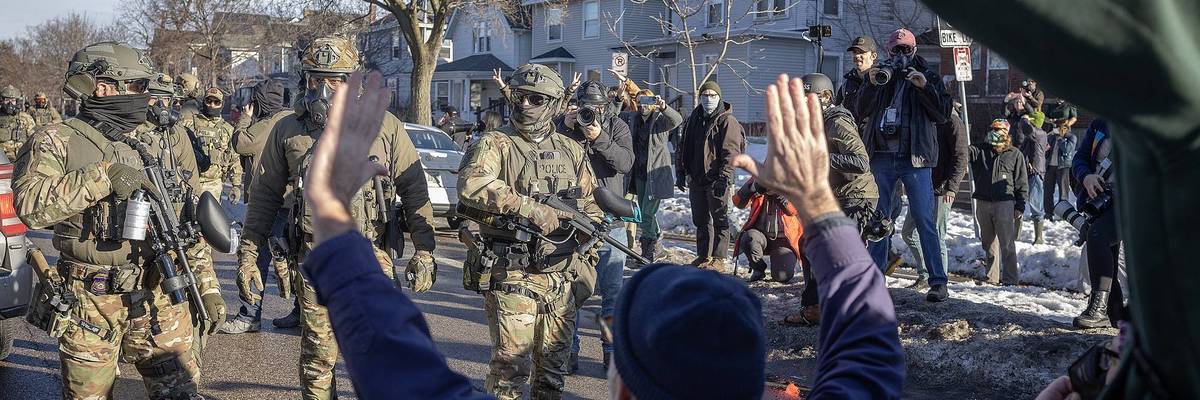
Protesters and Immigration and Customs Enforcement agents face each other near the area where Renee Good was killed by a federal immigration agent the previous week, in Minneapolis, Minnesota, on Tuesday, Jan. 13, 2026.
The distinction between “oppressive regime” as a concept in a textbook and “oppressive regime” as the texture of ordinary life—for millions of people living in this country right now, citizens and noncitizens alike—has ceased to exist.
Political scientists have a fairly dry checklist for what makes a regime oppressive: It silences dissent, it turns state power against its own people, it treats international law as optional, and it punishes anyone—institution or individual—who tries to hold it accountable. Read as a list, it sounds abstract or like something that happens elsewhere, in a dictatorship in a Third World country maybe.
For Americans, such a definition no longer feels abstract anymore.
Let’s start with the silencing. Since the war on Gaza escalated, human rights groups and journalists have documented, for years now, a pattern of pro-Palestinian content—protest footage, on-the-ground reporting, even the straightforward accounting of civilian deaths—being throttled, flagged, or removed from major platforms. Meanwhile, incitement and dehumanizing rhetoric spreads with far less friction. Independent researchers have called it out repeatedly. Platforms deny doing it on purpose.
Regimes like this have ended before, usually because enough ordinary people refused to stop saying what they saw.
The silencing isn’t limited to algorithms, either. Last month, the White House revoked press credentials for CNN, MS NOW, and Politico, physically barring their reporters from the building over what the president called unfavorable coverage. A federal judge has since ordered access temporarily restored, calling the move a likely violation of due process, but the message had already landed: Cover this administration the wrong way and you can be locked out of the room where the decisions get made. A press freedom advocate called it part of a broader pattern meant to intimidate journalists and deter critical reporting. When the people paid to tell the public the truth are the ones getting the door closed in their faces, “free press” starts to feel like a technicality rather than a guarantee.
Then there’s the gap between what the government does and what the country actually wants. This summer, Rep. Thomas Massie (R-Ky.) forced a vote to strip billions in US military funding to Israel. This was no fringe gesture but a real floor fight that split both parties and forced members to go on the record. It lost. But the fact that it happened at all, that a sitting Republican congressman felt he had to make Washington answer for the money it kept sending regardless of what constituents were saying, is itself the story. Institutions are moving in one direction while public sentiment visibly pulls in another, and the institutions are winning anyway.
And there’s the reach outward. When the International Criminal Court issued warrants tied to the Gaza war, Washington didn’t argue the law. It sanctioned the court itself, freezing officials’ bank accounts, cutting off their email, warning American staff they’d be arrested for traveling home. A body created specifically to stand outside any one government’s control got treated like an adversary for doing its job. If that’s what happens to an international court, it’s not hard to imagine what happens to an ordinary citizen who speaks too loudly.
Actually, it’s not hard to imagine because it is happening on a daily basis, especially for those who protest the Trump administration’s immigration policy. Last month, Donna Ganger—the mother of Renee Good, a US citizen shot and killed by an Immigration and Customs Enforcement (ICE) agent in Minneapolis in January—testified on Capitol Hill that she’s a registered Republican who voted for Donald Trump because she believed that these agents were there to protect citizens, not to treat her own family like the threat. She didn’t get an apology. “This is madness,” she concluded.
Every day, millions of people in America live the reality of a police state. They are afraid to leave their houses for fear of being detained by ICE, thrown into horrific holding centers, and sent back home to civil war or family abuse or even deportation to a third country they know nothing about. ICE has become something closer to a domestic enforcement arm than an immigration agency, and “wrong place, wrong time” is a real category of harm now, not a hypothetical one.
What does it mean to raise a child in a country where simply existing in the wrong neighborhood at the wrong moment carries risk? Where even a global court gets its accounts frozen for trying to hold power accountable?
It’s a strange kind of irony that at the United Nations last month, Trump denounced “the fanatical Iranian regime” for spreading “carnage and chaos” and called for its “complete economic isolation” over how it treats its own people. He’s not wrong that repression deserves condemnation. He’s just describing, almost point for point, the pattern playing out here at home—press outlets barred from covering their own government, citizens shot by agents meant to protect them, and dissent treated as the threat rather than the right.
The distinction between “oppressive regime” as a concept in a textbook and “oppressive regime” as the texture of ordinary life—for millions of people living in this country right now, citizens and noncitizens alike—has ceased to exist. Describing the disappearance of that distinction—calmly, specifically, without exaggeration—feels like the first form of resistance available to someone who isn’t a lawyer, a lawmaker, or a judge.
Regimes like this have ended before, usually because enough ordinary people refused to stop saying what they saw. That’s the piece I want to hold onto, even on the days when fear wins out.
Dear Common Dreams reader, It’s been nearly 30 years since I co-founded Common Dreams with my late wife, Lina Newhouser. We had the radical notion that journalism should serve the public good, not corporate profits. It was clear to us from the outset what it would take to build such a project. No paid advertisements. No corporate sponsors. No millionaire publisher telling us what to think or do. Many people said we wouldn't last a year, but we proved those doubters wrong. Together with a tremendous team of journalists and dedicated staff, we built an independent media outlet free from the constraints of profits and corporate control. Our mission has always been simple: To inform. To inspire. To ignite change for the common good. Building Common Dreams was not easy. Our survival was never guaranteed. When you take on the most powerful forces—Wall Street greed, fossil fuel industry destruction, Big Tech lobbyists, and uber-rich oligarchs who have spent billions upon billions rigging the economy and democracy in their favor—the only bulwark you have is supporters who believe in your work. But here’s the urgent message from me today. It's never been this bad out there. And it's never been this hard to keep us going. At the very moment Common Dreams is most needed, the threats we face are intensifying. We need your support now more than ever. We don't accept corporate advertising and never will. We don't have a paywall because we don't think people should be blocked from critical news based on their ability to pay. Everything we do is funded by the donations of readers like you. When everyone does the little they can afford, we are strong. But if that support retreats or dries up, so do we. Will you donate now to make sure Common Dreams not only survives but thrives? —Craig Brown, Co-founder |
Political scientists have a fairly dry checklist for what makes a regime oppressive: It silences dissent, it turns state power against its own people, it treats international law as optional, and it punishes anyone—institution or individual—who tries to hold it accountable. Read as a list, it sounds abstract or like something that happens elsewhere, in a dictatorship in a Third World country maybe.
For Americans, such a definition no longer feels abstract anymore.
Let’s start with the silencing. Since the war on Gaza escalated, human rights groups and journalists have documented, for years now, a pattern of pro-Palestinian content—protest footage, on-the-ground reporting, even the straightforward accounting of civilian deaths—being throttled, flagged, or removed from major platforms. Meanwhile, incitement and dehumanizing rhetoric spreads with far less friction. Independent researchers have called it out repeatedly. Platforms deny doing it on purpose.
Regimes like this have ended before, usually because enough ordinary people refused to stop saying what they saw.
The silencing isn’t limited to algorithms, either. Last month, the White House revoked press credentials for CNN, MS NOW, and Politico, physically barring their reporters from the building over what the president called unfavorable coverage. A federal judge has since ordered access temporarily restored, calling the move a likely violation of due process, but the message had already landed: Cover this administration the wrong way and you can be locked out of the room where the decisions get made. A press freedom advocate called it part of a broader pattern meant to intimidate journalists and deter critical reporting. When the people paid to tell the public the truth are the ones getting the door closed in their faces, “free press” starts to feel like a technicality rather than a guarantee.
Then there’s the gap between what the government does and what the country actually wants. This summer, Rep. Thomas Massie (R-Ky.) forced a vote to strip billions in US military funding to Israel. This was no fringe gesture but a real floor fight that split both parties and forced members to go on the record. It lost. But the fact that it happened at all, that a sitting Republican congressman felt he had to make Washington answer for the money it kept sending regardless of what constituents were saying, is itself the story. Institutions are moving in one direction while public sentiment visibly pulls in another, and the institutions are winning anyway.
And there’s the reach outward. When the International Criminal Court issued warrants tied to the Gaza war, Washington didn’t argue the law. It sanctioned the court itself, freezing officials’ bank accounts, cutting off their email, warning American staff they’d be arrested for traveling home. A body created specifically to stand outside any one government’s control got treated like an adversary for doing its job. If that’s what happens to an international court, it’s not hard to imagine what happens to an ordinary citizen who speaks too loudly.
Actually, it’s not hard to imagine because it is happening on a daily basis, especially for those who protest the Trump administration’s immigration policy. Last month, Donna Ganger—the mother of Renee Good, a US citizen shot and killed by an Immigration and Customs Enforcement (ICE) agent in Minneapolis in January—testified on Capitol Hill that she’s a registered Republican who voted for Donald Trump because she believed that these agents were there to protect citizens, not to treat her own family like the threat. She didn’t get an apology. “This is madness,” she concluded.
Every day, millions of people in America live the reality of a police state. They are afraid to leave their houses for fear of being detained by ICE, thrown into horrific holding centers, and sent back home to civil war or family abuse or even deportation to a third country they know nothing about. ICE has become something closer to a domestic enforcement arm than an immigration agency, and “wrong place, wrong time” is a real category of harm now, not a hypothetical one.
What does it mean to raise a child in a country where simply existing in the wrong neighborhood at the wrong moment carries risk? Where even a global court gets its accounts frozen for trying to hold power accountable?
It’s a strange kind of irony that at the United Nations last month, Trump denounced “the fanatical Iranian regime” for spreading “carnage and chaos” and called for its “complete economic isolation” over how it treats its own people. He’s not wrong that repression deserves condemnation. He’s just describing, almost point for point, the pattern playing out here at home—press outlets barred from covering their own government, citizens shot by agents meant to protect them, and dissent treated as the threat rather than the right.
The distinction between “oppressive regime” as a concept in a textbook and “oppressive regime” as the texture of ordinary life—for millions of people living in this country right now, citizens and noncitizens alike—has ceased to exist. Describing the disappearance of that distinction—calmly, specifically, without exaggeration—feels like the first form of resistance available to someone who isn’t a lawyer, a lawmaker, or a judge.
Regimes like this have ended before, usually because enough ordinary people refused to stop saying what they saw. That’s the piece I want to hold onto, even on the days when fear wins out.
Political scientists have a fairly dry checklist for what makes a regime oppressive: It silences dissent, it turns state power against its own people, it treats international law as optional, and it punishes anyone—institution or individual—who tries to hold it accountable. Read as a list, it sounds abstract or like something that happens elsewhere, in a dictatorship in a Third World country maybe.
For Americans, such a definition no longer feels abstract anymore.
Let’s start with the silencing. Since the war on Gaza escalated, human rights groups and journalists have documented, for years now, a pattern of pro-Palestinian content—protest footage, on-the-ground reporting, even the straightforward accounting of civilian deaths—being throttled, flagged, or removed from major platforms. Meanwhile, incitement and dehumanizing rhetoric spreads with far less friction. Independent researchers have called it out repeatedly. Platforms deny doing it on purpose.
Regimes like this have ended before, usually because enough ordinary people refused to stop saying what they saw.
The silencing isn’t limited to algorithms, either. Last month, the White House revoked press credentials for CNN, MS NOW, and Politico, physically barring their reporters from the building over what the president called unfavorable coverage. A federal judge has since ordered access temporarily restored, calling the move a likely violation of due process, but the message had already landed: Cover this administration the wrong way and you can be locked out of the room where the decisions get made. A press freedom advocate called it part of a broader pattern meant to intimidate journalists and deter critical reporting. When the people paid to tell the public the truth are the ones getting the door closed in their faces, “free press” starts to feel like a technicality rather than a guarantee.
Then there’s the gap between what the government does and what the country actually wants. This summer, Rep. Thomas Massie (R-Ky.) forced a vote to strip billions in US military funding to Israel. This was no fringe gesture but a real floor fight that split both parties and forced members to go on the record. It lost. But the fact that it happened at all, that a sitting Republican congressman felt he had to make Washington answer for the money it kept sending regardless of what constituents were saying, is itself the story. Institutions are moving in one direction while public sentiment visibly pulls in another, and the institutions are winning anyway.
And there’s the reach outward. When the International Criminal Court issued warrants tied to the Gaza war, Washington didn’t argue the law. It sanctioned the court itself, freezing officials’ bank accounts, cutting off their email, warning American staff they’d be arrested for traveling home. A body created specifically to stand outside any one government’s control got treated like an adversary for doing its job. If that’s what happens to an international court, it’s not hard to imagine what happens to an ordinary citizen who speaks too loudly.
Actually, it’s not hard to imagine because it is happening on a daily basis, especially for those who protest the Trump administration’s immigration policy. Last month, Donna Ganger—the mother of Renee Good, a US citizen shot and killed by an Immigration and Customs Enforcement (ICE) agent in Minneapolis in January—testified on Capitol Hill that she’s a registered Republican who voted for Donald Trump because she believed that these agents were there to protect citizens, not to treat her own family like the threat. She didn’t get an apology. “This is madness,” she concluded.
Every day, millions of people in America live the reality of a police state. They are afraid to leave their houses for fear of being detained by ICE, thrown into horrific holding centers, and sent back home to civil war or family abuse or even deportation to a third country they know nothing about. ICE has become something closer to a domestic enforcement arm than an immigration agency, and “wrong place, wrong time” is a real category of harm now, not a hypothetical one.
What does it mean to raise a child in a country where simply existing in the wrong neighborhood at the wrong moment carries risk? Where even a global court gets its accounts frozen for trying to hold power accountable?
It’s a strange kind of irony that at the United Nations last month, Trump denounced “the fanatical Iranian regime” for spreading “carnage and chaos” and called for its “complete economic isolation” over how it treats its own people. He’s not wrong that repression deserves condemnation. He’s just describing, almost point for point, the pattern playing out here at home—press outlets barred from covering their own government, citizens shot by agents meant to protect them, and dissent treated as the threat rather than the right.
The distinction between “oppressive regime” as a concept in a textbook and “oppressive regime” as the texture of ordinary life—for millions of people living in this country right now, citizens and noncitizens alike—has ceased to exist. Describing the disappearance of that distinction—calmly, specifically, without exaggeration—feels like the first form of resistance available to someone who isn’t a lawyer, a lawmaker, or a judge.
Regimes like this have ended before, usually because enough ordinary people refused to stop saying what they saw. That’s the piece I want to hold onto, even on the days when fear wins out.