
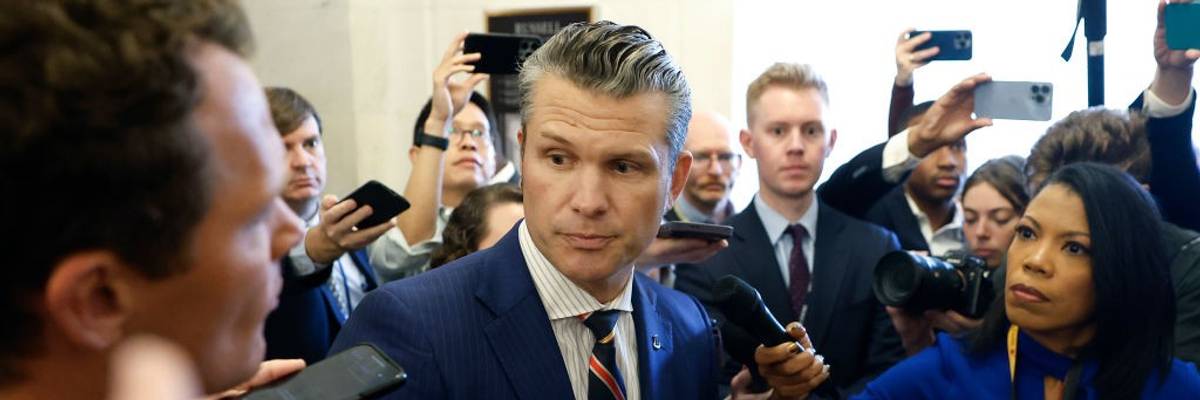
President-elect Donald Trump's nominee to be Secretary of Defense Pete Hegseth speaks to reporters as he leaves the Russell Senate Office Building on November 21, 2024 in Washington, DC. Hegseth was on Capitol Hill meeting with Senators to discuss his nomination and qualifications.
Trump's Cabinet Nominees Are Not a Joke, They're a Fascism-Inspired Dare
The individual nominees Trump has put forward forward are concerning on their own terms, but the implications of their nominations are even more chilling when taken as a whole.
As a professor of rhetoric who studies Nazism, fascism, and demagoguery, I've watched Trump’s cabinet picks with mounting unease. The majority of them are so egregiously unfit for the offices they're nominated to run, it seems like a perverse joke.
A wrestling CEO and the subject of a lawsuit accusing her of sheltering pedophiles for Secretary of Education? A celebrity doctor with a history of multi-level medical and insurance marketing schemes for Medicare and Medicaid administrator? A cable news personality whose called for purging “woke” generals from the military for Secretary of Defense? An anti-vaxxer with a history of drug abuse for Secretary of Health and Human Services? A dog murdering governor whose been banned from all the Tribal lands in her state for Secretary of Homeland Security? The list goes on.
But Trump’s cabinet nominees aren’t a joke. They’re a fascism-inspired dare.
In the last months of the campaign, not one but two of Trump’s former cabinet members, plus the former Chairman of the Joint Chiefs of Staff—all four-star generals—openly called him a fascist. Several other people, including his opponent, did as well. Whether or not the specific term “fascist” is accurate, there are reasons it keeps coming up.
Trump has repeatedly echoed fascist rhetoric, staging multiple fascism-inspired rallies, threating to be a dictator “on day one” if re-elected, and calling journalists and his political opponents “enemies from within.” He’s even threatened to deploy the military against U.S. citizens who oppose him. After General Mark Milley, criticized Trump’s role in the January 6 insurrection, Trump suggested he should be executed. Milley’s execution is not the only one Trump has fantasized about.
But even in his less provocative moments, Trump exhibits tendencies that align with fascist politics. He has consistently resisted or rejected the norms and institutions of democracy, including accepting election results, respecting non-partisan civil services, and upholding the separation of powers at the heart of American democracy.
Open opposition to democracy has been at the center of fascist politics since fascist politics have existed. Italy’s Benito Mussolini, Germany’s Adolf Hitler, Spain’s José Antonio Primo de Rivera, among others, rejected democracy as decadent, unnatural, and weak. In many cases—Italy and Germany, chief among them—fascist parties participated in democratic politics in order to rise to power, and even after they were in power, they often retained the trappings of democracy, including parliaments and elections.
But they also eviscerated the norms and institutions designed to keep them in check. Mussolini, for example, helped push through the Acerbo Law in 1923, which said that whichever party earned the highest number of votes in parliamentary elections automatically got two-thirds of the parliamentary seats. In 1933, Hitler and the Nazis took their proposal to suspend Germany’s constitution to the Reichstag for approval, which they got through coercion and changing voting rules on the spot.
Destroying democratic institutions, and other efforts like it, were of course intended to consolidate fascist power, but they were also explicit challenges to democratic lawmakers. They were so egregious that lawmakers were forced to unambiguously declare their allegiances—would they defiantly confront the fascists, or would they fall in line? Needless to say, defiant confrontation had predictable consequences and falling in line had obvious advantages.
Whether or not Trump intends to usurp two-thirds of Congress or suspend the Constitution, he’s leaning into the fascist tradition of issuing egregious demands, which require lawmakers to unambiguously declare their allegiances. In nominating a Director of National Intelligence who has no experience in national intelligence, Trump is forcing Senators—Republicans, in particular—to say publicly whether they’re with him or against him.
No one should imagine, even for a second, that Trump doesn’t know what he’s doing with his Cabinet picks. He knows his nominees need Senate confirmation. During his first term, his Cabinet nominees were “conventional” Republicans, which is to say anti-tax, anti-regulation, and pro-national security. Still, they faced considerable scrutiny, even among Senate Republicans. As several of his initial appointments resigned or found themselves caught up in ethics scandals, Trump resorted to “acting” appointments to circumvent the Senate.This time, Trump isn’t bothering with conventional nominees. He’s challenging the Senate by compiling a list of nominees that are more than just partisans. They’re more than just extreme. They are ultimatums. The question is not, “Is Nominee A or B qualified?” It’s “Are you going to try to stop me or not?”
The individual nominees Trump has put forward forward are concerning on their own terms, but the implications of their nominations are even more chilling when taken as a whole. How the Senate responds will tell us a lot about just what kind of threat to democracy Trump will be in the coming years. If history is any guide, we’d do well to pay careful attention.
We are at a crossroads
This country and this world are at a monumental crossroads. In a few short weeks, US voters will have an opportunity to beat back the forces of fascism and confront the billionaires who are rigging the economy, our media system, and our democracy, making it increasingly impossible for ordinary people to get by. We’re not just talking about the election. We’re talking about what must be done once these fascist elements are vanquished from power. We need a bolder set of solutions than what either major party has so far been willing to offer and a working-class movement ready to fight like hell for it. Trump didn't emerge from nowhere. The conditions that fueled MAGA authoritarianism were created by decades of radical neoliberal economic policies and a corrupt political system dominated by corporate interests. They slashed taxes on the super-rich, promising that the benefits would trickle down. They said giveaways to the corporate titans would make life more affordable for the rest of us. It was all bullshit. And when a bitter, betrayed populace searches for someone to blame, right-wing demagogues have little trouble finding scapegoats. People know when they're being lied to, but you won't hear any of this from the corporate media. Only independent journalism—powered and funded by people who believe in building a better world—can deliver truly trustworthy daily news. Our Fall Campaign is underway, and we need your help. To power our newsroom through the rest of the year, we need to raise $125,000 by midnight on October 31. So if you share our vision, please contribute whatever you can to sustain our work. |
As a professor of rhetoric who studies Nazism, fascism, and demagoguery, I've watched Trump’s cabinet picks with mounting unease. The majority of them are so egregiously unfit for the offices they're nominated to run, it seems like a perverse joke.
A wrestling CEO and the subject of a lawsuit accusing her of sheltering pedophiles for Secretary of Education? A celebrity doctor with a history of multi-level medical and insurance marketing schemes for Medicare and Medicaid administrator? A cable news personality whose called for purging “woke” generals from the military for Secretary of Defense? An anti-vaxxer with a history of drug abuse for Secretary of Health and Human Services? A dog murdering governor whose been banned from all the Tribal lands in her state for Secretary of Homeland Security? The list goes on.
But Trump’s cabinet nominees aren’t a joke. They’re a fascism-inspired dare.
In the last months of the campaign, not one but two of Trump’s former cabinet members, plus the former Chairman of the Joint Chiefs of Staff—all four-star generals—openly called him a fascist. Several other people, including his opponent, did as well. Whether or not the specific term “fascist” is accurate, there are reasons it keeps coming up.
Trump has repeatedly echoed fascist rhetoric, staging multiple fascism-inspired rallies, threating to be a dictator “on day one” if re-elected, and calling journalists and his political opponents “enemies from within.” He’s even threatened to deploy the military against U.S. citizens who oppose him. After General Mark Milley, criticized Trump’s role in the January 6 insurrection, Trump suggested he should be executed. Milley’s execution is not the only one Trump has fantasized about.
But even in his less provocative moments, Trump exhibits tendencies that align with fascist politics. He has consistently resisted or rejected the norms and institutions of democracy, including accepting election results, respecting non-partisan civil services, and upholding the separation of powers at the heart of American democracy.
Open opposition to democracy has been at the center of fascist politics since fascist politics have existed. Italy’s Benito Mussolini, Germany’s Adolf Hitler, Spain’s José Antonio Primo de Rivera, among others, rejected democracy as decadent, unnatural, and weak. In many cases—Italy and Germany, chief among them—fascist parties participated in democratic politics in order to rise to power, and even after they were in power, they often retained the trappings of democracy, including parliaments and elections.
But they also eviscerated the norms and institutions designed to keep them in check. Mussolini, for example, helped push through the Acerbo Law in 1923, which said that whichever party earned the highest number of votes in parliamentary elections automatically got two-thirds of the parliamentary seats. In 1933, Hitler and the Nazis took their proposal to suspend Germany’s constitution to the Reichstag for approval, which they got through coercion and changing voting rules on the spot.
Destroying democratic institutions, and other efforts like it, were of course intended to consolidate fascist power, but they were also explicit challenges to democratic lawmakers. They were so egregious that lawmakers were forced to unambiguously declare their allegiances—would they defiantly confront the fascists, or would they fall in line? Needless to say, defiant confrontation had predictable consequences and falling in line had obvious advantages.
Whether or not Trump intends to usurp two-thirds of Congress or suspend the Constitution, he’s leaning into the fascist tradition of issuing egregious demands, which require lawmakers to unambiguously declare their allegiances. In nominating a Director of National Intelligence who has no experience in national intelligence, Trump is forcing Senators—Republicans, in particular—to say publicly whether they’re with him or against him.
No one should imagine, even for a second, that Trump doesn’t know what he’s doing with his Cabinet picks. He knows his nominees need Senate confirmation. During his first term, his Cabinet nominees were “conventional” Republicans, which is to say anti-tax, anti-regulation, and pro-national security. Still, they faced considerable scrutiny, even among Senate Republicans. As several of his initial appointments resigned or found themselves caught up in ethics scandals, Trump resorted to “acting” appointments to circumvent the Senate.This time, Trump isn’t bothering with conventional nominees. He’s challenging the Senate by compiling a list of nominees that are more than just partisans. They’re more than just extreme. They are ultimatums. The question is not, “Is Nominee A or B qualified?” It’s “Are you going to try to stop me or not?”
The individual nominees Trump has put forward forward are concerning on their own terms, but the implications of their nominations are even more chilling when taken as a whole. How the Senate responds will tell us a lot about just what kind of threat to democracy Trump will be in the coming years. If history is any guide, we’d do well to pay careful attention.
As a professor of rhetoric who studies Nazism, fascism, and demagoguery, I've watched Trump’s cabinet picks with mounting unease. The majority of them are so egregiously unfit for the offices they're nominated to run, it seems like a perverse joke.
A wrestling CEO and the subject of a lawsuit accusing her of sheltering pedophiles for Secretary of Education? A celebrity doctor with a history of multi-level medical and insurance marketing schemes for Medicare and Medicaid administrator? A cable news personality whose called for purging “woke” generals from the military for Secretary of Defense? An anti-vaxxer with a history of drug abuse for Secretary of Health and Human Services? A dog murdering governor whose been banned from all the Tribal lands in her state for Secretary of Homeland Security? The list goes on.
But Trump’s cabinet nominees aren’t a joke. They’re a fascism-inspired dare.
In the last months of the campaign, not one but two of Trump’s former cabinet members, plus the former Chairman of the Joint Chiefs of Staff—all four-star generals—openly called him a fascist. Several other people, including his opponent, did as well. Whether or not the specific term “fascist” is accurate, there are reasons it keeps coming up.
Trump has repeatedly echoed fascist rhetoric, staging multiple fascism-inspired rallies, threating to be a dictator “on day one” if re-elected, and calling journalists and his political opponents “enemies from within.” He’s even threatened to deploy the military against U.S. citizens who oppose him. After General Mark Milley, criticized Trump’s role in the January 6 insurrection, Trump suggested he should be executed. Milley’s execution is not the only one Trump has fantasized about.
But even in his less provocative moments, Trump exhibits tendencies that align with fascist politics. He has consistently resisted or rejected the norms and institutions of democracy, including accepting election results, respecting non-partisan civil services, and upholding the separation of powers at the heart of American democracy.
Open opposition to democracy has been at the center of fascist politics since fascist politics have existed. Italy’s Benito Mussolini, Germany’s Adolf Hitler, Spain’s José Antonio Primo de Rivera, among others, rejected democracy as decadent, unnatural, and weak. In many cases—Italy and Germany, chief among them—fascist parties participated in democratic politics in order to rise to power, and even after they were in power, they often retained the trappings of democracy, including parliaments and elections.
But they also eviscerated the norms and institutions designed to keep them in check. Mussolini, for example, helped push through the Acerbo Law in 1923, which said that whichever party earned the highest number of votes in parliamentary elections automatically got two-thirds of the parliamentary seats. In 1933, Hitler and the Nazis took their proposal to suspend Germany’s constitution to the Reichstag for approval, which they got through coercion and changing voting rules on the spot.
Destroying democratic institutions, and other efforts like it, were of course intended to consolidate fascist power, but they were also explicit challenges to democratic lawmakers. They were so egregious that lawmakers were forced to unambiguously declare their allegiances—would they defiantly confront the fascists, or would they fall in line? Needless to say, defiant confrontation had predictable consequences and falling in line had obvious advantages.
Whether or not Trump intends to usurp two-thirds of Congress or suspend the Constitution, he’s leaning into the fascist tradition of issuing egregious demands, which require lawmakers to unambiguously declare their allegiances. In nominating a Director of National Intelligence who has no experience in national intelligence, Trump is forcing Senators—Republicans, in particular—to say publicly whether they’re with him or against him.
No one should imagine, even for a second, that Trump doesn’t know what he’s doing with his Cabinet picks. He knows his nominees need Senate confirmation. During his first term, his Cabinet nominees were “conventional” Republicans, which is to say anti-tax, anti-regulation, and pro-national security. Still, they faced considerable scrutiny, even among Senate Republicans. As several of his initial appointments resigned or found themselves caught up in ethics scandals, Trump resorted to “acting” appointments to circumvent the Senate.This time, Trump isn’t bothering with conventional nominees. He’s challenging the Senate by compiling a list of nominees that are more than just partisans. They’re more than just extreme. They are ultimatums. The question is not, “Is Nominee A or B qualified?” It’s “Are you going to try to stop me or not?”
The individual nominees Trump has put forward forward are concerning on their own terms, but the implications of their nominations are even more chilling when taken as a whole. How the Senate responds will tell us a lot about just what kind of threat to democracy Trump will be in the coming years. If history is any guide, we’d do well to pay careful attention.