SUBSCRIBE TO OUR FREE NEWSLETTER
Daily news & progressive opinion—funded by the people, not the corporations—delivered straight to your inbox.
5
#000000
#FFFFFF
To donate by check, phone, or other method, see our More Ways to Give page.
Daily news & progressive opinion—funded by the people, not the corporations—delivered straight to your inbox.
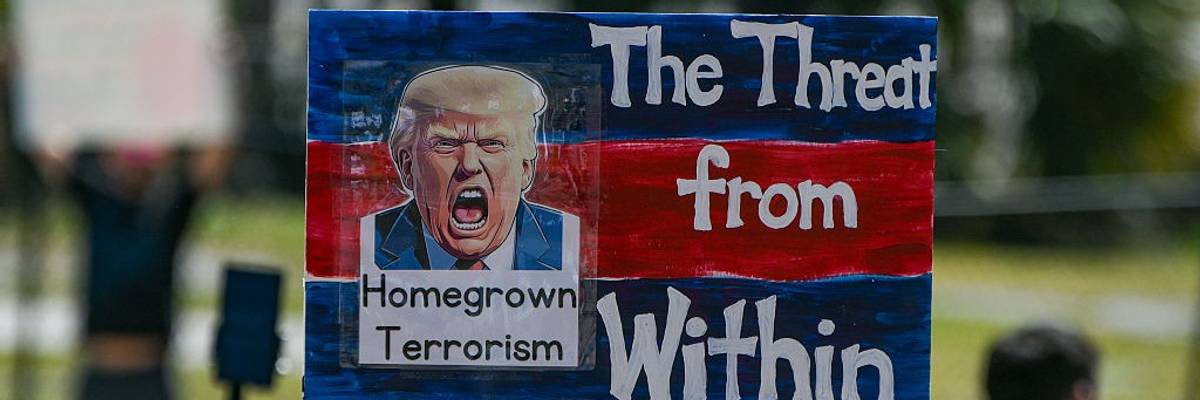
Protesters take to the streets of downtown Orlando, United States, on August 19, 2023, to demonstrate in favor of immigrants and students and against Donald Trump and billionaires and dictators.
Trump and his MAGA backers (white supremacists, the Christian right, tech billionaires) are part of the anti-democratic tradition that has existed in the United States literally since the early days of the republic.
The notion that the US is an empire in decline has been a recurring theme in international relations literature since the 1980s. Surely, the United States remains the dominant force in the world economy, but it faces daunting challenges from the emergence of China as an economic superpower. And there is no denying the fact that while the US is a military superpower, with the highest defense budget in the world and possessing a range of weapons that other major powers simply do not have, its influence over global politics has been getting weaker. It can bully a country like Venezuela into submission and strangle Cuba to death as part of a strategy of selective hegemony under Trump 2.0, but cannot shape political outcomes across Latin America; holds no monopoly over diplomacy in the Middle East; cannot dictate policy to Europe; cannot force Russia to end the war in Ukraine; and surely lacks the political and economic leverage to contain and isolate China.
Last week’s Trump-Xi summit drove home the reality of shifts in global power. Chinese leader Xi Jinping made US President Donald Trump look weak. Not only did “philosopher-king” Xi concede nothing to the American wannabe emperor but made a subtle threat to the US by invoking the Thucydides trap. In so doing, Xi was letting Trump know that China’s rise is real and that, as such, the world has once again come to a new crossroads. Subsequently, the US should be careful how it handles the new reality of a world no longer dominated by Washington; a strategic miscalculation on its part over Taiwan (the reddest of red lines for China) could lead to war.
Nonetheless, while the debate continues to rage over whether US global hegemony is in decline or not, there should be much less doubt about domestic decline. The over-extension of the empire, characterized by forever wars and endless aggression, an enormously bloated Pentagon budget, and roughly 800 military bases in over 80 countries, has imposed severe pressures on the domestic economy and led to the worsening of social conditions and the unraveling of civil society. The economy has been facing unsustainable economic imbalances (deficits in its fiscal and current account balances) since the late 1990s, and the national debt now exceeds the country’s GDP. In the meantime, the problems of the country as a whole are mounting: crumbling infrastructure, decaying cities, disintegrated education, an unaffordable healthcare system, and a housing crisis that has reached a breaking point make the US resemble a third world country. And the rich are getting richer every day while wages have remained stagnant for most US workers since the late 1970s.
As if this wasn’t bad enough for what is still the wealthiest country in the world, economic alienation and racism are tearing the social fabric apart, thereby offering more opportunities to extend the police operations of the imperial state to the domestic realm as well—increasing the size of the police and building more prisons, as mass incarceration is indeed “big business” in the United States.
Trump and his backers are a real menace to everything that defines a decent society.
The rise of Donald Trump to power is a symptom of the decline of the US as a world power and as an advanced industrial society. It is in that context that Trump’s “Make America Great Again” slogan captured the imagination of a large segment of the population, reflecting a desire for a return to some idealized state of American society. But it wasn’t simply economics that drove so many to Trump’s arms. The MAGA movement is dependent on racial resentment and straight-up racism. “Make America Great Again” is a politico-cultural project, not some blueprint for economic restructuring.
Many of followers of the MAGA movement professed an aversion to US imperial ambitions and believed that the system is somehow rigged, although they never explained in whose favor. But like traditional conservatives before them, they opposed the federal government not only because they saw it as an instrument of a globalized elite but because they oppose the expansion of federal programs. Their real frustration was over the direction in which the country was moving socially and culturally, which they felt had major ramifications for the economic status of white Americans. This made them perfect prey for Trump’s demagoguery.
Trump himself did identify some of the real economic problems facing the United States, such as decades of manufacturing decline and a growing trade deficit, and spoke from very early on of a collapsing infrastructure that made the US resemble a third world country. But it’s not just that Trump’s actual diagnosis of the structural problems facing the United States is wrong and that the remedies pursued by his administration (sweeping tariffs and mass deportations) are incoherent and designed to backfire. Trump is using the presidency to enrich himself and his family, enforce a plutocratic agenda, roll back decades of social progress, and get revenge on his political opponents any way that he can.
Trump and his MAGA backers (white supremacists, the Christian right, tech billionaires) are part of the anti-democratic tradition that has existed in the United States literally since the early days of the republic. From the 20th century onward, the enemy for the political tradition that Trump and his billionaire allies stand for is equality, social welfare, and redistribution. It was so for the era of Ronald Reagan and George W. Bush and remains so for today’s reactionaries. As Project 2025 perfectly epitomizes, which the Trump administration has been enforcing with great dedication, the enemy is a society that seeks to place the interests of working people ahead of greed, profit making, and the unlimited accumulation of capital by striving to create institutions that strengthen the public good and enforce democratic accountability.
What we have with Trump and the MAGA movement is an updated version of Social Darwinism, a foundational pillar of fascism. Trump and his backers are a real menace to everything that defines a decent society. For decent people everywhere, it can be said that the greatest of a nation can be judged by how it treats its weakest members. For Trump and his ilk, it can be judged by raising plutocratic power to new heights and inflicting as much pain as possible on the poor and the weak. In this manner, the Trump administration’s politics of cruelty and the callousness of its approach to social policy go beyond simply serving the interests of capitalism as they are designed to produce systemic fear and turn brutality into a source of pleasure. Part of the aim is to make the public numb and apathetic to the astonishing accumulation of wealth in the hands of a few and how it corrupts politics and the media.
How Trumpism ends is anyone’s guess. But while it must be defeated if there is to be a future hope for the United States, it must also be understood that a major part of the nation’s history is intrinsically linked to the anti-democratic tradition that made possible Donald Trump’s rise to power. How to uproot it is of vital importance for the realization of a good and just society.
Dear Common Dreams reader, It’s been nearly 30 years since I co-founded Common Dreams with my late wife, Lina Newhouser. We had the radical notion that journalism should serve the public good, not corporate profits. It was clear to us from the outset what it would take to build such a project. No paid advertisements. No corporate sponsors. No millionaire publisher telling us what to think or do. Many people said we wouldn't last a year, but we proved those doubters wrong. Together with a tremendous team of journalists and dedicated staff, we built an independent media outlet free from the constraints of profits and corporate control. Our mission has always been simple: To inform. To inspire. To ignite change for the common good. Building Common Dreams was not easy. Our survival was never guaranteed. When you take on the most powerful forces—Wall Street greed, fossil fuel industry destruction, Big Tech lobbyists, and uber-rich oligarchs who have spent billions upon billions rigging the economy and democracy in their favor—the only bulwark you have is supporters who believe in your work. But here’s the urgent message from me today. It's never been this bad out there. And it's never been this hard to keep us going. At the very moment Common Dreams is most needed, the threats we face are intensifying. We need your support now more than ever. We don't accept corporate advertising and never will. We don't have a paywall because we don't think people should be blocked from critical news based on their ability to pay. Everything we do is funded by the donations of readers like you. When everyone does the little they can afford, we are strong. But if that support retreats or dries up, so do we. Will you donate now to make sure Common Dreams not only survives but thrives? —Craig Brown, Co-founder |
The notion that the US is an empire in decline has been a recurring theme in international relations literature since the 1980s. Surely, the United States remains the dominant force in the world economy, but it faces daunting challenges from the emergence of China as an economic superpower. And there is no denying the fact that while the US is a military superpower, with the highest defense budget in the world and possessing a range of weapons that other major powers simply do not have, its influence over global politics has been getting weaker. It can bully a country like Venezuela into submission and strangle Cuba to death as part of a strategy of selective hegemony under Trump 2.0, but cannot shape political outcomes across Latin America; holds no monopoly over diplomacy in the Middle East; cannot dictate policy to Europe; cannot force Russia to end the war in Ukraine; and surely lacks the political and economic leverage to contain and isolate China.
Last week’s Trump-Xi summit drove home the reality of shifts in global power. Chinese leader Xi Jinping made US President Donald Trump look weak. Not only did “philosopher-king” Xi concede nothing to the American wannabe emperor but made a subtle threat to the US by invoking the Thucydides trap. In so doing, Xi was letting Trump know that China’s rise is real and that, as such, the world has once again come to a new crossroads. Subsequently, the US should be careful how it handles the new reality of a world no longer dominated by Washington; a strategic miscalculation on its part over Taiwan (the reddest of red lines for China) could lead to war.
Nonetheless, while the debate continues to rage over whether US global hegemony is in decline or not, there should be much less doubt about domestic decline. The over-extension of the empire, characterized by forever wars and endless aggression, an enormously bloated Pentagon budget, and roughly 800 military bases in over 80 countries, has imposed severe pressures on the domestic economy and led to the worsening of social conditions and the unraveling of civil society. The economy has been facing unsustainable economic imbalances (deficits in its fiscal and current account balances) since the late 1990s, and the national debt now exceeds the country’s GDP. In the meantime, the problems of the country as a whole are mounting: crumbling infrastructure, decaying cities, disintegrated education, an unaffordable healthcare system, and a housing crisis that has reached a breaking point make the US resemble a third world country. And the rich are getting richer every day while wages have remained stagnant for most US workers since the late 1970s.
As if this wasn’t bad enough for what is still the wealthiest country in the world, economic alienation and racism are tearing the social fabric apart, thereby offering more opportunities to extend the police operations of the imperial state to the domestic realm as well—increasing the size of the police and building more prisons, as mass incarceration is indeed “big business” in the United States.
Trump and his backers are a real menace to everything that defines a decent society.
The rise of Donald Trump to power is a symptom of the decline of the US as a world power and as an advanced industrial society. It is in that context that Trump’s “Make America Great Again” slogan captured the imagination of a large segment of the population, reflecting a desire for a return to some idealized state of American society. But it wasn’t simply economics that drove so many to Trump’s arms. The MAGA movement is dependent on racial resentment and straight-up racism. “Make America Great Again” is a politico-cultural project, not some blueprint for economic restructuring.
Many of followers of the MAGA movement professed an aversion to US imperial ambitions and believed that the system is somehow rigged, although they never explained in whose favor. But like traditional conservatives before them, they opposed the federal government not only because they saw it as an instrument of a globalized elite but because they oppose the expansion of federal programs. Their real frustration was over the direction in which the country was moving socially and culturally, which they felt had major ramifications for the economic status of white Americans. This made them perfect prey for Trump’s demagoguery.
Trump himself did identify some of the real economic problems facing the United States, such as decades of manufacturing decline and a growing trade deficit, and spoke from very early on of a collapsing infrastructure that made the US resemble a third world country. But it’s not just that Trump’s actual diagnosis of the structural problems facing the United States is wrong and that the remedies pursued by his administration (sweeping tariffs and mass deportations) are incoherent and designed to backfire. Trump is using the presidency to enrich himself and his family, enforce a plutocratic agenda, roll back decades of social progress, and get revenge on his political opponents any way that he can.
Trump and his MAGA backers (white supremacists, the Christian right, tech billionaires) are part of the anti-democratic tradition that has existed in the United States literally since the early days of the republic. From the 20th century onward, the enemy for the political tradition that Trump and his billionaire allies stand for is equality, social welfare, and redistribution. It was so for the era of Ronald Reagan and George W. Bush and remains so for today’s reactionaries. As Project 2025 perfectly epitomizes, which the Trump administration has been enforcing with great dedication, the enemy is a society that seeks to place the interests of working people ahead of greed, profit making, and the unlimited accumulation of capital by striving to create institutions that strengthen the public good and enforce democratic accountability.
What we have with Trump and the MAGA movement is an updated version of Social Darwinism, a foundational pillar of fascism. Trump and his backers are a real menace to everything that defines a decent society. For decent people everywhere, it can be said that the greatest of a nation can be judged by how it treats its weakest members. For Trump and his ilk, it can be judged by raising plutocratic power to new heights and inflicting as much pain as possible on the poor and the weak. In this manner, the Trump administration’s politics of cruelty and the callousness of its approach to social policy go beyond simply serving the interests of capitalism as they are designed to produce systemic fear and turn brutality into a source of pleasure. Part of the aim is to make the public numb and apathetic to the astonishing accumulation of wealth in the hands of a few and how it corrupts politics and the media.
How Trumpism ends is anyone’s guess. But while it must be defeated if there is to be a future hope for the United States, it must also be understood that a major part of the nation’s history is intrinsically linked to the anti-democratic tradition that made possible Donald Trump’s rise to power. How to uproot it is of vital importance for the realization of a good and just society.
The notion that the US is an empire in decline has been a recurring theme in international relations literature since the 1980s. Surely, the United States remains the dominant force in the world economy, but it faces daunting challenges from the emergence of China as an economic superpower. And there is no denying the fact that while the US is a military superpower, with the highest defense budget in the world and possessing a range of weapons that other major powers simply do not have, its influence over global politics has been getting weaker. It can bully a country like Venezuela into submission and strangle Cuba to death as part of a strategy of selective hegemony under Trump 2.0, but cannot shape political outcomes across Latin America; holds no monopoly over diplomacy in the Middle East; cannot dictate policy to Europe; cannot force Russia to end the war in Ukraine; and surely lacks the political and economic leverage to contain and isolate China.
Last week’s Trump-Xi summit drove home the reality of shifts in global power. Chinese leader Xi Jinping made US President Donald Trump look weak. Not only did “philosopher-king” Xi concede nothing to the American wannabe emperor but made a subtle threat to the US by invoking the Thucydides trap. In so doing, Xi was letting Trump know that China’s rise is real and that, as such, the world has once again come to a new crossroads. Subsequently, the US should be careful how it handles the new reality of a world no longer dominated by Washington; a strategic miscalculation on its part over Taiwan (the reddest of red lines for China) could lead to war.
Nonetheless, while the debate continues to rage over whether US global hegemony is in decline or not, there should be much less doubt about domestic decline. The over-extension of the empire, characterized by forever wars and endless aggression, an enormously bloated Pentagon budget, and roughly 800 military bases in over 80 countries, has imposed severe pressures on the domestic economy and led to the worsening of social conditions and the unraveling of civil society. The economy has been facing unsustainable economic imbalances (deficits in its fiscal and current account balances) since the late 1990s, and the national debt now exceeds the country’s GDP. In the meantime, the problems of the country as a whole are mounting: crumbling infrastructure, decaying cities, disintegrated education, an unaffordable healthcare system, and a housing crisis that has reached a breaking point make the US resemble a third world country. And the rich are getting richer every day while wages have remained stagnant for most US workers since the late 1970s.
As if this wasn’t bad enough for what is still the wealthiest country in the world, economic alienation and racism are tearing the social fabric apart, thereby offering more opportunities to extend the police operations of the imperial state to the domestic realm as well—increasing the size of the police and building more prisons, as mass incarceration is indeed “big business” in the United States.
Trump and his backers are a real menace to everything that defines a decent society.
The rise of Donald Trump to power is a symptom of the decline of the US as a world power and as an advanced industrial society. It is in that context that Trump’s “Make America Great Again” slogan captured the imagination of a large segment of the population, reflecting a desire for a return to some idealized state of American society. But it wasn’t simply economics that drove so many to Trump’s arms. The MAGA movement is dependent on racial resentment and straight-up racism. “Make America Great Again” is a politico-cultural project, not some blueprint for economic restructuring.
Many of followers of the MAGA movement professed an aversion to US imperial ambitions and believed that the system is somehow rigged, although they never explained in whose favor. But like traditional conservatives before them, they opposed the federal government not only because they saw it as an instrument of a globalized elite but because they oppose the expansion of federal programs. Their real frustration was over the direction in which the country was moving socially and culturally, which they felt had major ramifications for the economic status of white Americans. This made them perfect prey for Trump’s demagoguery.
Trump himself did identify some of the real economic problems facing the United States, such as decades of manufacturing decline and a growing trade deficit, and spoke from very early on of a collapsing infrastructure that made the US resemble a third world country. But it’s not just that Trump’s actual diagnosis of the structural problems facing the United States is wrong and that the remedies pursued by his administration (sweeping tariffs and mass deportations) are incoherent and designed to backfire. Trump is using the presidency to enrich himself and his family, enforce a plutocratic agenda, roll back decades of social progress, and get revenge on his political opponents any way that he can.
Trump and his MAGA backers (white supremacists, the Christian right, tech billionaires) are part of the anti-democratic tradition that has existed in the United States literally since the early days of the republic. From the 20th century onward, the enemy for the political tradition that Trump and his billionaire allies stand for is equality, social welfare, and redistribution. It was so for the era of Ronald Reagan and George W. Bush and remains so for today’s reactionaries. As Project 2025 perfectly epitomizes, which the Trump administration has been enforcing with great dedication, the enemy is a society that seeks to place the interests of working people ahead of greed, profit making, and the unlimited accumulation of capital by striving to create institutions that strengthen the public good and enforce democratic accountability.
What we have with Trump and the MAGA movement is an updated version of Social Darwinism, a foundational pillar of fascism. Trump and his backers are a real menace to everything that defines a decent society. For decent people everywhere, it can be said that the greatest of a nation can be judged by how it treats its weakest members. For Trump and his ilk, it can be judged by raising plutocratic power to new heights and inflicting as much pain as possible on the poor and the weak. In this manner, the Trump administration’s politics of cruelty and the callousness of its approach to social policy go beyond simply serving the interests of capitalism as they are designed to produce systemic fear and turn brutality into a source of pleasure. Part of the aim is to make the public numb and apathetic to the astonishing accumulation of wealth in the hands of a few and how it corrupts politics and the media.
How Trumpism ends is anyone’s guess. But while it must be defeated if there is to be a future hope for the United States, it must also be understood that a major part of the nation’s history is intrinsically linked to the anti-democratic tradition that made possible Donald Trump’s rise to power. How to uproot it is of vital importance for the realization of a good and just society.