SUBSCRIBE TO OUR FREE NEWSLETTER
Daily news & progressive opinion—funded by the people, not the corporations—delivered straight to your inbox.
5
#000000
#FFFFFF
To donate by check, phone, or other method, see our More Ways to Give page.
Daily news & progressive opinion—funded by the people, not the corporations—delivered straight to your inbox.
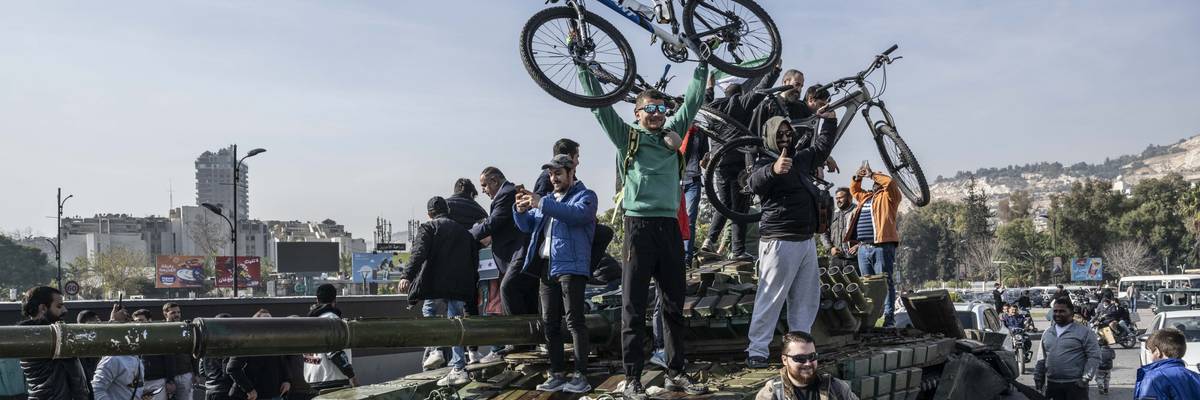
People celebrate the collapse of 61 years of Baath Party rule with the Syrian opposition's “revolution flag” at Umayyad Square after armed groups, opposing Syria's Bashar al-Assad regime, take control in Damascus, Syria on December 9, 2024.
After decades of oppression and 14 years of war, it will take much more to heal these wounds and guarantee a new era of freedom, justice, prosperity, and reconciliation.
Syria, known throughout history as the “crossroads of civilization,” now finds itself at a crossroads of its own. After 54 years, the Assad family’s brutal dictatorship in Syria has finally ended.
“I never thought I’d live to see this day,” said my dad, who left Aleppo as a teenager. My parents grew up there.
After Bashar al-Assad fled to Russia, elated Syrians rejoiced in the streets. Moving videos emerged of political prisoners being freed after enduring decades of torture in the regime’s notorious prisons. The whereabouts of many still remain unknown.
In addition to respecting Syria’s territorial integrity and the aspirations of its people in a future government, the U.S. should immediately lift all sanctions on Syria to help with reconstruction and economic recovery.
Assad’s fall is undeniably worth celebrating—it’s a rare unifying force for a deeply fractured country. But after decades of oppression and 14 years of war, it will take much more to heal these wounds and guarantee a new era of freedom, justice, prosperity, and reconciliation.
The popular uprising for Syrian dignity that ignited in March 2011 was violently crushed by Assad and morphed into several proxy wars involving Russia, Iran, Israel, the U.S., Turkey, and numerous armed groups, including al Qaeda-linked terrorists.
Heinous war crimes and other human rights violations were committed by all parties throughout the war, which has killed over 350,000 people. In the world’s largest forced displacement crisis, over 13 million Syrians have either fled their country or have been displaced within its borders.
The war has damaged Syria’s infrastructure while Western sanctions have further shattered Syria’s economy. Poverty is widespread, and more than half of the population currently grapples with food insecurity.
Hayat Tahrir al-Sham (HTS), once allied with al Qaeda in Syria, was largely responsible for Assad’s overthrow on December 8. Designated by the U.S as a terrorist organization, HTS has its own track record of brutality in Syria. The rebel group’s leader, Abu Mohammed al-Jolani, founded the Al Nusra Front, once had ties to ISIS, and still has a $10 million U.S. bounty on his head.
Jolani has since renounced his ties with al Qaeda and recently said he supports religious pluralism in Syria. But it’s reasonable to be skeptical that HTS and its allies are now truly committed to freedom, justice, and human rights for all long-suffering Syrians.
Still, foreign occupation and intervention are antithetical to a sovereign and “free” Syria.
Following Assad’s fall, Israel has launched hundreds of airstrikes and unlawfully seized more territory beyond its illegal, 57-year occupation of Syria’s Golan Heights. Whether Turkey gives up occupied land in northern Syria also remains to be seen, especially if Syrian Kurds end up forming an autonomous region within the country.
Meanwhile, the U.S. military still occupies part of Syria, including the oil fields in the northeast, and it’s unclear when the U.S. will withdraw its remaining 900 soldiers. In addition to respecting Syria’s territorial integrity and the aspirations of its people in a future government, the U.S. should immediately lift all sanctions on Syria to help with reconstruction and economic recovery.
As a Syrian American, I try to remain hopeful as I think about my relatives in Aleppo, friends in Damascus, and the generous strangers who’ve taken care of me as their own when I’ve visited. I look forward to returning to a Syria where people can finally breathe, rebuild, and live in dignity. But I also fear for the future.
Syrians have always taken pride in their rich ethnic and religious diversity. An inclusive and democratic government that guarantees the equal rights of all Syrians is essential to ensuring that the country stays unified and doesn’t plunge into sectarian chaos. It would be tragic if one authoritarian ruler is replaced by another or the country becomes balkanized into armed factions.
While much remains uncertain and immense challenges are ahead, prioritizing the immediate needs of Syrians is a logical first step. And, more than anything else, we must ensure that the Syrian people are the ones who steer the destiny of a peaceful, post-war Syria that reflects their remarkable resilience, courage, hopes, and dreams.
Dear Common Dreams reader, It’s been nearly 30 years since I co-founded Common Dreams with my late wife, Lina Newhouser. We had the radical notion that journalism should serve the public good, not corporate profits. It was clear to us from the outset what it would take to build such a project. No paid advertisements. No corporate sponsors. No millionaire publisher telling us what to think or do. Many people said we wouldn't last a year, but we proved those doubters wrong. Together with a tremendous team of journalists and dedicated staff, we built an independent media outlet free from the constraints of profits and corporate control. Our mission has always been simple: To inform. To inspire. To ignite change for the common good. Building Common Dreams was not easy. Our survival was never guaranteed. When you take on the most powerful forces—Wall Street greed, fossil fuel industry destruction, Big Tech lobbyists, and uber-rich oligarchs who have spent billions upon billions rigging the economy and democracy in their favor—the only bulwark you have is supporters who believe in your work. But here’s the urgent message from me today. It's never been this bad out there. And it's never been this hard to keep us going. At the very moment Common Dreams is most needed, the threats we face are intensifying. We need your support now more than ever. We don't accept corporate advertising and never will. We don't have a paywall because we don't think people should be blocked from critical news based on their ability to pay. Everything we do is funded by the donations of readers like you. When everyone does the little they can afford, we are strong. But if that support retreats or dries up, so do we. Will you donate now to make sure Common Dreams not only survives but thrives? —Craig Brown, Co-founder |
Syria, known throughout history as the “crossroads of civilization,” now finds itself at a crossroads of its own. After 54 years, the Assad family’s brutal dictatorship in Syria has finally ended.
“I never thought I’d live to see this day,” said my dad, who left Aleppo as a teenager. My parents grew up there.
After Bashar al-Assad fled to Russia, elated Syrians rejoiced in the streets. Moving videos emerged of political prisoners being freed after enduring decades of torture in the regime’s notorious prisons. The whereabouts of many still remain unknown.
In addition to respecting Syria’s territorial integrity and the aspirations of its people in a future government, the U.S. should immediately lift all sanctions on Syria to help with reconstruction and economic recovery.
Assad’s fall is undeniably worth celebrating—it’s a rare unifying force for a deeply fractured country. But after decades of oppression and 14 years of war, it will take much more to heal these wounds and guarantee a new era of freedom, justice, prosperity, and reconciliation.
The popular uprising for Syrian dignity that ignited in March 2011 was violently crushed by Assad and morphed into several proxy wars involving Russia, Iran, Israel, the U.S., Turkey, and numerous armed groups, including al Qaeda-linked terrorists.
Heinous war crimes and other human rights violations were committed by all parties throughout the war, which has killed over 350,000 people. In the world’s largest forced displacement crisis, over 13 million Syrians have either fled their country or have been displaced within its borders.
The war has damaged Syria’s infrastructure while Western sanctions have further shattered Syria’s economy. Poverty is widespread, and more than half of the population currently grapples with food insecurity.
Hayat Tahrir al-Sham (HTS), once allied with al Qaeda in Syria, was largely responsible for Assad’s overthrow on December 8. Designated by the U.S as a terrorist organization, HTS has its own track record of brutality in Syria. The rebel group’s leader, Abu Mohammed al-Jolani, founded the Al Nusra Front, once had ties to ISIS, and still has a $10 million U.S. bounty on his head.
Jolani has since renounced his ties with al Qaeda and recently said he supports religious pluralism in Syria. But it’s reasonable to be skeptical that HTS and its allies are now truly committed to freedom, justice, and human rights for all long-suffering Syrians.
Still, foreign occupation and intervention are antithetical to a sovereign and “free” Syria.
Following Assad’s fall, Israel has launched hundreds of airstrikes and unlawfully seized more territory beyond its illegal, 57-year occupation of Syria’s Golan Heights. Whether Turkey gives up occupied land in northern Syria also remains to be seen, especially if Syrian Kurds end up forming an autonomous region within the country.
Meanwhile, the U.S. military still occupies part of Syria, including the oil fields in the northeast, and it’s unclear when the U.S. will withdraw its remaining 900 soldiers. In addition to respecting Syria’s territorial integrity and the aspirations of its people in a future government, the U.S. should immediately lift all sanctions on Syria to help with reconstruction and economic recovery.
As a Syrian American, I try to remain hopeful as I think about my relatives in Aleppo, friends in Damascus, and the generous strangers who’ve taken care of me as their own when I’ve visited. I look forward to returning to a Syria where people can finally breathe, rebuild, and live in dignity. But I also fear for the future.
Syrians have always taken pride in their rich ethnic and religious diversity. An inclusive and democratic government that guarantees the equal rights of all Syrians is essential to ensuring that the country stays unified and doesn’t plunge into sectarian chaos. It would be tragic if one authoritarian ruler is replaced by another or the country becomes balkanized into armed factions.
While much remains uncertain and immense challenges are ahead, prioritizing the immediate needs of Syrians is a logical first step. And, more than anything else, we must ensure that the Syrian people are the ones who steer the destiny of a peaceful, post-war Syria that reflects their remarkable resilience, courage, hopes, and dreams.
Syria, known throughout history as the “crossroads of civilization,” now finds itself at a crossroads of its own. After 54 years, the Assad family’s brutal dictatorship in Syria has finally ended.
“I never thought I’d live to see this day,” said my dad, who left Aleppo as a teenager. My parents grew up there.
After Bashar al-Assad fled to Russia, elated Syrians rejoiced in the streets. Moving videos emerged of political prisoners being freed after enduring decades of torture in the regime’s notorious prisons. The whereabouts of many still remain unknown.
In addition to respecting Syria’s territorial integrity and the aspirations of its people in a future government, the U.S. should immediately lift all sanctions on Syria to help with reconstruction and economic recovery.
Assad’s fall is undeniably worth celebrating—it’s a rare unifying force for a deeply fractured country. But after decades of oppression and 14 years of war, it will take much more to heal these wounds and guarantee a new era of freedom, justice, prosperity, and reconciliation.
The popular uprising for Syrian dignity that ignited in March 2011 was violently crushed by Assad and morphed into several proxy wars involving Russia, Iran, Israel, the U.S., Turkey, and numerous armed groups, including al Qaeda-linked terrorists.
Heinous war crimes and other human rights violations were committed by all parties throughout the war, which has killed over 350,000 people. In the world’s largest forced displacement crisis, over 13 million Syrians have either fled their country or have been displaced within its borders.
The war has damaged Syria’s infrastructure while Western sanctions have further shattered Syria’s economy. Poverty is widespread, and more than half of the population currently grapples with food insecurity.
Hayat Tahrir al-Sham (HTS), once allied with al Qaeda in Syria, was largely responsible for Assad’s overthrow on December 8. Designated by the U.S as a terrorist organization, HTS has its own track record of brutality in Syria. The rebel group’s leader, Abu Mohammed al-Jolani, founded the Al Nusra Front, once had ties to ISIS, and still has a $10 million U.S. bounty on his head.
Jolani has since renounced his ties with al Qaeda and recently said he supports religious pluralism in Syria. But it’s reasonable to be skeptical that HTS and its allies are now truly committed to freedom, justice, and human rights for all long-suffering Syrians.
Still, foreign occupation and intervention are antithetical to a sovereign and “free” Syria.
Following Assad’s fall, Israel has launched hundreds of airstrikes and unlawfully seized more territory beyond its illegal, 57-year occupation of Syria’s Golan Heights. Whether Turkey gives up occupied land in northern Syria also remains to be seen, especially if Syrian Kurds end up forming an autonomous region within the country.
Meanwhile, the U.S. military still occupies part of Syria, including the oil fields in the northeast, and it’s unclear when the U.S. will withdraw its remaining 900 soldiers. In addition to respecting Syria’s territorial integrity and the aspirations of its people in a future government, the U.S. should immediately lift all sanctions on Syria to help with reconstruction and economic recovery.
As a Syrian American, I try to remain hopeful as I think about my relatives in Aleppo, friends in Damascus, and the generous strangers who’ve taken care of me as their own when I’ve visited. I look forward to returning to a Syria where people can finally breathe, rebuild, and live in dignity. But I also fear for the future.
Syrians have always taken pride in their rich ethnic and religious diversity. An inclusive and democratic government that guarantees the equal rights of all Syrians is essential to ensuring that the country stays unified and doesn’t plunge into sectarian chaos. It would be tragic if one authoritarian ruler is replaced by another or the country becomes balkanized into armed factions.
While much remains uncertain and immense challenges are ahead, prioritizing the immediate needs of Syrians is a logical first step. And, more than anything else, we must ensure that the Syrian people are the ones who steer the destiny of a peaceful, post-war Syria that reflects their remarkable resilience, courage, hopes, and dreams.