SUBSCRIBE TO OUR FREE NEWSLETTER
Daily news & progressive opinion—funded by the people, not the corporations—delivered straight to your inbox.
5
#000000
#FFFFFF
To donate by check, phone, or other method, see our More Ways to Give page.
Daily news & progressive opinion—funded by the people, not the corporations—delivered straight to your inbox.
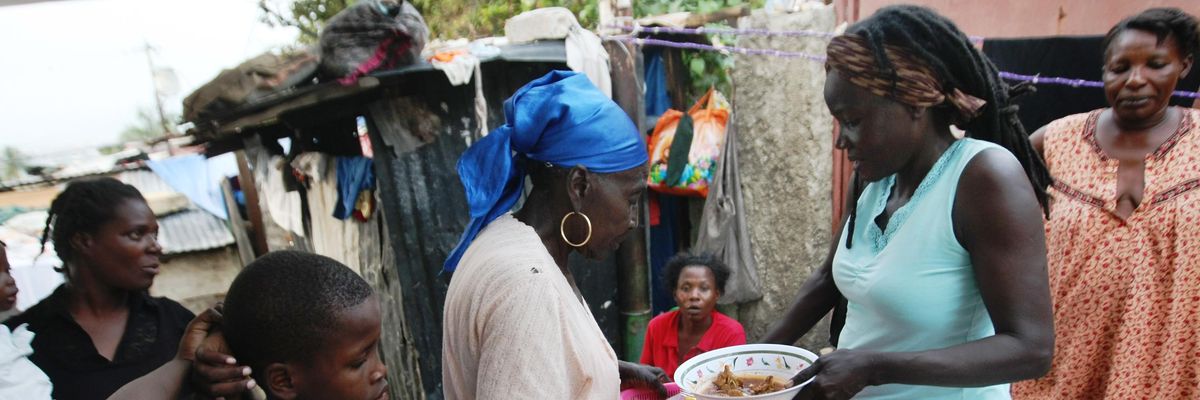
Women distribute aid in Haiti.
It’s necessary that the international community, especially the United States, works according to the needs emphasized by grassroots women’s organizations and civil society.
The recent waves of gang violence in Haiti, that have plagued the island since February 2024, have plunged it into another major humanitarian crisis. As reported by the United Nations Human Rights Council, the violence has been centered in Port-au-Prince and other areas in the Ouest and Artibonite Departments, but the reduced access to food, healthcare services, and general economic strain due to gang violence are being felt across the departments. With increasing armed violence events, 700,000 internally displaced people, almost 5 million people facing acute food insecurity, and only 28% of functioning healthcare services available, daily life and public safety continue to erode at a rapid pace. This is especially true for women and girls.
Lack of access to the formal economy, enduring threats of public violence, and lack of adequate protections from natural disasters make it exceedingly difficult for women and girls to safely navigate city and nation-wide emergencies. Such emergencies exacerbate the other substandard conditions of education, health, legal protections against gender-based violence, and political participation of Haitian women and girls. Historically, the Haitian women’s movement and feminist activists have provided essential educational resources, legal support services, and platforms for women’s stories to be heard and this political advocacy continues during the present violence.
Haitian women’s feminist groups developed the Policy Framework for an Effective and Equitable Transition. This document highlights the legal rights of Haitian women and girls established in the Haitian Constitution, the oppression Haitian women and girls endure in private and public life as well as recommendations on how the Presidential Transitional Council (TPC) should amend proposed harmful policies already set to be put in place. This Policy Framework is part of the rich legacy of political action taken by Haitian women and feminists since the emancipation of the island from French colonial rule. Haitian feminist activists and civil society leaders have time and time again shown up for their community on the ground during natural disasters and fighting against normalized gendered violence and discrimination. In this moment, they are pushing forward this Policy Framework to display the link between a successful democracy and gender equality.
The United States and other Western countries have a clear responsibility to materially support a locally-led stabilization of Haiti that effectively addresses the needs of all Haitian citizens.
Gang violence in Haiti isn’t a new phenomenon. Throughout the country’s history, the Haitian government relied on armed gangs to assert their authority and maintain power because there was no strong military or police presence. However, the type of armed brutality evident today is a result of the rapidly decaying relationship between Haitian politicians and armed gangs following the assassination of President Jovenel Moïse. Moreover, the armed power of these gangs, which has continued to overpower the Haitian National Police and the MSS mission, is primarily sustained by U.S. weapons sales into the country. The transitional government’s attempts to regain control and establish a stable democracy are failing to address the needs of Haitian women, expressly in this current crisis.
On the Transitional Presidential Council, its Haitian women’s groups have reported that of the nine members only one is a woman and she is one of two members who are unable to vote. In the newly established commission on criminal reform, the same pattern emerges—one woman to eight male members. The intention to restrict women in positions of political authority is cemented by the fact that during the search for an interim prime minister, there were no women invited to interview.
These patterns are dangerous because they directly undermine standards of gender equality established explicitly in the Haitian Constitution, where women are assured to hold at least 30% of political positions. Moreover, the few women that are granted access to political positions in the new government are not representatives of the women’s movement, which threatens to conceal the most pressing issues of Haitian women and girls and thus fail to adequately protect them. This is concerning because It’s been reported that women’s representation as leaders in peace processes is vital in developing sustainable peace agreements and post-conflict stability that create more just futures for the entirety of civil society.
It’s necessary that the international community, especially the United States, works according to the needs emphasized by grassroots women’s organizations and civil society. Prior international efforts meant to ease hardship in Haiti have worked to only make it worse. Decades of violent U.S. occupation, the unjust imposition of international debt from France, careless and corrupt U.N. peacekeeper missions, the destabilization of rice productions and the resulting economic fragility, along with current arms sales from the U.S., have helped create the Haiti we see today.
Because of this history, the United States and other Western countries have a clear responsibility to materially support a locally-led stabilization of Haiti that effectively addresses the needs of all Haitian citizens. Supporting Haitian feminist’s efforts such as the Policy Framework is the first step to respecting the lived experiences of people at the center of conflict and in remedying this historic violence.
Dear Common Dreams reader, It’s been nearly 30 years since I co-founded Common Dreams with my late wife, Lina Newhouser. We had the radical notion that journalism should serve the public good, not corporate profits. It was clear to us from the outset what it would take to build such a project. No paid advertisements. No corporate sponsors. No millionaire publisher telling us what to think or do. Many people said we wouldn't last a year, but we proved those doubters wrong. Together with a tremendous team of journalists and dedicated staff, we built an independent media outlet free from the constraints of profits and corporate control. Our mission has always been simple: To inform. To inspire. To ignite change for the common good. Building Common Dreams was not easy. Our survival was never guaranteed. When you take on the most powerful forces—Wall Street greed, fossil fuel industry destruction, Big Tech lobbyists, and uber-rich oligarchs who have spent billions upon billions rigging the economy and democracy in their favor—the only bulwark you have is supporters who believe in your work. But here’s the urgent message from me today. It's never been this bad out there. And it's never been this hard to keep us going. At the very moment Common Dreams is most needed, the threats we face are intensifying. We need your support now more than ever. We don't accept corporate advertising and never will. We don't have a paywall because we don't think people should be blocked from critical news based on their ability to pay. Everything we do is funded by the donations of readers like you. When everyone does the little they can afford, we are strong. But if that support retreats or dries up, so do we. Will you donate now to make sure Common Dreams not only survives but thrives? —Craig Brown, Co-founder |
The recent waves of gang violence in Haiti, that have plagued the island since February 2024, have plunged it into another major humanitarian crisis. As reported by the United Nations Human Rights Council, the violence has been centered in Port-au-Prince and other areas in the Ouest and Artibonite Departments, but the reduced access to food, healthcare services, and general economic strain due to gang violence are being felt across the departments. With increasing armed violence events, 700,000 internally displaced people, almost 5 million people facing acute food insecurity, and only 28% of functioning healthcare services available, daily life and public safety continue to erode at a rapid pace. This is especially true for women and girls.
Lack of access to the formal economy, enduring threats of public violence, and lack of adequate protections from natural disasters make it exceedingly difficult for women and girls to safely navigate city and nation-wide emergencies. Such emergencies exacerbate the other substandard conditions of education, health, legal protections against gender-based violence, and political participation of Haitian women and girls. Historically, the Haitian women’s movement and feminist activists have provided essential educational resources, legal support services, and platforms for women’s stories to be heard and this political advocacy continues during the present violence.
Haitian women’s feminist groups developed the Policy Framework for an Effective and Equitable Transition. This document highlights the legal rights of Haitian women and girls established in the Haitian Constitution, the oppression Haitian women and girls endure in private and public life as well as recommendations on how the Presidential Transitional Council (TPC) should amend proposed harmful policies already set to be put in place. This Policy Framework is part of the rich legacy of political action taken by Haitian women and feminists since the emancipation of the island from French colonial rule. Haitian feminist activists and civil society leaders have time and time again shown up for their community on the ground during natural disasters and fighting against normalized gendered violence and discrimination. In this moment, they are pushing forward this Policy Framework to display the link between a successful democracy and gender equality.
The United States and other Western countries have a clear responsibility to materially support a locally-led stabilization of Haiti that effectively addresses the needs of all Haitian citizens.
Gang violence in Haiti isn’t a new phenomenon. Throughout the country’s history, the Haitian government relied on armed gangs to assert their authority and maintain power because there was no strong military or police presence. However, the type of armed brutality evident today is a result of the rapidly decaying relationship between Haitian politicians and armed gangs following the assassination of President Jovenel Moïse. Moreover, the armed power of these gangs, which has continued to overpower the Haitian National Police and the MSS mission, is primarily sustained by U.S. weapons sales into the country. The transitional government’s attempts to regain control and establish a stable democracy are failing to address the needs of Haitian women, expressly in this current crisis.
On the Transitional Presidential Council, its Haitian women’s groups have reported that of the nine members only one is a woman and she is one of two members who are unable to vote. In the newly established commission on criminal reform, the same pattern emerges—one woman to eight male members. The intention to restrict women in positions of political authority is cemented by the fact that during the search for an interim prime minister, there were no women invited to interview.
These patterns are dangerous because they directly undermine standards of gender equality established explicitly in the Haitian Constitution, where women are assured to hold at least 30% of political positions. Moreover, the few women that are granted access to political positions in the new government are not representatives of the women’s movement, which threatens to conceal the most pressing issues of Haitian women and girls and thus fail to adequately protect them. This is concerning because It’s been reported that women’s representation as leaders in peace processes is vital in developing sustainable peace agreements and post-conflict stability that create more just futures for the entirety of civil society.
It’s necessary that the international community, especially the United States, works according to the needs emphasized by grassroots women’s organizations and civil society. Prior international efforts meant to ease hardship in Haiti have worked to only make it worse. Decades of violent U.S. occupation, the unjust imposition of international debt from France, careless and corrupt U.N. peacekeeper missions, the destabilization of rice productions and the resulting economic fragility, along with current arms sales from the U.S., have helped create the Haiti we see today.
Because of this history, the United States and other Western countries have a clear responsibility to materially support a locally-led stabilization of Haiti that effectively addresses the needs of all Haitian citizens. Supporting Haitian feminist’s efforts such as the Policy Framework is the first step to respecting the lived experiences of people at the center of conflict and in remedying this historic violence.
The recent waves of gang violence in Haiti, that have plagued the island since February 2024, have plunged it into another major humanitarian crisis. As reported by the United Nations Human Rights Council, the violence has been centered in Port-au-Prince and other areas in the Ouest and Artibonite Departments, but the reduced access to food, healthcare services, and general economic strain due to gang violence are being felt across the departments. With increasing armed violence events, 700,000 internally displaced people, almost 5 million people facing acute food insecurity, and only 28% of functioning healthcare services available, daily life and public safety continue to erode at a rapid pace. This is especially true for women and girls.
Lack of access to the formal economy, enduring threats of public violence, and lack of adequate protections from natural disasters make it exceedingly difficult for women and girls to safely navigate city and nation-wide emergencies. Such emergencies exacerbate the other substandard conditions of education, health, legal protections against gender-based violence, and political participation of Haitian women and girls. Historically, the Haitian women’s movement and feminist activists have provided essential educational resources, legal support services, and platforms for women’s stories to be heard and this political advocacy continues during the present violence.
Haitian women’s feminist groups developed the Policy Framework for an Effective and Equitable Transition. This document highlights the legal rights of Haitian women and girls established in the Haitian Constitution, the oppression Haitian women and girls endure in private and public life as well as recommendations on how the Presidential Transitional Council (TPC) should amend proposed harmful policies already set to be put in place. This Policy Framework is part of the rich legacy of political action taken by Haitian women and feminists since the emancipation of the island from French colonial rule. Haitian feminist activists and civil society leaders have time and time again shown up for their community on the ground during natural disasters and fighting against normalized gendered violence and discrimination. In this moment, they are pushing forward this Policy Framework to display the link between a successful democracy and gender equality.
The United States and other Western countries have a clear responsibility to materially support a locally-led stabilization of Haiti that effectively addresses the needs of all Haitian citizens.
Gang violence in Haiti isn’t a new phenomenon. Throughout the country’s history, the Haitian government relied on armed gangs to assert their authority and maintain power because there was no strong military or police presence. However, the type of armed brutality evident today is a result of the rapidly decaying relationship between Haitian politicians and armed gangs following the assassination of President Jovenel Moïse. Moreover, the armed power of these gangs, which has continued to overpower the Haitian National Police and the MSS mission, is primarily sustained by U.S. weapons sales into the country. The transitional government’s attempts to regain control and establish a stable democracy are failing to address the needs of Haitian women, expressly in this current crisis.
On the Transitional Presidential Council, its Haitian women’s groups have reported that of the nine members only one is a woman and she is one of two members who are unable to vote. In the newly established commission on criminal reform, the same pattern emerges—one woman to eight male members. The intention to restrict women in positions of political authority is cemented by the fact that during the search for an interim prime minister, there were no women invited to interview.
These patterns are dangerous because they directly undermine standards of gender equality established explicitly in the Haitian Constitution, where women are assured to hold at least 30% of political positions. Moreover, the few women that are granted access to political positions in the new government are not representatives of the women’s movement, which threatens to conceal the most pressing issues of Haitian women and girls and thus fail to adequately protect them. This is concerning because It’s been reported that women’s representation as leaders in peace processes is vital in developing sustainable peace agreements and post-conflict stability that create more just futures for the entirety of civil society.
It’s necessary that the international community, especially the United States, works according to the needs emphasized by grassroots women’s organizations and civil society. Prior international efforts meant to ease hardship in Haiti have worked to only make it worse. Decades of violent U.S. occupation, the unjust imposition of international debt from France, careless and corrupt U.N. peacekeeper missions, the destabilization of rice productions and the resulting economic fragility, along with current arms sales from the U.S., have helped create the Haiti we see today.
Because of this history, the United States and other Western countries have a clear responsibility to materially support a locally-led stabilization of Haiti that effectively addresses the needs of all Haitian citizens. Supporting Haitian feminist’s efforts such as the Policy Framework is the first step to respecting the lived experiences of people at the center of conflict and in remedying this historic violence.