SUBSCRIBE TO OUR FREE NEWSLETTER
Daily news & progressive opinion—funded by the people, not the corporations—delivered straight to your inbox.
5
#000000
#FFFFFF
To donate by check, phone, or other method, see our More Ways to Give page.
Daily news & progressive opinion—funded by the people, not the corporations—delivered straight to your inbox.
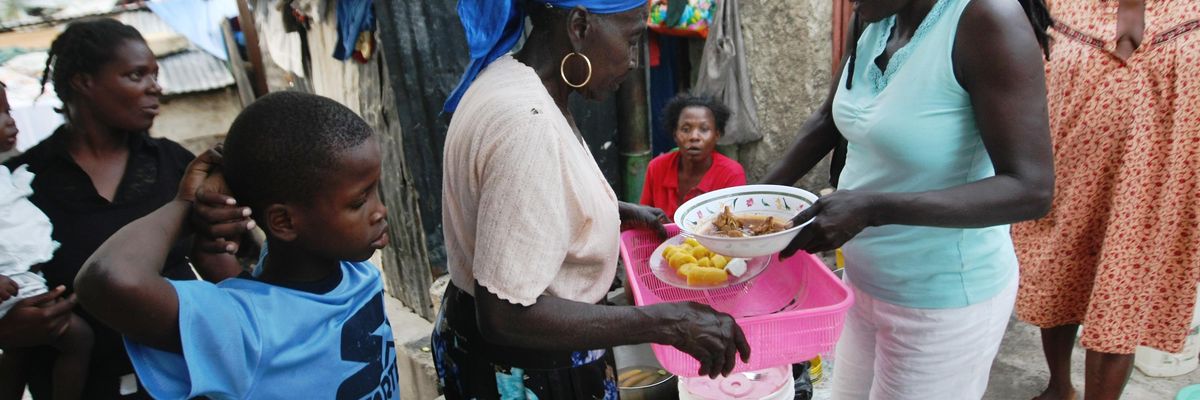
It's widely accepted that women-led provision of humanitarian relief is the best way to ensure that supplies reach those most in need. (Photo: Flickr/cc/United Nations Development Programme)
As Haiti experiences a surge of crises--political upheaval, an earthquake in August, tropical storms--we might ask ourselves what we can do to support people there whose lives have been upended. But the better question is: what does the world, and especially the US, owe to the Haitian people, as a matter of justice?
On July 7, President Jovenel Moise was assassinated, compounding political turmoil that predated his death. He had benefited from US support even as he tried to unlawfully extend his term and rewrite the constitution earlier this year. And the US still seems bent on manipulating Haiti's electoral future.
Recovery means Haitian sovereignty, and transforming the relationship between the US and Haiti from one of exploitation and extraction to reparations and justice.
Then, on August 14, southwestern Haiti was struck by a 7.2 magnitude earthquake. While the media paid only fleeting attention, tropical Storm Grace tore through the area only two days later, just as people were beginning to assess loss of life and damage from the earthquake.
We have also seen the unconscionable treatment of Haitian asylum seekers, including children, at the US-Mexico border, and the Biden Administration's heartless deportation of thousands of Haitians back to a country reeling from overlapping political, humanitarian, and human rights crises--crises that the US has helped to perpetuate for centuries.
We cannot forget that Haiti was born of the first successful revolt of Black enslaved people, and that the US and other world powers retaliated by isolating and punishing the country and its people. The US military occupied Haiti for almost two decades in the early 20th century, forced illegitimate debt payments that crushed Haiti's economy, decimated Haitian farmers through unfair agricultural policies, and interfered in democratic processes.
To repair this ugly history, we must take action to support Haitian grassroots feminists and other progressive social movement actors who are sustaining their communities and demanding more just policies toward their country.
Taking Action in Haiti
MADRE, the global feminist fund and women's human rights organization I direct, has partnered with Haitian feminists for decades. We began working with local women's organizations in 1994, during the US-backed coup d'etat against Haiti's first democratically elected President. We helped our partners document and prosecute cases of political and sexual violence committed to enforce the coup. Since then, we have supported anti-violence programs and women's campaigns to change laws on gender-based violence.
After the 2010 earthquake, we sent aid to on-the-ground groups who could channel support directly to those made most vulnerable by the disaster, including women and LGBTIQ+ people. Today, it's widely accepted that women-led provision of humanitarian relief is the best way to ensure that supplies reach those most in need.
When this year's earthquake struck, we reached out to our partners, the Haitian Women's Collective (HWC), a network of community-based organizations led by and for women and girls. We asked what they needed and they immediately named priorities that large international aid groups and governments often miss. Money to pay teachers, who would be vital community leads, was critical, they said. What's more, it was crucial to support a network of midwives who would continue to assist in births and provide sexual and reproductive health care.
The members of HWC also thought about how to connect emergency relief to long-term recovery and sustainability. We focused on sourcing humanitarian food aid from Haitian women farmers and women-led businesses. That's especially critical in a country that's been overrun by foreign nonprofits. Too often, these groups perpetuate an international aid system that benefits industrial agriculture and aid organizations in rich countries while undermining local economies.
"We need partners that offer solidarity, not aid dependency," says Carine Jocelyn of HWC. "We want to bring about meaningful change that will strengthen the sovereignty of the Haitian people. We want to transform the conditions--often a direct result of harmful US policies--that put Haitians at risk to begin with. That's why we advocate for policies that would produce accountability for aid dollars, and ensure more just immigration procedures and a halt to deportations. Unless we can create space for Haitian voices, especially women's voices, in policies that affect them, Haiti will continue to suffer. For true recovery to happen, the US must take responsibility for some of the abusive conditions in Haiti."
Genuine recovery, Carine noted, will require long-term solutions to the humanitarian, political, economic, climate, and human rights crises that Haiti faces. Recovery means Haitian sovereignty, and transforming the relationship between the US and Haiti from one of exploitation and extraction to reparations and justice.
Indeed, grassroots organizations led by and for women, girls, and LGBTIQ+ Haitians are best positioned to understand and address the immediate needs of their communities grappling with ongoing humanitarian and human rights disasters. But they are equally well-positioned to know what it takes to bring about a just, inclusive, and sustainable future for Haiti. It is their vision that we must trust. It is their lead that we must finally follow.
Dear Common Dreams reader, It’s been nearly 30 years since I co-founded Common Dreams with my late wife, Lina Newhouser. We had the radical notion that journalism should serve the public good, not corporate profits. It was clear to us from the outset what it would take to build such a project. No paid advertisements. No corporate sponsors. No millionaire publisher telling us what to think or do. Many people said we wouldn't last a year, but we proved those doubters wrong. Together with a tremendous team of journalists and dedicated staff, we built an independent media outlet free from the constraints of profits and corporate control. Our mission has always been simple: To inform. To inspire. To ignite change for the common good. Building Common Dreams was not easy. Our survival was never guaranteed. When you take on the most powerful forces—Wall Street greed, fossil fuel industry destruction, Big Tech lobbyists, and uber-rich oligarchs who have spent billions upon billions rigging the economy and democracy in their favor—the only bulwark you have is supporters who believe in your work. But here’s the urgent message from me today. It's never been this bad out there. And it's never been this hard to keep us going. At the very moment Common Dreams is most needed, the threats we face are intensifying. We need your support now more than ever. We don't accept corporate advertising and never will. We don't have a paywall because we don't think people should be blocked from critical news based on their ability to pay. Everything we do is funded by the donations of readers like you. When everyone does the little they can afford, we are strong. But if that support retreats or dries up, so do we. Will you donate now to make sure Common Dreams not only survives but thrives? —Craig Brown, Co-founder |
As Haiti experiences a surge of crises--political upheaval, an earthquake in August, tropical storms--we might ask ourselves what we can do to support people there whose lives have been upended. But the better question is: what does the world, and especially the US, owe to the Haitian people, as a matter of justice?
On July 7, President Jovenel Moise was assassinated, compounding political turmoil that predated his death. He had benefited from US support even as he tried to unlawfully extend his term and rewrite the constitution earlier this year. And the US still seems bent on manipulating Haiti's electoral future.
Recovery means Haitian sovereignty, and transforming the relationship between the US and Haiti from one of exploitation and extraction to reparations and justice.
Then, on August 14, southwestern Haiti was struck by a 7.2 magnitude earthquake. While the media paid only fleeting attention, tropical Storm Grace tore through the area only two days later, just as people were beginning to assess loss of life and damage from the earthquake.
We have also seen the unconscionable treatment of Haitian asylum seekers, including children, at the US-Mexico border, and the Biden Administration's heartless deportation of thousands of Haitians back to a country reeling from overlapping political, humanitarian, and human rights crises--crises that the US has helped to perpetuate for centuries.
We cannot forget that Haiti was born of the first successful revolt of Black enslaved people, and that the US and other world powers retaliated by isolating and punishing the country and its people. The US military occupied Haiti for almost two decades in the early 20th century, forced illegitimate debt payments that crushed Haiti's economy, decimated Haitian farmers through unfair agricultural policies, and interfered in democratic processes.
To repair this ugly history, we must take action to support Haitian grassroots feminists and other progressive social movement actors who are sustaining their communities and demanding more just policies toward their country.
Taking Action in Haiti
MADRE, the global feminist fund and women's human rights organization I direct, has partnered with Haitian feminists for decades. We began working with local women's organizations in 1994, during the US-backed coup d'etat against Haiti's first democratically elected President. We helped our partners document and prosecute cases of political and sexual violence committed to enforce the coup. Since then, we have supported anti-violence programs and women's campaigns to change laws on gender-based violence.
After the 2010 earthquake, we sent aid to on-the-ground groups who could channel support directly to those made most vulnerable by the disaster, including women and LGBTIQ+ people. Today, it's widely accepted that women-led provision of humanitarian relief is the best way to ensure that supplies reach those most in need.
When this year's earthquake struck, we reached out to our partners, the Haitian Women's Collective (HWC), a network of community-based organizations led by and for women and girls. We asked what they needed and they immediately named priorities that large international aid groups and governments often miss. Money to pay teachers, who would be vital community leads, was critical, they said. What's more, it was crucial to support a network of midwives who would continue to assist in births and provide sexual and reproductive health care.
The members of HWC also thought about how to connect emergency relief to long-term recovery and sustainability. We focused on sourcing humanitarian food aid from Haitian women farmers and women-led businesses. That's especially critical in a country that's been overrun by foreign nonprofits. Too often, these groups perpetuate an international aid system that benefits industrial agriculture and aid organizations in rich countries while undermining local economies.
"We need partners that offer solidarity, not aid dependency," says Carine Jocelyn of HWC. "We want to bring about meaningful change that will strengthen the sovereignty of the Haitian people. We want to transform the conditions--often a direct result of harmful US policies--that put Haitians at risk to begin with. That's why we advocate for policies that would produce accountability for aid dollars, and ensure more just immigration procedures and a halt to deportations. Unless we can create space for Haitian voices, especially women's voices, in policies that affect them, Haiti will continue to suffer. For true recovery to happen, the US must take responsibility for some of the abusive conditions in Haiti."
Genuine recovery, Carine noted, will require long-term solutions to the humanitarian, political, economic, climate, and human rights crises that Haiti faces. Recovery means Haitian sovereignty, and transforming the relationship between the US and Haiti from one of exploitation and extraction to reparations and justice.
Indeed, grassroots organizations led by and for women, girls, and LGBTIQ+ Haitians are best positioned to understand and address the immediate needs of their communities grappling with ongoing humanitarian and human rights disasters. But they are equally well-positioned to know what it takes to bring about a just, inclusive, and sustainable future for Haiti. It is their vision that we must trust. It is their lead that we must finally follow.
As Haiti experiences a surge of crises--political upheaval, an earthquake in August, tropical storms--we might ask ourselves what we can do to support people there whose lives have been upended. But the better question is: what does the world, and especially the US, owe to the Haitian people, as a matter of justice?
On July 7, President Jovenel Moise was assassinated, compounding political turmoil that predated his death. He had benefited from US support even as he tried to unlawfully extend his term and rewrite the constitution earlier this year. And the US still seems bent on manipulating Haiti's electoral future.
Recovery means Haitian sovereignty, and transforming the relationship between the US and Haiti from one of exploitation and extraction to reparations and justice.
Then, on August 14, southwestern Haiti was struck by a 7.2 magnitude earthquake. While the media paid only fleeting attention, tropical Storm Grace tore through the area only two days later, just as people were beginning to assess loss of life and damage from the earthquake.
We have also seen the unconscionable treatment of Haitian asylum seekers, including children, at the US-Mexico border, and the Biden Administration's heartless deportation of thousands of Haitians back to a country reeling from overlapping political, humanitarian, and human rights crises--crises that the US has helped to perpetuate for centuries.
We cannot forget that Haiti was born of the first successful revolt of Black enslaved people, and that the US and other world powers retaliated by isolating and punishing the country and its people. The US military occupied Haiti for almost two decades in the early 20th century, forced illegitimate debt payments that crushed Haiti's economy, decimated Haitian farmers through unfair agricultural policies, and interfered in democratic processes.
To repair this ugly history, we must take action to support Haitian grassroots feminists and other progressive social movement actors who are sustaining their communities and demanding more just policies toward their country.
Taking Action in Haiti
MADRE, the global feminist fund and women's human rights organization I direct, has partnered with Haitian feminists for decades. We began working with local women's organizations in 1994, during the US-backed coup d'etat against Haiti's first democratically elected President. We helped our partners document and prosecute cases of political and sexual violence committed to enforce the coup. Since then, we have supported anti-violence programs and women's campaigns to change laws on gender-based violence.
After the 2010 earthquake, we sent aid to on-the-ground groups who could channel support directly to those made most vulnerable by the disaster, including women and LGBTIQ+ people. Today, it's widely accepted that women-led provision of humanitarian relief is the best way to ensure that supplies reach those most in need.
When this year's earthquake struck, we reached out to our partners, the Haitian Women's Collective (HWC), a network of community-based organizations led by and for women and girls. We asked what they needed and they immediately named priorities that large international aid groups and governments often miss. Money to pay teachers, who would be vital community leads, was critical, they said. What's more, it was crucial to support a network of midwives who would continue to assist in births and provide sexual and reproductive health care.
The members of HWC also thought about how to connect emergency relief to long-term recovery and sustainability. We focused on sourcing humanitarian food aid from Haitian women farmers and women-led businesses. That's especially critical in a country that's been overrun by foreign nonprofits. Too often, these groups perpetuate an international aid system that benefits industrial agriculture and aid organizations in rich countries while undermining local economies.
"We need partners that offer solidarity, not aid dependency," says Carine Jocelyn of HWC. "We want to bring about meaningful change that will strengthen the sovereignty of the Haitian people. We want to transform the conditions--often a direct result of harmful US policies--that put Haitians at risk to begin with. That's why we advocate for policies that would produce accountability for aid dollars, and ensure more just immigration procedures and a halt to deportations. Unless we can create space for Haitian voices, especially women's voices, in policies that affect them, Haiti will continue to suffer. For true recovery to happen, the US must take responsibility for some of the abusive conditions in Haiti."
Genuine recovery, Carine noted, will require long-term solutions to the humanitarian, political, economic, climate, and human rights crises that Haiti faces. Recovery means Haitian sovereignty, and transforming the relationship between the US and Haiti from one of exploitation and extraction to reparations and justice.
Indeed, grassroots organizations led by and for women, girls, and LGBTIQ+ Haitians are best positioned to understand and address the immediate needs of their communities grappling with ongoing humanitarian and human rights disasters. But they are equally well-positioned to know what it takes to bring about a just, inclusive, and sustainable future for Haiti. It is their vision that we must trust. It is their lead that we must finally follow.