SUBSCRIBE TO OUR FREE NEWSLETTER
Daily news & progressive opinion—funded by the people, not the corporations—delivered straight to your inbox.
5
#000000
#FFFFFF
To donate by check, phone, or other method, see our More Ways to Give page.
Daily news & progressive opinion—funded by the people, not the corporations—delivered straight to your inbox.
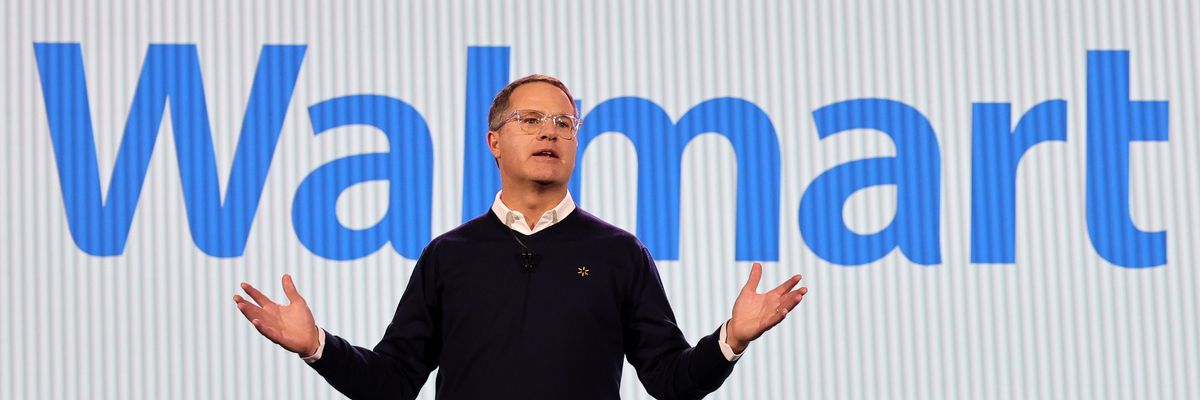
Walmart president and CEO Doug McMillon delivers a keynote address during an event on January 9, 2024 in Las Vegas, Nevada.
"There's nothing to be gained for everyday Americans by doubling down on the Trump corporate tax breaks—a historic mistake that added trillions to the deficit while threatening critical priorities like Social Security and Medicare."
The 15 largest corporate beneficiaries of former President Donald Trump's 2017 tax law have dumped a combined $839 billion into executive-enriching stock buybacks and dividends since the measure's passage, according to research released Wednesday by the progressive watchdog group Accountable.US.
The new analysis, which cites figures from the Institute on Taxation and Economic Policy, was published amid an ongoing congressional debate over whether to extend elements of the 2017 law that are set to expire at the end of next year. It also comes as Trump, the Republican presidential nominee, is campaigning on a fresh round of tax cuts for the wealthy and large corporations.
Republican lawmakers, bolstered by an army of corporate lobbyists, have signaled that they are prepared to quickly ram through new tax breaks if Trump wins the presidency and the GOP secures control of the House and Senate in next month's election.
Vice President Kamala Harris, the Democratic nominee, has proposed raising the corporate tax rate from 21% to 28%.
"The biggest corporate winners of the Trump tax giveaway used their massive windfall mostly to pad profits and enrich a small group of wealthy investors instead of raising their workers' wages and lowering prices for consumers," Accountable.US president Caroline Ciccone said in a statement. "There's nothing to be gained for everyday Americans by doubling down on the Trump corporate tax breaks—a historic mistake that added trillions to the deficit while threatening critical priorities like Social Security and Medicare."
"It's time billionaires, wealthy tax cheats, and price-gouging corporations stop avoiding their fair share of taxes at the expense of everyone else," Ciccone added.
"The Trump administration's giant corporate tax cut mainly resulted in higher executive pay and massive shareholder payouts."
The 15 corporations examined in the new report are Verizon, Walmart, AT&T, Meta, Home Depot, Intel, Comcast, Walt Disney, Visa, Capital One Financial, Lockheed Martin, Amazon, Lowe's, United Parcel Service (UPS), and Texas Instruments.
Collectively, according to the Accountable.US report, those companies saw their profits surge by over $257 billion and have spent over $464 billion on stock buybacks and $374 billion on dividends since the passage of the Trump-GOP tax cuts. Large shareholder payouts in the form of share repurchases—which are on track for a new U.S. record in 2024—have been linked to mass layoffs.
In the years preceding enactment of the 2017 law, which cut the statutory corporate tax rate from 35% to 21%, the 15 corporations studied in the new analysis paid an average effective tax rate of 27%. In the four years following the law's passage, the companies paid an average effective rate of 13%.
Meanwhile, the substantial benefits that the law's boosters promised the U.S. working class have not materialized.
As the Center on Budget and Policy Priorities noted over the summer, "Trump administration officials claimed their centerpiece corporate tax rate cut would 'very conservatively' lead to a $4,000 boost in household income," but "research shows that workers who earned less than about $114,000 on average in 2016 saw 'no change in earnings' from the corporate tax rate cut, while top executive salaries increased sharply."
Bharat Ramamurti, former deputy director of the National Economic Council, said Wednesday that "instead of trickling down to higher wages for workers and producing a surge in business investment as they claimed at the time, the Trump administration's giant corporate tax cut mainly resulted in higher executive pay and massive shareholder payouts."
"It was a failed approach," said Ramamurti, "and Congress should use the expiration of key provisions of the Trump tax bill next year to bring in more revenue from corporations and the wealthy."
Dear Common Dreams reader, It’s been nearly 30 years since I co-founded Common Dreams with my late wife, Lina Newhouser. We had the radical notion that journalism should serve the public good, not corporate profits. It was clear to us from the outset what it would take to build such a project. No paid advertisements. No corporate sponsors. No millionaire publisher telling us what to think or do. Many people said we wouldn't last a year, but we proved those doubters wrong. Together with a tremendous team of journalists and dedicated staff, we built an independent media outlet free from the constraints of profits and corporate control. Our mission has always been simple: To inform. To inspire. To ignite change for the common good. Building Common Dreams was not easy. Our survival was never guaranteed. When you take on the most powerful forces—Wall Street greed, fossil fuel industry destruction, Big Tech lobbyists, and uber-rich oligarchs who have spent billions upon billions rigging the economy and democracy in their favor—the only bulwark you have is supporters who believe in your work. But here’s the urgent message from me today. It's never been this bad out there. And it's never been this hard to keep us going. At the very moment Common Dreams is most needed, the threats we face are intensifying. We need your support now more than ever. We don't accept corporate advertising and never will. We don't have a paywall because we don't think people should be blocked from critical news based on their ability to pay. Everything we do is funded by the donations of readers like you. When everyone does the little they can afford, we are strong. But if that support retreats or dries up, so do we. Will you donate now to make sure Common Dreams not only survives but thrives? —Craig Brown, Co-founder |
The 15 largest corporate beneficiaries of former President Donald Trump's 2017 tax law have dumped a combined $839 billion into executive-enriching stock buybacks and dividends since the measure's passage, according to research released Wednesday by the progressive watchdog group Accountable.US.
The new analysis, which cites figures from the Institute on Taxation and Economic Policy, was published amid an ongoing congressional debate over whether to extend elements of the 2017 law that are set to expire at the end of next year. It also comes as Trump, the Republican presidential nominee, is campaigning on a fresh round of tax cuts for the wealthy and large corporations.
Republican lawmakers, bolstered by an army of corporate lobbyists, have signaled that they are prepared to quickly ram through new tax breaks if Trump wins the presidency and the GOP secures control of the House and Senate in next month's election.
Vice President Kamala Harris, the Democratic nominee, has proposed raising the corporate tax rate from 21% to 28%.
"The biggest corporate winners of the Trump tax giveaway used their massive windfall mostly to pad profits and enrich a small group of wealthy investors instead of raising their workers' wages and lowering prices for consumers," Accountable.US president Caroline Ciccone said in a statement. "There's nothing to be gained for everyday Americans by doubling down on the Trump corporate tax breaks—a historic mistake that added trillions to the deficit while threatening critical priorities like Social Security and Medicare."
"It's time billionaires, wealthy tax cheats, and price-gouging corporations stop avoiding their fair share of taxes at the expense of everyone else," Ciccone added.
"The Trump administration's giant corporate tax cut mainly resulted in higher executive pay and massive shareholder payouts."
The 15 corporations examined in the new report are Verizon, Walmart, AT&T, Meta, Home Depot, Intel, Comcast, Walt Disney, Visa, Capital One Financial, Lockheed Martin, Amazon, Lowe's, United Parcel Service (UPS), and Texas Instruments.
Collectively, according to the Accountable.US report, those companies saw their profits surge by over $257 billion and have spent over $464 billion on stock buybacks and $374 billion on dividends since the passage of the Trump-GOP tax cuts. Large shareholder payouts in the form of share repurchases—which are on track for a new U.S. record in 2024—have been linked to mass layoffs.
In the years preceding enactment of the 2017 law, which cut the statutory corporate tax rate from 35% to 21%, the 15 corporations studied in the new analysis paid an average effective tax rate of 27%. In the four years following the law's passage, the companies paid an average effective rate of 13%.
Meanwhile, the substantial benefits that the law's boosters promised the U.S. working class have not materialized.
As the Center on Budget and Policy Priorities noted over the summer, "Trump administration officials claimed their centerpiece corporate tax rate cut would 'very conservatively' lead to a $4,000 boost in household income," but "research shows that workers who earned less than about $114,000 on average in 2016 saw 'no change in earnings' from the corporate tax rate cut, while top executive salaries increased sharply."
Bharat Ramamurti, former deputy director of the National Economic Council, said Wednesday that "instead of trickling down to higher wages for workers and producing a surge in business investment as they claimed at the time, the Trump administration's giant corporate tax cut mainly resulted in higher executive pay and massive shareholder payouts."
"It was a failed approach," said Ramamurti, "and Congress should use the expiration of key provisions of the Trump tax bill next year to bring in more revenue from corporations and the wealthy."
The 15 largest corporate beneficiaries of former President Donald Trump's 2017 tax law have dumped a combined $839 billion into executive-enriching stock buybacks and dividends since the measure's passage, according to research released Wednesday by the progressive watchdog group Accountable.US.
The new analysis, which cites figures from the Institute on Taxation and Economic Policy, was published amid an ongoing congressional debate over whether to extend elements of the 2017 law that are set to expire at the end of next year. It also comes as Trump, the Republican presidential nominee, is campaigning on a fresh round of tax cuts for the wealthy and large corporations.
Republican lawmakers, bolstered by an army of corporate lobbyists, have signaled that they are prepared to quickly ram through new tax breaks if Trump wins the presidency and the GOP secures control of the House and Senate in next month's election.
Vice President Kamala Harris, the Democratic nominee, has proposed raising the corporate tax rate from 21% to 28%.
"The biggest corporate winners of the Trump tax giveaway used their massive windfall mostly to pad profits and enrich a small group of wealthy investors instead of raising their workers' wages and lowering prices for consumers," Accountable.US president Caroline Ciccone said in a statement. "There's nothing to be gained for everyday Americans by doubling down on the Trump corporate tax breaks—a historic mistake that added trillions to the deficit while threatening critical priorities like Social Security and Medicare."
"It's time billionaires, wealthy tax cheats, and price-gouging corporations stop avoiding their fair share of taxes at the expense of everyone else," Ciccone added.
"The Trump administration's giant corporate tax cut mainly resulted in higher executive pay and massive shareholder payouts."
The 15 corporations examined in the new report are Verizon, Walmart, AT&T, Meta, Home Depot, Intel, Comcast, Walt Disney, Visa, Capital One Financial, Lockheed Martin, Amazon, Lowe's, United Parcel Service (UPS), and Texas Instruments.
Collectively, according to the Accountable.US report, those companies saw their profits surge by over $257 billion and have spent over $464 billion on stock buybacks and $374 billion on dividends since the passage of the Trump-GOP tax cuts. Large shareholder payouts in the form of share repurchases—which are on track for a new U.S. record in 2024—have been linked to mass layoffs.
In the years preceding enactment of the 2017 law, which cut the statutory corporate tax rate from 35% to 21%, the 15 corporations studied in the new analysis paid an average effective tax rate of 27%. In the four years following the law's passage, the companies paid an average effective rate of 13%.
Meanwhile, the substantial benefits that the law's boosters promised the U.S. working class have not materialized.
As the Center on Budget and Policy Priorities noted over the summer, "Trump administration officials claimed their centerpiece corporate tax rate cut would 'very conservatively' lead to a $4,000 boost in household income," but "research shows that workers who earned less than about $114,000 on average in 2016 saw 'no change in earnings' from the corporate tax rate cut, while top executive salaries increased sharply."
Bharat Ramamurti, former deputy director of the National Economic Council, said Wednesday that "instead of trickling down to higher wages for workers and producing a surge in business investment as they claimed at the time, the Trump administration's giant corporate tax cut mainly resulted in higher executive pay and massive shareholder payouts."
"It was a failed approach," said Ramamurti, "and Congress should use the expiration of key provisions of the Trump tax bill next year to bring in more revenue from corporations and the wealthy."