SUBSCRIBE TO OUR FREE NEWSLETTER
Daily news & progressive opinion—funded by the people, not the corporations—delivered straight to your inbox.
5
#000000
#FFFFFF
To donate by check, phone, or other method, see our More Ways to Give page.
Daily news & progressive opinion—funded by the people, not the corporations—delivered straight to your inbox.
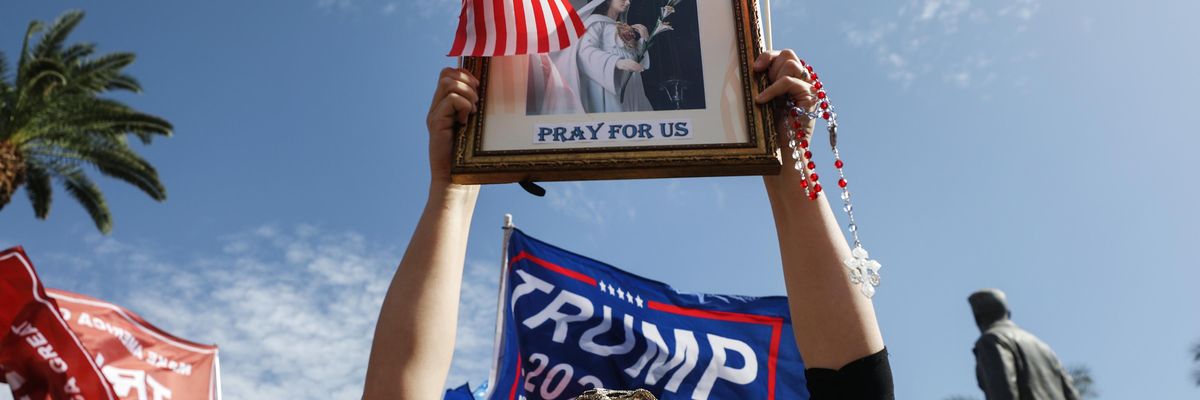
Trump supporters at a “Stop the Steal” rally in front of Arizona’s State Capitol in Phoenix after Biden reportedly won the election.
In 2020, the election deniers were improvisational and slapdash; now they are systematic, organized, and well funded.
How precisely will election deniers try to undermine the results in 2024? Will we see a rerun of 2020’s parade of falsehoods—rigged voting machines, USB drives masquerading as breath mints, and bamboo-laced ballots from China? Or will they premiere some new tricks this election season? One answer has come into sharper focus in recent weeks. Will our system be ready? That remains to be seen.
We all learned in 2020 that we do not have one election, or even 50 state elections. Decisions are made by hundreds of county boards and officials. Usually that is routine. Just after voting takes place, poll workers and local election officials begin a rigorous, multistep process to accurately determine the results. This is all “ministerial.” Two plus two equals four. We have a winner! The voters vote, the results are tabulated, you affirm the numbers, and you go home.
All of which points to Georgia, where alarms are ringing. Rogue officials there are already preparing the ground to ignore voters in November.
Election deniers have quietly infiltrated county boards across the country. In Nevada, one official in the state’s second-largest county recently refused to certify her own election. Stop the steal!
You may remember former U.S. President Donald Trump’s rally at Georgia State University on August 3. That was the speech in which he attacked Republican Gov. Brian Kemp, Secretary of State Brad Raffensperger, and, for good measure, Kemp’s wife. What was noteworthy, though, was the fellow Republicans he praised. He lauded three newly appointed members of the state election board. “They’re on fire. They are doing a great job,” he declared.
Three days later we learned why he was so effusive. The state officials announced a new rule to require county officials across Georgia to conduct a “reasonable inquiry” before they can certify results.
That is a permission slip for subversion. In May, a board member who oversees elections in Fulton County—home of Atlanta, the biggest Black-majority city in the state—refused to certify a primary result, and to press her case, she sued her own election board. It turned out she is an organizer for Cleta Mitchell, a participant in Trump’s notorious “I just want to find 11,780 votes” phone call to Raffensperger in January 2021.
Indeed, election deniers have quietly infiltrated county boards across the country. In Nevada, one official in the state’s second-largest county recently refused to certify her own election. Stop the steal!
Even before the new Georgia rule went into effect, the Brennan Center and other voting rights groups went to court to support advocates working to protect the vote in Fulton County. We represent the Georgia NAACP and the League of Women Voters of Georgia.
That’s the thing: When a county official refuses to certify the votes because of... vibes, it’s not just antidemocratic. It’s unlawful. The Georgia Supreme Court has repeatedly ruled that local officials don’t have a choice.
And for good reason. In the rough-and-tumble early years of our republic, elections were messy, and it was not uncommon for rogue local officials to interfere with certification to benefit their preferred candidate. Early American state courts and legislatures took notice. As my colleague Lauren Miller Karalunas explains in a widely cited law review article, they shaped election certification into a mandatory duty precisely so that officials like those in Fulton County couldn’t take election results into their own hands. In the prescient words of the Oklahoma Supreme Court in 1909, allowing local certifying officials to reopen election returns and investigate the election itself “would afford temptation and great opportunity for the commission of fraud.”
In 2020, the election deniers were improvisational and slapdash. Now they are systematic, organized, and well funded. Trump already falsely claims that millions of noncitizens are preparing to vote. House Speaker Mike Johnson (R-La.) asserts that “we all know, intuitively, that a lot of illegals are voting in federal elections. But,” he admits, “it’s not been something that is easily provable.” The House passed legislation purportedly cracking down on the nonexistent plague of noncitizen voting. All of this creates an atmosphere of suspicion and panic—the very vibes that can be exploited by unscrupulous officials to delay certification and derail the vote.
At his Georgia State rally, Trump praised the election officials as “pit bulls” who sought “victory.” It will be up to courts to stand up for something other than “victory”—democracy, fairness, and the rule of law.
Dear Common Dreams reader, It’s been nearly 30 years since I co-founded Common Dreams with my late wife, Lina Newhouser. We had the radical notion that journalism should serve the public good, not corporate profits. It was clear to us from the outset what it would take to build such a project. No paid advertisements. No corporate sponsors. No millionaire publisher telling us what to think or do. Many people said we wouldn't last a year, but we proved those doubters wrong. Together with a tremendous team of journalists and dedicated staff, we built an independent media outlet free from the constraints of profits and corporate control. Our mission has always been simple: To inform. To inspire. To ignite change for the common good. Building Common Dreams was not easy. Our survival was never guaranteed. When you take on the most powerful forces—Wall Street greed, fossil fuel industry destruction, Big Tech lobbyists, and uber-rich oligarchs who have spent billions upon billions rigging the economy and democracy in their favor—the only bulwark you have is supporters who believe in your work. But here’s the urgent message from me today. It's never been this bad out there. And it's never been this hard to keep us going. At the very moment Common Dreams is most needed, the threats we face are intensifying. We need your support now more than ever. We don't accept corporate advertising and never will. We don't have a paywall because we don't think people should be blocked from critical news based on their ability to pay. Everything we do is funded by the donations of readers like you. When everyone does the little they can afford, we are strong. But if that support retreats or dries up, so do we. Will you donate now to make sure Common Dreams not only survives but thrives? —Craig Brown, Co-founder |
How precisely will election deniers try to undermine the results in 2024? Will we see a rerun of 2020’s parade of falsehoods—rigged voting machines, USB drives masquerading as breath mints, and bamboo-laced ballots from China? Or will they premiere some new tricks this election season? One answer has come into sharper focus in recent weeks. Will our system be ready? That remains to be seen.
We all learned in 2020 that we do not have one election, or even 50 state elections. Decisions are made by hundreds of county boards and officials. Usually that is routine. Just after voting takes place, poll workers and local election officials begin a rigorous, multistep process to accurately determine the results. This is all “ministerial.” Two plus two equals four. We have a winner! The voters vote, the results are tabulated, you affirm the numbers, and you go home.
All of which points to Georgia, where alarms are ringing. Rogue officials there are already preparing the ground to ignore voters in November.
Election deniers have quietly infiltrated county boards across the country. In Nevada, one official in the state’s second-largest county recently refused to certify her own election. Stop the steal!
You may remember former U.S. President Donald Trump’s rally at Georgia State University on August 3. That was the speech in which he attacked Republican Gov. Brian Kemp, Secretary of State Brad Raffensperger, and, for good measure, Kemp’s wife. What was noteworthy, though, was the fellow Republicans he praised. He lauded three newly appointed members of the state election board. “They’re on fire. They are doing a great job,” he declared.
Three days later we learned why he was so effusive. The state officials announced a new rule to require county officials across Georgia to conduct a “reasonable inquiry” before they can certify results.
That is a permission slip for subversion. In May, a board member who oversees elections in Fulton County—home of Atlanta, the biggest Black-majority city in the state—refused to certify a primary result, and to press her case, she sued her own election board. It turned out she is an organizer for Cleta Mitchell, a participant in Trump’s notorious “I just want to find 11,780 votes” phone call to Raffensperger in January 2021.
Indeed, election deniers have quietly infiltrated county boards across the country. In Nevada, one official in the state’s second-largest county recently refused to certify her own election. Stop the steal!
Even before the new Georgia rule went into effect, the Brennan Center and other voting rights groups went to court to support advocates working to protect the vote in Fulton County. We represent the Georgia NAACP and the League of Women Voters of Georgia.
That’s the thing: When a county official refuses to certify the votes because of... vibes, it’s not just antidemocratic. It’s unlawful. The Georgia Supreme Court has repeatedly ruled that local officials don’t have a choice.
And for good reason. In the rough-and-tumble early years of our republic, elections were messy, and it was not uncommon for rogue local officials to interfere with certification to benefit their preferred candidate. Early American state courts and legislatures took notice. As my colleague Lauren Miller Karalunas explains in a widely cited law review article, they shaped election certification into a mandatory duty precisely so that officials like those in Fulton County couldn’t take election results into their own hands. In the prescient words of the Oklahoma Supreme Court in 1909, allowing local certifying officials to reopen election returns and investigate the election itself “would afford temptation and great opportunity for the commission of fraud.”
In 2020, the election deniers were improvisational and slapdash. Now they are systematic, organized, and well funded. Trump already falsely claims that millions of noncitizens are preparing to vote. House Speaker Mike Johnson (R-La.) asserts that “we all know, intuitively, that a lot of illegals are voting in federal elections. But,” he admits, “it’s not been something that is easily provable.” The House passed legislation purportedly cracking down on the nonexistent plague of noncitizen voting. All of this creates an atmosphere of suspicion and panic—the very vibes that can be exploited by unscrupulous officials to delay certification and derail the vote.
At his Georgia State rally, Trump praised the election officials as “pit bulls” who sought “victory.” It will be up to courts to stand up for something other than “victory”—democracy, fairness, and the rule of law.
How precisely will election deniers try to undermine the results in 2024? Will we see a rerun of 2020’s parade of falsehoods—rigged voting machines, USB drives masquerading as breath mints, and bamboo-laced ballots from China? Or will they premiere some new tricks this election season? One answer has come into sharper focus in recent weeks. Will our system be ready? That remains to be seen.
We all learned in 2020 that we do not have one election, or even 50 state elections. Decisions are made by hundreds of county boards and officials. Usually that is routine. Just after voting takes place, poll workers and local election officials begin a rigorous, multistep process to accurately determine the results. This is all “ministerial.” Two plus two equals four. We have a winner! The voters vote, the results are tabulated, you affirm the numbers, and you go home.
All of which points to Georgia, where alarms are ringing. Rogue officials there are already preparing the ground to ignore voters in November.
Election deniers have quietly infiltrated county boards across the country. In Nevada, one official in the state’s second-largest county recently refused to certify her own election. Stop the steal!
You may remember former U.S. President Donald Trump’s rally at Georgia State University on August 3. That was the speech in which he attacked Republican Gov. Brian Kemp, Secretary of State Brad Raffensperger, and, for good measure, Kemp’s wife. What was noteworthy, though, was the fellow Republicans he praised. He lauded three newly appointed members of the state election board. “They’re on fire. They are doing a great job,” he declared.
Three days later we learned why he was so effusive. The state officials announced a new rule to require county officials across Georgia to conduct a “reasonable inquiry” before they can certify results.
That is a permission slip for subversion. In May, a board member who oversees elections in Fulton County—home of Atlanta, the biggest Black-majority city in the state—refused to certify a primary result, and to press her case, she sued her own election board. It turned out she is an organizer for Cleta Mitchell, a participant in Trump’s notorious “I just want to find 11,780 votes” phone call to Raffensperger in January 2021.
Indeed, election deniers have quietly infiltrated county boards across the country. In Nevada, one official in the state’s second-largest county recently refused to certify her own election. Stop the steal!
Even before the new Georgia rule went into effect, the Brennan Center and other voting rights groups went to court to support advocates working to protect the vote in Fulton County. We represent the Georgia NAACP and the League of Women Voters of Georgia.
That’s the thing: When a county official refuses to certify the votes because of... vibes, it’s not just antidemocratic. It’s unlawful. The Georgia Supreme Court has repeatedly ruled that local officials don’t have a choice.
And for good reason. In the rough-and-tumble early years of our republic, elections were messy, and it was not uncommon for rogue local officials to interfere with certification to benefit their preferred candidate. Early American state courts and legislatures took notice. As my colleague Lauren Miller Karalunas explains in a widely cited law review article, they shaped election certification into a mandatory duty precisely so that officials like those in Fulton County couldn’t take election results into their own hands. In the prescient words of the Oklahoma Supreme Court in 1909, allowing local certifying officials to reopen election returns and investigate the election itself “would afford temptation and great opportunity for the commission of fraud.”
In 2020, the election deniers were improvisational and slapdash. Now they are systematic, organized, and well funded. Trump already falsely claims that millions of noncitizens are preparing to vote. House Speaker Mike Johnson (R-La.) asserts that “we all know, intuitively, that a lot of illegals are voting in federal elections. But,” he admits, “it’s not been something that is easily provable.” The House passed legislation purportedly cracking down on the nonexistent plague of noncitizen voting. All of this creates an atmosphere of suspicion and panic—the very vibes that can be exploited by unscrupulous officials to delay certification and derail the vote.
At his Georgia State rally, Trump praised the election officials as “pit bulls” who sought “victory.” It will be up to courts to stand up for something other than “victory”—democracy, fairness, and the rule of law.