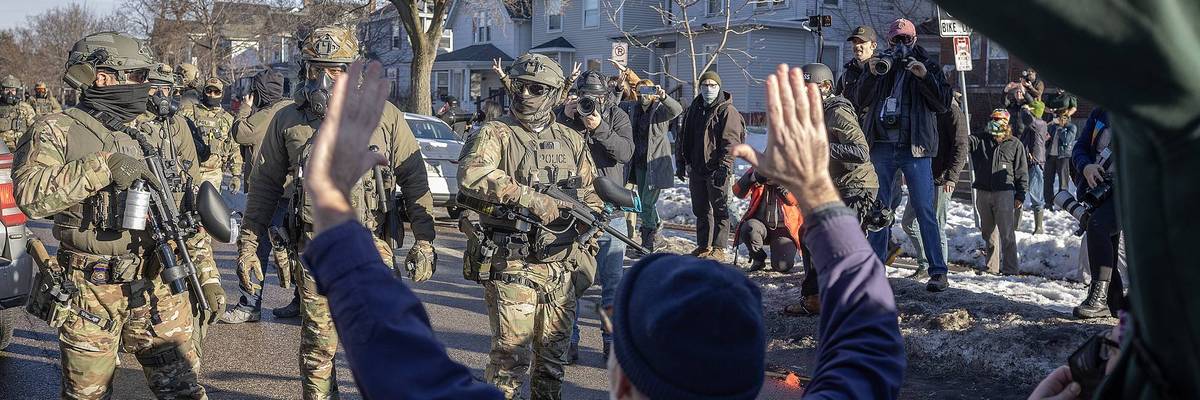
Protestors and ICE agents near the area where Renee Good was killed by a federal immigration agent the previous week, in Minneapolis, Minn., on Tuesday, Jan. 13, 2026.
Tactical Rage: On Violence and Resistance in Minneapolis
What is to be done when an assault on a city's population is an assault on democracy itself?
The denizens of Minneapolis are currently undergoing a violent attack on and occupation of their city by over three thousand heavily armed ICE and Border Patrol agents dispatched to the city by the Trump administration, over the strenuous objections of Minnesota Governor Tim Walz and Minneapolis Mayor Jacob Frey. This military assault on the city by “Homeland Security” has already resulted in the murder by ICE agents of one unarmed person, 37-year-old Renee Good, a US citizen; the shooting by ICE agents of at least one other individual; and untold incidents of harassment, intimidation, kidnapping, and the use of brute force.
This attack poses a threat, either directly or indirectly, to everyone living in Minneapolis.
At the same time, the attack is part of Trump’s broader authoritarian agenda, which centers on (1) a xenophobic campaign to arrest and deport over one million undocumented immigrants a year, which has led to similar “surges” of heavily armed ICE agents in Los Angeles, Portland, Chicago, Washington, D.C., Memphis, and Charlotte, some backed up by federalized National Guard troops, and (2) the pursuit of “retribution” against Democrat-controlled cities and states and against political opposition more generally. What is happening in Minneapolis right now thus poses a threat to every citizen of the US, and indeed every resident of the country whatever their legal citizenship status. For what is going on is a direct and indeed deliberate assault on civil liberties that are guaranteed by the US Constitution, and on constitutional democracy itself.
State power is now being wielded directly and violently by the Trump administration against individuals “under suspicion” of being “illegal,” against the communities where these individuals live and work, and against all citizens who act in solidarity with the victims of administration assaults or who join in protest against these assaults.
Participation in mass protest is a deliberately chosen public act as well as an individual moral choice. And so practices of civil resistance also implicate challenging questions of political ethics.
Last year’s intellectual debates about whether this is “fascism” have now been rendered entirely academic, for the manifest violence and the cruelty are now obvious for all to see, however various political theorists may choose to describe it.
Resisting this direct attack on civil liberty and constitutional democracy is essential, for the people directly violated, and for all who care about such violations or who are themselves vulnerable to similar violations–and anyone serious about democratic citizenship or even about going out in public without fear is so vulnerable.
Such an observation is hardly “academic” or merely theoretical. For right now, as the city of Minneapolis is the site of an assault, it is also the site of resistance to this assault, by masses of citizens who have taken to the streets of Minneapolis to protest, obstruct, disrupt, and counter ICE violence.
The situation is very dangerous, because ICE agents are heavily armed; either poorly trained or expertly trained to kill enemies in war rather than to patrol US cities; and obviously contemptuous of civil liberties and disposed to react to perceived “threats” with overwhelming force.
It is also dangerous because Trump has very publicly and repeatedly stated that if the situation on the streets devolves into greater chaos or violent confrontation, as he defines this, he is poised to invoke the Insurrection Act, which authorize him to deploy thousands of National Guard soldiers and active duty US military troops to back up the ICE occupation. This would in effect place the entire city of Minneapolis under martial law, and it would likely lead to similar measures taken in every city where protests intensify–and in that event protests will surely intensify in every city. Trump’s hesitance to take such measures thus far should provide no comfort for anyone, given the possibilities for things to spin out of control through misunderstanding or ICE provocation, and given Trump’s very serious mental instability, which is a very real factor that should frighten everyone.
What is to be done to resist this assault on a city and on democracy itself?
I’ve followed much of the discussion of this question online and in the media. And while the urge to hold forth with categorical statements of praise or denunciation is understandable, especially in a time of such heightened danger, there is surely more than one thing to be done, and differently situated people will surely respond differently, in ways that are often complementary but will also sometimes be in tension. Being clearer about these different ways, and mindful that tension between them can be genuinely productive, is thus important. Towards this end, I think it is particularly important to distinguish between morally justified forms of self-defense, and forms of public collective action that involve less proximate, and thus more political, goals.
Individuals that ICE seeks to detain on the grounds that they are “illegal”—a vile term– have every right to refuse to cooperate, to attempt to flee, and to fight back if attacked. In a moral sense, the violence of the situation clearly makes the use of counter-violence in self-defense legitimate. Whether it is wise to do so is a secondary but important question. But it is entirely reasonable for anyone approached by ICE to consider arrest by ICE as an extra-legal infringement of one’s liberty and an endangerment of one’s very life.
Individuals who ICE seeks to detain, or merely to subdue, because they protest the above efforts to detain people suspected of being “illegal,” also cannot reasonably be expected to simply submit to ICE orders. For such orders have questionable legal validity, and following them places any individual at serious risk of harm, disappearance, or worse. Here too, whether or not it is wise not simply to flee but to resist, to the point of employing counter-violence, is a secondary question. What is primary is that every individual has the moral and even arguably the legal right to judge this for themselves.
But participation in mass protest is a deliberately chosen public act as well as an individual moral choice. And so practices of civil resistance also implicate challenging questions of political ethics. For here the moral question is also a political one, not “how should an individual threatened directly by ICE respond?” but “how should organized groups of citizens act collectively to oppose ICE threats to individuals and to resist the broader ICE occupation?”
It is uncommon for elected politicians to hold forth with seriousness and integrity on such questions of political ethics. But in the current crisis, Minnesota’s elected politicians have spoken publicly ways I consider exemplary. Minneapolis Mayor Jacob Frey’s immediate response to the killing of Renee Good—an emphatic rejection of Trump administration bullshit about the killing and about Good, combined with an equally emphatic “get the fuck our of our city”—is one example. But here it is the response of Governor Tim Walz—who, let us not forget, was also in the cross-hairs of Justice Department allegations of corruption, even before it was announced that he and Frey were being investigated for their responses to the ICE occupation—that concerns me. Two nights ago, Walz put out a statement that has received much attention. It is worth quoting in its entirety:
My fellow Minnesotans:
What’s happening in Minnesota right now defies belief.
News reports simply don’t do justice to the level of chaos and disruption and trauma the federal government is raining down upon our communities. Two to three thousand armed agents of the federal government have been deployed to Minnesota. Armed, masked, undertrained ICE agents are going door to door, ordering people to point out where their neighbors of color live. They’re pulling over people indiscriminately, including US citizens, and demanding to see their papers. And at grocery stores, at bus stops, even at schools, they’re breaking windows, dragging pregnant women down the street, just plain grabbing Minnesotans and shoving them into unmarked vans, kidnapping innocent people with no warning and no due process.
Let’s be very, very clear: This long ago stopped being a matter of immigration enforcement. Instead, it is a campaign of organized brutality against the people of Minnesota by our own federal government. Last week, that campaign claimed the life of Renee Nicole Good. We’ve all watched the video. We all have seen what happened. And yet, instead of conducting an impartial investigation so we can hold accountable the officer responsible for Renee’s death, the Trump administration is devoting the full power of the federal government to finding an excuse to attack the victim and her family. Just yesterday, six federal prosecutors – including the longtime career prosecutor leading the charge to investigate and eliminate fraud in our state’s programs – quit their jobs rather than go along with this assault on the United States Constitution.
But as bad as it’s been, Donald Trump intends for it to get worse. This week, he went online to promise that, quote, “the day of retribution and reckoning is coming.” That is a direct threat against the people of this state, who dared to vote against him three times, and who continue to stand up for freedom with courage and empathy and profound grace. All across Minnesota, people are stepping up to help neighbors who are being unjustly, and unlawfully, targeted. They’re distributing care packages and walking kids to school and raising their voices in peaceful protest even though doing so has made many of our fellow Minnesotans targets for violent retribution.
Folks, I know this is scary. And I know it’s absurd that we all have to be defending law and order, justice, and humanity while also caring for our families and doing our jobs.
So, tonight, let me say, once again, to Donald Trump and Kristi Noem: End this occupation. You’ve done enough.
Let me say four critical things to the people of Minnesota – four things I need you to hear as you watch the news and look out for your neighbors.
First: Donald Trump wants chaos. He wants confusion. And, yes, he wants more violence on our streets. We cannot give him what he wants. We can – we must – protest: loudly, urgently, but also peacefully. Indeed, as hard as we will fight in the courts and at the ballot box, we cannot, and will not, let violence prevail.
You’re angry. I’m angry. Angry might not be strong enough of a word. But we must remain peaceful.
Second: You are not powerless. You are not helpless. And you are not alone. All across Minnesota, people are learning about opportunities not just to resist, but to help people who are in danger. Thousands upon thousands of Minnesotans are going to be relying on mutual aid in the days and weeks to come, and they need our support. Tonight, I want to share another way you can help: Witness. Help us establish a record of exactly what’s happening in our communities. You have an absolute right to peacefully film ICE agents as they conduct their activities. So carry your phone with you at all times. And if you see ICE in your neighborhood, take out that phone and hit record. Help us create a database of the atrocities against Minnesotans – not just to establish a record for posterity, but to bank evidence for future prosecution.
That’s the third thing I want to tell you tonight: We will not have to live like this forever. Accountability is coming, at the voting booth and in court. We will reclaim our communities from Donald Trump. We will re-establish a sense of safety for our neighbors. We will bring an end to this moment of chaos and confusion. We will find a way to move forward – together. And we will not be alone. Every day, we are working with business leaders, faith leaders, legal experts, and elected officials from all across the country. They have seen what Donald Trump is trying to do to our state. They know their states could be next.
And that brings me to the fourth thing I want to tell you tonight. Minnesota, I’m so proud of the way we’ve risen to meet this unbearable moment. But I’m not surprised. Because this – this is who we are. Minnesotans believe in the rule of law. And Minnesotans believe in the dignity of all people. We’re a place where there’s room for everybody, no matter who you are or who you love or where you came from. A place where we feed our kids, take care of our neighbors, and look out for those in the shadows of life. We’re an island of decency in a country being driven towards cruelty. We will remain an island of decency, of justice, of community, of peace. And, tonight, I come before you simply to ask: Do not let anyone take that away from us.
Thank you. Protect each other And God bless the people of Minnesota.
Some have praised this statement as a necessary call for “civility” and respect for law and order at a moment of disorder that promises great danger. Many on the left have denounced the statement as a reactionary call for “civility” at a moment of disorder and crisis that presents opportunities for more robust “resistance” to ICE and for “antifascism” more generally.
Debate about such matters is healthy—but only if it generates greater understanding among those who stand, together, against Trump’s fascism. This means greater appreciation among some centrists for the justified outrange, and passionate opposition, that many protesters are acting out on the streets of Minneapolis. But it also involves much greater seriousness among some on the left about the grave dangers associated with the possible escalation of violent confrontation.
Careful attention to Walz’s words makes clear that his statement is not a simple appeal to “civility” or call for citizens, as one colleague has put it, to “stand down.” After leading with a denunciation of the Trump administration for orchestrating “a campaign of organized brutality against the people of Minnesota by our own federal government,” Walz proceeds to praise fellow Minnesotans for taking initiative both “to resist” and “to help people who are in danger.” He validates public anger and indignation, and declares that “We can – we must – protest: loudly, urgently, but also peacefully. Indeed, as hard as we will fight in the courts and at the ballot box, we cannot, and will not, let violence prevail.” He is very clear that the source of the violence is ICE, and not ordinary citizens who are resisting and protesting. He is also clear that while action in the courts and at the ballot box is crucial, protest is equally legitimate important. He is not telling people to go home and be patient, or to have faith in politics as usual. For he is very clear that the situation is not “normal” and represents a genuine crisis.
The danger of violent escalation is very great and the likelihood that it will lead to an even more repressive response by the fascistic Trump, Hegseth, and Noem is equally great.
Some have claimed that the insistence that “we must remain peaceful” is reactionary in a situation where calls for more resolute confrontation are possible. But what else can any elected politician in the flawed constitutional democracy that is the US be expected to say? Walz is not a revolutionary—if he was, he would not be Governor of Minnesota (Zohran Mamdani is also not a revolutionary, which is why he is the elected Mayor of New York City and not an editorialist for the DSA newsletter). And Minneapolis today is not the Paris Commune of 1871 or the revolutionary Bavaria of 1918-1919 or the Budapest-based Soviet Republic of 1919—all arguably noble revolutionary experiments, and all experiments that were crushed by overwhelming military force.
When Walz says that Trump “wants chaos,” because it mobilizes his base and can serve as a pretext for the invocation of the Insurrection Act, he is simply saying what is obviously true. Saying this does not morally or politically absolve Trump or Stephen Miller or Kristi Noem or Tom Homan or ordinary ICE agents of their criminal complicity in violence, nor does it imply in any way that counter-violence is the primary problem at issue. No false equivalence is being asserted. It is true, as some critics have noted, that Trump has gone very far on the basis of lies about non-existent “domestic invasions” and “radical threats.” What is the guarantee that a commitment to non-violent protest will inhibit him from going farther, it is asked. There is no such guarantee. But it is obviously that Trump can yet go much farther down the fascist road than he has thus far done, and it is simply naïve to ignore that chaos in the streets of Minneapolis would offer him a very convenient pretext to do so.
More importantly, it is worse than naïve to imagine that it is possible, through counter-violence, not simply to put Minneapolis ICE agents on the defensive, but to defeat Trumpism.
First, because Trump retains some measure of procedurally democratic legitimacy in the U.S—over seventy-seven millionpeople voted for him a little more than a year ago, for God’s sake; Trump’s recent poll numbers do not represent any kind of dramatic political reversal, and he will occupy the White House for the next three years, whatever happens in this year’s midterm elections (assuming that free and fair elections will even take place).
Second, because Trump and Hegseth have purged the US military of all independent voices and scrupulous career professionals, and have laid the basis for the Pentagon’s massive domestic deployment of overwhelming force—as the widely reported September meeting at Quantico made plain.
Finally, because those who might understandably fantasize about a “revolutionary conjuncture” fail to take account of the fact that in the event a serious outbreak of violent conflict it’s not just the US military that will follow Trump’s commands. There is also the large number of state and local police officers, many of whom lean far right, however liberal their Governors or Mayors might be. Further, in a real civil war, the far right in this country would annihilate the left in pretty much everyplace outside of the major coastal cities. I know there are left militias too. And they amount to little more than nothing by comparison to their fascist counterparts, who typically recruit combat veterans and retired police officers with real military training, and who have been prepping for decades.
In short, the danger of violent escalation is very great and the likelihood that it will lead to an even more repressive response by the fascistic Trump, Hegseth, and Noem is equally great.
It is worth repeating that the call to practice nonviolent resistance does not mean that individuals in the literal grasp of ICE ought to submit. Walz’s words do not include a call for individuals to submit to ICE commands or detentions. Nor do they imply that the kind of civic monitoring and solidarity offered by people like Renee Good and her wife, and thousands of others, is wrong even if it obstructs “officers.” There is no suggestion that it was wrong of Nicole Good to be parked where she was, or to try to drive away when approached by ICE agents. She clearly was in the right.
Walz is calling–as a public official who is, to be candid, totally outgunned and overpowered by Trump’s federal government—not for submission but for strategies and tactics likely to build political support without provoking a wave of repression far greater than anything yet attempted by Trump.
I can’t imagine a better response to the situation at hand from any elected public official in the country in which we actually live.
Obviously, protest leaders and movement activists speak from a very different place. It is understandable that some might be suspicious of Walz when he says that “we all have to be defending law and order, justice, and humanity,” and might believe, contrary to Walz, that tactics that press the boundaries of “civility” and “order” might be effective in mobilizing activists in the streets or even provoking ICE overreach. There are legitimate arguments to be had about such things. Indeed, such arguments are going on right now. For no movement can speak with a single voice. Yesterday’s Minnesota Star Tribune thus reports that “Debate grows in protest movement over how hard to push back against ICE,” and that “shootings by ICE agents have led to tension among protesters calling for a peaceful approach and those who want to get more confrontational.”
Indeed, such debates have characterized every significant social movement in US history that has struggled against injustice. At the same time, it is important to recognize that outside of the Civil War, every successful movement resisting injustice has by and large proceeded, and succeeded, through non-violent means. Yes, such movements have typically included radical groupings often willing to practice more risky forms of direction action and even to employ forms of counter-violence. But such efforts have always worked at the margins, and only up to a point. More importantly, there has never been a US president like Trump, who is so drawn to fascist ideology and so willing to flout the Constitution, subvert democratic elections, and deploy armed force, in cities across the country, to suppress opposition. And it has thus never been more dangerous to promote any kind of protest activity.
Now is a good time to recall the very distinguished tradition of non-violent movement activism and organized protest that has played such an important role in US history.
As I think about the exemplary upsurge of protest on the streets of Minneapolis, I am reminded of the most dramatic moment in “No Easy Walk,” an installment of the acclaimed PBS documentary “Eyes on the Prize,” which chronicled the evolution of the USUS civil rights movement. The installment centered on the 1963 Birmingham campaign, and featured a lesser known but hugely important movement leader, James Bevel. Bevel, a leader of the Freedom Rides, and a leading tactician of non-violent direct action, found himself at the head of one particular march, during “the children’s crusade,” that was threatening to erupt into a violent confrontation. In newsreel footage, Bevel is seen being given a bullhorn by a policeman on site, and using it to calm his large and understandably heated crowd. In voiceover, he recounts his experience, worth quoting at length:
We were coming off a demonstration and the police was driving the students back with water and dogs. . . The students was being playful and jovial and mocking the police, but the adults — upon seeing a lot of the students knocked down by the water and their clothes torn off by dogs — began to organize their guns and knives and bricks.
What I did, actually, was tell the students that they had to respect police officers, that their job was to help police and to keep order. That the police was there to keep order and that the people who was there throwing [things] was probably paid instigators, and therefore we had to watch them. And it was very effective. It started all the students to pointing at adults who had rocks and knives and guns, and then the adults had to start dropping them. Because it would’ve started a riot, and a riot would’ve gotten off the issue. The students was very aware of that, and the adults weren’t aware of that. . . [and there was] this policeman with a bullhorn not knowing what to do with it to keep order. . . And I said, ‘Let me use your bullhorn.’
So he just gave it to me, and I said, "OK, get off the streets now. We’re not going to have violence. If you’re not going to respect policemen, you’re not going to be in the movement."
Bevel, John Lewis, Diane Nash, and other young movement leaders– who studied nonviolent direct action with James Lawson in Nashville, Tennessee, first practiced it at lunch counters in Nashville and Greensboro, North Carolina, and in 1960 proceeded that year to form the Student Nonviolent Coordinating Committee—understood, from years of experience, that the practice of self-restraint has both ethical and strategic value. The 1963 Birmingham campaign organized by King’s Southern Christian Leadership Conference was indeed called “Project C,” with the “C” standing for Confrontation. Bevel, like King a student of Reinhold Niebuhr, understood that it is possible to confront injustice, even violent injustice, in ways that are coercive even as they abjure physical violence.
The whole world is now watching Minneapolis, the site of appalling ICE violence, but also brave civic solidarity and resistance to the violence.
The rhetoric of civility is often a rhetoric of pacification, a way of saying “calm down, be reasonable, be patient” to rebellious citizens who have been told too long to “wait,” and of insinuating that “we are all in this together” to people who have for too long been ignored, denied, or suppressed. Appeals to this rhetoric can be a way for power holders and those who believe in the essential rightness of the status quo to quiet dissenting and disruptive voices.
But it can also be a way for savvy citizen activists to build oppositional power in situations where mass direct confrontation with police, or the use of organized violence in response to police violence, is likely to furnish pretexts for much more violent and repressive official responses, and where creative nonviolence can more effectively resist injustice.
The whole world is now watching Minneapolis, the site of appalling ICE violence, but also brave civic solidarity and resistance to the violence.
And what happens in Minneapolis in the coming weeks will quite likely play an outsized role in what happens politically in the country at large. And the danger of a massive, full-scale campaign of repression, and thus of a dramatic curtailment of constitutional freedoms already stretched to the breaking point, has never been greater.
Tim Walz and Jacob Frey are not activists. But in the situation we face, which pits a fascistic Trump administration against both Minnesota’s citizens and its elected state and local governments, they are supporters and even allies of a political resistance not only to the brutal and unjust ICE assaults, but to Trumpism more generally. And in this context, their use of the rhetoric of “law and order” against the manifestly lawless violence of the Trump administration, plays a very important role, not as a substitute for angrier rhetoric or passionate protest, but as a necessary call for civic self-limitation in the name of democracy.
Rep. Ilhan Omar is an activist, even as she is also an elected member of the US House of Representatives. And just yesterday she urged similar restraint in response to reports of protesters hurling projectiles at police. Her public appeal seems a fitting way to conclude: “Do not let your anger get the best of you. . . We are justified in the rage that we feel, as Minnesotans with the paramilitary force that is roaming our streets and the brutality in which our neighbors are being treated and the inhumane ways we are being described, but giving into that rage gives them license to terrorize more.”
I’d like to thank my dear friends Bob Ivie and Bob Orsi for their helpful suggestions on this piece.
We are at a crossroads
This country and this world are at a monumental crossroads. In a few short weeks, US voters will have an opportunity to beat back the forces of fascism and confront the billionaires who are rigging the economy, our media system, and our democracy, making it increasingly impossible for ordinary people to get by. We’re not just talking about the election. We’re talking about what must be done once these fascist elements are vanquished from power. We need a bolder set of solutions than what either major party has so far been willing to offer and a working-class movement ready to fight like hell for it. Trump didn't emerge from nowhere. The conditions that fueled MAGA authoritarianism were created by decades of radical neoliberal economic policies and a corrupt political system dominated by corporate interests. They slashed taxes on the super-rich, promising that the benefits would trickle down. They said giveaways to the corporate titans would make life more affordable for the rest of us. It was all bullshit. And when a bitter, betrayed populace searches for someone to blame, right-wing demagogues have little trouble finding scapegoats. People know when they're being lied to, but you won't hear any of this from the corporate media. Only independent journalism—powered and funded by people who believe in building a better world—can deliver truly trustworthy daily news. Our Fall Campaign is underway, and we need your help. To power our newsroom through the rest of the year, we need to raise $125,000 by midnight on October 31. So if you share our vision, please contribute whatever you can to sustain our work. |
The denizens of Minneapolis are currently undergoing a violent attack on and occupation of their city by over three thousand heavily armed ICE and Border Patrol agents dispatched to the city by the Trump administration, over the strenuous objections of Minnesota Governor Tim Walz and Minneapolis Mayor Jacob Frey. This military assault on the city by “Homeland Security” has already resulted in the murder by ICE agents of one unarmed person, 37-year-old Renee Good, a US citizen; the shooting by ICE agents of at least one other individual; and untold incidents of harassment, intimidation, kidnapping, and the use of brute force.
This attack poses a threat, either directly or indirectly, to everyone living in Minneapolis.
At the same time, the attack is part of Trump’s broader authoritarian agenda, which centers on (1) a xenophobic campaign to arrest and deport over one million undocumented immigrants a year, which has led to similar “surges” of heavily armed ICE agents in Los Angeles, Portland, Chicago, Washington, D.C., Memphis, and Charlotte, some backed up by federalized National Guard troops, and (2) the pursuit of “retribution” against Democrat-controlled cities and states and against political opposition more generally. What is happening in Minneapolis right now thus poses a threat to every citizen of the US, and indeed every resident of the country whatever their legal citizenship status. For what is going on is a direct and indeed deliberate assault on civil liberties that are guaranteed by the US Constitution, and on constitutional democracy itself.
State power is now being wielded directly and violently by the Trump administration against individuals “under suspicion” of being “illegal,” against the communities where these individuals live and work, and against all citizens who act in solidarity with the victims of administration assaults or who join in protest against these assaults.
Participation in mass protest is a deliberately chosen public act as well as an individual moral choice. And so practices of civil resistance also implicate challenging questions of political ethics.
Last year’s intellectual debates about whether this is “fascism” have now been rendered entirely academic, for the manifest violence and the cruelty are now obvious for all to see, however various political theorists may choose to describe it.
Resisting this direct attack on civil liberty and constitutional democracy is essential, for the people directly violated, and for all who care about such violations or who are themselves vulnerable to similar violations–and anyone serious about democratic citizenship or even about going out in public without fear is so vulnerable.
Such an observation is hardly “academic” or merely theoretical. For right now, as the city of Minneapolis is the site of an assault, it is also the site of resistance to this assault, by masses of citizens who have taken to the streets of Minneapolis to protest, obstruct, disrupt, and counter ICE violence.
The situation is very dangerous, because ICE agents are heavily armed; either poorly trained or expertly trained to kill enemies in war rather than to patrol US cities; and obviously contemptuous of civil liberties and disposed to react to perceived “threats” with overwhelming force.
It is also dangerous because Trump has very publicly and repeatedly stated that if the situation on the streets devolves into greater chaos or violent confrontation, as he defines this, he is poised to invoke the Insurrection Act, which authorize him to deploy thousands of National Guard soldiers and active duty US military troops to back up the ICE occupation. This would in effect place the entire city of Minneapolis under martial law, and it would likely lead to similar measures taken in every city where protests intensify–and in that event protests will surely intensify in every city. Trump’s hesitance to take such measures thus far should provide no comfort for anyone, given the possibilities for things to spin out of control through misunderstanding or ICE provocation, and given Trump’s very serious mental instability, which is a very real factor that should frighten everyone.
What is to be done to resist this assault on a city and on democracy itself?
I’ve followed much of the discussion of this question online and in the media. And while the urge to hold forth with categorical statements of praise or denunciation is understandable, especially in a time of such heightened danger, there is surely more than one thing to be done, and differently situated people will surely respond differently, in ways that are often complementary but will also sometimes be in tension. Being clearer about these different ways, and mindful that tension between them can be genuinely productive, is thus important. Towards this end, I think it is particularly important to distinguish between morally justified forms of self-defense, and forms of public collective action that involve less proximate, and thus more political, goals.
Individuals that ICE seeks to detain on the grounds that they are “illegal”—a vile term– have every right to refuse to cooperate, to attempt to flee, and to fight back if attacked. In a moral sense, the violence of the situation clearly makes the use of counter-violence in self-defense legitimate. Whether it is wise to do so is a secondary but important question. But it is entirely reasonable for anyone approached by ICE to consider arrest by ICE as an extra-legal infringement of one’s liberty and an endangerment of one’s very life.
Individuals who ICE seeks to detain, or merely to subdue, because they protest the above efforts to detain people suspected of being “illegal,” also cannot reasonably be expected to simply submit to ICE orders. For such orders have questionable legal validity, and following them places any individual at serious risk of harm, disappearance, or worse. Here too, whether or not it is wise not simply to flee but to resist, to the point of employing counter-violence, is a secondary question. What is primary is that every individual has the moral and even arguably the legal right to judge this for themselves.
But participation in mass protest is a deliberately chosen public act as well as an individual moral choice. And so practices of civil resistance also implicate challenging questions of political ethics. For here the moral question is also a political one, not “how should an individual threatened directly by ICE respond?” but “how should organized groups of citizens act collectively to oppose ICE threats to individuals and to resist the broader ICE occupation?”
It is uncommon for elected politicians to hold forth with seriousness and integrity on such questions of political ethics. But in the current crisis, Minnesota’s elected politicians have spoken publicly ways I consider exemplary. Minneapolis Mayor Jacob Frey’s immediate response to the killing of Renee Good—an emphatic rejection of Trump administration bullshit about the killing and about Good, combined with an equally emphatic “get the fuck our of our city”—is one example. But here it is the response of Governor Tim Walz—who, let us not forget, was also in the cross-hairs of Justice Department allegations of corruption, even before it was announced that he and Frey were being investigated for their responses to the ICE occupation—that concerns me. Two nights ago, Walz put out a statement that has received much attention. It is worth quoting in its entirety:
My fellow Minnesotans:
What’s happening in Minnesota right now defies belief.
News reports simply don’t do justice to the level of chaos and disruption and trauma the federal government is raining down upon our communities. Two to three thousand armed agents of the federal government have been deployed to Minnesota. Armed, masked, undertrained ICE agents are going door to door, ordering people to point out where their neighbors of color live. They’re pulling over people indiscriminately, including US citizens, and demanding to see their papers. And at grocery stores, at bus stops, even at schools, they’re breaking windows, dragging pregnant women down the street, just plain grabbing Minnesotans and shoving them into unmarked vans, kidnapping innocent people with no warning and no due process.
Let’s be very, very clear: This long ago stopped being a matter of immigration enforcement. Instead, it is a campaign of organized brutality against the people of Minnesota by our own federal government. Last week, that campaign claimed the life of Renee Nicole Good. We’ve all watched the video. We all have seen what happened. And yet, instead of conducting an impartial investigation so we can hold accountable the officer responsible for Renee’s death, the Trump administration is devoting the full power of the federal government to finding an excuse to attack the victim and her family. Just yesterday, six federal prosecutors – including the longtime career prosecutor leading the charge to investigate and eliminate fraud in our state’s programs – quit their jobs rather than go along with this assault on the United States Constitution.
But as bad as it’s been, Donald Trump intends for it to get worse. This week, he went online to promise that, quote, “the day of retribution and reckoning is coming.” That is a direct threat against the people of this state, who dared to vote against him three times, and who continue to stand up for freedom with courage and empathy and profound grace. All across Minnesota, people are stepping up to help neighbors who are being unjustly, and unlawfully, targeted. They’re distributing care packages and walking kids to school and raising their voices in peaceful protest even though doing so has made many of our fellow Minnesotans targets for violent retribution.
Folks, I know this is scary. And I know it’s absurd that we all have to be defending law and order, justice, and humanity while also caring for our families and doing our jobs.
So, tonight, let me say, once again, to Donald Trump and Kristi Noem: End this occupation. You’ve done enough.
Let me say four critical things to the people of Minnesota – four things I need you to hear as you watch the news and look out for your neighbors.
First: Donald Trump wants chaos. He wants confusion. And, yes, he wants more violence on our streets. We cannot give him what he wants. We can – we must – protest: loudly, urgently, but also peacefully. Indeed, as hard as we will fight in the courts and at the ballot box, we cannot, and will not, let violence prevail.
You’re angry. I’m angry. Angry might not be strong enough of a word. But we must remain peaceful.
Second: You are not powerless. You are not helpless. And you are not alone. All across Minnesota, people are learning about opportunities not just to resist, but to help people who are in danger. Thousands upon thousands of Minnesotans are going to be relying on mutual aid in the days and weeks to come, and they need our support. Tonight, I want to share another way you can help: Witness. Help us establish a record of exactly what’s happening in our communities. You have an absolute right to peacefully film ICE agents as they conduct their activities. So carry your phone with you at all times. And if you see ICE in your neighborhood, take out that phone and hit record. Help us create a database of the atrocities against Minnesotans – not just to establish a record for posterity, but to bank evidence for future prosecution.
That’s the third thing I want to tell you tonight: We will not have to live like this forever. Accountability is coming, at the voting booth and in court. We will reclaim our communities from Donald Trump. We will re-establish a sense of safety for our neighbors. We will bring an end to this moment of chaos and confusion. We will find a way to move forward – together. And we will not be alone. Every day, we are working with business leaders, faith leaders, legal experts, and elected officials from all across the country. They have seen what Donald Trump is trying to do to our state. They know their states could be next.
And that brings me to the fourth thing I want to tell you tonight. Minnesota, I’m so proud of the way we’ve risen to meet this unbearable moment. But I’m not surprised. Because this – this is who we are. Minnesotans believe in the rule of law. And Minnesotans believe in the dignity of all people. We’re a place where there’s room for everybody, no matter who you are or who you love or where you came from. A place where we feed our kids, take care of our neighbors, and look out for those in the shadows of life. We’re an island of decency in a country being driven towards cruelty. We will remain an island of decency, of justice, of community, of peace. And, tonight, I come before you simply to ask: Do not let anyone take that away from us.
Thank you. Protect each other And God bless the people of Minnesota.
Some have praised this statement as a necessary call for “civility” and respect for law and order at a moment of disorder that promises great danger. Many on the left have denounced the statement as a reactionary call for “civility” at a moment of disorder and crisis that presents opportunities for more robust “resistance” to ICE and for “antifascism” more generally.
Debate about such matters is healthy—but only if it generates greater understanding among those who stand, together, against Trump’s fascism. This means greater appreciation among some centrists for the justified outrange, and passionate opposition, that many protesters are acting out on the streets of Minneapolis. But it also involves much greater seriousness among some on the left about the grave dangers associated with the possible escalation of violent confrontation.
Careful attention to Walz’s words makes clear that his statement is not a simple appeal to “civility” or call for citizens, as one colleague has put it, to “stand down.” After leading with a denunciation of the Trump administration for orchestrating “a campaign of organized brutality against the people of Minnesota by our own federal government,” Walz proceeds to praise fellow Minnesotans for taking initiative both “to resist” and “to help people who are in danger.” He validates public anger and indignation, and declares that “We can – we must – protest: loudly, urgently, but also peacefully. Indeed, as hard as we will fight in the courts and at the ballot box, we cannot, and will not, let violence prevail.” He is very clear that the source of the violence is ICE, and not ordinary citizens who are resisting and protesting. He is also clear that while action in the courts and at the ballot box is crucial, protest is equally legitimate important. He is not telling people to go home and be patient, or to have faith in politics as usual. For he is very clear that the situation is not “normal” and represents a genuine crisis.
The danger of violent escalation is very great and the likelihood that it will lead to an even more repressive response by the fascistic Trump, Hegseth, and Noem is equally great.
Some have claimed that the insistence that “we must remain peaceful” is reactionary in a situation where calls for more resolute confrontation are possible. But what else can any elected politician in the flawed constitutional democracy that is the US be expected to say? Walz is not a revolutionary—if he was, he would not be Governor of Minnesota (Zohran Mamdani is also not a revolutionary, which is why he is the elected Mayor of New York City and not an editorialist for the DSA newsletter). And Minneapolis today is not the Paris Commune of 1871 or the revolutionary Bavaria of 1918-1919 or the Budapest-based Soviet Republic of 1919—all arguably noble revolutionary experiments, and all experiments that were crushed by overwhelming military force.
When Walz says that Trump “wants chaos,” because it mobilizes his base and can serve as a pretext for the invocation of the Insurrection Act, he is simply saying what is obviously true. Saying this does not morally or politically absolve Trump or Stephen Miller or Kristi Noem or Tom Homan or ordinary ICE agents of their criminal complicity in violence, nor does it imply in any way that counter-violence is the primary problem at issue. No false equivalence is being asserted. It is true, as some critics have noted, that Trump has gone very far on the basis of lies about non-existent “domestic invasions” and “radical threats.” What is the guarantee that a commitment to non-violent protest will inhibit him from going farther, it is asked. There is no such guarantee. But it is obviously that Trump can yet go much farther down the fascist road than he has thus far done, and it is simply naïve to ignore that chaos in the streets of Minneapolis would offer him a very convenient pretext to do so.
More importantly, it is worse than naïve to imagine that it is possible, through counter-violence, not simply to put Minneapolis ICE agents on the defensive, but to defeat Trumpism.
First, because Trump retains some measure of procedurally democratic legitimacy in the U.S—over seventy-seven millionpeople voted for him a little more than a year ago, for God’s sake; Trump’s recent poll numbers do not represent any kind of dramatic political reversal, and he will occupy the White House for the next three years, whatever happens in this year’s midterm elections (assuming that free and fair elections will even take place).
Second, because Trump and Hegseth have purged the US military of all independent voices and scrupulous career professionals, and have laid the basis for the Pentagon’s massive domestic deployment of overwhelming force—as the widely reported September meeting at Quantico made plain.
Finally, because those who might understandably fantasize about a “revolutionary conjuncture” fail to take account of the fact that in the event a serious outbreak of violent conflict it’s not just the US military that will follow Trump’s commands. There is also the large number of state and local police officers, many of whom lean far right, however liberal their Governors or Mayors might be. Further, in a real civil war, the far right in this country would annihilate the left in pretty much everyplace outside of the major coastal cities. I know there are left militias too. And they amount to little more than nothing by comparison to their fascist counterparts, who typically recruit combat veterans and retired police officers with real military training, and who have been prepping for decades.
In short, the danger of violent escalation is very great and the likelihood that it will lead to an even more repressive response by the fascistic Trump, Hegseth, and Noem is equally great.
It is worth repeating that the call to practice nonviolent resistance does not mean that individuals in the literal grasp of ICE ought to submit. Walz’s words do not include a call for individuals to submit to ICE commands or detentions. Nor do they imply that the kind of civic monitoring and solidarity offered by people like Renee Good and her wife, and thousands of others, is wrong even if it obstructs “officers.” There is no suggestion that it was wrong of Nicole Good to be parked where she was, or to try to drive away when approached by ICE agents. She clearly was in the right.
Walz is calling–as a public official who is, to be candid, totally outgunned and overpowered by Trump’s federal government—not for submission but for strategies and tactics likely to build political support without provoking a wave of repression far greater than anything yet attempted by Trump.
I can’t imagine a better response to the situation at hand from any elected public official in the country in which we actually live.
Obviously, protest leaders and movement activists speak from a very different place. It is understandable that some might be suspicious of Walz when he says that “we all have to be defending law and order, justice, and humanity,” and might believe, contrary to Walz, that tactics that press the boundaries of “civility” and “order” might be effective in mobilizing activists in the streets or even provoking ICE overreach. There are legitimate arguments to be had about such things. Indeed, such arguments are going on right now. For no movement can speak with a single voice. Yesterday’s Minnesota Star Tribune thus reports that “Debate grows in protest movement over how hard to push back against ICE,” and that “shootings by ICE agents have led to tension among protesters calling for a peaceful approach and those who want to get more confrontational.”
Indeed, such debates have characterized every significant social movement in US history that has struggled against injustice. At the same time, it is important to recognize that outside of the Civil War, every successful movement resisting injustice has by and large proceeded, and succeeded, through non-violent means. Yes, such movements have typically included radical groupings often willing to practice more risky forms of direction action and even to employ forms of counter-violence. But such efforts have always worked at the margins, and only up to a point. More importantly, there has never been a US president like Trump, who is so drawn to fascist ideology and so willing to flout the Constitution, subvert democratic elections, and deploy armed force, in cities across the country, to suppress opposition. And it has thus never been more dangerous to promote any kind of protest activity.
Now is a good time to recall the very distinguished tradition of non-violent movement activism and organized protest that has played such an important role in US history.
As I think about the exemplary upsurge of protest on the streets of Minneapolis, I am reminded of the most dramatic moment in “No Easy Walk,” an installment of the acclaimed PBS documentary “Eyes on the Prize,” which chronicled the evolution of the USUS civil rights movement. The installment centered on the 1963 Birmingham campaign, and featured a lesser known but hugely important movement leader, James Bevel. Bevel, a leader of the Freedom Rides, and a leading tactician of non-violent direct action, found himself at the head of one particular march, during “the children’s crusade,” that was threatening to erupt into a violent confrontation. In newsreel footage, Bevel is seen being given a bullhorn by a policeman on site, and using it to calm his large and understandably heated crowd. In voiceover, he recounts his experience, worth quoting at length:
We were coming off a demonstration and the police was driving the students back with water and dogs. . . The students was being playful and jovial and mocking the police, but the adults — upon seeing a lot of the students knocked down by the water and their clothes torn off by dogs — began to organize their guns and knives and bricks.
What I did, actually, was tell the students that they had to respect police officers, that their job was to help police and to keep order. That the police was there to keep order and that the people who was there throwing [things] was probably paid instigators, and therefore we had to watch them. And it was very effective. It started all the students to pointing at adults who had rocks and knives and guns, and then the adults had to start dropping them. Because it would’ve started a riot, and a riot would’ve gotten off the issue. The students was very aware of that, and the adults weren’t aware of that. . . [and there was] this policeman with a bullhorn not knowing what to do with it to keep order. . . And I said, ‘Let me use your bullhorn.’
So he just gave it to me, and I said, "OK, get off the streets now. We’re not going to have violence. If you’re not going to respect policemen, you’re not going to be in the movement."
Bevel, John Lewis, Diane Nash, and other young movement leaders– who studied nonviolent direct action with James Lawson in Nashville, Tennessee, first practiced it at lunch counters in Nashville and Greensboro, North Carolina, and in 1960 proceeded that year to form the Student Nonviolent Coordinating Committee—understood, from years of experience, that the practice of self-restraint has both ethical and strategic value. The 1963 Birmingham campaign organized by King’s Southern Christian Leadership Conference was indeed called “Project C,” with the “C” standing for Confrontation. Bevel, like King a student of Reinhold Niebuhr, understood that it is possible to confront injustice, even violent injustice, in ways that are coercive even as they abjure physical violence.
The whole world is now watching Minneapolis, the site of appalling ICE violence, but also brave civic solidarity and resistance to the violence.
The rhetoric of civility is often a rhetoric of pacification, a way of saying “calm down, be reasonable, be patient” to rebellious citizens who have been told too long to “wait,” and of insinuating that “we are all in this together” to people who have for too long been ignored, denied, or suppressed. Appeals to this rhetoric can be a way for power holders and those who believe in the essential rightness of the status quo to quiet dissenting and disruptive voices.
But it can also be a way for savvy citizen activists to build oppositional power in situations where mass direct confrontation with police, or the use of organized violence in response to police violence, is likely to furnish pretexts for much more violent and repressive official responses, and where creative nonviolence can more effectively resist injustice.
The whole world is now watching Minneapolis, the site of appalling ICE violence, but also brave civic solidarity and resistance to the violence.
And what happens in Minneapolis in the coming weeks will quite likely play an outsized role in what happens politically in the country at large. And the danger of a massive, full-scale campaign of repression, and thus of a dramatic curtailment of constitutional freedoms already stretched to the breaking point, has never been greater.
Tim Walz and Jacob Frey are not activists. But in the situation we face, which pits a fascistic Trump administration against both Minnesota’s citizens and its elected state and local governments, they are supporters and even allies of a political resistance not only to the brutal and unjust ICE assaults, but to Trumpism more generally. And in this context, their use of the rhetoric of “law and order” against the manifestly lawless violence of the Trump administration, plays a very important role, not as a substitute for angrier rhetoric or passionate protest, but as a necessary call for civic self-limitation in the name of democracy.
Rep. Ilhan Omar is an activist, even as she is also an elected member of the US House of Representatives. And just yesterday she urged similar restraint in response to reports of protesters hurling projectiles at police. Her public appeal seems a fitting way to conclude: “Do not let your anger get the best of you. . . We are justified in the rage that we feel, as Minnesotans with the paramilitary force that is roaming our streets and the brutality in which our neighbors are being treated and the inhumane ways we are being described, but giving into that rage gives them license to terrorize more.”
I’d like to thank my dear friends Bob Ivie and Bob Orsi for their helpful suggestions on this piece.
The denizens of Minneapolis are currently undergoing a violent attack on and occupation of their city by over three thousand heavily armed ICE and Border Patrol agents dispatched to the city by the Trump administration, over the strenuous objections of Minnesota Governor Tim Walz and Minneapolis Mayor Jacob Frey. This military assault on the city by “Homeland Security” has already resulted in the murder by ICE agents of one unarmed person, 37-year-old Renee Good, a US citizen; the shooting by ICE agents of at least one other individual; and untold incidents of harassment, intimidation, kidnapping, and the use of brute force.
This attack poses a threat, either directly or indirectly, to everyone living in Minneapolis.
At the same time, the attack is part of Trump’s broader authoritarian agenda, which centers on (1) a xenophobic campaign to arrest and deport over one million undocumented immigrants a year, which has led to similar “surges” of heavily armed ICE agents in Los Angeles, Portland, Chicago, Washington, D.C., Memphis, and Charlotte, some backed up by federalized National Guard troops, and (2) the pursuit of “retribution” against Democrat-controlled cities and states and against political opposition more generally. What is happening in Minneapolis right now thus poses a threat to every citizen of the US, and indeed every resident of the country whatever their legal citizenship status. For what is going on is a direct and indeed deliberate assault on civil liberties that are guaranteed by the US Constitution, and on constitutional democracy itself.
State power is now being wielded directly and violently by the Trump administration against individuals “under suspicion” of being “illegal,” against the communities where these individuals live and work, and against all citizens who act in solidarity with the victims of administration assaults or who join in protest against these assaults.
Participation in mass protest is a deliberately chosen public act as well as an individual moral choice. And so practices of civil resistance also implicate challenging questions of political ethics.
Last year’s intellectual debates about whether this is “fascism” have now been rendered entirely academic, for the manifest violence and the cruelty are now obvious for all to see, however various political theorists may choose to describe it.
Resisting this direct attack on civil liberty and constitutional democracy is essential, for the people directly violated, and for all who care about such violations or who are themselves vulnerable to similar violations–and anyone serious about democratic citizenship or even about going out in public without fear is so vulnerable.
Such an observation is hardly “academic” or merely theoretical. For right now, as the city of Minneapolis is the site of an assault, it is also the site of resistance to this assault, by masses of citizens who have taken to the streets of Minneapolis to protest, obstruct, disrupt, and counter ICE violence.
The situation is very dangerous, because ICE agents are heavily armed; either poorly trained or expertly trained to kill enemies in war rather than to patrol US cities; and obviously contemptuous of civil liberties and disposed to react to perceived “threats” with overwhelming force.
It is also dangerous because Trump has very publicly and repeatedly stated that if the situation on the streets devolves into greater chaos or violent confrontation, as he defines this, he is poised to invoke the Insurrection Act, which authorize him to deploy thousands of National Guard soldiers and active duty US military troops to back up the ICE occupation. This would in effect place the entire city of Minneapolis under martial law, and it would likely lead to similar measures taken in every city where protests intensify–and in that event protests will surely intensify in every city. Trump’s hesitance to take such measures thus far should provide no comfort for anyone, given the possibilities for things to spin out of control through misunderstanding or ICE provocation, and given Trump’s very serious mental instability, which is a very real factor that should frighten everyone.
What is to be done to resist this assault on a city and on democracy itself?
I’ve followed much of the discussion of this question online and in the media. And while the urge to hold forth with categorical statements of praise or denunciation is understandable, especially in a time of such heightened danger, there is surely more than one thing to be done, and differently situated people will surely respond differently, in ways that are often complementary but will also sometimes be in tension. Being clearer about these different ways, and mindful that tension between them can be genuinely productive, is thus important. Towards this end, I think it is particularly important to distinguish between morally justified forms of self-defense, and forms of public collective action that involve less proximate, and thus more political, goals.
Individuals that ICE seeks to detain on the grounds that they are “illegal”—a vile term– have every right to refuse to cooperate, to attempt to flee, and to fight back if attacked. In a moral sense, the violence of the situation clearly makes the use of counter-violence in self-defense legitimate. Whether it is wise to do so is a secondary but important question. But it is entirely reasonable for anyone approached by ICE to consider arrest by ICE as an extra-legal infringement of one’s liberty and an endangerment of one’s very life.
Individuals who ICE seeks to detain, or merely to subdue, because they protest the above efforts to detain people suspected of being “illegal,” also cannot reasonably be expected to simply submit to ICE orders. For such orders have questionable legal validity, and following them places any individual at serious risk of harm, disappearance, or worse. Here too, whether or not it is wise not simply to flee but to resist, to the point of employing counter-violence, is a secondary question. What is primary is that every individual has the moral and even arguably the legal right to judge this for themselves.
But participation in mass protest is a deliberately chosen public act as well as an individual moral choice. And so practices of civil resistance also implicate challenging questions of political ethics. For here the moral question is also a political one, not “how should an individual threatened directly by ICE respond?” but “how should organized groups of citizens act collectively to oppose ICE threats to individuals and to resist the broader ICE occupation?”
It is uncommon for elected politicians to hold forth with seriousness and integrity on such questions of political ethics. But in the current crisis, Minnesota’s elected politicians have spoken publicly ways I consider exemplary. Minneapolis Mayor Jacob Frey’s immediate response to the killing of Renee Good—an emphatic rejection of Trump administration bullshit about the killing and about Good, combined with an equally emphatic “get the fuck our of our city”—is one example. But here it is the response of Governor Tim Walz—who, let us not forget, was also in the cross-hairs of Justice Department allegations of corruption, even before it was announced that he and Frey were being investigated for their responses to the ICE occupation—that concerns me. Two nights ago, Walz put out a statement that has received much attention. It is worth quoting in its entirety:
My fellow Minnesotans:
What’s happening in Minnesota right now defies belief.
News reports simply don’t do justice to the level of chaos and disruption and trauma the federal government is raining down upon our communities. Two to three thousand armed agents of the federal government have been deployed to Minnesota. Armed, masked, undertrained ICE agents are going door to door, ordering people to point out where their neighbors of color live. They’re pulling over people indiscriminately, including US citizens, and demanding to see their papers. And at grocery stores, at bus stops, even at schools, they’re breaking windows, dragging pregnant women down the street, just plain grabbing Minnesotans and shoving them into unmarked vans, kidnapping innocent people with no warning and no due process.
Let’s be very, very clear: This long ago stopped being a matter of immigration enforcement. Instead, it is a campaign of organized brutality against the people of Minnesota by our own federal government. Last week, that campaign claimed the life of Renee Nicole Good. We’ve all watched the video. We all have seen what happened. And yet, instead of conducting an impartial investigation so we can hold accountable the officer responsible for Renee’s death, the Trump administration is devoting the full power of the federal government to finding an excuse to attack the victim and her family. Just yesterday, six federal prosecutors – including the longtime career prosecutor leading the charge to investigate and eliminate fraud in our state’s programs – quit their jobs rather than go along with this assault on the United States Constitution.
But as bad as it’s been, Donald Trump intends for it to get worse. This week, he went online to promise that, quote, “the day of retribution and reckoning is coming.” That is a direct threat against the people of this state, who dared to vote against him three times, and who continue to stand up for freedom with courage and empathy and profound grace. All across Minnesota, people are stepping up to help neighbors who are being unjustly, and unlawfully, targeted. They’re distributing care packages and walking kids to school and raising their voices in peaceful protest even though doing so has made many of our fellow Minnesotans targets for violent retribution.
Folks, I know this is scary. And I know it’s absurd that we all have to be defending law and order, justice, and humanity while also caring for our families and doing our jobs.
So, tonight, let me say, once again, to Donald Trump and Kristi Noem: End this occupation. You’ve done enough.
Let me say four critical things to the people of Minnesota – four things I need you to hear as you watch the news and look out for your neighbors.
First: Donald Trump wants chaos. He wants confusion. And, yes, he wants more violence on our streets. We cannot give him what he wants. We can – we must – protest: loudly, urgently, but also peacefully. Indeed, as hard as we will fight in the courts and at the ballot box, we cannot, and will not, let violence prevail.
You’re angry. I’m angry. Angry might not be strong enough of a word. But we must remain peaceful.
Second: You are not powerless. You are not helpless. And you are not alone. All across Minnesota, people are learning about opportunities not just to resist, but to help people who are in danger. Thousands upon thousands of Minnesotans are going to be relying on mutual aid in the days and weeks to come, and they need our support. Tonight, I want to share another way you can help: Witness. Help us establish a record of exactly what’s happening in our communities. You have an absolute right to peacefully film ICE agents as they conduct their activities. So carry your phone with you at all times. And if you see ICE in your neighborhood, take out that phone and hit record. Help us create a database of the atrocities against Minnesotans – not just to establish a record for posterity, but to bank evidence for future prosecution.
That’s the third thing I want to tell you tonight: We will not have to live like this forever. Accountability is coming, at the voting booth and in court. We will reclaim our communities from Donald Trump. We will re-establish a sense of safety for our neighbors. We will bring an end to this moment of chaos and confusion. We will find a way to move forward – together. And we will not be alone. Every day, we are working with business leaders, faith leaders, legal experts, and elected officials from all across the country. They have seen what Donald Trump is trying to do to our state. They know their states could be next.
And that brings me to the fourth thing I want to tell you tonight. Minnesota, I’m so proud of the way we’ve risen to meet this unbearable moment. But I’m not surprised. Because this – this is who we are. Minnesotans believe in the rule of law. And Minnesotans believe in the dignity of all people. We’re a place where there’s room for everybody, no matter who you are or who you love or where you came from. A place where we feed our kids, take care of our neighbors, and look out for those in the shadows of life. We’re an island of decency in a country being driven towards cruelty. We will remain an island of decency, of justice, of community, of peace. And, tonight, I come before you simply to ask: Do not let anyone take that away from us.
Thank you. Protect each other And God bless the people of Minnesota.
Some have praised this statement as a necessary call for “civility” and respect for law and order at a moment of disorder that promises great danger. Many on the left have denounced the statement as a reactionary call for “civility” at a moment of disorder and crisis that presents opportunities for more robust “resistance” to ICE and for “antifascism” more generally.
Debate about such matters is healthy—but only if it generates greater understanding among those who stand, together, against Trump’s fascism. This means greater appreciation among some centrists for the justified outrange, and passionate opposition, that many protesters are acting out on the streets of Minneapolis. But it also involves much greater seriousness among some on the left about the grave dangers associated with the possible escalation of violent confrontation.
Careful attention to Walz’s words makes clear that his statement is not a simple appeal to “civility” or call for citizens, as one colleague has put it, to “stand down.” After leading with a denunciation of the Trump administration for orchestrating “a campaign of organized brutality against the people of Minnesota by our own federal government,” Walz proceeds to praise fellow Minnesotans for taking initiative both “to resist” and “to help people who are in danger.” He validates public anger and indignation, and declares that “We can – we must – protest: loudly, urgently, but also peacefully. Indeed, as hard as we will fight in the courts and at the ballot box, we cannot, and will not, let violence prevail.” He is very clear that the source of the violence is ICE, and not ordinary citizens who are resisting and protesting. He is also clear that while action in the courts and at the ballot box is crucial, protest is equally legitimate important. He is not telling people to go home and be patient, or to have faith in politics as usual. For he is very clear that the situation is not “normal” and represents a genuine crisis.
The danger of violent escalation is very great and the likelihood that it will lead to an even more repressive response by the fascistic Trump, Hegseth, and Noem is equally great.
Some have claimed that the insistence that “we must remain peaceful” is reactionary in a situation where calls for more resolute confrontation are possible. But what else can any elected politician in the flawed constitutional democracy that is the US be expected to say? Walz is not a revolutionary—if he was, he would not be Governor of Minnesota (Zohran Mamdani is also not a revolutionary, which is why he is the elected Mayor of New York City and not an editorialist for the DSA newsletter). And Minneapolis today is not the Paris Commune of 1871 or the revolutionary Bavaria of 1918-1919 or the Budapest-based Soviet Republic of 1919—all arguably noble revolutionary experiments, and all experiments that were crushed by overwhelming military force.
When Walz says that Trump “wants chaos,” because it mobilizes his base and can serve as a pretext for the invocation of the Insurrection Act, he is simply saying what is obviously true. Saying this does not morally or politically absolve Trump or Stephen Miller or Kristi Noem or Tom Homan or ordinary ICE agents of their criminal complicity in violence, nor does it imply in any way that counter-violence is the primary problem at issue. No false equivalence is being asserted. It is true, as some critics have noted, that Trump has gone very far on the basis of lies about non-existent “domestic invasions” and “radical threats.” What is the guarantee that a commitment to non-violent protest will inhibit him from going farther, it is asked. There is no such guarantee. But it is obviously that Trump can yet go much farther down the fascist road than he has thus far done, and it is simply naïve to ignore that chaos in the streets of Minneapolis would offer him a very convenient pretext to do so.
More importantly, it is worse than naïve to imagine that it is possible, through counter-violence, not simply to put Minneapolis ICE agents on the defensive, but to defeat Trumpism.
First, because Trump retains some measure of procedurally democratic legitimacy in the U.S—over seventy-seven millionpeople voted for him a little more than a year ago, for God’s sake; Trump’s recent poll numbers do not represent any kind of dramatic political reversal, and he will occupy the White House for the next three years, whatever happens in this year’s midterm elections (assuming that free and fair elections will even take place).
Second, because Trump and Hegseth have purged the US military of all independent voices and scrupulous career professionals, and have laid the basis for the Pentagon’s massive domestic deployment of overwhelming force—as the widely reported September meeting at Quantico made plain.
Finally, because those who might understandably fantasize about a “revolutionary conjuncture” fail to take account of the fact that in the event a serious outbreak of violent conflict it’s not just the US military that will follow Trump’s commands. There is also the large number of state and local police officers, many of whom lean far right, however liberal their Governors or Mayors might be. Further, in a real civil war, the far right in this country would annihilate the left in pretty much everyplace outside of the major coastal cities. I know there are left militias too. And they amount to little more than nothing by comparison to their fascist counterparts, who typically recruit combat veterans and retired police officers with real military training, and who have been prepping for decades.
In short, the danger of violent escalation is very great and the likelihood that it will lead to an even more repressive response by the fascistic Trump, Hegseth, and Noem is equally great.
It is worth repeating that the call to practice nonviolent resistance does not mean that individuals in the literal grasp of ICE ought to submit. Walz’s words do not include a call for individuals to submit to ICE commands or detentions. Nor do they imply that the kind of civic monitoring and solidarity offered by people like Renee Good and her wife, and thousands of others, is wrong even if it obstructs “officers.” There is no suggestion that it was wrong of Nicole Good to be parked where she was, or to try to drive away when approached by ICE agents. She clearly was in the right.
Walz is calling–as a public official who is, to be candid, totally outgunned and overpowered by Trump’s federal government—not for submission but for strategies and tactics likely to build political support without provoking a wave of repression far greater than anything yet attempted by Trump.
I can’t imagine a better response to the situation at hand from any elected public official in the country in which we actually live.
Obviously, protest leaders and movement activists speak from a very different place. It is understandable that some might be suspicious of Walz when he says that “we all have to be defending law and order, justice, and humanity,” and might believe, contrary to Walz, that tactics that press the boundaries of “civility” and “order” might be effective in mobilizing activists in the streets or even provoking ICE overreach. There are legitimate arguments to be had about such things. Indeed, such arguments are going on right now. For no movement can speak with a single voice. Yesterday’s Minnesota Star Tribune thus reports that “Debate grows in protest movement over how hard to push back against ICE,” and that “shootings by ICE agents have led to tension among protesters calling for a peaceful approach and those who want to get more confrontational.”
Indeed, such debates have characterized every significant social movement in US history that has struggled against injustice. At the same time, it is important to recognize that outside of the Civil War, every successful movement resisting injustice has by and large proceeded, and succeeded, through non-violent means. Yes, such movements have typically included radical groupings often willing to practice more risky forms of direction action and even to employ forms of counter-violence. But such efforts have always worked at the margins, and only up to a point. More importantly, there has never been a US president like Trump, who is so drawn to fascist ideology and so willing to flout the Constitution, subvert democratic elections, and deploy armed force, in cities across the country, to suppress opposition. And it has thus never been more dangerous to promote any kind of protest activity.
Now is a good time to recall the very distinguished tradition of non-violent movement activism and organized protest that has played such an important role in US history.
As I think about the exemplary upsurge of protest on the streets of Minneapolis, I am reminded of the most dramatic moment in “No Easy Walk,” an installment of the acclaimed PBS documentary “Eyes on the Prize,” which chronicled the evolution of the USUS civil rights movement. The installment centered on the 1963 Birmingham campaign, and featured a lesser known but hugely important movement leader, James Bevel. Bevel, a leader of the Freedom Rides, and a leading tactician of non-violent direct action, found himself at the head of one particular march, during “the children’s crusade,” that was threatening to erupt into a violent confrontation. In newsreel footage, Bevel is seen being given a bullhorn by a policeman on site, and using it to calm his large and understandably heated crowd. In voiceover, he recounts his experience, worth quoting at length:
We were coming off a demonstration and the police was driving the students back with water and dogs. . . The students was being playful and jovial and mocking the police, but the adults — upon seeing a lot of the students knocked down by the water and their clothes torn off by dogs — began to organize their guns and knives and bricks.
What I did, actually, was tell the students that they had to respect police officers, that their job was to help police and to keep order. That the police was there to keep order and that the people who was there throwing [things] was probably paid instigators, and therefore we had to watch them. And it was very effective. It started all the students to pointing at adults who had rocks and knives and guns, and then the adults had to start dropping them. Because it would’ve started a riot, and a riot would’ve gotten off the issue. The students was very aware of that, and the adults weren’t aware of that. . . [and there was] this policeman with a bullhorn not knowing what to do with it to keep order. . . And I said, ‘Let me use your bullhorn.’
So he just gave it to me, and I said, "OK, get off the streets now. We’re not going to have violence. If you’re not going to respect policemen, you’re not going to be in the movement."
Bevel, John Lewis, Diane Nash, and other young movement leaders– who studied nonviolent direct action with James Lawson in Nashville, Tennessee, first practiced it at lunch counters in Nashville and Greensboro, North Carolina, and in 1960 proceeded that year to form the Student Nonviolent Coordinating Committee—understood, from years of experience, that the practice of self-restraint has both ethical and strategic value. The 1963 Birmingham campaign organized by King’s Southern Christian Leadership Conference was indeed called “Project C,” with the “C” standing for Confrontation. Bevel, like King a student of Reinhold Niebuhr, understood that it is possible to confront injustice, even violent injustice, in ways that are coercive even as they abjure physical violence.
The whole world is now watching Minneapolis, the site of appalling ICE violence, but also brave civic solidarity and resistance to the violence.
The rhetoric of civility is often a rhetoric of pacification, a way of saying “calm down, be reasonable, be patient” to rebellious citizens who have been told too long to “wait,” and of insinuating that “we are all in this together” to people who have for too long been ignored, denied, or suppressed. Appeals to this rhetoric can be a way for power holders and those who believe in the essential rightness of the status quo to quiet dissenting and disruptive voices.
But it can also be a way for savvy citizen activists to build oppositional power in situations where mass direct confrontation with police, or the use of organized violence in response to police violence, is likely to furnish pretexts for much more violent and repressive official responses, and where creative nonviolence can more effectively resist injustice.
The whole world is now watching Minneapolis, the site of appalling ICE violence, but also brave civic solidarity and resistance to the violence.
And what happens in Minneapolis in the coming weeks will quite likely play an outsized role in what happens politically in the country at large. And the danger of a massive, full-scale campaign of repression, and thus of a dramatic curtailment of constitutional freedoms already stretched to the breaking point, has never been greater.
Tim Walz and Jacob Frey are not activists. But in the situation we face, which pits a fascistic Trump administration against both Minnesota’s citizens and its elected state and local governments, they are supporters and even allies of a political resistance not only to the brutal and unjust ICE assaults, but to Trumpism more generally. And in this context, their use of the rhetoric of “law and order” against the manifestly lawless violence of the Trump administration, plays a very important role, not as a substitute for angrier rhetoric or passionate protest, but as a necessary call for civic self-limitation in the name of democracy.
Rep. Ilhan Omar is an activist, even as she is also an elected member of the US House of Representatives. And just yesterday she urged similar restraint in response to reports of protesters hurling projectiles at police. Her public appeal seems a fitting way to conclude: “Do not let your anger get the best of you. . . We are justified in the rage that we feel, as Minnesotans with the paramilitary force that is roaming our streets and the brutality in which our neighbors are being treated and the inhumane ways we are being described, but giving into that rage gives them license to terrorize more.”
I’d like to thank my dear friends Bob Ivie and Bob Orsi for their helpful suggestions on this piece.