SUBSCRIBE TO OUR FREE NEWSLETTER
Daily news & progressive opinion—funded by the people, not the corporations—delivered straight to your inbox.
5
#000000
#FFFFFF
To donate by check, phone, or other method, see our More Ways to Give page.
Daily news & progressive opinion—funded by the people, not the corporations—delivered straight to your inbox.
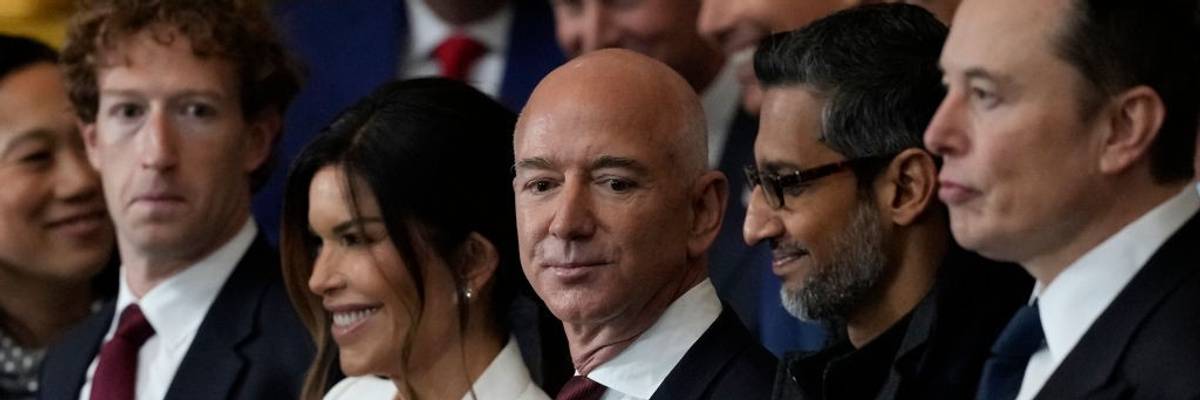
Guests including Mark Zuckerberg, Lauren Sanchez, Jeff Bezos, Sundar Pichai, and Elon Musk attend the Inauguration of Donald J. Trump in the US Capitol Rotunda on January 20, 2025 in Washington, DC.
Even if the Democrats secure a victory in the midterm elections, would-be king Donald’s ultra-rich supporters will continue to find ways to protect their privileged status in society.
Two opposing views from America’s Founding Fathers are particularly relevant to the upcoming No Kings rallies:
I once played the historic figure of Gouverneur Morris in Paul Foster’s stage play, Tom Paine, about the life of Thomas Paine who, in 1776, wrote a pamphlet called “Common Sense,” which guided and gave form to the American Revolution. Much has been written about how that work has direct relevance to today’s No Kings rallies, making a compelling case for the preservation of a republic and representative democracy over authoritarianism. However, thinking back to Foster’s play, I’m reminded that it’s important to also remember Morris because, as a bitter critic of Paine, he represents a viewpoint diametrically opposed to Paine’s egalitarianism, as represented in the role of oligarchs in society, or the “gentry,” as he called them. Their loyalty and support underpins the power of a king. And 250 years later, this is just as true for today’s oligarchs and their would-be king, Donald J. Trump.
Simply have a look at any image of the 2025 presidential inauguration. The platform behind Trump is crowded with the richest people in the country, among them, Elon Musk, Mark Zuckerberg, Jeff Bezos, Tim Cook, Sam Altman, Sundar Pichai, and Rupert Murdoch.
Attending the No Kings rallies to express loudly and clearly the views of the 99% is a step in the right direction.
These people are enablers of Donald Trump, but at the same time, as Paine points out, the relationship between oligarchs and an authoritarian ruler is an uneasy one: “The rich are in general slaves to fear, and submit to courtly power with the trembling duplicity of a spaniel.” How else to describe the obsequious fawning over Donald Trump by those same people on the platform?
A wealthy landholder and capitalist, Gouverneur Morris was a member the “1%” of his day. And when resentment against King George III was brewing in the colonies in the 1770s, he and his fellow landowners worried that any change to the status quo could threaten their power and privilege. Suppressing discontent, however, he realized, would not be easy. Referring to popular leaders in the colonies, in a 1774 letter to John Penn, Morris wrote: “These sheep, simple as they are, cannot be gulled as heretofore. In short, there is no ruling them; and now, to leave the metaphor, the heads of the mobility [mob] grow dangerous to the gentry, and how to keep them down is the question.”
Today’s oligarchs have a simple answer: Spend a billion dollars to elect right-wing candidates in this year’s midterm elections. The degree to which that will work any better than Morris’ efforts in the 1770s remains to be seen.
After armed conflict broke out between colonists and British troops in Lexington and Concord in April 1775, most wealthy landholders did not openly side with the king. However, many argued for negotiations to end the hostilities and reconciliation with the Crown. Thomas Paine thought this was madness. Once blood has been shed, he said, reconciliation was impossible: “As well can the lover forgive the ravisher of his mistress, as the continent forgive the murders of Britain." Indeed, in the end, a peaceful settlement between king and colonists was not to be.
Today, with two years of increasing violence, both rhetorical and physical, on the part of the second Trump administration, that same line has undeniably been crossed.
If in the elections on November 3, Democrats win control of Congress, there will no doubt be calls for toning down the rhetoric, more cooperation across the aisle, and a working relationship between Trump and a Democratic Congress. But, as with Paine’s argument, that may very well not be possible.
At the end of the War of Independence, when the new country’s constitution was being considered, America’s wealthy managed to guarantee their continued privileged position in society. Paine had argued: “The true and only true basis of representative government is equality of rights. Every man has a right to one vote… The rich have no more right to exclude the poor from the right of voting, or of electing and being elected, than the poor have to exclude the rich.” However, at the Constitutional Convention of 1787, Morris made the case that only those who owned property should have the right to vote. “Children do not vote,” he said, “Why? Because they want prudence; because they have no will of their own. The ignorant and the dependent can be as little trusted with the public interest.” James Madison, Alexander Hamilton, and John Adams agreed, and although the Constitution left the right to vote in the hands of the individual states, in most cases that meant that only white male voters with property could vote.
Although they will still seek to benefit from their proximity to power in the wake of a Democratic victory in the midterms, like Morris and his fellow gentry, Trump’s ultra-rich supporters will continue to find ways to protect their privileged status in society. With virtually unlimited resources, both financial and technical (including advanced AI models), along with increasing control of the media, the oligarchs will do their best to influence policy, legislation, regulation, and public opinion. This will make them difficult to keep in check. But attending the No Kings rallies to express loudly and clearly the views of the 99% is a step in the right direction.
Before the war, judges in the colonies were appointed and paid by the Crown. This made them natural allies of the king and the wealthy in society. Morris believed that “the principle purpose of the state was protecting private property” and a strong executive and the courts were the instruments to ensure that. In today’s America, this alliance is again in force on the Supreme Court. Trump has nominated 3 of its 9 judges, and 3 others were nominated by Republican presidents, giving the conservatives a supermajority. For this reason, the court has ruled in Trump’s favor in many cases, notably rolling back voting rights and loosening campaign financing laws, both of which entrench the power of the wealthy over the poor. But the court has also afforded Trump king-like immunity from prosecution for all “official acts.”
Thomas Paine had a response to that: “When it is laid down as a maxim, that a King can do no wrong, it places him in a state of similar security with that of idiots and persons insane, and responsibility is out of the question with respect to himself.” I leave it to you to decide if that description applies to our would-be king.
Dear Common Dreams reader, It’s been nearly 30 years since I co-founded Common Dreams with my late wife, Lina Newhouser. We had the radical notion that journalism should serve the public good, not corporate profits. It was clear to us from the outset what it would take to build such a project. No paid advertisements. No corporate sponsors. No millionaire publisher telling us what to think or do. Many people said we wouldn't last a year, but we proved those doubters wrong. Together with a tremendous team of journalists and dedicated staff, we built an independent media outlet free from the constraints of profits and corporate control. Our mission has always been simple: To inform. To inspire. To ignite change for the common good. Building Common Dreams was not easy. Our survival was never guaranteed. When you take on the most powerful forces—Wall Street greed, fossil fuel industry destruction, Big Tech lobbyists, and uber-rich oligarchs who have spent billions upon billions rigging the economy and democracy in their favor—the only bulwark you have is supporters who believe in your work. But here’s the urgent message from me today. It's never been this bad out there. And it's never been this hard to keep us going. At the very moment Common Dreams is most needed, the threats we face are intensifying. We need your support now more than ever. We don't accept corporate advertising and never will. We don't have a paywall because we don't think people should be blocked from critical news based on their ability to pay. Everything we do is funded by the donations of readers like you. When everyone does the little they can afford, we are strong. But if that support retreats or dries up, so do we. Will you donate now to make sure Common Dreams not only survives but thrives? —Craig Brown, Co-founder |
Two opposing views from America’s Founding Fathers are particularly relevant to the upcoming No Kings rallies:
I once played the historic figure of Gouverneur Morris in Paul Foster’s stage play, Tom Paine, about the life of Thomas Paine who, in 1776, wrote a pamphlet called “Common Sense,” which guided and gave form to the American Revolution. Much has been written about how that work has direct relevance to today’s No Kings rallies, making a compelling case for the preservation of a republic and representative democracy over authoritarianism. However, thinking back to Foster’s play, I’m reminded that it’s important to also remember Morris because, as a bitter critic of Paine, he represents a viewpoint diametrically opposed to Paine’s egalitarianism, as represented in the role of oligarchs in society, or the “gentry,” as he called them. Their loyalty and support underpins the power of a king. And 250 years later, this is just as true for today’s oligarchs and their would-be king, Donald J. Trump.
Simply have a look at any image of the 2025 presidential inauguration. The platform behind Trump is crowded with the richest people in the country, among them, Elon Musk, Mark Zuckerberg, Jeff Bezos, Tim Cook, Sam Altman, Sundar Pichai, and Rupert Murdoch.
Attending the No Kings rallies to express loudly and clearly the views of the 99% is a step in the right direction.
These people are enablers of Donald Trump, but at the same time, as Paine points out, the relationship between oligarchs and an authoritarian ruler is an uneasy one: “The rich are in general slaves to fear, and submit to courtly power with the trembling duplicity of a spaniel.” How else to describe the obsequious fawning over Donald Trump by those same people on the platform?
A wealthy landholder and capitalist, Gouverneur Morris was a member the “1%” of his day. And when resentment against King George III was brewing in the colonies in the 1770s, he and his fellow landowners worried that any change to the status quo could threaten their power and privilege. Suppressing discontent, however, he realized, would not be easy. Referring to popular leaders in the colonies, in a 1774 letter to John Penn, Morris wrote: “These sheep, simple as they are, cannot be gulled as heretofore. In short, there is no ruling them; and now, to leave the metaphor, the heads of the mobility [mob] grow dangerous to the gentry, and how to keep them down is the question.”
Today’s oligarchs have a simple answer: Spend a billion dollars to elect right-wing candidates in this year’s midterm elections. The degree to which that will work any better than Morris’ efforts in the 1770s remains to be seen.
After armed conflict broke out between colonists and British troops in Lexington and Concord in April 1775, most wealthy landholders did not openly side with the king. However, many argued for negotiations to end the hostilities and reconciliation with the Crown. Thomas Paine thought this was madness. Once blood has been shed, he said, reconciliation was impossible: “As well can the lover forgive the ravisher of his mistress, as the continent forgive the murders of Britain." Indeed, in the end, a peaceful settlement between king and colonists was not to be.
Today, with two years of increasing violence, both rhetorical and physical, on the part of the second Trump administration, that same line has undeniably been crossed.
If in the elections on November 3, Democrats win control of Congress, there will no doubt be calls for toning down the rhetoric, more cooperation across the aisle, and a working relationship between Trump and a Democratic Congress. But, as with Paine’s argument, that may very well not be possible.
At the end of the War of Independence, when the new country’s constitution was being considered, America’s wealthy managed to guarantee their continued privileged position in society. Paine had argued: “The true and only true basis of representative government is equality of rights. Every man has a right to one vote… The rich have no more right to exclude the poor from the right of voting, or of electing and being elected, than the poor have to exclude the rich.” However, at the Constitutional Convention of 1787, Morris made the case that only those who owned property should have the right to vote. “Children do not vote,” he said, “Why? Because they want prudence; because they have no will of their own. The ignorant and the dependent can be as little trusted with the public interest.” James Madison, Alexander Hamilton, and John Adams agreed, and although the Constitution left the right to vote in the hands of the individual states, in most cases that meant that only white male voters with property could vote.
Although they will still seek to benefit from their proximity to power in the wake of a Democratic victory in the midterms, like Morris and his fellow gentry, Trump’s ultra-rich supporters will continue to find ways to protect their privileged status in society. With virtually unlimited resources, both financial and technical (including advanced AI models), along with increasing control of the media, the oligarchs will do their best to influence policy, legislation, regulation, and public opinion. This will make them difficult to keep in check. But attending the No Kings rallies to express loudly and clearly the views of the 99% is a step in the right direction.
Before the war, judges in the colonies were appointed and paid by the Crown. This made them natural allies of the king and the wealthy in society. Morris believed that “the principle purpose of the state was protecting private property” and a strong executive and the courts were the instruments to ensure that. In today’s America, this alliance is again in force on the Supreme Court. Trump has nominated 3 of its 9 judges, and 3 others were nominated by Republican presidents, giving the conservatives a supermajority. For this reason, the court has ruled in Trump’s favor in many cases, notably rolling back voting rights and loosening campaign financing laws, both of which entrench the power of the wealthy over the poor. But the court has also afforded Trump king-like immunity from prosecution for all “official acts.”
Thomas Paine had a response to that: “When it is laid down as a maxim, that a King can do no wrong, it places him in a state of similar security with that of idiots and persons insane, and responsibility is out of the question with respect to himself.” I leave it to you to decide if that description applies to our would-be king.
Two opposing views from America’s Founding Fathers are particularly relevant to the upcoming No Kings rallies:
I once played the historic figure of Gouverneur Morris in Paul Foster’s stage play, Tom Paine, about the life of Thomas Paine who, in 1776, wrote a pamphlet called “Common Sense,” which guided and gave form to the American Revolution. Much has been written about how that work has direct relevance to today’s No Kings rallies, making a compelling case for the preservation of a republic and representative democracy over authoritarianism. However, thinking back to Foster’s play, I’m reminded that it’s important to also remember Morris because, as a bitter critic of Paine, he represents a viewpoint diametrically opposed to Paine’s egalitarianism, as represented in the role of oligarchs in society, or the “gentry,” as he called them. Their loyalty and support underpins the power of a king. And 250 years later, this is just as true for today’s oligarchs and their would-be king, Donald J. Trump.
Simply have a look at any image of the 2025 presidential inauguration. The platform behind Trump is crowded with the richest people in the country, among them, Elon Musk, Mark Zuckerberg, Jeff Bezos, Tim Cook, Sam Altman, Sundar Pichai, and Rupert Murdoch.
Attending the No Kings rallies to express loudly and clearly the views of the 99% is a step in the right direction.
These people are enablers of Donald Trump, but at the same time, as Paine points out, the relationship between oligarchs and an authoritarian ruler is an uneasy one: “The rich are in general slaves to fear, and submit to courtly power with the trembling duplicity of a spaniel.” How else to describe the obsequious fawning over Donald Trump by those same people on the platform?
A wealthy landholder and capitalist, Gouverneur Morris was a member the “1%” of his day. And when resentment against King George III was brewing in the colonies in the 1770s, he and his fellow landowners worried that any change to the status quo could threaten their power and privilege. Suppressing discontent, however, he realized, would not be easy. Referring to popular leaders in the colonies, in a 1774 letter to John Penn, Morris wrote: “These sheep, simple as they are, cannot be gulled as heretofore. In short, there is no ruling them; and now, to leave the metaphor, the heads of the mobility [mob] grow dangerous to the gentry, and how to keep them down is the question.”
Today’s oligarchs have a simple answer: Spend a billion dollars to elect right-wing candidates in this year’s midterm elections. The degree to which that will work any better than Morris’ efforts in the 1770s remains to be seen.
After armed conflict broke out between colonists and British troops in Lexington and Concord in April 1775, most wealthy landholders did not openly side with the king. However, many argued for negotiations to end the hostilities and reconciliation with the Crown. Thomas Paine thought this was madness. Once blood has been shed, he said, reconciliation was impossible: “As well can the lover forgive the ravisher of his mistress, as the continent forgive the murders of Britain." Indeed, in the end, a peaceful settlement between king and colonists was not to be.
Today, with two years of increasing violence, both rhetorical and physical, on the part of the second Trump administration, that same line has undeniably been crossed.
If in the elections on November 3, Democrats win control of Congress, there will no doubt be calls for toning down the rhetoric, more cooperation across the aisle, and a working relationship between Trump and a Democratic Congress. But, as with Paine’s argument, that may very well not be possible.
At the end of the War of Independence, when the new country’s constitution was being considered, America’s wealthy managed to guarantee their continued privileged position in society. Paine had argued: “The true and only true basis of representative government is equality of rights. Every man has a right to one vote… The rich have no more right to exclude the poor from the right of voting, or of electing and being elected, than the poor have to exclude the rich.” However, at the Constitutional Convention of 1787, Morris made the case that only those who owned property should have the right to vote. “Children do not vote,” he said, “Why? Because they want prudence; because they have no will of their own. The ignorant and the dependent can be as little trusted with the public interest.” James Madison, Alexander Hamilton, and John Adams agreed, and although the Constitution left the right to vote in the hands of the individual states, in most cases that meant that only white male voters with property could vote.
Although they will still seek to benefit from their proximity to power in the wake of a Democratic victory in the midterms, like Morris and his fellow gentry, Trump’s ultra-rich supporters will continue to find ways to protect their privileged status in society. With virtually unlimited resources, both financial and technical (including advanced AI models), along with increasing control of the media, the oligarchs will do their best to influence policy, legislation, regulation, and public opinion. This will make them difficult to keep in check. But attending the No Kings rallies to express loudly and clearly the views of the 99% is a step in the right direction.
Before the war, judges in the colonies were appointed and paid by the Crown. This made them natural allies of the king and the wealthy in society. Morris believed that “the principle purpose of the state was protecting private property” and a strong executive and the courts were the instruments to ensure that. In today’s America, this alliance is again in force on the Supreme Court. Trump has nominated 3 of its 9 judges, and 3 others were nominated by Republican presidents, giving the conservatives a supermajority. For this reason, the court has ruled in Trump’s favor in many cases, notably rolling back voting rights and loosening campaign financing laws, both of which entrench the power of the wealthy over the poor. But the court has also afforded Trump king-like immunity from prosecution for all “official acts.”
Thomas Paine had a response to that: “When it is laid down as a maxim, that a King can do no wrong, it places him in a state of similar security with that of idiots and persons insane, and responsibility is out of the question with respect to himself.” I leave it to you to decide if that description applies to our would-be king.