5
#000000
#FFFFFF
To donate by check, phone, or other method, see our More Ways to Give page.
Daily news & progressive opinion—funded by the people, not the corporations—delivered straight to your inbox.
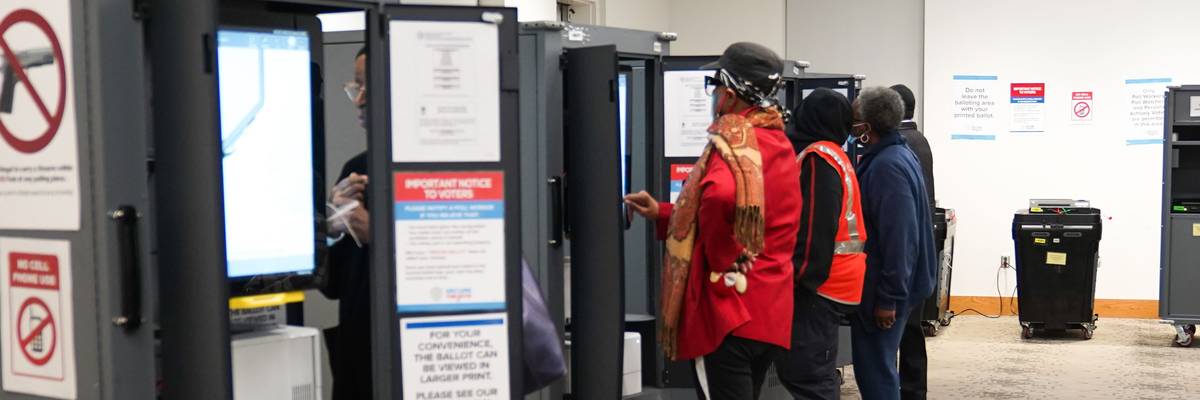
People cast their votes on the first day of early voting in the US Presidential election at Metropolitan library on October 15, 2024 in Atlanta,
Democracy has always depended on more than elections. It depends on institutions that people believe are worthy of their participation and capable of improving their lives.
As millions head to the polls in the 2026 elections, voters are showing up disappointed, forgotten, and worn down from years of failed policies.
After nearly two decades working inside campaigns, Democratic leaders, national advocacy organizations, and movement institutions have made it clear: We’ve got a problem on our hands.
The challenge before us is not simply that Democrats have a messaging problem, nor is it that Republicans have become better communicators. The deeper problem is that we have spent years trying to win elections while underinvesting in the communities, relationships, and culture that make political victories durable.
People don’t organize their lives around resistance alone. They organize around belonging, purpose, hope, and the possibility that tomorrow can be better than today.
Narratives don’t emerge from communications plans, but rather from institutions that people trust. This distinction matters.
We keep hearing the same question: Why aren’t more young people and people of color engaged in the civic process? This is the wrong question.
The question we need to be asking is whether or not our current institutions are willing to or even positioned to share power with us. More often than not, participation is shared only after decisions are made, and usually with an ask attached.
We are not waiting for institutions to tell us how to participate. We have lived the reality of what happens when institutions fail, time and time again. We have seen how powerful it is when we build our own.
Young Black folks in particular are organizing, creating, building community, and culture. Especially for those who are young, queer, and Black, so much of the language and swagger that shapes our lives has been created by us. We know that when institutional belonging is unavailable, community creates belonging. We got us.
As Black queer Americans, we inherit a tradition shaped by people who understood that institutions rarely surrender power simply because the moral argument is clear. Generations before us organized, marched, litigated, and forced America to confront the distance between its ideals and its reality. Progress has never been inevitable. It has always been demanded.
A collective 20 years inside politics has made it clear to us: Institutions rarely fail overnight. Long before they lose public trust, they lose relevance. They become more concerned with protecting existing power than with creating new possibilities, optimizing for stability rather than adaptation.
Eventually, they find themselves speaking fluently to one another while struggling to connect with the people they were created to serve. That is where much of the progressive movement finds itself today.
Americans are losing faith in politics and in the idea that our institutions can solve the problems shaping their everyday lives.
People do not experience institutional failure in constitutional language or policy briefs. They experience it through rising costs, unstable jobs, inaccessible housing, underfunded schools, broken infrastructure, and the growing sense that the rules apply differently depending on who you are and how much power you hold. They talk about fairness, opportunity, dignity, and whether working hard still leads to a better life.
These conversations are not separate from politics. They are politics. We can’t continue mistaking communications for culture.
Too often, the response has been to refine the message rather than rebuild the institution that delivers it. We have mistaken communication for culture, which has led to the consequences we are all currently living with.
The progressive movement has become extraordinarily sophisticated at producing content. We can generate messaging guidance overnight, build rapid-response campaigns within hours, and create endless streams of digital content. Yet none of those capabilities automatically produce trust.
Trust is earned when people see themselves reflected not only in the message but in the leadership, values, and relationships behind it. You can’t message your way out of a deficit of trust. No amount of message testing can compensate for institutions that people no longer believe understand their lives.
This is where imagination becomes essential.
Since 2016, countless postmortems have focused on messaging, media strategy, and digital infrastructure. Those conversations matter, but they begin from an incomplete premise. They assume we already have a compelling story to tell.
We are not convinced we do.
Sentiments such as “fight” or “protect democracy” are important calls to action, but they are not visions of the future. They put us on the defensive and describe what we oppose more clearly than what we are building. People don’t organize their lives around resistance alone. They organize around belonging, purpose, hope, and the possibility that tomorrow can be better than today.
That kind of vision cannot be manufactured through advertising.
It grows from culture. It expands from artists, educators, organizers, faith leaders, entrepreneurs, local institutions, and civic spaces where people build relationships long before anyone asks for their vote.
We can look back at the Obama era, as one example of how politics can bend the arc of history. If you were near a college campus on November 4, 2008, you remember the celebrations. Music poured from dorm rooms and car speakers, topped off with dancing in the street. For a brief moment, hope felt less like a slogan and more like a possibility finally personified. The belief in our collective power and the possibilities it could create ignited a generation.
Research supports what many organizers have understood intuitively for decades. Economist Raj Chetty’s work on economic mobility found that social capital (the relationships that connect people across communities and opportunities) is among the strongest predictors of upward mobility. That insight extends beyond economics.
Relationships shape what people believe is possible. They influence trust, aspiration, and whether institutions feel relevant to everyday life. Politics is no different.
Queer communities have long understood something about the power of relationships that institutions are only beginning to relearn. We call it chosen family: the idea that belonging can be deliberately built through relationships of trust, care, responsibility, and mutual recognition. There is a civic lesson in that tradition. Durable movements are built the same way. Not through an email list or a message tested to perfection, but through relationships strong enough to survive disagreement, disappointment, and the space between elections.
The same is true for Black communities, particularly Black women, whose creativity, organizing, and cultural leadership have repeatedly expanded the boundaries of American democracy while too often receiving recognition only after the fact.
Innovation doesn’t come from preserving the status quo. History has shown us that it comes from creating space for voices that institutions have historically overlooked.
That means the work ahead demands more than better campaigns. It requires rebuilding civic infrastructure and cultivating leaders rather than personalities. A focus on relationships instead of audiences and investing in organizations that remain present between election cycles.
Institutional renewal is no longer optional as artificial intelligence, economic uncertainty, climate disruption, and political polarization reshape public life simultaneously. The pace of change is accelerating, while confidence in the institutions meant to guide us continues to decline.
That should concern all of us. Democracy has always depended on more than elections. It depends on institutions that people believe are worthy of their participation and capable of improving their lives.
The encouraging news is that Americans have not completely lost faith in one another. Mutual aid networks, local organizers, community leaders, and everyday people continue to demonstrate the generosity and resilience our institutions often struggle to match.
We must build institutions strong enough, imaginative enough, and trustworthy enough for the story to tell itself. There’s no other choice.
Dear Common Dreams reader, It’s been nearly 30 years since I co-founded Common Dreams with my late wife, Lina Newhouser. We had the radical notion that journalism should serve the public good, not corporate profits. It was clear to us from the outset what it would take to build such a project. No paid advertisements. No corporate sponsors. No millionaire publisher telling us what to think or do. Many people said we wouldn't last a year, but we proved those doubters wrong. Together with a tremendous team of journalists and dedicated staff, we built an independent media outlet free from the constraints of profits and corporate control. Our mission has always been simple: To inform. To inspire. To ignite change for the common good. Building Common Dreams was not easy. Our survival was never guaranteed. When you take on the most powerful forces—Wall Street greed, fossil fuel industry destruction, Big Tech lobbyists, and uber-rich oligarchs who have spent billions upon billions rigging the economy and democracy in their favor—the only bulwark you have is supporters who believe in your work. But here’s the urgent message from me today. It's never been this bad out there. And it's never been this hard to keep us going. At the very moment Common Dreams is most needed, the threats we face are intensifying. We need your support now more than ever. We don't accept corporate advertising and never will. We don't have a paywall because we don't think people should be blocked from critical news based on their ability to pay. Everything we do is funded by the donations of readers like you. When everyone does the little they can afford, we are strong. But if that support retreats or dries up, so do we. Will you donate now to make sure Common Dreams not only survives but thrives? —Craig Brown, Co-founder |
As millions head to the polls in the 2026 elections, voters are showing up disappointed, forgotten, and worn down from years of failed policies.
After nearly two decades working inside campaigns, Democratic leaders, national advocacy organizations, and movement institutions have made it clear: We’ve got a problem on our hands.
The challenge before us is not simply that Democrats have a messaging problem, nor is it that Republicans have become better communicators. The deeper problem is that we have spent years trying to win elections while underinvesting in the communities, relationships, and culture that make political victories durable.
People don’t organize their lives around resistance alone. They organize around belonging, purpose, hope, and the possibility that tomorrow can be better than today.
Narratives don’t emerge from communications plans, but rather from institutions that people trust. This distinction matters.
We keep hearing the same question: Why aren’t more young people and people of color engaged in the civic process? This is the wrong question.
The question we need to be asking is whether or not our current institutions are willing to or even positioned to share power with us. More often than not, participation is shared only after decisions are made, and usually with an ask attached.
We are not waiting for institutions to tell us how to participate. We have lived the reality of what happens when institutions fail, time and time again. We have seen how powerful it is when we build our own.
Young Black folks in particular are organizing, creating, building community, and culture. Especially for those who are young, queer, and Black, so much of the language and swagger that shapes our lives has been created by us. We know that when institutional belonging is unavailable, community creates belonging. We got us.
As Black queer Americans, we inherit a tradition shaped by people who understood that institutions rarely surrender power simply because the moral argument is clear. Generations before us organized, marched, litigated, and forced America to confront the distance between its ideals and its reality. Progress has never been inevitable. It has always been demanded.
A collective 20 years inside politics has made it clear to us: Institutions rarely fail overnight. Long before they lose public trust, they lose relevance. They become more concerned with protecting existing power than with creating new possibilities, optimizing for stability rather than adaptation.
Eventually, they find themselves speaking fluently to one another while struggling to connect with the people they were created to serve. That is where much of the progressive movement finds itself today.
Americans are losing faith in politics and in the idea that our institutions can solve the problems shaping their everyday lives.
People do not experience institutional failure in constitutional language or policy briefs. They experience it through rising costs, unstable jobs, inaccessible housing, underfunded schools, broken infrastructure, and the growing sense that the rules apply differently depending on who you are and how much power you hold. They talk about fairness, opportunity, dignity, and whether working hard still leads to a better life.
These conversations are not separate from politics. They are politics. We can’t continue mistaking communications for culture.
Too often, the response has been to refine the message rather than rebuild the institution that delivers it. We have mistaken communication for culture, which has led to the consequences we are all currently living with.
The progressive movement has become extraordinarily sophisticated at producing content. We can generate messaging guidance overnight, build rapid-response campaigns within hours, and create endless streams of digital content. Yet none of those capabilities automatically produce trust.
Trust is earned when people see themselves reflected not only in the message but in the leadership, values, and relationships behind it. You can’t message your way out of a deficit of trust. No amount of message testing can compensate for institutions that people no longer believe understand their lives.
This is where imagination becomes essential.
Since 2016, countless postmortems have focused on messaging, media strategy, and digital infrastructure. Those conversations matter, but they begin from an incomplete premise. They assume we already have a compelling story to tell.
We are not convinced we do.
Sentiments such as “fight” or “protect democracy” are important calls to action, but they are not visions of the future. They put us on the defensive and describe what we oppose more clearly than what we are building. People don’t organize their lives around resistance alone. They organize around belonging, purpose, hope, and the possibility that tomorrow can be better than today.
That kind of vision cannot be manufactured through advertising.
It grows from culture. It expands from artists, educators, organizers, faith leaders, entrepreneurs, local institutions, and civic spaces where people build relationships long before anyone asks for their vote.
We can look back at the Obama era, as one example of how politics can bend the arc of history. If you were near a college campus on November 4, 2008, you remember the celebrations. Music poured from dorm rooms and car speakers, topped off with dancing in the street. For a brief moment, hope felt less like a slogan and more like a possibility finally personified. The belief in our collective power and the possibilities it could create ignited a generation.
Research supports what many organizers have understood intuitively for decades. Economist Raj Chetty’s work on economic mobility found that social capital (the relationships that connect people across communities and opportunities) is among the strongest predictors of upward mobility. That insight extends beyond economics.
Relationships shape what people believe is possible. They influence trust, aspiration, and whether institutions feel relevant to everyday life. Politics is no different.
Queer communities have long understood something about the power of relationships that institutions are only beginning to relearn. We call it chosen family: the idea that belonging can be deliberately built through relationships of trust, care, responsibility, and mutual recognition. There is a civic lesson in that tradition. Durable movements are built the same way. Not through an email list or a message tested to perfection, but through relationships strong enough to survive disagreement, disappointment, and the space between elections.
The same is true for Black communities, particularly Black women, whose creativity, organizing, and cultural leadership have repeatedly expanded the boundaries of American democracy while too often receiving recognition only after the fact.
Innovation doesn’t come from preserving the status quo. History has shown us that it comes from creating space for voices that institutions have historically overlooked.
That means the work ahead demands more than better campaigns. It requires rebuilding civic infrastructure and cultivating leaders rather than personalities. A focus on relationships instead of audiences and investing in organizations that remain present between election cycles.
Institutional renewal is no longer optional as artificial intelligence, economic uncertainty, climate disruption, and political polarization reshape public life simultaneously. The pace of change is accelerating, while confidence in the institutions meant to guide us continues to decline.
That should concern all of us. Democracy has always depended on more than elections. It depends on institutions that people believe are worthy of their participation and capable of improving their lives.
The encouraging news is that Americans have not completely lost faith in one another. Mutual aid networks, local organizers, community leaders, and everyday people continue to demonstrate the generosity and resilience our institutions often struggle to match.
We must build institutions strong enough, imaginative enough, and trustworthy enough for the story to tell itself. There’s no other choice.
As millions head to the polls in the 2026 elections, voters are showing up disappointed, forgotten, and worn down from years of failed policies.
After nearly two decades working inside campaigns, Democratic leaders, national advocacy organizations, and movement institutions have made it clear: We’ve got a problem on our hands.
The challenge before us is not simply that Democrats have a messaging problem, nor is it that Republicans have become better communicators. The deeper problem is that we have spent years trying to win elections while underinvesting in the communities, relationships, and culture that make political victories durable.
People don’t organize their lives around resistance alone. They organize around belonging, purpose, hope, and the possibility that tomorrow can be better than today.
Narratives don’t emerge from communications plans, but rather from institutions that people trust. This distinction matters.
We keep hearing the same question: Why aren’t more young people and people of color engaged in the civic process? This is the wrong question.
The question we need to be asking is whether or not our current institutions are willing to or even positioned to share power with us. More often than not, participation is shared only after decisions are made, and usually with an ask attached.
We are not waiting for institutions to tell us how to participate. We have lived the reality of what happens when institutions fail, time and time again. We have seen how powerful it is when we build our own.
Young Black folks in particular are organizing, creating, building community, and culture. Especially for those who are young, queer, and Black, so much of the language and swagger that shapes our lives has been created by us. We know that when institutional belonging is unavailable, community creates belonging. We got us.
As Black queer Americans, we inherit a tradition shaped by people who understood that institutions rarely surrender power simply because the moral argument is clear. Generations before us organized, marched, litigated, and forced America to confront the distance between its ideals and its reality. Progress has never been inevitable. It has always been demanded.
A collective 20 years inside politics has made it clear to us: Institutions rarely fail overnight. Long before they lose public trust, they lose relevance. They become more concerned with protecting existing power than with creating new possibilities, optimizing for stability rather than adaptation.
Eventually, they find themselves speaking fluently to one another while struggling to connect with the people they were created to serve. That is where much of the progressive movement finds itself today.
Americans are losing faith in politics and in the idea that our institutions can solve the problems shaping their everyday lives.
People do not experience institutional failure in constitutional language or policy briefs. They experience it through rising costs, unstable jobs, inaccessible housing, underfunded schools, broken infrastructure, and the growing sense that the rules apply differently depending on who you are and how much power you hold. They talk about fairness, opportunity, dignity, and whether working hard still leads to a better life.
These conversations are not separate from politics. They are politics. We can’t continue mistaking communications for culture.
Too often, the response has been to refine the message rather than rebuild the institution that delivers it. We have mistaken communication for culture, which has led to the consequences we are all currently living with.
The progressive movement has become extraordinarily sophisticated at producing content. We can generate messaging guidance overnight, build rapid-response campaigns within hours, and create endless streams of digital content. Yet none of those capabilities automatically produce trust.
Trust is earned when people see themselves reflected not only in the message but in the leadership, values, and relationships behind it. You can’t message your way out of a deficit of trust. No amount of message testing can compensate for institutions that people no longer believe understand their lives.
This is where imagination becomes essential.
Since 2016, countless postmortems have focused on messaging, media strategy, and digital infrastructure. Those conversations matter, but they begin from an incomplete premise. They assume we already have a compelling story to tell.
We are not convinced we do.
Sentiments such as “fight” or “protect democracy” are important calls to action, but they are not visions of the future. They put us on the defensive and describe what we oppose more clearly than what we are building. People don’t organize their lives around resistance alone. They organize around belonging, purpose, hope, and the possibility that tomorrow can be better than today.
That kind of vision cannot be manufactured through advertising.
It grows from culture. It expands from artists, educators, organizers, faith leaders, entrepreneurs, local institutions, and civic spaces where people build relationships long before anyone asks for their vote.
We can look back at the Obama era, as one example of how politics can bend the arc of history. If you were near a college campus on November 4, 2008, you remember the celebrations. Music poured from dorm rooms and car speakers, topped off with dancing in the street. For a brief moment, hope felt less like a slogan and more like a possibility finally personified. The belief in our collective power and the possibilities it could create ignited a generation.
Research supports what many organizers have understood intuitively for decades. Economist Raj Chetty’s work on economic mobility found that social capital (the relationships that connect people across communities and opportunities) is among the strongest predictors of upward mobility. That insight extends beyond economics.
Relationships shape what people believe is possible. They influence trust, aspiration, and whether institutions feel relevant to everyday life. Politics is no different.
Queer communities have long understood something about the power of relationships that institutions are only beginning to relearn. We call it chosen family: the idea that belonging can be deliberately built through relationships of trust, care, responsibility, and mutual recognition. There is a civic lesson in that tradition. Durable movements are built the same way. Not through an email list or a message tested to perfection, but through relationships strong enough to survive disagreement, disappointment, and the space between elections.
The same is true for Black communities, particularly Black women, whose creativity, organizing, and cultural leadership have repeatedly expanded the boundaries of American democracy while too often receiving recognition only after the fact.
Innovation doesn’t come from preserving the status quo. History has shown us that it comes from creating space for voices that institutions have historically overlooked.
That means the work ahead demands more than better campaigns. It requires rebuilding civic infrastructure and cultivating leaders rather than personalities. A focus on relationships instead of audiences and investing in organizations that remain present between election cycles.
Institutional renewal is no longer optional as artificial intelligence, economic uncertainty, climate disruption, and political polarization reshape public life simultaneously. The pace of change is accelerating, while confidence in the institutions meant to guide us continues to decline.
That should concern all of us. Democracy has always depended on more than elections. It depends on institutions that people believe are worthy of their participation and capable of improving their lives.
The encouraging news is that Americans have not completely lost faith in one another. Mutual aid networks, local organizers, community leaders, and everyday people continue to demonstrate the generosity and resilience our institutions often struggle to match.
We must build institutions strong enough, imaginative enough, and trustworthy enough for the story to tell itself. There’s no other choice.