SUBSCRIBE TO OUR FREE NEWSLETTER
Daily news & progressive opinion—funded by the people, not the corporations—delivered straight to your inbox.
5
#000000
#FFFFFF
To donate by check, phone, or other method, see our More Ways to Give page.
Daily news & progressive opinion—funded by the people, not the corporations—delivered straight to your inbox.
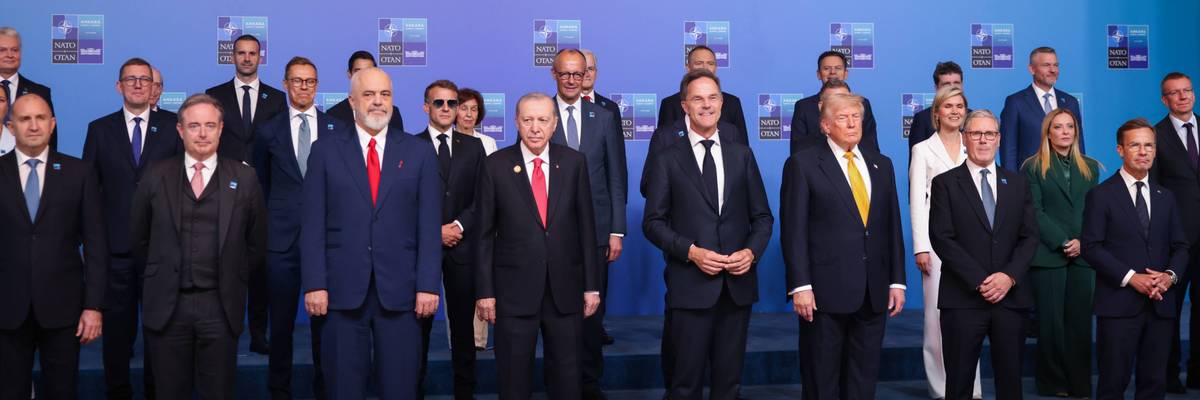
Mark Rutte, secretary general of NATO; Donald Trump, president of United States; and Keir Starmer, prime minister of United Kingdom; and other heads of states pose for a family photo at Bestepe Presidential Compound during the 2026 NATO Ankara Summit in Ankara, Turkiye, on July 8th, 2026.
NATO’s leaders would do well to remember that true security is not measured in the size of an arsenal, but in the strength of the societies it claims to protect.
As NATO convenes once again to double down on military spending, arms production, and the logic of deterrence through superior firepower—this despite the alliance’s own members having repeatedly used force in violation of international law in recent years, in Iran, Iraq, Venezuela, Libya, Syria, and the open-ended War on Terror—it is worth asking: What kind of security are we actually buying?
These interventions, often justified under the guise of humanitarianism or collective defense, have in practice destabilized entire regions, fueled insurgencies, and visited immense suffering upon some of the world’s most vulnerable populations. The result is a perverse paradox of an alliance that presents itself as the guardian of a rules-based order but has, through its own actions, undermined that very order, deepening the insecurity it claims to combat.
The record is unambiguous: Militarized security is reactive, not preventive. It treats symptoms—territorial disputes, insurgencies, great-power rivalry—while ignoring root causes such as inequality, resource scarcity, political exclusion, and the erosion of trust in institutions. The post-1945 era, for all its flaws, demonstrated that stability is not the product of arms races, but of norms, institutions, and the rule of law.
The relative peace among liberal democracies, the decline in international armed conflicts, and the gradual expansion of human rights all occurred not because states built bigger arsenals, but because they built stronger frameworks for cooperation. International organizations—including the United Nations, the World Health Organization, the International Labor Organization, and the International Court of Justice—have encouraged cooperation and stability, while aircraft carriers or hypersonic missiles have mainly spread terror and destruction. Yet as NATO attempts to expand its influence these very institutions of social cooperation are under attack by the same NATO member states who have cut funding and even withdrawn from the organizations in some cases.
What we require is a legal framework that serves as the foundation for a truly equitable international community—one that enforces cooperation over competition, shared development over extraction, and the rights of all people over the privileges of a few.
The opportunity cost of this militarized approach urged by NATO is staggering. The combined military expenditure of NATO members now exceeds $1.3 trillion annually according to the Stockholm International Peace Research Institute (SIPRI). The UN Development Programme’s (UNDP) Human Development Reports indicates this is a figure that dwarfs the estimated $40 billion needed to close the global gaps in education, healthcare, and food security.
For the price of a single nuclear-powered submarine, a nation could fund universal pre-kindergarten for its entire population for a year. For the cost of a new fighter jet squadron, it could eliminate malaria in an entire region. These are not moral abstractions; they are strategic failures.
Study after study has shown that spending on healthcare, education, and renewable energy generates far greater economic multipliers in terms of job creation and GDP growth than equivalent spending on defense. Military expenditure distorts economies, prioritizing a narrow industrial base of contractors and exporters over diversified, sustainable development. It exacerbates inequality by funneling public resources into capital-intensive sectors that benefit elites, while social services—hospitals, schools, public transit—suffer from chronic underfunding. When citizens see their tax dollars funding bombs rather than bridges, cynicism replaces civic engagement, and the very legitimacy of a country’s governance is undermined.
International law, which has been a strong impetus to cooperation in the world and which can provide fundamental rules of fairness, has been used as an instrument to promote militarization and violence in the world by the wealthiest and most powerful countries in the world.
The path forward demands a radical reimagining of international law—not as it is currently wielded by powerful states to justify intervention, enforce economic dependency, or entrench global hierarchies, but as a tool for genuine equity, cooperation, and shared prosperity.
Today, international law is too often a weapon of the strong, invoked selectively to punish adversaries while ignoring the transgressions of allies. This is not the international law we need. What we require is a legal framework that serves as the foundation for a truly equitable international community—one that enforces cooperation over competition, shared development over extraction, and the rights of all people over the privileges of a few.
Such a system must prioritize binding agreements on climate change to ensure our natural environment is protected not as a luxury but as a fundamental right. A fair international legal system would mandate fair trade practices that prevent the exploitation of weaker economies, and it would guarantee economic rights—food, water, education, healthcare—as inalienable entitlements for every human being, not as charities doled out at the discretion of the wealthy. A rejuvenated international law would also hold all states, regardless of power, accountable to the same standards, ending the hypocrisy that allows some nations to flout norms with impunity while others are punished for far lesser offenses.
The argument for participatory governance is not merely moral but strategic. States that involve all their citizens in a meaningful way in the governance of their country are less likely to engage in external conflict because their leaders are accountable to electorates who bear the costs of war. But this participation must be substantive, not procedural. Holding elections means little if economic inequality allows elites to dominate policy, if media concentration distorts public discourse, or if voter suppression silences marginalized groups. True participation requires deliberative assemblies, workplace unionization, digital direct democracy, and local autonomy. When people feel ownership over their government, they are less susceptible to the siren song of populist demagogues and the xenophobic chants of nationalists.
The post-2008 austerity consensus has been a disaster for global stability. Neoliberalism’s core assumption—that unregulated competition drives progress—ignores the fact that markets produce winners and losers, and that losers, when abandoned, turn to extremism. The rise of far-right parties, the spread of extremist movements, and the surge in gang violence are all, in no insignificant part, responses to economic despair.
A global fair deal must prioritize universal basic services as human rights, not commodities. It must invest in green industrial policy to create high-wage, low-carbon jobs. It must cancel the crushing debts of the Global South and replace free trade with fair trade, ensuring that corporations cannot exploit weak regulations in developing States. And it must tax extreme wealth to fund the end of extreme poverty. These are not socialist or communist ideas; they are merely common sense policies.
Yet NATO’s current trajectory assumes that security is a zero-sum game, where one state’s gain is another’s loss. This ignores that the greatest threats of our time—climate change, pandemics, nuclear proliferation—respect no borders. Even China and the United States, despite their rivalry, have cooperated on climate accords and pandemic response when it served their interests. The Montreal Protocol succeeded because states realized ozone depletion threatened them all. Collective security, properly structured, can work. The question is not whether cooperation is possible, but whether we have the will to pursue it. NATO does not answer this challenge, but seeks to exploit it by setting people against each other in the name of militarization.
We have a choice. We can continue down the path of militarized security, where trillions are spent on weapons that guarantee mutual destruction, where inequality festers, and where the logic of competition ensures that no one is ever truly safe. Or we can invest in a future where no child goes hungry, no family lacks healthcare, and no nation lives in fear of another—a future where international law serves as an equalizer, ensuring that the rights and dignity of all people are upheld, and that our shared planet is preserved for generations to come. The former is the path of barbarism. The latter is the path of civilization.
NATO’s leaders would do well to remember that true security is not measured in the size of an arsenal, but in the strength of the societies it claims to protect—and that those societies are far weaker when their most vulnerable members are abandoned to the consequences of unchecked militarism.
Dear Common Dreams reader, It’s been nearly 30 years since I co-founded Common Dreams with my late wife, Lina Newhouser. We had the radical notion that journalism should serve the public good, not corporate profits. It was clear to us from the outset what it would take to build such a project. No paid advertisements. No corporate sponsors. No millionaire publisher telling us what to think or do. Many people said we wouldn't last a year, but we proved those doubters wrong. Together with a tremendous team of journalists and dedicated staff, we built an independent media outlet free from the constraints of profits and corporate control. Our mission has always been simple: To inform. To inspire. To ignite change for the common good. Building Common Dreams was not easy. Our survival was never guaranteed. When you take on the most powerful forces—Wall Street greed, fossil fuel industry destruction, Big Tech lobbyists, and uber-rich oligarchs who have spent billions upon billions rigging the economy and democracy in their favor—the only bulwark you have is supporters who believe in your work. But here’s the urgent message from me today. It's never been this bad out there. And it's never been this hard to keep us going. At the very moment Common Dreams is most needed, the threats we face are intensifying. We need your support now more than ever. We don't accept corporate advertising and never will. We don't have a paywall because we don't think people should be blocked from critical news based on their ability to pay. Everything we do is funded by the donations of readers like you. When everyone does the little they can afford, we are strong. But if that support retreats or dries up, so do we. Will you donate now to make sure Common Dreams not only survives but thrives? —Craig Brown, Co-founder |
As NATO convenes once again to double down on military spending, arms production, and the logic of deterrence through superior firepower—this despite the alliance’s own members having repeatedly used force in violation of international law in recent years, in Iran, Iraq, Venezuela, Libya, Syria, and the open-ended War on Terror—it is worth asking: What kind of security are we actually buying?
These interventions, often justified under the guise of humanitarianism or collective defense, have in practice destabilized entire regions, fueled insurgencies, and visited immense suffering upon some of the world’s most vulnerable populations. The result is a perverse paradox of an alliance that presents itself as the guardian of a rules-based order but has, through its own actions, undermined that very order, deepening the insecurity it claims to combat.
The record is unambiguous: Militarized security is reactive, not preventive. It treats symptoms—territorial disputes, insurgencies, great-power rivalry—while ignoring root causes such as inequality, resource scarcity, political exclusion, and the erosion of trust in institutions. The post-1945 era, for all its flaws, demonstrated that stability is not the product of arms races, but of norms, institutions, and the rule of law.
The relative peace among liberal democracies, the decline in international armed conflicts, and the gradual expansion of human rights all occurred not because states built bigger arsenals, but because they built stronger frameworks for cooperation. International organizations—including the United Nations, the World Health Organization, the International Labor Organization, and the International Court of Justice—have encouraged cooperation and stability, while aircraft carriers or hypersonic missiles have mainly spread terror and destruction. Yet as NATO attempts to expand its influence these very institutions of social cooperation are under attack by the same NATO member states who have cut funding and even withdrawn from the organizations in some cases.
What we require is a legal framework that serves as the foundation for a truly equitable international community—one that enforces cooperation over competition, shared development over extraction, and the rights of all people over the privileges of a few.
The opportunity cost of this militarized approach urged by NATO is staggering. The combined military expenditure of NATO members now exceeds $1.3 trillion annually according to the Stockholm International Peace Research Institute (SIPRI). The UN Development Programme’s (UNDP) Human Development Reports indicates this is a figure that dwarfs the estimated $40 billion needed to close the global gaps in education, healthcare, and food security.
For the price of a single nuclear-powered submarine, a nation could fund universal pre-kindergarten for its entire population for a year. For the cost of a new fighter jet squadron, it could eliminate malaria in an entire region. These are not moral abstractions; they are strategic failures.
Study after study has shown that spending on healthcare, education, and renewable energy generates far greater economic multipliers in terms of job creation and GDP growth than equivalent spending on defense. Military expenditure distorts economies, prioritizing a narrow industrial base of contractors and exporters over diversified, sustainable development. It exacerbates inequality by funneling public resources into capital-intensive sectors that benefit elites, while social services—hospitals, schools, public transit—suffer from chronic underfunding. When citizens see their tax dollars funding bombs rather than bridges, cynicism replaces civic engagement, and the very legitimacy of a country’s governance is undermined.
International law, which has been a strong impetus to cooperation in the world and which can provide fundamental rules of fairness, has been used as an instrument to promote militarization and violence in the world by the wealthiest and most powerful countries in the world.
The path forward demands a radical reimagining of international law—not as it is currently wielded by powerful states to justify intervention, enforce economic dependency, or entrench global hierarchies, but as a tool for genuine equity, cooperation, and shared prosperity.
Today, international law is too often a weapon of the strong, invoked selectively to punish adversaries while ignoring the transgressions of allies. This is not the international law we need. What we require is a legal framework that serves as the foundation for a truly equitable international community—one that enforces cooperation over competition, shared development over extraction, and the rights of all people over the privileges of a few.
Such a system must prioritize binding agreements on climate change to ensure our natural environment is protected not as a luxury but as a fundamental right. A fair international legal system would mandate fair trade practices that prevent the exploitation of weaker economies, and it would guarantee economic rights—food, water, education, healthcare—as inalienable entitlements for every human being, not as charities doled out at the discretion of the wealthy. A rejuvenated international law would also hold all states, regardless of power, accountable to the same standards, ending the hypocrisy that allows some nations to flout norms with impunity while others are punished for far lesser offenses.
The argument for participatory governance is not merely moral but strategic. States that involve all their citizens in a meaningful way in the governance of their country are less likely to engage in external conflict because their leaders are accountable to electorates who bear the costs of war. But this participation must be substantive, not procedural. Holding elections means little if economic inequality allows elites to dominate policy, if media concentration distorts public discourse, or if voter suppression silences marginalized groups. True participation requires deliberative assemblies, workplace unionization, digital direct democracy, and local autonomy. When people feel ownership over their government, they are less susceptible to the siren song of populist demagogues and the xenophobic chants of nationalists.
The post-2008 austerity consensus has been a disaster for global stability. Neoliberalism’s core assumption—that unregulated competition drives progress—ignores the fact that markets produce winners and losers, and that losers, when abandoned, turn to extremism. The rise of far-right parties, the spread of extremist movements, and the surge in gang violence are all, in no insignificant part, responses to economic despair.
A global fair deal must prioritize universal basic services as human rights, not commodities. It must invest in green industrial policy to create high-wage, low-carbon jobs. It must cancel the crushing debts of the Global South and replace free trade with fair trade, ensuring that corporations cannot exploit weak regulations in developing States. And it must tax extreme wealth to fund the end of extreme poverty. These are not socialist or communist ideas; they are merely common sense policies.
Yet NATO’s current trajectory assumes that security is a zero-sum game, where one state’s gain is another’s loss. This ignores that the greatest threats of our time—climate change, pandemics, nuclear proliferation—respect no borders. Even China and the United States, despite their rivalry, have cooperated on climate accords and pandemic response when it served their interests. The Montreal Protocol succeeded because states realized ozone depletion threatened them all. Collective security, properly structured, can work. The question is not whether cooperation is possible, but whether we have the will to pursue it. NATO does not answer this challenge, but seeks to exploit it by setting people against each other in the name of militarization.
We have a choice. We can continue down the path of militarized security, where trillions are spent on weapons that guarantee mutual destruction, where inequality festers, and where the logic of competition ensures that no one is ever truly safe. Or we can invest in a future where no child goes hungry, no family lacks healthcare, and no nation lives in fear of another—a future where international law serves as an equalizer, ensuring that the rights and dignity of all people are upheld, and that our shared planet is preserved for generations to come. The former is the path of barbarism. The latter is the path of civilization.
NATO’s leaders would do well to remember that true security is not measured in the size of an arsenal, but in the strength of the societies it claims to protect—and that those societies are far weaker when their most vulnerable members are abandoned to the consequences of unchecked militarism.
As NATO convenes once again to double down on military spending, arms production, and the logic of deterrence through superior firepower—this despite the alliance’s own members having repeatedly used force in violation of international law in recent years, in Iran, Iraq, Venezuela, Libya, Syria, and the open-ended War on Terror—it is worth asking: What kind of security are we actually buying?
These interventions, often justified under the guise of humanitarianism or collective defense, have in practice destabilized entire regions, fueled insurgencies, and visited immense suffering upon some of the world’s most vulnerable populations. The result is a perverse paradox of an alliance that presents itself as the guardian of a rules-based order but has, through its own actions, undermined that very order, deepening the insecurity it claims to combat.
The record is unambiguous: Militarized security is reactive, not preventive. It treats symptoms—territorial disputes, insurgencies, great-power rivalry—while ignoring root causes such as inequality, resource scarcity, political exclusion, and the erosion of trust in institutions. The post-1945 era, for all its flaws, demonstrated that stability is not the product of arms races, but of norms, institutions, and the rule of law.
The relative peace among liberal democracies, the decline in international armed conflicts, and the gradual expansion of human rights all occurred not because states built bigger arsenals, but because they built stronger frameworks for cooperation. International organizations—including the United Nations, the World Health Organization, the International Labor Organization, and the International Court of Justice—have encouraged cooperation and stability, while aircraft carriers or hypersonic missiles have mainly spread terror and destruction. Yet as NATO attempts to expand its influence these very institutions of social cooperation are under attack by the same NATO member states who have cut funding and even withdrawn from the organizations in some cases.
What we require is a legal framework that serves as the foundation for a truly equitable international community—one that enforces cooperation over competition, shared development over extraction, and the rights of all people over the privileges of a few.
The opportunity cost of this militarized approach urged by NATO is staggering. The combined military expenditure of NATO members now exceeds $1.3 trillion annually according to the Stockholm International Peace Research Institute (SIPRI). The UN Development Programme’s (UNDP) Human Development Reports indicates this is a figure that dwarfs the estimated $40 billion needed to close the global gaps in education, healthcare, and food security.
For the price of a single nuclear-powered submarine, a nation could fund universal pre-kindergarten for its entire population for a year. For the cost of a new fighter jet squadron, it could eliminate malaria in an entire region. These are not moral abstractions; they are strategic failures.
Study after study has shown that spending on healthcare, education, and renewable energy generates far greater economic multipliers in terms of job creation and GDP growth than equivalent spending on defense. Military expenditure distorts economies, prioritizing a narrow industrial base of contractors and exporters over diversified, sustainable development. It exacerbates inequality by funneling public resources into capital-intensive sectors that benefit elites, while social services—hospitals, schools, public transit—suffer from chronic underfunding. When citizens see their tax dollars funding bombs rather than bridges, cynicism replaces civic engagement, and the very legitimacy of a country’s governance is undermined.
International law, which has been a strong impetus to cooperation in the world and which can provide fundamental rules of fairness, has been used as an instrument to promote militarization and violence in the world by the wealthiest and most powerful countries in the world.
The path forward demands a radical reimagining of international law—not as it is currently wielded by powerful states to justify intervention, enforce economic dependency, or entrench global hierarchies, but as a tool for genuine equity, cooperation, and shared prosperity.
Today, international law is too often a weapon of the strong, invoked selectively to punish adversaries while ignoring the transgressions of allies. This is not the international law we need. What we require is a legal framework that serves as the foundation for a truly equitable international community—one that enforces cooperation over competition, shared development over extraction, and the rights of all people over the privileges of a few.
Such a system must prioritize binding agreements on climate change to ensure our natural environment is protected not as a luxury but as a fundamental right. A fair international legal system would mandate fair trade practices that prevent the exploitation of weaker economies, and it would guarantee economic rights—food, water, education, healthcare—as inalienable entitlements for every human being, not as charities doled out at the discretion of the wealthy. A rejuvenated international law would also hold all states, regardless of power, accountable to the same standards, ending the hypocrisy that allows some nations to flout norms with impunity while others are punished for far lesser offenses.
The argument for participatory governance is not merely moral but strategic. States that involve all their citizens in a meaningful way in the governance of their country are less likely to engage in external conflict because their leaders are accountable to electorates who bear the costs of war. But this participation must be substantive, not procedural. Holding elections means little if economic inequality allows elites to dominate policy, if media concentration distorts public discourse, or if voter suppression silences marginalized groups. True participation requires deliberative assemblies, workplace unionization, digital direct democracy, and local autonomy. When people feel ownership over their government, they are less susceptible to the siren song of populist demagogues and the xenophobic chants of nationalists.
The post-2008 austerity consensus has been a disaster for global stability. Neoliberalism’s core assumption—that unregulated competition drives progress—ignores the fact that markets produce winners and losers, and that losers, when abandoned, turn to extremism. The rise of far-right parties, the spread of extremist movements, and the surge in gang violence are all, in no insignificant part, responses to economic despair.
A global fair deal must prioritize universal basic services as human rights, not commodities. It must invest in green industrial policy to create high-wage, low-carbon jobs. It must cancel the crushing debts of the Global South and replace free trade with fair trade, ensuring that corporations cannot exploit weak regulations in developing States. And it must tax extreme wealth to fund the end of extreme poverty. These are not socialist or communist ideas; they are merely common sense policies.
Yet NATO’s current trajectory assumes that security is a zero-sum game, where one state’s gain is another’s loss. This ignores that the greatest threats of our time—climate change, pandemics, nuclear proliferation—respect no borders. Even China and the United States, despite their rivalry, have cooperated on climate accords and pandemic response when it served their interests. The Montreal Protocol succeeded because states realized ozone depletion threatened them all. Collective security, properly structured, can work. The question is not whether cooperation is possible, but whether we have the will to pursue it. NATO does not answer this challenge, but seeks to exploit it by setting people against each other in the name of militarization.
We have a choice. We can continue down the path of militarized security, where trillions are spent on weapons that guarantee mutual destruction, where inequality festers, and where the logic of competition ensures that no one is ever truly safe. Or we can invest in a future where no child goes hungry, no family lacks healthcare, and no nation lives in fear of another—a future where international law serves as an equalizer, ensuring that the rights and dignity of all people are upheld, and that our shared planet is preserved for generations to come. The former is the path of barbarism. The latter is the path of civilization.
NATO’s leaders would do well to remember that true security is not measured in the size of an arsenal, but in the strength of the societies it claims to protect—and that those societies are far weaker when their most vulnerable members are abandoned to the consequences of unchecked militarism.