5
#000000
#FFFFFF
To donate by check, phone, or other method, see our More Ways to Give page.
Daily news & progressive opinion—funded by the people, not the corporations—delivered straight to your inbox.
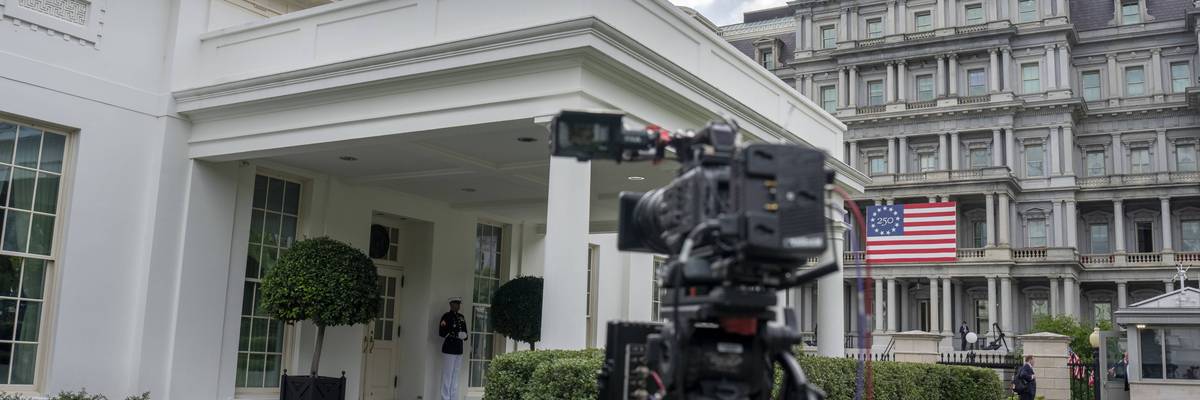
A television camera is pointed at the entrance to the West Wing of the White House on September 18, 2026 in Washington, DC.
Together, media organizations have the ability to cut off the air supply that Trump routinely sucks out of every situation. If they translate this tactic into a much longer-term strategy, they could shift the relationship onto much healthier ground.
In his typical fashion, which many commentators characterize as act first, think never, President Donald Trump has handed the media, i.e., the enemy of the people, an extremely potent weapon if only they have the fortitude to use it. Much as his illegal and unwinnable war enabled the Iranians to translate their potential control over the Strait of Hormuz into an actual lever of economic, military, and geopolitical power, so too his “ban” on CNN, MSNOW, and Politico could initiate a shift in the power dynamics of Trump-press relations.
If the initial and much too rare show of solidarity among the news organizations can be sustained long enough to demonstrate their ability to deprive Trump of the constant attention he so desperately craves, this could become the basis for a much-needed recalibration of the bully-bullied interactions.
The constitutional aspects of the case are startlingly clear. It is almost (and in these fraught moments, the “almost” is necessary) impossible to imagine the circumstances that would sustain Trump’s ban. His own statements make clear that the exclusions (and those that might follow) are based on viewpoint, a basis specifically and repeatedly denied by the courts. Given that the lawsuit filed by the three banned organizations is being handled by the same judge that ruled against Trump when he barred CNN’s then-reporter Jim Acosta, the outcome appears predictable. If so, the three plaintiffs will be reinstated and confiscated credentials will be returned.
If and when that happens, what should these news outlets and the others who are now standing with them do? Should they return to the same abusive environment that saw them banned in the first place? An environment that degrades and demeans their work whenever Trump needs to feed his ego or his base? Or should they, with their new-found cudgel of silencing him, make a series of demands to shift the ground on which they might operate moving forward? The present actions have already demonstrated that, together, these media organizations have the ability to cut off the air supply that Trump routinely sucks out of every situation. If they translate this tactic into a much longer-term strategy (the threat of boycott) they could shift the relationship onto much healthier ground. Just as a bonus, Trump’s ranting and raving about his lack of coverage would, itself, be a ratings bonanza.
What kinds of demands should constitute the new order? First and foremost, should be an insistence that Trump treat the press in general with the respect that the First Amendment requires. No more “enemy of the people” and empty “fake news” epithets. Secondly, and equally importantly, should be a no-nonsense prohibition on attacks on individual journalists, particularly women journalists, and most especially female journalists of color. No more threatening lunges; no more “quiet piggy;” no more comments on appearance or (dis)ability or (too thinly veiled) race. Finally (although in cooler-head moments more demands might appear), the representatives of the press should insist on equal access for reporters and journalists from all viewpoints on the political spectrum. If Trump and his nearby psychophants are unwilling to negotiate these terms in good faith, and then abide by them, the press as a solidary group should be ready, able, and willing to close the Strait of No-News. After all, a spine is a terrible thing to waste!
Dear Common Dreams reader, It’s been nearly 30 years since I co-founded Common Dreams with my late wife, Lina Newhouser. We had the radical notion that journalism should serve the public good, not corporate profits. It was clear to us from the outset what it would take to build such a project. No paid advertisements. No corporate sponsors. No millionaire publisher telling us what to think or do. Many people said we wouldn't last a year, but we proved those doubters wrong. Together with a tremendous team of journalists and dedicated staff, we built an independent media outlet free from the constraints of profits and corporate control. Our mission has always been simple: To inform. To inspire. To ignite change for the common good. Building Common Dreams was not easy. Our survival was never guaranteed. When you take on the most powerful forces—Wall Street greed, fossil fuel industry destruction, Big Tech lobbyists, and uber-rich oligarchs who have spent billions upon billions rigging the economy and democracy in their favor—the only bulwark you have is supporters who believe in your work. But here’s the urgent message from me today. It's never been this bad out there. And it's never been this hard to keep us going. At the very moment Common Dreams is most needed, the threats we face are intensifying. We need your support now more than ever. We don't accept corporate advertising and never will. We don't have a paywall because we don't think people should be blocked from critical news based on their ability to pay. Everything we do is funded by the donations of readers like you. When everyone does the little they can afford, we are strong. But if that support retreats or dries up, so do we. Will you donate now to make sure Common Dreams not only survives but thrives? —Craig Brown, Co-founder |
Marv Waterstone is professor emeritus in the School of Geography, Development, and Environment at the University of Arizona, and is the coauthor most recently with Noam Chomsky of Consequences of Capitalism: Manufacturing Discontent and Resistance (Haymarket Books).
In his typical fashion, which many commentators characterize as act first, think never, President Donald Trump has handed the media, i.e., the enemy of the people, an extremely potent weapon if only they have the fortitude to use it. Much as his illegal and unwinnable war enabled the Iranians to translate their potential control over the Strait of Hormuz into an actual lever of economic, military, and geopolitical power, so too his “ban” on CNN, MSNOW, and Politico could initiate a shift in the power dynamics of Trump-press relations.
If the initial and much too rare show of solidarity among the news organizations can be sustained long enough to demonstrate their ability to deprive Trump of the constant attention he so desperately craves, this could become the basis for a much-needed recalibration of the bully-bullied interactions.
The constitutional aspects of the case are startlingly clear. It is almost (and in these fraught moments, the “almost” is necessary) impossible to imagine the circumstances that would sustain Trump’s ban. His own statements make clear that the exclusions (and those that might follow) are based on viewpoint, a basis specifically and repeatedly denied by the courts. Given that the lawsuit filed by the three banned organizations is being handled by the same judge that ruled against Trump when he barred CNN’s then-reporter Jim Acosta, the outcome appears predictable. If so, the three plaintiffs will be reinstated and confiscated credentials will be returned.
If and when that happens, what should these news outlets and the others who are now standing with them do? Should they return to the same abusive environment that saw them banned in the first place? An environment that degrades and demeans their work whenever Trump needs to feed his ego or his base? Or should they, with their new-found cudgel of silencing him, make a series of demands to shift the ground on which they might operate moving forward? The present actions have already demonstrated that, together, these media organizations have the ability to cut off the air supply that Trump routinely sucks out of every situation. If they translate this tactic into a much longer-term strategy (the threat of boycott) they could shift the relationship onto much healthier ground. Just as a bonus, Trump’s ranting and raving about his lack of coverage would, itself, be a ratings bonanza.
What kinds of demands should constitute the new order? First and foremost, should be an insistence that Trump treat the press in general with the respect that the First Amendment requires. No more “enemy of the people” and empty “fake news” epithets. Secondly, and equally importantly, should be a no-nonsense prohibition on attacks on individual journalists, particularly women journalists, and most especially female journalists of color. No more threatening lunges; no more “quiet piggy;” no more comments on appearance or (dis)ability or (too thinly veiled) race. Finally (although in cooler-head moments more demands might appear), the representatives of the press should insist on equal access for reporters and journalists from all viewpoints on the political spectrum. If Trump and his nearby psychophants are unwilling to negotiate these terms in good faith, and then abide by them, the press as a solidary group should be ready, able, and willing to close the Strait of No-News. After all, a spine is a terrible thing to waste!
Marv Waterstone is professor emeritus in the School of Geography, Development, and Environment at the University of Arizona, and is the coauthor most recently with Noam Chomsky of Consequences of Capitalism: Manufacturing Discontent and Resistance (Haymarket Books).
In his typical fashion, which many commentators characterize as act first, think never, President Donald Trump has handed the media, i.e., the enemy of the people, an extremely potent weapon if only they have the fortitude to use it. Much as his illegal and unwinnable war enabled the Iranians to translate their potential control over the Strait of Hormuz into an actual lever of economic, military, and geopolitical power, so too his “ban” on CNN, MSNOW, and Politico could initiate a shift in the power dynamics of Trump-press relations.
If the initial and much too rare show of solidarity among the news organizations can be sustained long enough to demonstrate their ability to deprive Trump of the constant attention he so desperately craves, this could become the basis for a much-needed recalibration of the bully-bullied interactions.
The constitutional aspects of the case are startlingly clear. It is almost (and in these fraught moments, the “almost” is necessary) impossible to imagine the circumstances that would sustain Trump’s ban. His own statements make clear that the exclusions (and those that might follow) are based on viewpoint, a basis specifically and repeatedly denied by the courts. Given that the lawsuit filed by the three banned organizations is being handled by the same judge that ruled against Trump when he barred CNN’s then-reporter Jim Acosta, the outcome appears predictable. If so, the three plaintiffs will be reinstated and confiscated credentials will be returned.
If and when that happens, what should these news outlets and the others who are now standing with them do? Should they return to the same abusive environment that saw them banned in the first place? An environment that degrades and demeans their work whenever Trump needs to feed his ego or his base? Or should they, with their new-found cudgel of silencing him, make a series of demands to shift the ground on which they might operate moving forward? The present actions have already demonstrated that, together, these media organizations have the ability to cut off the air supply that Trump routinely sucks out of every situation. If they translate this tactic into a much longer-term strategy (the threat of boycott) they could shift the relationship onto much healthier ground. Just as a bonus, Trump’s ranting and raving about his lack of coverage would, itself, be a ratings bonanza.
What kinds of demands should constitute the new order? First and foremost, should be an insistence that Trump treat the press in general with the respect that the First Amendment requires. No more “enemy of the people” and empty “fake news” epithets. Secondly, and equally importantly, should be a no-nonsense prohibition on attacks on individual journalists, particularly women journalists, and most especially female journalists of color. No more threatening lunges; no more “quiet piggy;” no more comments on appearance or (dis)ability or (too thinly veiled) race. Finally (although in cooler-head moments more demands might appear), the representatives of the press should insist on equal access for reporters and journalists from all viewpoints on the political spectrum. If Trump and his nearby psychophants are unwilling to negotiate these terms in good faith, and then abide by them, the press as a solidary group should be ready, able, and willing to close the Strait of No-News. After all, a spine is a terrible thing to waste!