
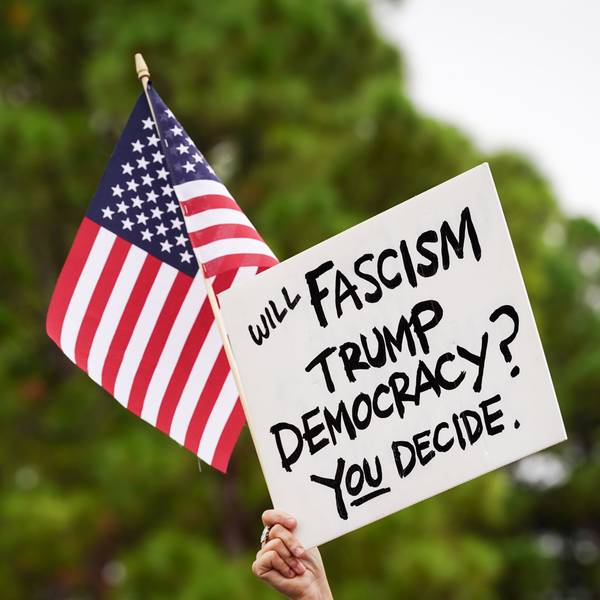
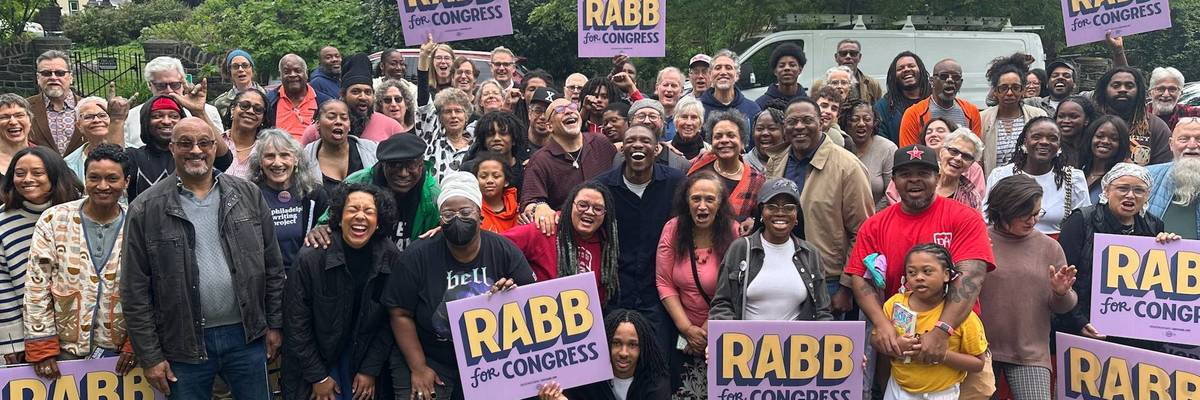
Local volunteers pose while canvassing for progressive Pennsylvania state Rep. Chris Rabb in the Democratic House primary.
Washington Won't Save Us; Our Neighbors Might
Why the midterms will be won or lost at the community level—and what that means for how we organize now.
A recent political event at a local community center left me smiling. A Latina special educator teacher running for state legislature had gathered a room full of supporters. Labor union members, religious leaders, political activists, family, and friends showed up in the late afternoon this spring to help her launch her campaign. The fundraising pitch was co-led by a very exuberant trans performer and a buttoned-up county prosecutor, filling the space with laughter and donations.
It was just one event, but it reminded me that building grassroots power goes hand in hand with building community. Both will be needed if the upcoming midterm elections are to be the pivot we need. This is the time grassroots power can stop fascism and begin the long but hopeful journey to an inclusive, fair, and sustainable world.
What Has Community Got to Do With It?
We are bombarded by news of the disastrous policies coming out of a billionaire-led administration, following the marching orders of the tech bros; the Heritage Foundation’s corporate agenda; and, according to conjecture, such foreign leaders as Russian President Vladimir Putin and Israeli Prime Minister Benjamin Netanyahu. It’s enough to create chronic panic.
Less often discussed are the victories of the people working together in their neighborhoods and towns to push back on Immigration and Customs Enforcement crackdowns and AI data complexes, to stand up for voting rights, and to fight to get food and healthcare to those cut off from these basic needs. These grassroots groups are also providing essential backing to the elected officials who are standing up to the Trump regime’s worst abuses.
History shows that fascism can overrun a society when people are fractured and isolated. We can counter powerlessness when we act with others where we live.
These victories don’t come from national Democratic Party leaders or celebrities. They come from ordinary people who show up; work together; and build the trust, relationships, and coordination that make further action possible.
The Midterms Pivot
This grassroots power will make the difference in the upcoming midterm elections, which could in turn determine whether fascism strengthens its hold on American life.
Poll after poll is telling us that growing majorities of Americans oppose President Donald Trump’s policies, and that his disapproval rating is reaching unprecedented levels. Still, there are strong headwinds for those working for change.
Funding for progressive grassroots work is falling short, according to a recent analysis by the Movement Voters Project. Meanwhile, the Trump administration is rolling out executive orders and court cases that can discourage voting by those who might oppose him, removing citizens from the voting rolls, raising false claims about election integrity, and putting bureaucratic roadblocks in the way of casting a ballot.
And then it got worse. On April 29, 2026, the US Supreme Court ruling in the Louisiana v. Callais case struck a near-fatal blow to the Voting Rights Act. After years of struggle for equal voting rights for African Americans, this case threatens to fracture the power of Black communities, diluting their ability to elect members of Congress and state and local officials who truly represent them. According to Black Voters Matter, the ruling threatens to create an additional 19 entrenched seats for Republicans in Congress, and 191 entrenched Republican legislative seats.
But here is what the ruling also did: It relocated the battle to exactly the terrain where organized communities are strongest—the state and local level. The people with the most power to determine what happens in November are not in Washington. They are wherever you are, deciding whether to show up.
How we organize locally could make the difference.
Building power means inviting in people who have not been active until now. It means building an agenda for a better, more inclusive future, and making political gatherings a time for community building as well as for carrying out effective strategies. It means prioritizing collaboration across races and identities and issues to build power for the common good. Now is the time—during primary season, when we have the most leverage.
Here’s what that looks like:
We Need to Keep Voting Accessible, Safe, and Fair. Restore Voting Rights
Elections are run by state and local officials, not by the federal government. The work varies by region, but wherever you are, you can work with your local, county, and state officials to make district maps fair, to ensure polling stations are secure and that eligible voters have unfettered access to the polls, and that the election process is free from bias and intimidation.
The Callais decision makes this work tougher, but it also is unleashing the unstoppable energy of those who have been excluded too often and for too long.
Organize Sustained Grassroots Power. Candidates Are Not the Whole Story
Elected officials work for us. We have the right to set the agenda, and find and elect candidates who will carry out our priorities. And we have the right to hold incumbents accountable. For the vast majority of us who lack billions of dollars, building power means organizing: creating collaborations among existing groups, creating new groups when needed, affiliating with regional and national organizations when appropriate. It means building connections and power year round, not only during election season.
National groups that are effective in building grassroots power include the Movement Voters Project, which supports grassroots groups building progressive power, especially in swing states, year round, not only during election season. The Working Families Party and the Democratic Socialists of America, which played key roles in organizing and mobilizing the massive grassroots campaign that won the New York mayoral election for Zohran Mamdani. Your local Democratic Party might—or might not—be helpful.
Elect Fighters!
This is the right time, during the primaries, to challenge incumbents to take strong positions supporting voting rights and the interests of all working people in our communities, not the corporations and billionaires. Ask candidates tough questions when they are on home visits or campaigning. Research their voting records. Hold candidates forums.
If the incumbent is caving in to corporate interests or racist gerrymandering, taking money from American Israel Public Affairs Committee or Wall Street PACs, or failing to fight for poor and working class people, support strong candidates who challenge them. In the general election, we may need to support any candidate who will oppose MAGA, but in the primaries, we should press for the leadership that will best serve us.
Spread Stories of Power, Not Just Fear
Many of us live with the daily drama of Trump’s latest impulses. It’s hard to avoid. But we need to remember that there is so much more to our nation’s story. Research and share news about the progressive office holders and community organizing that is making life better for everyday people. What you share on social media makes a difference. Supply your elected officials with tangible examples of successful policies to help them see a path forward. Write an editorial or letter to the editor of your local newspaper or in your group’s newsletter about wins. Mamdani’s recent successes are great examples—offering free day care for 2-year-olds, and increasing the stock of affordable housing with funding proposed through a tax on luxury second homes.
People need to see what grassroots power looks like, and so do our elected representatives. Allowing the outrages of the MAGA Regime to occupy all of our attention makes us think and feel like victims, preparing for the next blow, rather than embodying our rights to be powerful protagonists. We forget that we can get things done and that we deserve better.
Gather With Others
History shows that fascism can overrun a society when people are fractured and isolated. We can counter powerlessness when we act with others where we live. People want to make a difference—many are just waiting for the right invitation. Create spaces that foster belonging, a topic I explore in my recent zine, “Community As Strategy.” Combine the hard work with joy-filled gatherings. Hold dance parties, picnics, or fun runs. Turn protests into parades.
***
We actually do have a path forward. We can defeat fascism before the remaining institutions of American democracy are corrupted and dismembered. We can do that best by joining together locally and finally offering Americans what so many want—universal healthcare, peace, protection for our natural heritage, an economy that works for working people. We have majority support for many of these positions, and the creativity and energy to make them a reality. Together, we have the power when we organize where we live.
An Urgent Message From Our Co-Founder
Dear Common Dreams reader, It’s been nearly 30 years since I co-founded Common Dreams with my late wife, Lina Newhouser. We had the radical notion that journalism should serve the public good, not corporate profits. It was clear to us from the outset what it would take to build such a project. No paid advertisements. No corporate sponsors. No millionaire publisher telling us what to think or do. Many people said we wouldn't last a year, but we proved those doubters wrong. Together with a tremendous team of journalists and dedicated staff, we built an independent media outlet free from the constraints of profits and corporate control. Our mission has always been simple: To inform. To inspire. To ignite change for the common good. Building Common Dreams was not easy. Our survival was never guaranteed. When you take on the most powerful forces—Wall Street greed, fossil fuel industry destruction, Big Tech lobbyists, and uber-rich oligarchs who have spent billions upon billions rigging the economy and democracy in their favor—the only bulwark you have is supporters who believe in your work. But here’s the urgent message from me today. It's never been this bad out there. And it's never been this hard to keep us going. At the very moment Common Dreams is most needed, the threats we face are intensifying. We need your support now more than ever. We don't accept corporate advertising and never will. We don't have a paywall because we don't think people should be blocked from critical news based on their ability to pay. Everything we do is funded by the donations of readers like you. When everyone does the little they can afford, we are strong. But if that support retreats or dries up, so do we. Will you donate now to make sure Common Dreams not only survives but thrives? —Craig Brown, Co-founder |
A recent political event at a local community center left me smiling. A Latina special educator teacher running for state legislature had gathered a room full of supporters. Labor union members, religious leaders, political activists, family, and friends showed up in the late afternoon this spring to help her launch her campaign. The fundraising pitch was co-led by a very exuberant trans performer and a buttoned-up county prosecutor, filling the space with laughter and donations.
It was just one event, but it reminded me that building grassroots power goes hand in hand with building community. Both will be needed if the upcoming midterm elections are to be the pivot we need. This is the time grassroots power can stop fascism and begin the long but hopeful journey to an inclusive, fair, and sustainable world.
What Has Community Got to Do With It?
We are bombarded by news of the disastrous policies coming out of a billionaire-led administration, following the marching orders of the tech bros; the Heritage Foundation’s corporate agenda; and, according to conjecture, such foreign leaders as Russian President Vladimir Putin and Israeli Prime Minister Benjamin Netanyahu. It’s enough to create chronic panic.
Less often discussed are the victories of the people working together in their neighborhoods and towns to push back on Immigration and Customs Enforcement crackdowns and AI data complexes, to stand up for voting rights, and to fight to get food and healthcare to those cut off from these basic needs. These grassroots groups are also providing essential backing to the elected officials who are standing up to the Trump regime’s worst abuses.
History shows that fascism can overrun a society when people are fractured and isolated. We can counter powerlessness when we act with others where we live.
These victories don’t come from national Democratic Party leaders or celebrities. They come from ordinary people who show up; work together; and build the trust, relationships, and coordination that make further action possible.
The Midterms Pivot
This grassroots power will make the difference in the upcoming midterm elections, which could in turn determine whether fascism strengthens its hold on American life.
Poll after poll is telling us that growing majorities of Americans oppose President Donald Trump’s policies, and that his disapproval rating is reaching unprecedented levels. Still, there are strong headwinds for those working for change.
Funding for progressive grassroots work is falling short, according to a recent analysis by the Movement Voters Project. Meanwhile, the Trump administration is rolling out executive orders and court cases that can discourage voting by those who might oppose him, removing citizens from the voting rolls, raising false claims about election integrity, and putting bureaucratic roadblocks in the way of casting a ballot.
And then it got worse. On April 29, 2026, the US Supreme Court ruling in the Louisiana v. Callais case struck a near-fatal blow to the Voting Rights Act. After years of struggle for equal voting rights for African Americans, this case threatens to fracture the power of Black communities, diluting their ability to elect members of Congress and state and local officials who truly represent them. According to Black Voters Matter, the ruling threatens to create an additional 19 entrenched seats for Republicans in Congress, and 191 entrenched Republican legislative seats.
But here is what the ruling also did: It relocated the battle to exactly the terrain where organized communities are strongest—the state and local level. The people with the most power to determine what happens in November are not in Washington. They are wherever you are, deciding whether to show up.
How we organize locally could make the difference.
Building power means inviting in people who have not been active until now. It means building an agenda for a better, more inclusive future, and making political gatherings a time for community building as well as for carrying out effective strategies. It means prioritizing collaboration across races and identities and issues to build power for the common good. Now is the time—during primary season, when we have the most leverage.
Here’s what that looks like:
We Need to Keep Voting Accessible, Safe, and Fair. Restore Voting Rights
Elections are run by state and local officials, not by the federal government. The work varies by region, but wherever you are, you can work with your local, county, and state officials to make district maps fair, to ensure polling stations are secure and that eligible voters have unfettered access to the polls, and that the election process is free from bias and intimidation.
The Callais decision makes this work tougher, but it also is unleashing the unstoppable energy of those who have been excluded too often and for too long.
Organize Sustained Grassroots Power. Candidates Are Not the Whole Story
Elected officials work for us. We have the right to set the agenda, and find and elect candidates who will carry out our priorities. And we have the right to hold incumbents accountable. For the vast majority of us who lack billions of dollars, building power means organizing: creating collaborations among existing groups, creating new groups when needed, affiliating with regional and national organizations when appropriate. It means building connections and power year round, not only during election season.
National groups that are effective in building grassroots power include the Movement Voters Project, which supports grassroots groups building progressive power, especially in swing states, year round, not only during election season. The Working Families Party and the Democratic Socialists of America, which played key roles in organizing and mobilizing the massive grassroots campaign that won the New York mayoral election for Zohran Mamdani. Your local Democratic Party might—or might not—be helpful.
Elect Fighters!
This is the right time, during the primaries, to challenge incumbents to take strong positions supporting voting rights and the interests of all working people in our communities, not the corporations and billionaires. Ask candidates tough questions when they are on home visits or campaigning. Research their voting records. Hold candidates forums.
If the incumbent is caving in to corporate interests or racist gerrymandering, taking money from American Israel Public Affairs Committee or Wall Street PACs, or failing to fight for poor and working class people, support strong candidates who challenge them. In the general election, we may need to support any candidate who will oppose MAGA, but in the primaries, we should press for the leadership that will best serve us.
Spread Stories of Power, Not Just Fear
Many of us live with the daily drama of Trump’s latest impulses. It’s hard to avoid. But we need to remember that there is so much more to our nation’s story. Research and share news about the progressive office holders and community organizing that is making life better for everyday people. What you share on social media makes a difference. Supply your elected officials with tangible examples of successful policies to help them see a path forward. Write an editorial or letter to the editor of your local newspaper or in your group’s newsletter about wins. Mamdani’s recent successes are great examples—offering free day care for 2-year-olds, and increasing the stock of affordable housing with funding proposed through a tax on luxury second homes.
People need to see what grassroots power looks like, and so do our elected representatives. Allowing the outrages of the MAGA Regime to occupy all of our attention makes us think and feel like victims, preparing for the next blow, rather than embodying our rights to be powerful protagonists. We forget that we can get things done and that we deserve better.
Gather With Others
History shows that fascism can overrun a society when people are fractured and isolated. We can counter powerlessness when we act with others where we live. People want to make a difference—many are just waiting for the right invitation. Create spaces that foster belonging, a topic I explore in my recent zine, “Community As Strategy.” Combine the hard work with joy-filled gatherings. Hold dance parties, picnics, or fun runs. Turn protests into parades.
***
We actually do have a path forward. We can defeat fascism before the remaining institutions of American democracy are corrupted and dismembered. We can do that best by joining together locally and finally offering Americans what so many want—universal healthcare, peace, protection for our natural heritage, an economy that works for working people. We have majority support for many of these positions, and the creativity and energy to make them a reality. Together, we have the power when we organize where we live.
A recent political event at a local community center left me smiling. A Latina special educator teacher running for state legislature had gathered a room full of supporters. Labor union members, religious leaders, political activists, family, and friends showed up in the late afternoon this spring to help her launch her campaign. The fundraising pitch was co-led by a very exuberant trans performer and a buttoned-up county prosecutor, filling the space with laughter and donations.
It was just one event, but it reminded me that building grassroots power goes hand in hand with building community. Both will be needed if the upcoming midterm elections are to be the pivot we need. This is the time grassroots power can stop fascism and begin the long but hopeful journey to an inclusive, fair, and sustainable world.
What Has Community Got to Do With It?
We are bombarded by news of the disastrous policies coming out of a billionaire-led administration, following the marching orders of the tech bros; the Heritage Foundation’s corporate agenda; and, according to conjecture, such foreign leaders as Russian President Vladimir Putin and Israeli Prime Minister Benjamin Netanyahu. It’s enough to create chronic panic.
Less often discussed are the victories of the people working together in their neighborhoods and towns to push back on Immigration and Customs Enforcement crackdowns and AI data complexes, to stand up for voting rights, and to fight to get food and healthcare to those cut off from these basic needs. These grassroots groups are also providing essential backing to the elected officials who are standing up to the Trump regime’s worst abuses.
History shows that fascism can overrun a society when people are fractured and isolated. We can counter powerlessness when we act with others where we live.
These victories don’t come from national Democratic Party leaders or celebrities. They come from ordinary people who show up; work together; and build the trust, relationships, and coordination that make further action possible.
The Midterms Pivot
This grassroots power will make the difference in the upcoming midterm elections, which could in turn determine whether fascism strengthens its hold on American life.
Poll after poll is telling us that growing majorities of Americans oppose President Donald Trump’s policies, and that his disapproval rating is reaching unprecedented levels. Still, there are strong headwinds for those working for change.
Funding for progressive grassroots work is falling short, according to a recent analysis by the Movement Voters Project. Meanwhile, the Trump administration is rolling out executive orders and court cases that can discourage voting by those who might oppose him, removing citizens from the voting rolls, raising false claims about election integrity, and putting bureaucratic roadblocks in the way of casting a ballot.
And then it got worse. On April 29, 2026, the US Supreme Court ruling in the Louisiana v. Callais case struck a near-fatal blow to the Voting Rights Act. After years of struggle for equal voting rights for African Americans, this case threatens to fracture the power of Black communities, diluting their ability to elect members of Congress and state and local officials who truly represent them. According to Black Voters Matter, the ruling threatens to create an additional 19 entrenched seats for Republicans in Congress, and 191 entrenched Republican legislative seats.
But here is what the ruling also did: It relocated the battle to exactly the terrain where organized communities are strongest—the state and local level. The people with the most power to determine what happens in November are not in Washington. They are wherever you are, deciding whether to show up.
How we organize locally could make the difference.
Building power means inviting in people who have not been active until now. It means building an agenda for a better, more inclusive future, and making political gatherings a time for community building as well as for carrying out effective strategies. It means prioritizing collaboration across races and identities and issues to build power for the common good. Now is the time—during primary season, when we have the most leverage.
Here’s what that looks like:
We Need to Keep Voting Accessible, Safe, and Fair. Restore Voting Rights
Elections are run by state and local officials, not by the federal government. The work varies by region, but wherever you are, you can work with your local, county, and state officials to make district maps fair, to ensure polling stations are secure and that eligible voters have unfettered access to the polls, and that the election process is free from bias and intimidation.
The Callais decision makes this work tougher, but it also is unleashing the unstoppable energy of those who have been excluded too often and for too long.
Organize Sustained Grassroots Power. Candidates Are Not the Whole Story
Elected officials work for us. We have the right to set the agenda, and find and elect candidates who will carry out our priorities. And we have the right to hold incumbents accountable. For the vast majority of us who lack billions of dollars, building power means organizing: creating collaborations among existing groups, creating new groups when needed, affiliating with regional and national organizations when appropriate. It means building connections and power year round, not only during election season.
National groups that are effective in building grassroots power include the Movement Voters Project, which supports grassroots groups building progressive power, especially in swing states, year round, not only during election season. The Working Families Party and the Democratic Socialists of America, which played key roles in organizing and mobilizing the massive grassroots campaign that won the New York mayoral election for Zohran Mamdani. Your local Democratic Party might—or might not—be helpful.
Elect Fighters!
This is the right time, during the primaries, to challenge incumbents to take strong positions supporting voting rights and the interests of all working people in our communities, not the corporations and billionaires. Ask candidates tough questions when they are on home visits or campaigning. Research their voting records. Hold candidates forums.
If the incumbent is caving in to corporate interests or racist gerrymandering, taking money from American Israel Public Affairs Committee or Wall Street PACs, or failing to fight for poor and working class people, support strong candidates who challenge them. In the general election, we may need to support any candidate who will oppose MAGA, but in the primaries, we should press for the leadership that will best serve us.
Spread Stories of Power, Not Just Fear
Many of us live with the daily drama of Trump’s latest impulses. It’s hard to avoid. But we need to remember that there is so much more to our nation’s story. Research and share news about the progressive office holders and community organizing that is making life better for everyday people. What you share on social media makes a difference. Supply your elected officials with tangible examples of successful policies to help them see a path forward. Write an editorial or letter to the editor of your local newspaper or in your group’s newsletter about wins. Mamdani’s recent successes are great examples—offering free day care for 2-year-olds, and increasing the stock of affordable housing with funding proposed through a tax on luxury second homes.
People need to see what grassroots power looks like, and so do our elected representatives. Allowing the outrages of the MAGA Regime to occupy all of our attention makes us think and feel like victims, preparing for the next blow, rather than embodying our rights to be powerful protagonists. We forget that we can get things done and that we deserve better.
Gather With Others
History shows that fascism can overrun a society when people are fractured and isolated. We can counter powerlessness when we act with others where we live. People want to make a difference—many are just waiting for the right invitation. Create spaces that foster belonging, a topic I explore in my recent zine, “Community As Strategy.” Combine the hard work with joy-filled gatherings. Hold dance parties, picnics, or fun runs. Turn protests into parades.
***
We actually do have a path forward. We can defeat fascism before the remaining institutions of American democracy are corrupted and dismembered. We can do that best by joining together locally and finally offering Americans what so many want—universal healthcare, peace, protection for our natural heritage, an economy that works for working people. We have majority support for many of these positions, and the creativity and energy to make them a reality. Together, we have the power when we organize where we live.