SUBSCRIBE TO OUR FREE NEWSLETTER
Daily news & progressive opinion—funded by the people, not the corporations—delivered straight to your inbox.
5
#000000
#FFFFFF
To donate by check, phone, or other method, see our More Ways to Give page.
Daily news & progressive opinion—funded by the people, not the corporations—delivered straight to your inbox.
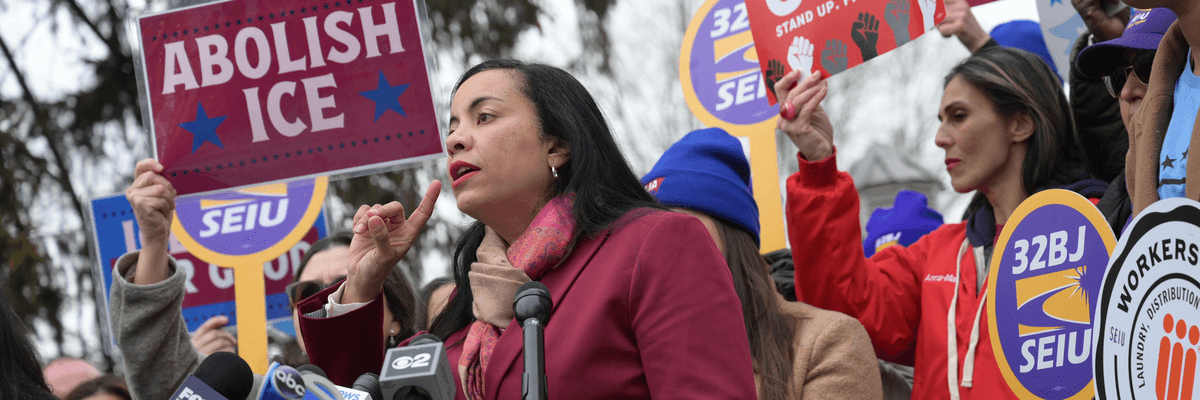
Analilia Mejía speaks at a rally ahead of her February 10, 2026 victory in the Democratic primary in New Jersey’s 11th Congressional District.
In an era defined by authoritarian escalation and billionaire consolidation, many ask whether democracy can defend itself. No, it cannot. But organized neighbors can.
When I stepped into leadership as co-executive director of Popular Democracy in Action alongside Analilia Mejia in 2021, the central question we both set out to answer was not whether the far-right was consolidating power. That much was obvious. The question, as leaders of the largest progressive networks of base-building organizations in the country, was whether we could scale our power to meet it.
How do you build enough base and narrative power to confront a coordinated, well-funded, disciplined right-wing shift? How do you move beyond reactive mobilization and build durable organizing infrastructure? How do you prepare communities not just to resist authoritarianism, but to win governing power?
For years, our organization invested in answering those questions. We refined our organizing model through practice, experimentation, and hard-earned lessons. So when the opportunity arose last November for one of our own, Analilia Mejía, to run for the open seat in New Jersey’s 11th District left vacant by Mikie Sherrill’s successful gubernatorial bid, I understood it as more than a campaign. It was an opportunity to test our theory of change.
On Monday, as Analilia was sworn into the House of Representatives as New Jersey’s newest congresswoman, there were many reasons to celebrate. She beat her opponent by at least 20 points, running a whopping 12 points ahead of 2024 presidential margins, underscoring the strength of a people-powered campaign. Not only did our movement succeed in sending a champion for the working class to Congress, but we have proven that our organizing model could hold up under today’s political conditions and win.
Organizers often inherit an electoral culture built on urgency and amnesia. Consultants arrive late. Mailers flood inboxes. Relentless text and phone calls. Volunteers are recruited weeks before Election Day. Then everyone disappears until the next crisis.
We grew tired of repeating a cycle that left our people feeling mobilized in the moment and abandoned afterward. So we chose a different path.
This victory in NJ-11 required deep relationship building; message discipline; and courage from organizers, volunteers, and voters alike.
We built the Guardians of Democracy program, and through it Popular Democracy in Action and our affiliates invested in leadership development rooted in political education and hyperlocal relational organizing. At its core, Guardians is a civic infrastructure strategy—one that can be replicated, scaled, and paired with other leadership pipelines to deliver material wins for Black, brown, and working-class communities.
Participants ground themselves in a worker-centered history of America—from the Reconstruction Amendments to the Civil Rights Movement—connecting neighborhood organizing to a longer arc of struggle over who counts and who governs. After a series of trainings, they practice organizing where they live. Each participant receives a list of 100 of their closest neighbors, often on their own block. They learn to initiate organizing conversations, sustain relationships, and bring more people into their local campaigns.
The goal is simple and ambitious: Build neighborhood-based leaders during non-election years who could be activated when it matters most.
Over the last few years, we've trained 12,430 leaders across the country. We've mapped strategic geographies and have worked closely with our affiliates to refine the model: Train members deeply, anchor them locally, and maintain consistent outreach long before ballots are even printed.
This is the kind of quiet, patient, disciplined organizing infrastructure that can become an organization’s secret weapon.
In a crowded field of 13 candidates in NJ-11, with virtually no district-wide name recognition and a firm commitment to reject corporate PAC money, Analilia entered the race as a clear underdog. From the moment the seat opened, colleagues, movement peers, elected officials, and community leaders urged her to step forward. For me, her candidacy represented a proving ground. Could our organizing infrastructure pass this stress test?
As one of the first races of the 2026 midterm cycle, the outcome in NJ-11 carries significant weight in the broader narrative wars shaping this political moment. Would voters in a district long represented by establishment figures choose a movement candidate running unapologetically on Medicare for All, abolishing Immigration and Customs Enforcement (ICE), and taxing the wealthiest individuals and corporations?
Then there was the question on building power in strategic geographies: Could long-term relational organizing—rooted in political education and neighborhood leadership—overcome the gravitational pull of big money and name recognition?
Yes, yes, and yes.
Analilia’s victory in NJ-11 was powered by more than any single organization. Labor unions, local and national movement organizations, progressive elected leaders, and grassroots networks across the district consolidated quickly and decisively around her candidacy. Organizers who have been fighting for housing, healthcare, immigrant rights, and worker power recognized the stakes of this race and pulled their weight, aligning people and resources behind a shared vision.
But any honest accounting of this victory would be remiss to not center the extraordinary organizing efforts of Make the Road Action New Jersey (MRANJ).
For years, MRANJ has built deep relationships with working-class voters, immigrants, and communities of color across NJ-11. Their members are not seasonal volunteers. They are leaders formed through a common fight for housing, economic, and immigrant justice.
When Analilia’s campaign began, the organizing muscle was already there.
Over the course of the campaign, Make the Road Action NJ led a relentless, people-powered field operation—knocking 25,100 doors in freezing winter and spring sun alike, making 154,430 calls to voters across the district, and organizing 1,078 volunteer canvass shifts. Popular Democracy in Action supported this work by mobilizing our national network, deploying staff to coordinate volunteer operations in the district, hosting national phone banks, and aligning resources with the strategy on the ground. In the lead-up to the primary on February 5, we helped fund targeted outreach, including mobile billboards in key areas and a free party bus to the polls in Belleville to boost turnout.
But numbers alone do not tell the story.
What mattered was that many of the people knocking those doors were Guardians—leaders trained in prior years to organize their own neighborhoods. They were not strangers coming into the turf. They were familiar faces. They were neighbors.
Relational organizing is often dismissed as a buzzword. In practice, it is slow, trust-based work. It means your neighbor opens the door because they know you. It means you can have a conversation about rent hikes, losing your healthcare, or fear of ICE raids because of shared lived realities.
This is what years of investment in people looks like, and it went a long way in this campaign.
This victory in NJ-11 required deep relationship building; message discipline; and courage from organizers, volunteers, and voters alike. It required labor partners, grassroots organizations, and national networks pulling in the same direction. And it required the steady leadership of Make the Road Action New Jersey, whose long-term base building anchored the work on the ground.
During these last few months, I have seen firsthand the unique power of our network.
We proved that investing in hyperlocal leaders during non-election years must come first. We proved that narrative power and base building, developed patiently over time, can withstand the test of a competitive race. Most importantly, we proved that organized people can defeat better-funded opponents without surrendering their values.
In an era defined by authoritarian escalation and billionaire consolidation, many ask whether democracy can defend itself.
No, it cannot.
But organized neighbors can.
Analilia’s victory in NJ-11 is not the end of a story. It is evidence of what becomes possible when movements invest in long-term organizing models. For organizers across the country, the lesson is clear: If we want material gains—universal healthcare, immigrant rights, wages that keep up with inflation—we must invest in leadership, relationships, and narrative power long before the next fight reaches the ballot box.
Dear Common Dreams reader, It’s been nearly 30 years since I co-founded Common Dreams with my late wife, Lina Newhouser. We had the radical notion that journalism should serve the public good, not corporate profits. It was clear to us from the outset what it would take to build such a project. No paid advertisements. No corporate sponsors. No millionaire publisher telling us what to think or do. Many people said we wouldn't last a year, but we proved those doubters wrong. Together with a tremendous team of journalists and dedicated staff, we built an independent media outlet free from the constraints of profits and corporate control. Our mission has always been simple: To inform. To inspire. To ignite change for the common good. Building Common Dreams was not easy. Our survival was never guaranteed. When you take on the most powerful forces—Wall Street greed, fossil fuel industry destruction, Big Tech lobbyists, and uber-rich oligarchs who have spent billions upon billions rigging the economy and democracy in their favor—the only bulwark you have is supporters who believe in your work. But here’s the urgent message from me today. It's never been this bad out there. And it's never been this hard to keep us going. At the very moment Common Dreams is most needed, the threats we face are intensifying. We need your support now more than ever. We don't accept corporate advertising and never will. We don't have a paywall because we don't think people should be blocked from critical news based on their ability to pay. Everything we do is funded by the donations of readers like you. When everyone does the little they can afford, we are strong. But if that support retreats or dries up, so do we. Will you donate now to make sure Common Dreams not only survives but thrives? —Craig Brown, Co-founder |
When I stepped into leadership as co-executive director of Popular Democracy in Action alongside Analilia Mejia in 2021, the central question we both set out to answer was not whether the far-right was consolidating power. That much was obvious. The question, as leaders of the largest progressive networks of base-building organizations in the country, was whether we could scale our power to meet it.
How do you build enough base and narrative power to confront a coordinated, well-funded, disciplined right-wing shift? How do you move beyond reactive mobilization and build durable organizing infrastructure? How do you prepare communities not just to resist authoritarianism, but to win governing power?
For years, our organization invested in answering those questions. We refined our organizing model through practice, experimentation, and hard-earned lessons. So when the opportunity arose last November for one of our own, Analilia Mejía, to run for the open seat in New Jersey’s 11th District left vacant by Mikie Sherrill’s successful gubernatorial bid, I understood it as more than a campaign. It was an opportunity to test our theory of change.
On Monday, as Analilia was sworn into the House of Representatives as New Jersey’s newest congresswoman, there were many reasons to celebrate. She beat her opponent by at least 20 points, running a whopping 12 points ahead of 2024 presidential margins, underscoring the strength of a people-powered campaign. Not only did our movement succeed in sending a champion for the working class to Congress, but we have proven that our organizing model could hold up under today’s political conditions and win.
Organizers often inherit an electoral culture built on urgency and amnesia. Consultants arrive late. Mailers flood inboxes. Relentless text and phone calls. Volunteers are recruited weeks before Election Day. Then everyone disappears until the next crisis.
We grew tired of repeating a cycle that left our people feeling mobilized in the moment and abandoned afterward. So we chose a different path.
This victory in NJ-11 required deep relationship building; message discipline; and courage from organizers, volunteers, and voters alike.
We built the Guardians of Democracy program, and through it Popular Democracy in Action and our affiliates invested in leadership development rooted in political education and hyperlocal relational organizing. At its core, Guardians is a civic infrastructure strategy—one that can be replicated, scaled, and paired with other leadership pipelines to deliver material wins for Black, brown, and working-class communities.
Participants ground themselves in a worker-centered history of America—from the Reconstruction Amendments to the Civil Rights Movement—connecting neighborhood organizing to a longer arc of struggle over who counts and who governs. After a series of trainings, they practice organizing where they live. Each participant receives a list of 100 of their closest neighbors, often on their own block. They learn to initiate organizing conversations, sustain relationships, and bring more people into their local campaigns.
The goal is simple and ambitious: Build neighborhood-based leaders during non-election years who could be activated when it matters most.
Over the last few years, we've trained 12,430 leaders across the country. We've mapped strategic geographies and have worked closely with our affiliates to refine the model: Train members deeply, anchor them locally, and maintain consistent outreach long before ballots are even printed.
This is the kind of quiet, patient, disciplined organizing infrastructure that can become an organization’s secret weapon.
In a crowded field of 13 candidates in NJ-11, with virtually no district-wide name recognition and a firm commitment to reject corporate PAC money, Analilia entered the race as a clear underdog. From the moment the seat opened, colleagues, movement peers, elected officials, and community leaders urged her to step forward. For me, her candidacy represented a proving ground. Could our organizing infrastructure pass this stress test?
As one of the first races of the 2026 midterm cycle, the outcome in NJ-11 carries significant weight in the broader narrative wars shaping this political moment. Would voters in a district long represented by establishment figures choose a movement candidate running unapologetically on Medicare for All, abolishing Immigration and Customs Enforcement (ICE), and taxing the wealthiest individuals and corporations?
Then there was the question on building power in strategic geographies: Could long-term relational organizing—rooted in political education and neighborhood leadership—overcome the gravitational pull of big money and name recognition?
Yes, yes, and yes.
Analilia’s victory in NJ-11 was powered by more than any single organization. Labor unions, local and national movement organizations, progressive elected leaders, and grassroots networks across the district consolidated quickly and decisively around her candidacy. Organizers who have been fighting for housing, healthcare, immigrant rights, and worker power recognized the stakes of this race and pulled their weight, aligning people and resources behind a shared vision.
But any honest accounting of this victory would be remiss to not center the extraordinary organizing efforts of Make the Road Action New Jersey (MRANJ).
For years, MRANJ has built deep relationships with working-class voters, immigrants, and communities of color across NJ-11. Their members are not seasonal volunteers. They are leaders formed through a common fight for housing, economic, and immigrant justice.
When Analilia’s campaign began, the organizing muscle was already there.
Over the course of the campaign, Make the Road Action NJ led a relentless, people-powered field operation—knocking 25,100 doors in freezing winter and spring sun alike, making 154,430 calls to voters across the district, and organizing 1,078 volunteer canvass shifts. Popular Democracy in Action supported this work by mobilizing our national network, deploying staff to coordinate volunteer operations in the district, hosting national phone banks, and aligning resources with the strategy on the ground. In the lead-up to the primary on February 5, we helped fund targeted outreach, including mobile billboards in key areas and a free party bus to the polls in Belleville to boost turnout.
But numbers alone do not tell the story.
What mattered was that many of the people knocking those doors were Guardians—leaders trained in prior years to organize their own neighborhoods. They were not strangers coming into the turf. They were familiar faces. They were neighbors.
Relational organizing is often dismissed as a buzzword. In practice, it is slow, trust-based work. It means your neighbor opens the door because they know you. It means you can have a conversation about rent hikes, losing your healthcare, or fear of ICE raids because of shared lived realities.
This is what years of investment in people looks like, and it went a long way in this campaign.
This victory in NJ-11 required deep relationship building; message discipline; and courage from organizers, volunteers, and voters alike. It required labor partners, grassroots organizations, and national networks pulling in the same direction. And it required the steady leadership of Make the Road Action New Jersey, whose long-term base building anchored the work on the ground.
During these last few months, I have seen firsthand the unique power of our network.
We proved that investing in hyperlocal leaders during non-election years must come first. We proved that narrative power and base building, developed patiently over time, can withstand the test of a competitive race. Most importantly, we proved that organized people can defeat better-funded opponents without surrendering their values.
In an era defined by authoritarian escalation and billionaire consolidation, many ask whether democracy can defend itself.
No, it cannot.
But organized neighbors can.
Analilia’s victory in NJ-11 is not the end of a story. It is evidence of what becomes possible when movements invest in long-term organizing models. For organizers across the country, the lesson is clear: If we want material gains—universal healthcare, immigrant rights, wages that keep up with inflation—we must invest in leadership, relationships, and narrative power long before the next fight reaches the ballot box.
When I stepped into leadership as co-executive director of Popular Democracy in Action alongside Analilia Mejia in 2021, the central question we both set out to answer was not whether the far-right was consolidating power. That much was obvious. The question, as leaders of the largest progressive networks of base-building organizations in the country, was whether we could scale our power to meet it.
How do you build enough base and narrative power to confront a coordinated, well-funded, disciplined right-wing shift? How do you move beyond reactive mobilization and build durable organizing infrastructure? How do you prepare communities not just to resist authoritarianism, but to win governing power?
For years, our organization invested in answering those questions. We refined our organizing model through practice, experimentation, and hard-earned lessons. So when the opportunity arose last November for one of our own, Analilia Mejía, to run for the open seat in New Jersey’s 11th District left vacant by Mikie Sherrill’s successful gubernatorial bid, I understood it as more than a campaign. It was an opportunity to test our theory of change.
On Monday, as Analilia was sworn into the House of Representatives as New Jersey’s newest congresswoman, there were many reasons to celebrate. She beat her opponent by at least 20 points, running a whopping 12 points ahead of 2024 presidential margins, underscoring the strength of a people-powered campaign. Not only did our movement succeed in sending a champion for the working class to Congress, but we have proven that our organizing model could hold up under today’s political conditions and win.
Organizers often inherit an electoral culture built on urgency and amnesia. Consultants arrive late. Mailers flood inboxes. Relentless text and phone calls. Volunteers are recruited weeks before Election Day. Then everyone disappears until the next crisis.
We grew tired of repeating a cycle that left our people feeling mobilized in the moment and abandoned afterward. So we chose a different path.
This victory in NJ-11 required deep relationship building; message discipline; and courage from organizers, volunteers, and voters alike.
We built the Guardians of Democracy program, and through it Popular Democracy in Action and our affiliates invested in leadership development rooted in political education and hyperlocal relational organizing. At its core, Guardians is a civic infrastructure strategy—one that can be replicated, scaled, and paired with other leadership pipelines to deliver material wins for Black, brown, and working-class communities.
Participants ground themselves in a worker-centered history of America—from the Reconstruction Amendments to the Civil Rights Movement—connecting neighborhood organizing to a longer arc of struggle over who counts and who governs. After a series of trainings, they practice organizing where they live. Each participant receives a list of 100 of their closest neighbors, often on their own block. They learn to initiate organizing conversations, sustain relationships, and bring more people into their local campaigns.
The goal is simple and ambitious: Build neighborhood-based leaders during non-election years who could be activated when it matters most.
Over the last few years, we've trained 12,430 leaders across the country. We've mapped strategic geographies and have worked closely with our affiliates to refine the model: Train members deeply, anchor them locally, and maintain consistent outreach long before ballots are even printed.
This is the kind of quiet, patient, disciplined organizing infrastructure that can become an organization’s secret weapon.
In a crowded field of 13 candidates in NJ-11, with virtually no district-wide name recognition and a firm commitment to reject corporate PAC money, Analilia entered the race as a clear underdog. From the moment the seat opened, colleagues, movement peers, elected officials, and community leaders urged her to step forward. For me, her candidacy represented a proving ground. Could our organizing infrastructure pass this stress test?
As one of the first races of the 2026 midterm cycle, the outcome in NJ-11 carries significant weight in the broader narrative wars shaping this political moment. Would voters in a district long represented by establishment figures choose a movement candidate running unapologetically on Medicare for All, abolishing Immigration and Customs Enforcement (ICE), and taxing the wealthiest individuals and corporations?
Then there was the question on building power in strategic geographies: Could long-term relational organizing—rooted in political education and neighborhood leadership—overcome the gravitational pull of big money and name recognition?
Yes, yes, and yes.
Analilia’s victory in NJ-11 was powered by more than any single organization. Labor unions, local and national movement organizations, progressive elected leaders, and grassroots networks across the district consolidated quickly and decisively around her candidacy. Organizers who have been fighting for housing, healthcare, immigrant rights, and worker power recognized the stakes of this race and pulled their weight, aligning people and resources behind a shared vision.
But any honest accounting of this victory would be remiss to not center the extraordinary organizing efforts of Make the Road Action New Jersey (MRANJ).
For years, MRANJ has built deep relationships with working-class voters, immigrants, and communities of color across NJ-11. Their members are not seasonal volunteers. They are leaders formed through a common fight for housing, economic, and immigrant justice.
When Analilia’s campaign began, the organizing muscle was already there.
Over the course of the campaign, Make the Road Action NJ led a relentless, people-powered field operation—knocking 25,100 doors in freezing winter and spring sun alike, making 154,430 calls to voters across the district, and organizing 1,078 volunteer canvass shifts. Popular Democracy in Action supported this work by mobilizing our national network, deploying staff to coordinate volunteer operations in the district, hosting national phone banks, and aligning resources with the strategy on the ground. In the lead-up to the primary on February 5, we helped fund targeted outreach, including mobile billboards in key areas and a free party bus to the polls in Belleville to boost turnout.
But numbers alone do not tell the story.
What mattered was that many of the people knocking those doors were Guardians—leaders trained in prior years to organize their own neighborhoods. They were not strangers coming into the turf. They were familiar faces. They were neighbors.
Relational organizing is often dismissed as a buzzword. In practice, it is slow, trust-based work. It means your neighbor opens the door because they know you. It means you can have a conversation about rent hikes, losing your healthcare, or fear of ICE raids because of shared lived realities.
This is what years of investment in people looks like, and it went a long way in this campaign.
This victory in NJ-11 required deep relationship building; message discipline; and courage from organizers, volunteers, and voters alike. It required labor partners, grassroots organizations, and national networks pulling in the same direction. And it required the steady leadership of Make the Road Action New Jersey, whose long-term base building anchored the work on the ground.
During these last few months, I have seen firsthand the unique power of our network.
We proved that investing in hyperlocal leaders during non-election years must come first. We proved that narrative power and base building, developed patiently over time, can withstand the test of a competitive race. Most importantly, we proved that organized people can defeat better-funded opponents without surrendering their values.
In an era defined by authoritarian escalation and billionaire consolidation, many ask whether democracy can defend itself.
No, it cannot.
But organized neighbors can.
Analilia’s victory in NJ-11 is not the end of a story. It is evidence of what becomes possible when movements invest in long-term organizing models. For organizers across the country, the lesson is clear: If we want material gains—universal healthcare, immigrant rights, wages that keep up with inflation—we must invest in leadership, relationships, and narrative power long before the next fight reaches the ballot box.