SUBSCRIBE TO OUR FREE NEWSLETTER
Daily news & progressive opinion—funded by the people, not the corporations—delivered straight to your inbox.
5
#000000
#FFFFFF
To donate by check, phone, or other method, see our More Ways to Give page.
Daily news & progressive opinion—funded by the people, not the corporations—delivered straight to your inbox.

Palestinian children wounded by Israeli airstrike on Al-Maghazi refugee camp at Gaza hospital.
While the ICJ has no power to enforce its decisions, its rulings are binding under international law, and the outcome could further erode Israel’s global reputation and relations with other countries.
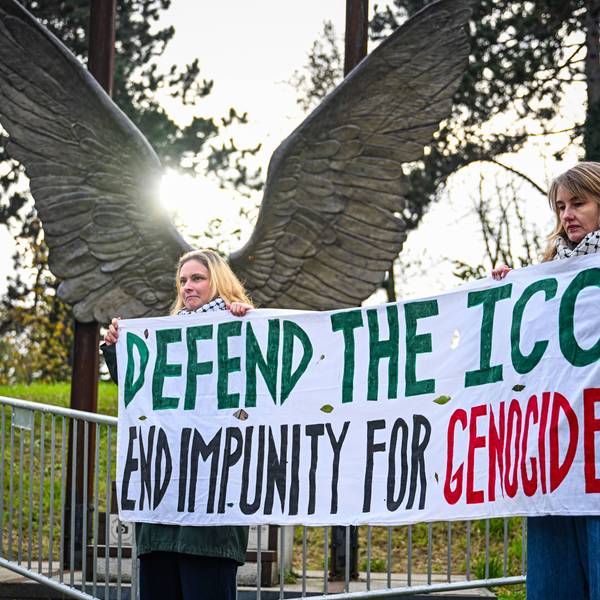
The International Court of Justice (ICJ) is holding hearings this week on a case brought by South Africa accusing Israel of genocide in the Gaza war. The case seeks an emergency suspension of the Israeli war on Gaza, with a hearing scheduled in the Hague on 11-12 January.
We Palestinians highly appreciate the symbolism of South Africa, a country that also suffered from apartheid, racial discrimination and genocide, submitting this complaint to the ICJ. It is a historic move, marking the first time any country has filed a genocide case against Israel before the World Court.
Will the court succeed in achieving what the entire international community has failed to obtain: an urgent ceasefire and accountability for Israeli criminals?
As we continue to suffer the scourge of war, our eyes turn to the Hague, in hopes that the screams of Palestinian children and women will prevail over the executioner’s whip.
The arguments presented against Israel in the genocide case are certainly credible. Palestinians have lived and suffered from these horrific crimes over decades of occupation, and especially in the current war, which is being broadcast live for the world to see.
More than 23,000 Palestinians have been killed in this war and around 60,000 injured. Tens of thousands of buildings have been damaged or destroyed, while the majority of the people of Gaza have been starved and displaced from their homes over a period of more than three months.
Although the Palestinian people believe in the justice of their cause and are fully aware of the injustices and crimes committed against them, they still harbour legitimate fears, given their bitter experiences with the international community and the United Nations Security Council. Many of us have doubts about the seriousness of the international community - especially the US - when it comes to ending, or even mitigating, Israel’s crimes against us.
Although the final judgment of the ICJ will likely take years, we hope the court will make a quick decision on a ceasefire. But this hope dulls when we realise that implementing the ruling depends on the Security Council, where the US can veto any resolution against Israel. This has allowed Israel to long behave with impunity and in disregard of the Geneva Conventions.
At the same time, we wonder: where are the countries of the so-called free world that have always spoken out about justice and human rights? We feel let down, because none of the Arab or Islamic states - who are supposed to be closest to the Palestinian people - contributed to bringing this case before the ICJ.
ICJ hearing against Israel: All you need to know about South Africa's case in the Haguewww.youtube.com
We also view with suspicion the double standards of the international justice system, which was able to relatively quickly issue an arrest warrant against Russian President Vladimir Putin over alleged war crimes in Ukraine through the International Criminal Court last March. Not only that, but in March 2022, a couple of weeks after the conflict broke out, the ICJ ordered Russia to “immediately suspend” its military operations after Ukraine raised a genocide complaint.
The term “genocide” refers to the intentional destruction, in whole or in part, of a national, ethnic, racial or religious group. Some experts say the most difficult thing to prove is genocidal intent. But Israeli officials at the highest levels have made their intent clear.
They have repeatedly stated their aim of collectively punishing civilians in Gaza over the 7 October attack. In announcing a full siege of the territory, cutting off electricity and water, Israeli Defence Minister Yoav Gallant described Palestinians as “human animals.”
Israeli President Isaac Herzog said there was no distinction between armed fighters and civilians in Gaza, noting: “It is an entire nation out there that is responsible. It’s not true this rhetoric about civilians not aware, not involved … and we will fight until we break their backbone.”
Israel may argue that the ICJ’s authority to rule on provisional measures is constrained by the right to self-defence recognised in the UN Charter. But what Israel is doing is not self-defence; it is clearly on the offensive. Who could realistically argue that self-defence entails displacing and starving two million people; besieging and destroying hospitals; and killing premature infants, children and women? Is cutting off water, electricity, fuel and food to an entire population an act of self-defence?
While the ICJ has no power to enforce its decisions, its rulings are binding under international law, and the outcome could further erode Israel’s global reputation and relations with other countries.
As we continue to suffer the scourge of war, our eyes turn to the Hague, in hopes that the screams of Palestinian children and women will prevail over the executioner’s whip. This could be the last chance for Palestinians to regain confidence and trust in the international community, which has never succeeded in stopping the Israeli occupation and injustice.
We hope South Africa’s case will start a new chapter for our oppressed people - and that the days of Israeli impunity will end once and for all.
This country and this world are at a monumental crossroads. US voters have an opportunity to beat back the forces of fascism and confront the billionaires who are rigging the economy, our media system, and our democracy, making it increasingly impossible for ordinary people to get by. We’re not just talking about the election. We’re talking about what must be done once these fascist elements are vanquished from power. We need a bolder set of solutions than what either major party has so far been willing to offer and a working-class movement ready to fight like hell for it. Trump didn't emerge from nowhere. The conditions that fueled MAGA authoritarianism were created by decades of radical neoliberal economic policies and a corrupt political system dominated by corporate interests. They slashed taxes on the super-rich, promising that the benefits would trickle down. They said giveaways to the corporate titans would make life more affordable for the rest of us. It was all bullshit. And when a bitter, betrayed populace searches for someone to blame, right-wing demagogues have little trouble finding scapegoats. People know when they're being lied to, but you won't hear any of this from the corporate media. Only independent journalism—powered and funded by people who believe in building a better world—can deliver truly trustworthy daily news. If you share our vision, please contribute whatever you can to sustain our work. |
The International Court of Justice (ICJ) is holding hearings this week on a case brought by South Africa accusing Israel of genocide in the Gaza war. The case seeks an emergency suspension of the Israeli war on Gaza, with a hearing scheduled in the Hague on 11-12 January.
We Palestinians highly appreciate the symbolism of South Africa, a country that also suffered from apartheid, racial discrimination and genocide, submitting this complaint to the ICJ. It is a historic move, marking the first time any country has filed a genocide case against Israel before the World Court.
Will the court succeed in achieving what the entire international community has failed to obtain: an urgent ceasefire and accountability for Israeli criminals?
As we continue to suffer the scourge of war, our eyes turn to the Hague, in hopes that the screams of Palestinian children and women will prevail over the executioner’s whip.
The arguments presented against Israel in the genocide case are certainly credible. Palestinians have lived and suffered from these horrific crimes over decades of occupation, and especially in the current war, which is being broadcast live for the world to see.
More than 23,000 Palestinians have been killed in this war and around 60,000 injured. Tens of thousands of buildings have been damaged or destroyed, while the majority of the people of Gaza have been starved and displaced from their homes over a period of more than three months.
Although the Palestinian people believe in the justice of their cause and are fully aware of the injustices and crimes committed against them, they still harbour legitimate fears, given their bitter experiences with the international community and the United Nations Security Council. Many of us have doubts about the seriousness of the international community - especially the US - when it comes to ending, or even mitigating, Israel’s crimes against us.
Although the final judgment of the ICJ will likely take years, we hope the court will make a quick decision on a ceasefire. But this hope dulls when we realise that implementing the ruling depends on the Security Council, where the US can veto any resolution against Israel. This has allowed Israel to long behave with impunity and in disregard of the Geneva Conventions.
At the same time, we wonder: where are the countries of the so-called free world that have always spoken out about justice and human rights? We feel let down, because none of the Arab or Islamic states - who are supposed to be closest to the Palestinian people - contributed to bringing this case before the ICJ.
ICJ hearing against Israel: All you need to know about South Africa's case in the Haguewww.youtube.com
We also view with suspicion the double standards of the international justice system, which was able to relatively quickly issue an arrest warrant against Russian President Vladimir Putin over alleged war crimes in Ukraine through the International Criminal Court last March. Not only that, but in March 2022, a couple of weeks after the conflict broke out, the ICJ ordered Russia to “immediately suspend” its military operations after Ukraine raised a genocide complaint.
The term “genocide” refers to the intentional destruction, in whole or in part, of a national, ethnic, racial or religious group. Some experts say the most difficult thing to prove is genocidal intent. But Israeli officials at the highest levels have made their intent clear.
They have repeatedly stated their aim of collectively punishing civilians in Gaza over the 7 October attack. In announcing a full siege of the territory, cutting off electricity and water, Israeli Defence Minister Yoav Gallant described Palestinians as “human animals.”
Israeli President Isaac Herzog said there was no distinction between armed fighters and civilians in Gaza, noting: “It is an entire nation out there that is responsible. It’s not true this rhetoric about civilians not aware, not involved … and we will fight until we break their backbone.”
Israel may argue that the ICJ’s authority to rule on provisional measures is constrained by the right to self-defence recognised in the UN Charter. But what Israel is doing is not self-defence; it is clearly on the offensive. Who could realistically argue that self-defence entails displacing and starving two million people; besieging and destroying hospitals; and killing premature infants, children and women? Is cutting off water, electricity, fuel and food to an entire population an act of self-defence?
While the ICJ has no power to enforce its decisions, its rulings are binding under international law, and the outcome could further erode Israel’s global reputation and relations with other countries.
As we continue to suffer the scourge of war, our eyes turn to the Hague, in hopes that the screams of Palestinian children and women will prevail over the executioner’s whip. This could be the last chance for Palestinians to regain confidence and trust in the international community, which has never succeeded in stopping the Israeli occupation and injustice.
We hope South Africa’s case will start a new chapter for our oppressed people - and that the days of Israeli impunity will end once and for all.