5
#000000
#FFFFFF
To donate by check, phone, or other method, see our More Ways to Give page.
Daily news & progressive opinion—funded by the people, not the corporations—delivered straight to your inbox.

Protesting students carry out blockading action outside the Gustave Eiffel secondary school in Bordeaux, south-western France, on October 1, 2026.
The American Revolution helped inspire France’s struggle for liberty. Now, France’s students are offering Americans an example we ought to consider: A generation can defend its future together instead of being told, one person at a time, to adjust its expectations.
France’s October 6 mobilization challenges Americans to defend their future through peaceful collective action.
Call me a Jacobin. Call me whatever you want.
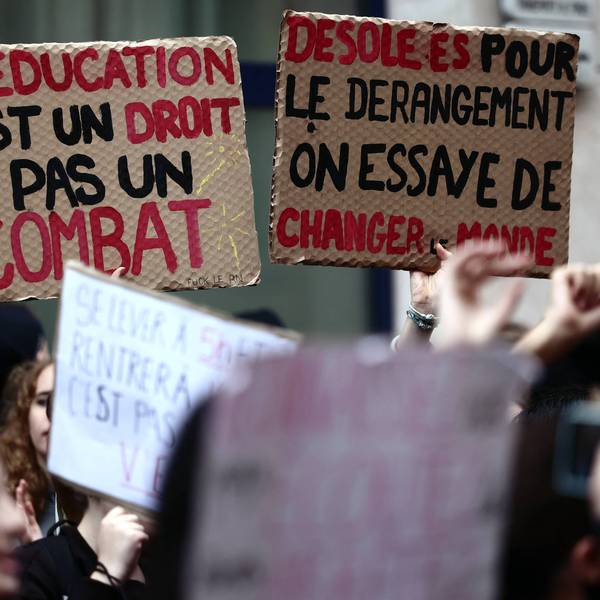
On October 6, students, teachers, and parents took to the streets across France in a national day of action over missing teachers, overcrowded classrooms, and deteriorating schools. Americans should pay attention to what they are demanding—and what their pressure has already helped put on the political agenda.
Our circumstances differ from France’s, but the gap between a promised future and a delivered one is familiar.
When I watch young people in France insist that their futures deserve more than another promise, I feel something like the hope Thomas Jefferson felt watching the beginnings of the French Revolution: the possibility that ordinary people might demand a greater say in the society they inhabit.
History does not offer a clean comparison. Jefferson’s enthusiasm led him to excuse terrible bloodshed, and I will not follow him there. What moves me today is the courage of students organizing peacefully, walking out, and refusing to treat deteriorating conditions as the natural order of things.
The American Revolution helped inspire France’s struggle for liberty. Now, France’s students are offering Americans an example we ought to consider: A generation can defend its future together instead of being told, one person at a time, to adjust its expectations.
The immediate grievances are concrete. Reuters has reported on French high school students protesting overcrowded classrooms, deteriorating buildings, and teacher shortages. One 17-year-old aspiring teacher described taking her French examination without having had a French teacher. A younger student carried a sign declaring, “Our address should not decide our future.” [Source]
That is a demand for the promise of education to mean something.
We tell young people to attend class, work hard, and prepare for a career. We tell them that education is their route to stability. Then, when the institutions responsible for providing that education fail them, we act surprised that they refuse to keep participating quietly.
Their sacrifice deserves acknowledgment. Walking out can mean missed instruction, disciplinary consequences, and added pressure around examinations. These students have futures to build. Their willingness to interrupt that work should make us ask why continuing as usual feels like the greater risk.
And with teachers missing, some students were already losing instruction. A government cannot count every hour lost to protest while overlooking the hours its own failures have taken.
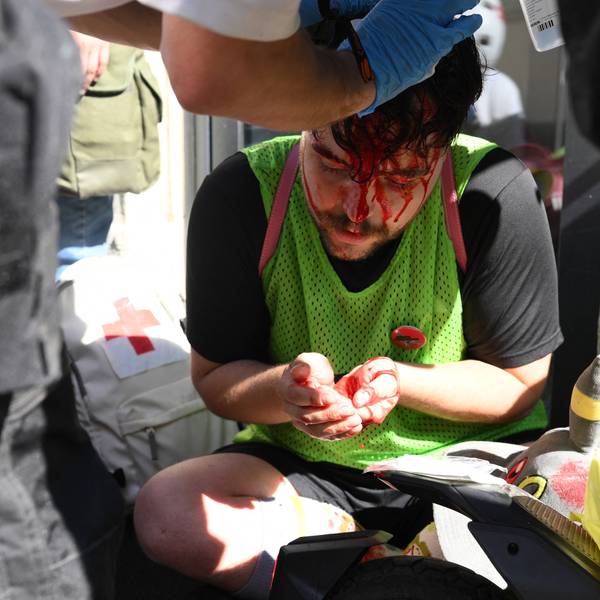
The violence must be named plainly. By October 2, Education Minister Édouard Geffray reported at least 65 injured staff members, including 40 principals, about 170 wounded students, and more than 100 severely damaged high schools. By October 6, the prime minister reported 215 injured teenagers and 85 injured school staff. Schools have been set on fire. Reuters reported that two teachers in Marseille were inadvertently splashed with gasoline as a student tried to throw it into a trash bin. A regional education spokesperson separately reported a youth spraying gasoline at a teacher in La Ciotat; Reuters could not verify that incident’s circumstances.
Burning a school and endangering its staff betray the demand for a better education. Whoever commits those acts should be held accountable. Students, teachers, and principals deserve protection.
Officials also dispute the movement’s origins. Justice Minister Gérald Darmanin said outsiders had hijacked it; Interior Minister Laurent Nuñez described troublemakers moving between schools to incite violence. According to a government source cited by Reuters, intelligence agencies attributed its initiation to La France Insoumise and far-left allies. LFI denied the allegation. Those claims deserve scrutiny, rather than being treated as proof that every student’s complaint is manufactured.
Some Paris-area students told Reuters they were staying away because of the escalating violence. That is a loss of their voice, too. A peaceful movement needs to protect their ability to participate. Nonviolence must remain a commitment, especially when anger is justified. The society we want to build has to be visible in the way we fight for it.
If the police are more interested in silencing you than hearing your complaint, then that society deserves protesting, in my view. Police officers cannot resolve every political grievance, but they can respect the right to express one. When authorities answer peaceful dissent with intimidation or unjustified force, their response becomes another reason to protest.
A student should not have to fall silent to be treated as someone worth protecting.
But calls for order must come with an answer to the conditions that brought students into the streets. Returning everyone to the classroom will not resolve a teacher vacancy. Ending a blockade will not repair a neglected building.
If leaders want stability, they have to give young people a reason to believe the institutions around them can deliver it.
Promises alone cannot do that anymore.
There has already been a concrete retreat. On October 1, Education Minister Édouard Geffray announced that the government would withdraw proposed annual registration fees for students without scholarships in BTS technical programs and preparatory classes for the Grandes Écoles. The proposed charges were €178 and €270, respectively. He cited discussions with unions and the prime minister.
That reversal came amid the student mobilization. It does not prove that street protests alone caused the decision, and it does not repair a classroom. But it shows that a government proposal can be challenged and withdrawn. Pressure can produce something more tangible than another invitation to be patient.
Students deserve commitments they can evaluate: which positions will be filled, which buildings will be repaired, what resources will reach underserved schools, and when those changes will happen. A consultation can help identify a problem. It cannot become a permanent substitute for fixing it.
American Gen Z should take note.
Consider our fight over student debt. In June 2023, the Supreme Court struck down the Biden administration’s plan to cancel up to $10,000 in eligible federal student debt, or $20,000 for eligible Pell Grant recipients. The court held that the administration lacked authority under the law it had invoked. Borrowers who had been offered relief were left without that promised cancellation.
The legal question matters. So does the political responsibility to deliver a workable solution. Telling young Americans that education is the path to stability, then leaving them to navigate its financial consequences, is hardly an invitation to trust another announcement. Our circumstances differ from France’s, but the gap between a promised future and a delivered one is familiar.
Peaceful collective action gives that frustration somewhere to go. Student associations, unions, public meetings, demonstrations, and the ballot can turn private discouragement into demands people can act on together.
I do not expect every young American to take the same risk. Some cannot afford to miss a shift or a class. A serious movement makes room for them, too. Solidarity should widen participation and help people bear its costs.
What I admire in France is the refusal to surrender the idea that public institutions owe the next generation a fair chance.
God bless France. God bless the students peacefully standing up for the society they want to inherit.
And may America’s young people recognize that they deserve a voice in shaping theirs.
Dear Common Dreams reader, It’s been nearly 30 years since I co-founded Common Dreams with my late wife, Lina Newhouser. We had the radical notion that journalism should serve the public good, not corporate profits. It was clear to us from the outset what it would take to build such a project. No paid advertisements. No corporate sponsors. No millionaire publisher telling us what to think or do. Many people said we wouldn't last a year, but we proved those doubters wrong. Together with a tremendous team of journalists and dedicated staff, we built an independent media outlet free from the constraints of profits and corporate control. Our mission has always been simple: To inform. To inspire. To ignite change for the common good. Building Common Dreams was not easy. Our survival was never guaranteed. When you take on the most powerful forces—Wall Street greed, fossil fuel industry destruction, Big Tech lobbyists, and uber-rich oligarchs who have spent billions upon billions rigging the economy and democracy in their favor—the only bulwark you have is supporters who believe in your work. But here’s the urgent message from me today. It's never been this bad out there. And it's never been this hard to keep us going. At the very moment Common Dreams is most needed, the threats we face are intensifying. We need your support now more than ever. We don't accept corporate advertising and never will. We don't have a paywall because we don't think people should be blocked from critical news based on their ability to pay. Everything we do is funded by the donations of readers like you. When everyone does the little they can afford, we are strong. But if that support retreats or dries up, so do we. Will you donate now to make sure Common Dreams not only survives but thrives? —Craig Brown, Co-founder |
France’s October 6 mobilization challenges Americans to defend their future through peaceful collective action.
Call me a Jacobin. Call me whatever you want.
On October 6, students, teachers, and parents took to the streets across France in a national day of action over missing teachers, overcrowded classrooms, and deteriorating schools. Americans should pay attention to what they are demanding—and what their pressure has already helped put on the political agenda.
Our circumstances differ from France’s, but the gap between a promised future and a delivered one is familiar.
When I watch young people in France insist that their futures deserve more than another promise, I feel something like the hope Thomas Jefferson felt watching the beginnings of the French Revolution: the possibility that ordinary people might demand a greater say in the society they inhabit.
History does not offer a clean comparison. Jefferson’s enthusiasm led him to excuse terrible bloodshed, and I will not follow him there. What moves me today is the courage of students organizing peacefully, walking out, and refusing to treat deteriorating conditions as the natural order of things.
The American Revolution helped inspire France’s struggle for liberty. Now, France’s students are offering Americans an example we ought to consider: A generation can defend its future together instead of being told, one person at a time, to adjust its expectations.
The immediate grievances are concrete. Reuters has reported on French high school students protesting overcrowded classrooms, deteriorating buildings, and teacher shortages. One 17-year-old aspiring teacher described taking her French examination without having had a French teacher. A younger student carried a sign declaring, “Our address should not decide our future.” [Source]
That is a demand for the promise of education to mean something.
We tell young people to attend class, work hard, and prepare for a career. We tell them that education is their route to stability. Then, when the institutions responsible for providing that education fail them, we act surprised that they refuse to keep participating quietly.
Their sacrifice deserves acknowledgment. Walking out can mean missed instruction, disciplinary consequences, and added pressure around examinations. These students have futures to build. Their willingness to interrupt that work should make us ask why continuing as usual feels like the greater risk.
And with teachers missing, some students were already losing instruction. A government cannot count every hour lost to protest while overlooking the hours its own failures have taken.
The violence must be named plainly. By October 2, Education Minister Édouard Geffray reported at least 65 injured staff members, including 40 principals, about 170 wounded students, and more than 100 severely damaged high schools. By October 6, the prime minister reported 215 injured teenagers and 85 injured school staff. Schools have been set on fire. Reuters reported that two teachers in Marseille were inadvertently splashed with gasoline as a student tried to throw it into a trash bin. A regional education spokesperson separately reported a youth spraying gasoline at a teacher in La Ciotat; Reuters could not verify that incident’s circumstances.
Burning a school and endangering its staff betray the demand for a better education. Whoever commits those acts should be held accountable. Students, teachers, and principals deserve protection.
Officials also dispute the movement’s origins. Justice Minister Gérald Darmanin said outsiders had hijacked it; Interior Minister Laurent Nuñez described troublemakers moving between schools to incite violence. According to a government source cited by Reuters, intelligence agencies attributed its initiation to La France Insoumise and far-left allies. LFI denied the allegation. Those claims deserve scrutiny, rather than being treated as proof that every student’s complaint is manufactured.
Some Paris-area students told Reuters they were staying away because of the escalating violence. That is a loss of their voice, too. A peaceful movement needs to protect their ability to participate. Nonviolence must remain a commitment, especially when anger is justified. The society we want to build has to be visible in the way we fight for it.
If the police are more interested in silencing you than hearing your complaint, then that society deserves protesting, in my view. Police officers cannot resolve every political grievance, but they can respect the right to express one. When authorities answer peaceful dissent with intimidation or unjustified force, their response becomes another reason to protest.
A student should not have to fall silent to be treated as someone worth protecting.
But calls for order must come with an answer to the conditions that brought students into the streets. Returning everyone to the classroom will not resolve a teacher vacancy. Ending a blockade will not repair a neglected building.
If leaders want stability, they have to give young people a reason to believe the institutions around them can deliver it.
Promises alone cannot do that anymore.
There has already been a concrete retreat. On October 1, Education Minister Édouard Geffray announced that the government would withdraw proposed annual registration fees for students without scholarships in BTS technical programs and preparatory classes for the Grandes Écoles. The proposed charges were €178 and €270, respectively. He cited discussions with unions and the prime minister.
That reversal came amid the student mobilization. It does not prove that street protests alone caused the decision, and it does not repair a classroom. But it shows that a government proposal can be challenged and withdrawn. Pressure can produce something more tangible than another invitation to be patient.
Students deserve commitments they can evaluate: which positions will be filled, which buildings will be repaired, what resources will reach underserved schools, and when those changes will happen. A consultation can help identify a problem. It cannot become a permanent substitute for fixing it.
American Gen Z should take note.
Consider our fight over student debt. In June 2023, the Supreme Court struck down the Biden administration’s plan to cancel up to $10,000 in eligible federal student debt, or $20,000 for eligible Pell Grant recipients. The court held that the administration lacked authority under the law it had invoked. Borrowers who had been offered relief were left without that promised cancellation.
The legal question matters. So does the political responsibility to deliver a workable solution. Telling young Americans that education is the path to stability, then leaving them to navigate its financial consequences, is hardly an invitation to trust another announcement. Our circumstances differ from France’s, but the gap between a promised future and a delivered one is familiar.
Peaceful collective action gives that frustration somewhere to go. Student associations, unions, public meetings, demonstrations, and the ballot can turn private discouragement into demands people can act on together.
I do not expect every young American to take the same risk. Some cannot afford to miss a shift or a class. A serious movement makes room for them, too. Solidarity should widen participation and help people bear its costs.
What I admire in France is the refusal to surrender the idea that public institutions owe the next generation a fair chance.
God bless France. God bless the students peacefully standing up for the society they want to inherit.
And may America’s young people recognize that they deserve a voice in shaping theirs.
France’s October 6 mobilization challenges Americans to defend their future through peaceful collective action.
Call me a Jacobin. Call me whatever you want.
On October 6, students, teachers, and parents took to the streets across France in a national day of action over missing teachers, overcrowded classrooms, and deteriorating schools. Americans should pay attention to what they are demanding—and what their pressure has already helped put on the political agenda.
Our circumstances differ from France’s, but the gap between a promised future and a delivered one is familiar.
When I watch young people in France insist that their futures deserve more than another promise, I feel something like the hope Thomas Jefferson felt watching the beginnings of the French Revolution: the possibility that ordinary people might demand a greater say in the society they inhabit.
History does not offer a clean comparison. Jefferson’s enthusiasm led him to excuse terrible bloodshed, and I will not follow him there. What moves me today is the courage of students organizing peacefully, walking out, and refusing to treat deteriorating conditions as the natural order of things.
The American Revolution helped inspire France’s struggle for liberty. Now, France’s students are offering Americans an example we ought to consider: A generation can defend its future together instead of being told, one person at a time, to adjust its expectations.
The immediate grievances are concrete. Reuters has reported on French high school students protesting overcrowded classrooms, deteriorating buildings, and teacher shortages. One 17-year-old aspiring teacher described taking her French examination without having had a French teacher. A younger student carried a sign declaring, “Our address should not decide our future.” [Source]
That is a demand for the promise of education to mean something.
We tell young people to attend class, work hard, and prepare for a career. We tell them that education is their route to stability. Then, when the institutions responsible for providing that education fail them, we act surprised that they refuse to keep participating quietly.
Their sacrifice deserves acknowledgment. Walking out can mean missed instruction, disciplinary consequences, and added pressure around examinations. These students have futures to build. Their willingness to interrupt that work should make us ask why continuing as usual feels like the greater risk.
And with teachers missing, some students were already losing instruction. A government cannot count every hour lost to protest while overlooking the hours its own failures have taken.
The violence must be named plainly. By October 2, Education Minister Édouard Geffray reported at least 65 injured staff members, including 40 principals, about 170 wounded students, and more than 100 severely damaged high schools. By October 6, the prime minister reported 215 injured teenagers and 85 injured school staff. Schools have been set on fire. Reuters reported that two teachers in Marseille were inadvertently splashed with gasoline as a student tried to throw it into a trash bin. A regional education spokesperson separately reported a youth spraying gasoline at a teacher in La Ciotat; Reuters could not verify that incident’s circumstances.
Burning a school and endangering its staff betray the demand for a better education. Whoever commits those acts should be held accountable. Students, teachers, and principals deserve protection.
Officials also dispute the movement’s origins. Justice Minister Gérald Darmanin said outsiders had hijacked it; Interior Minister Laurent Nuñez described troublemakers moving between schools to incite violence. According to a government source cited by Reuters, intelligence agencies attributed its initiation to La France Insoumise and far-left allies. LFI denied the allegation. Those claims deserve scrutiny, rather than being treated as proof that every student’s complaint is manufactured.
Some Paris-area students told Reuters they were staying away because of the escalating violence. That is a loss of their voice, too. A peaceful movement needs to protect their ability to participate. Nonviolence must remain a commitment, especially when anger is justified. The society we want to build has to be visible in the way we fight for it.
If the police are more interested in silencing you than hearing your complaint, then that society deserves protesting, in my view. Police officers cannot resolve every political grievance, but they can respect the right to express one. When authorities answer peaceful dissent with intimidation or unjustified force, their response becomes another reason to protest.
A student should not have to fall silent to be treated as someone worth protecting.
But calls for order must come with an answer to the conditions that brought students into the streets. Returning everyone to the classroom will not resolve a teacher vacancy. Ending a blockade will not repair a neglected building.
If leaders want stability, they have to give young people a reason to believe the institutions around them can deliver it.
Promises alone cannot do that anymore.
There has already been a concrete retreat. On October 1, Education Minister Édouard Geffray announced that the government would withdraw proposed annual registration fees for students without scholarships in BTS technical programs and preparatory classes for the Grandes Écoles. The proposed charges were €178 and €270, respectively. He cited discussions with unions and the prime minister.
That reversal came amid the student mobilization. It does not prove that street protests alone caused the decision, and it does not repair a classroom. But it shows that a government proposal can be challenged and withdrawn. Pressure can produce something more tangible than another invitation to be patient.
Students deserve commitments they can evaluate: which positions will be filled, which buildings will be repaired, what resources will reach underserved schools, and when those changes will happen. A consultation can help identify a problem. It cannot become a permanent substitute for fixing it.
American Gen Z should take note.
Consider our fight over student debt. In June 2023, the Supreme Court struck down the Biden administration’s plan to cancel up to $10,000 in eligible federal student debt, or $20,000 for eligible Pell Grant recipients. The court held that the administration lacked authority under the law it had invoked. Borrowers who had been offered relief were left without that promised cancellation.
The legal question matters. So does the political responsibility to deliver a workable solution. Telling young Americans that education is the path to stability, then leaving them to navigate its financial consequences, is hardly an invitation to trust another announcement. Our circumstances differ from France’s, but the gap between a promised future and a delivered one is familiar.
Peaceful collective action gives that frustration somewhere to go. Student associations, unions, public meetings, demonstrations, and the ballot can turn private discouragement into demands people can act on together.
I do not expect every young American to take the same risk. Some cannot afford to miss a shift or a class. A serious movement makes room for them, too. Solidarity should widen participation and help people bear its costs.
What I admire in France is the refusal to surrender the idea that public institutions owe the next generation a fair chance.
God bless France. God bless the students peacefully standing up for the society they want to inherit.
And may America’s young people recognize that they deserve a voice in shaping theirs.