SUBSCRIBE TO OUR FREE NEWSLETTER
Daily news & progressive opinion—funded by the people, not the corporations—delivered straight to your inbox.
5
#000000
#FFFFFF
To donate by check, phone, or other method, see our More Ways to Give page.
Daily news & progressive opinion—funded by the people, not the corporations—delivered straight to your inbox.
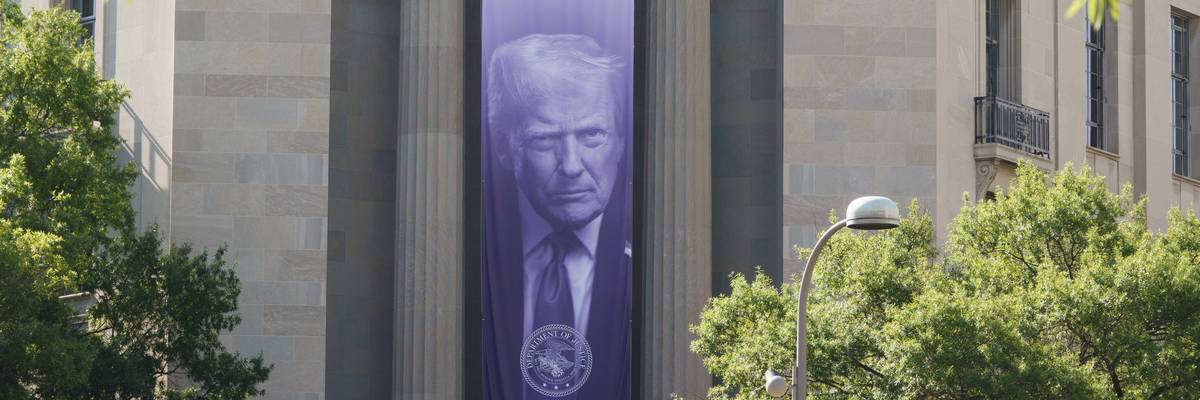
A banner with a photo of President Donald Trump is displayed outside of the Robert F. Kennedy Department of Justice Building, headquarters of the US Department of Justice on August 8, 2026 in Washington, DC.
He has taken us over and, resist as we will, we live in "his" world now. Even our thoughts are shaped and limited by the polarity he has bludgeoned onto the world.
Hope,
Vanquished, cries, and an atrocious and despotic Anguish,
On my bent neck plants his black flag.
[Charles Baudelaire, “Spleen”]
It should have been an ordinary conversation. A former political colleague; her partner, a poet; my wife, and I, at a farmer’s market we visit every Saturday. We talked about a few people we knew, and then we paused. “We won’t talk about the larger political situation,” the poet said. “Too much depressing stuff there.”
I was taken by surprise, because what she said was true. Not in the usual sense, that a nameless police force was arresting and deporting Americans, that there was a hell-mell push into fossil fuels despite the rapid progress of global warming, that democracy and free elections were imperiled, that the social safety net was being slashed to ribbons of its former self. That the rich were getting evermore rich, and faster, or that corruption on a monumental scale had infected our politics.
No, what was surprising was my realization that worry and decline and hopelessness had so infected our lives that there was little else to talk about. With that subject out of bounds—we would not, could not, talk about Donald Trump—we were reduced to silence. A good book, a wonderful movie, the pleasures of the late summer garden, a recipe we liked, even the weather: All were reduced to the margin, crowded out by an administration intent on destroying not only the present, but the future. Unchecked AI could destroy humanity within 10 years; the American president (at the United Nations no less!) threatened to drop nuclear weapons and eradicate Iran; measles and polio were once again on the brink of becoming an epidemic: These were things we would not discuss.
Donald Trump had pervaded every nook and cranny of our consciousness. And if we ruled out talking about him and his coterie, well, there was nothing left to talk about.
Donald Trump has turned our minds into a battlefield where his image dominates every activity.
It was a terrifying realization, that all life and thought had been reduced to talking about Trump. With him, terror abounds; without him, conversation shrinks into silence.
This is the most lasting damage he has done. He has taken over our waking (and non-waking, perhaps) lives, reducing the richness of consciousness to the sterility of staring at ruin and catastrophe, all over, all the time.
Seventy years ago, in his satiric poem, “America,” Allen Ginsberg asked, “Are you going to let your emotional life be run by Time magazine?” Today, it is Donald Trump who runs our emotional lives. Without him, we have little to talk about, other than family. (It should be stated: Often family is very much worth talking about, and being connected to. A healthful alternative to Trump.)
Trump’s monuments to himself (the ballroom, the helipad, the triumphal arch) will not, no matter what he thinks, remain. Like Ozymandias, the ancient king whom Percy Bysshe Shelley memorialized by writing of his statue, all will one day be in ruins.
Nothing beside remains. Round the decay
Of that colossal Wreck, boundless and bare,
The lone and level sands stretch far away.
But in another way, he has succeeded. We each have only one life to live. So much of our waking lives, of our consciousness, has been colonized by Donald Trump. In this, his presence looms immense. He is the colossus of our thoughts, and without him, we don’t know who or what we are.
At the risk of redundancy, let me repeat: Donald Trump has colonized our minds. There is little room in our consciousness for imagining the better future we once longed for, and worked for: Not much room for peace, justice, caring for the less fortunate, empathy for others. He, the potentate of revenge, to quote Baudelaire about the wreckage wrought by despair, “has planted his black flag on our bent neck.”
We marvel and rebel at his colonization of all branches of government, on his desire to turn allies into vassal states, on his dividing the nation and the world into spheres he can control. What we do not pay enough notice to is how at the same time Donald Trump’s existence has reduced our lives and hopes. He has taken us over and, resist as we will, we live in "his" world now. Even our thoughts are shaped and limited by the polarity he has bludgeoned onto the world.
Our minds were once, to press a metaphor, a garden where we could gambol as imagination pushed us one way or another, a free space where we could hope, or plan for a better future, or just replenish ourselves as we move through the difficulties of daily life. Now? Donald Trump has turned our minds into a battlefield where his image dominates every activity. We are his, now. Alas.
Dear Common Dreams reader, It’s been nearly 30 years since I co-founded Common Dreams with my late wife, Lina Newhouser. We had the radical notion that journalism should serve the public good, not corporate profits. It was clear to us from the outset what it would take to build such a project. No paid advertisements. No corporate sponsors. No millionaire publisher telling us what to think or do. Many people said we wouldn't last a year, but we proved those doubters wrong. Together with a tremendous team of journalists and dedicated staff, we built an independent media outlet free from the constraints of profits and corporate control. Our mission has always been simple: To inform. To inspire. To ignite change for the common good. Building Common Dreams was not easy. Our survival was never guaranteed. When you take on the most powerful forces—Wall Street greed, fossil fuel industry destruction, Big Tech lobbyists, and uber-rich oligarchs who have spent billions upon billions rigging the economy and democracy in their favor—the only bulwark you have is supporters who believe in your work. But here’s the urgent message from me today. It's never been this bad out there. And it's never been this hard to keep us going. At the very moment Common Dreams is most needed, the threats we face are intensifying. We need your support now more than ever. We don't accept corporate advertising and never will. We don't have a paywall because we don't think people should be blocked from critical news based on their ability to pay. Everything we do is funded by the donations of readers like you. When everyone does the little they can afford, we are strong. But if that support retreats or dries up, so do we. Will you donate now to make sure Common Dreams not only survives but thrives? —Craig Brown, Co-founder |
Hope,
Vanquished, cries, and an atrocious and despotic Anguish,
On my bent neck plants his black flag.
[Charles Baudelaire, “Spleen”]
It should have been an ordinary conversation. A former political colleague; her partner, a poet; my wife, and I, at a farmer’s market we visit every Saturday. We talked about a few people we knew, and then we paused. “We won’t talk about the larger political situation,” the poet said. “Too much depressing stuff there.”
I was taken by surprise, because what she said was true. Not in the usual sense, that a nameless police force was arresting and deporting Americans, that there was a hell-mell push into fossil fuels despite the rapid progress of global warming, that democracy and free elections were imperiled, that the social safety net was being slashed to ribbons of its former self. That the rich were getting evermore rich, and faster, or that corruption on a monumental scale had infected our politics.
No, what was surprising was my realization that worry and decline and hopelessness had so infected our lives that there was little else to talk about. With that subject out of bounds—we would not, could not, talk about Donald Trump—we were reduced to silence. A good book, a wonderful movie, the pleasures of the late summer garden, a recipe we liked, even the weather: All were reduced to the margin, crowded out by an administration intent on destroying not only the present, but the future. Unchecked AI could destroy humanity within 10 years; the American president (at the United Nations no less!) threatened to drop nuclear weapons and eradicate Iran; measles and polio were once again on the brink of becoming an epidemic: These were things we would not discuss.
Donald Trump had pervaded every nook and cranny of our consciousness. And if we ruled out talking about him and his coterie, well, there was nothing left to talk about.
Donald Trump has turned our minds into a battlefield where his image dominates every activity.
It was a terrifying realization, that all life and thought had been reduced to talking about Trump. With him, terror abounds; without him, conversation shrinks into silence.
This is the most lasting damage he has done. He has taken over our waking (and non-waking, perhaps) lives, reducing the richness of consciousness to the sterility of staring at ruin and catastrophe, all over, all the time.
Seventy years ago, in his satiric poem, “America,” Allen Ginsberg asked, “Are you going to let your emotional life be run by Time magazine?” Today, it is Donald Trump who runs our emotional lives. Without him, we have little to talk about, other than family. (It should be stated: Often family is very much worth talking about, and being connected to. A healthful alternative to Trump.)
Trump’s monuments to himself (the ballroom, the helipad, the triumphal arch) will not, no matter what he thinks, remain. Like Ozymandias, the ancient king whom Percy Bysshe Shelley memorialized by writing of his statue, all will one day be in ruins.
Nothing beside remains. Round the decay
Of that colossal Wreck, boundless and bare,
The lone and level sands stretch far away.
But in another way, he has succeeded. We each have only one life to live. So much of our waking lives, of our consciousness, has been colonized by Donald Trump. In this, his presence looms immense. He is the colossus of our thoughts, and without him, we don’t know who or what we are.
At the risk of redundancy, let me repeat: Donald Trump has colonized our minds. There is little room in our consciousness for imagining the better future we once longed for, and worked for: Not much room for peace, justice, caring for the less fortunate, empathy for others. He, the potentate of revenge, to quote Baudelaire about the wreckage wrought by despair, “has planted his black flag on our bent neck.”
We marvel and rebel at his colonization of all branches of government, on his desire to turn allies into vassal states, on his dividing the nation and the world into spheres he can control. What we do not pay enough notice to is how at the same time Donald Trump’s existence has reduced our lives and hopes. He has taken us over and, resist as we will, we live in "his" world now. Even our thoughts are shaped and limited by the polarity he has bludgeoned onto the world.
Our minds were once, to press a metaphor, a garden where we could gambol as imagination pushed us one way or another, a free space where we could hope, or plan for a better future, or just replenish ourselves as we move through the difficulties of daily life. Now? Donald Trump has turned our minds into a battlefield where his image dominates every activity. We are his, now. Alas.
Hope,
Vanquished, cries, and an atrocious and despotic Anguish,
On my bent neck plants his black flag.
[Charles Baudelaire, “Spleen”]
It should have been an ordinary conversation. A former political colleague; her partner, a poet; my wife, and I, at a farmer’s market we visit every Saturday. We talked about a few people we knew, and then we paused. “We won’t talk about the larger political situation,” the poet said. “Too much depressing stuff there.”
I was taken by surprise, because what she said was true. Not in the usual sense, that a nameless police force was arresting and deporting Americans, that there was a hell-mell push into fossil fuels despite the rapid progress of global warming, that democracy and free elections were imperiled, that the social safety net was being slashed to ribbons of its former self. That the rich were getting evermore rich, and faster, or that corruption on a monumental scale had infected our politics.
No, what was surprising was my realization that worry and decline and hopelessness had so infected our lives that there was little else to talk about. With that subject out of bounds—we would not, could not, talk about Donald Trump—we were reduced to silence. A good book, a wonderful movie, the pleasures of the late summer garden, a recipe we liked, even the weather: All were reduced to the margin, crowded out by an administration intent on destroying not only the present, but the future. Unchecked AI could destroy humanity within 10 years; the American president (at the United Nations no less!) threatened to drop nuclear weapons and eradicate Iran; measles and polio were once again on the brink of becoming an epidemic: These were things we would not discuss.
Donald Trump had pervaded every nook and cranny of our consciousness. And if we ruled out talking about him and his coterie, well, there was nothing left to talk about.
Donald Trump has turned our minds into a battlefield where his image dominates every activity.
It was a terrifying realization, that all life and thought had been reduced to talking about Trump. With him, terror abounds; without him, conversation shrinks into silence.
This is the most lasting damage he has done. He has taken over our waking (and non-waking, perhaps) lives, reducing the richness of consciousness to the sterility of staring at ruin and catastrophe, all over, all the time.
Seventy years ago, in his satiric poem, “America,” Allen Ginsberg asked, “Are you going to let your emotional life be run by Time magazine?” Today, it is Donald Trump who runs our emotional lives. Without him, we have little to talk about, other than family. (It should be stated: Often family is very much worth talking about, and being connected to. A healthful alternative to Trump.)
Trump’s monuments to himself (the ballroom, the helipad, the triumphal arch) will not, no matter what he thinks, remain. Like Ozymandias, the ancient king whom Percy Bysshe Shelley memorialized by writing of his statue, all will one day be in ruins.
Nothing beside remains. Round the decay
Of that colossal Wreck, boundless and bare,
The lone and level sands stretch far away.
But in another way, he has succeeded. We each have only one life to live. So much of our waking lives, of our consciousness, has been colonized by Donald Trump. In this, his presence looms immense. He is the colossus of our thoughts, and without him, we don’t know who or what we are.
At the risk of redundancy, let me repeat: Donald Trump has colonized our minds. There is little room in our consciousness for imagining the better future we once longed for, and worked for: Not much room for peace, justice, caring for the less fortunate, empathy for others. He, the potentate of revenge, to quote Baudelaire about the wreckage wrought by despair, “has planted his black flag on our bent neck.”
We marvel and rebel at his colonization of all branches of government, on his desire to turn allies into vassal states, on his dividing the nation and the world into spheres he can control. What we do not pay enough notice to is how at the same time Donald Trump’s existence has reduced our lives and hopes. He has taken us over and, resist as we will, we live in "his" world now. Even our thoughts are shaped and limited by the polarity he has bludgeoned onto the world.
Our minds were once, to press a metaphor, a garden where we could gambol as imagination pushed us one way or another, a free space where we could hope, or plan for a better future, or just replenish ourselves as we move through the difficulties of daily life. Now? Donald Trump has turned our minds into a battlefield where his image dominates every activity. We are his, now. Alas.