5
#000000
#FFFFFF
To donate by check, phone, or other method, see our More Ways to Give page.
Daily news & progressive opinion—funded by the people, not the corporations—delivered straight to your inbox.
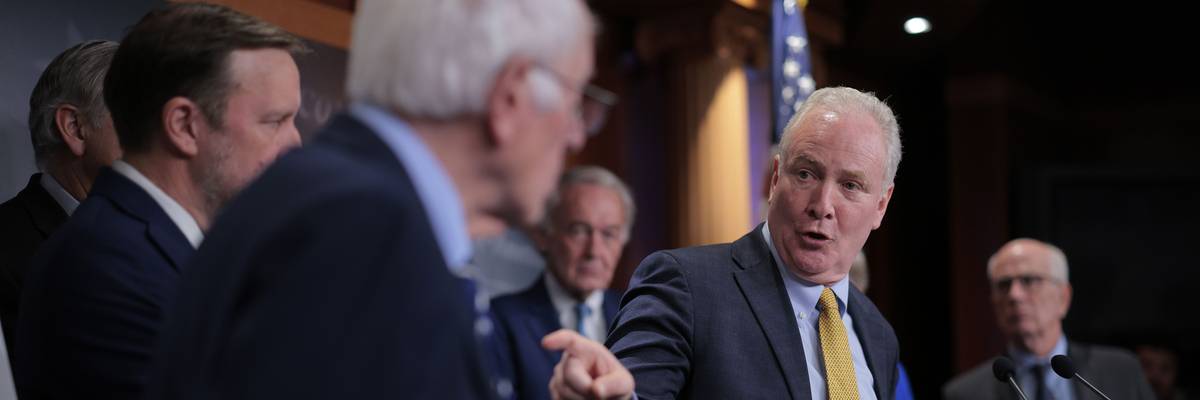
WASHINGTON, DC - OCTOBER 29: Sen. Chris Van Hollen (D-MD) speaks during a news conference with fellow Democratic senators on the 29th day of the federal government shutdown at the US Capitol on October 29, 2025 in Washington, DC. The Democratic senator demanded that the Trump administration pay the cost of the Supplemental Nutrition Assistance Program (SNAP) and Women, Infants, and Children (WIC) during the shutdown, making it possible for more than 42 million people to afford groceries.
If the party is to meet the moment, restructuring US ties with Israel is only a starting point.
By any measure, 2026 has been a disastrous year for President Donald Trump’s foreign policy.
An Iran war in which Trump promised quick victory has turned into a protracted farce dragging down the world economy. The president’s “reciprocal tariffs” were gutted by the Supreme Court, and his administration’s trade agenda remains deeply unpopular. Even his regime change operation in Venezuela, an apparent success, was broadly rejected by the American public and has put the United States into an imperial caretaker role in that country that could prove complicated and costly.
It is no surprise, then, that the president’s approval rating on foreign policy has sunk by almost 30% since his inauguration for his second term. With Trump’s overall polling numbers cratering, Democrats appear to have a decisive advantage in November’s midterms. Yet this has not translated into a lead in foreign affairs, where polling suggests the two parties are essentially tied.
This reality may stem from the fact that, while Democrats have correctly lambasted the president’s actions abroad, the party — and especially its top leadership — has yet to articulate a vision for US foreign policy that reckons with how Trump’s two terms have changed the world and America’s role in it.
While Trump’s first presidency could be viewed as an aberration from the normal course of American politics, his second has been more consequential: a “rupture,” as Canadian Prime Minister Mark Carney memorably put it in his Davos speech early this year.
American partners who have relied on US markets or security backing can no longer hope for a return to normalcy after Trump. They are acting accordingly: in the past year, US allies in Europe, Asia, and the Middle East have engaged in a flurry of activity, inking new trade and defense agreements in a long-term effort to reduce dependence on the United States.
If Democrats are to regain some credibility on foreign policy with audiences both at home and abroad, they must show a similar willingness to break with the past. Yet this willingness has so far been in short supply. While some leading party figures acknowledge that a return to business as usual is impossible, their prescriptions have continued to echo the agenda of the Biden administration: restoring US leadership, renewing alliances, and crafting an international coalition to compete with China.
As much as former President Joe Biden’s foreign policy struggled under the weight of its contradictions, a retread of his agenda would face even more daunting challenges. Can the United States credibly claim to lead its allies — much less the world — when it has repeatedly shown that its commitments don’t outlast a single presidency? Will any partners want to double down on ties with a hegemon that has proven so eager to exploit dependencies for short-term gain? And what kind of international program can the American public be expected to support after years of anger at the status quo and Trumpian disruption alike?
The Democrats have yet to address these questions in a serious way. Fortunately, the intra-party struggle taking place around the US relationship with Israel has created an opening for a broader reevaluation of Democratic foreign policy.
What kind of international program can the American public be expected to support after years of anger at the status quo and Trumpian disruption alike?
Across the country, progressive primary challengers have trounced establishment candidates by appealing to voters’ desire to end blank-check support for Israel. The relationship has become a litmus test for candidates’ willingness to break with destructive orthodoxies. As Sen. Chris Van Hollen (D-Md.) put it, “primary voters won’t trust any Democratic presidential candidate who does not have a record of moral and strategic clarity on these issues.”
If the party is to meet the moment, restructuring US ties with Israel is only a starting point. Candidates and elected officials alike need to put forward bold ideas covering a range of issues, from reasserting congressional war powers to crafting a reformed approach to global aid.
Crucially, their proposals need to go beyond opposition to Trump. Rather than just calling out the stupidity of the Iran war, Democrats should pointedly reject the policy of US military primacy in the Middle East that led to it and make the vigorous case for diplomacy that the conflict has so clearly validated. In addition to overturning Trump’s tariffs, the party should develop an agenda for positive-sum economic engagement with the world that does not treat economic prosperity as a scarce resource to be hoarded by some countries at the expense of others. Instead of attacking Trump for weakness in his apparent dovish turn on China, Democrats can advance a strategy that centers cooperation and conflict prevention alongside targeted pushback on Chinese policies where necessary.
In the broadest terms, a new Democratic foreign policy should entail uniting behind a vision for US global engagement that recognizes America cannot lead on every issue and in every instance. This does not mean abandoning the commitment to a world governed by rules and institutions; in fact, renewed investment in international cooperation stands the best chance of sustaining a genuine “rules-based order” at a time when the United States clearly lacks the will and ability to stand up such a system on its own. This approach would mesh well with proposals by allied leaders like Carney and Spanish Prime Minister Pedro Sánchez, who have each sketched out ideas for a more just, resilient global order upheld by multilateralism and flexible coalition-building.
Democrats must build on these efforts and offer a compelling alternative both to Trumpism and to the exhausted status quo that helped produce it. Failure to do so would invite disappointment on the world stage — and provide a blessing to Trump’s would-be successors.
Dear Common Dreams reader, It’s been nearly 30 years since I co-founded Common Dreams with my late wife, Lina Newhouser. We had the radical notion that journalism should serve the public good, not corporate profits. It was clear to us from the outset what it would take to build such a project. No paid advertisements. No corporate sponsors. No millionaire publisher telling us what to think or do. Many people said we wouldn't last a year, but we proved those doubters wrong. Together with a tremendous team of journalists and dedicated staff, we built an independent media outlet free from the constraints of profits and corporate control. Our mission has always been simple: To inform. To inspire. To ignite change for the common good. Building Common Dreams was not easy. Our survival was never guaranteed. When you take on the most powerful forces—Wall Street greed, fossil fuel industry destruction, Big Tech lobbyists, and uber-rich oligarchs who have spent billions upon billions rigging the economy and democracy in their favor—the only bulwark you have is supporters who believe in your work. But here’s the urgent message from me today. It's never been this bad out there. And it's never been this hard to keep us going. At the very moment Common Dreams is most needed, the threats we face are intensifying. We need your support now more than ever. We don't accept corporate advertising and never will. We don't have a paywall because we don't think people should be blocked from critical news based on their ability to pay. Everything we do is funded by the donations of readers like you. When everyone does the little they can afford, we are strong. But if that support retreats or dries up, so do we. Will you donate now to make sure Common Dreams not only survives but thrives? —Craig Brown, Co-founder |
By any measure, 2026 has been a disastrous year for President Donald Trump’s foreign policy.
An Iran war in which Trump promised quick victory has turned into a protracted farce dragging down the world economy. The president’s “reciprocal tariffs” were gutted by the Supreme Court, and his administration’s trade agenda remains deeply unpopular. Even his regime change operation in Venezuela, an apparent success, was broadly rejected by the American public and has put the United States into an imperial caretaker role in that country that could prove complicated and costly.
It is no surprise, then, that the president’s approval rating on foreign policy has sunk by almost 30% since his inauguration for his second term. With Trump’s overall polling numbers cratering, Democrats appear to have a decisive advantage in November’s midterms. Yet this has not translated into a lead in foreign affairs, where polling suggests the two parties are essentially tied.
This reality may stem from the fact that, while Democrats have correctly lambasted the president’s actions abroad, the party — and especially its top leadership — has yet to articulate a vision for US foreign policy that reckons with how Trump’s two terms have changed the world and America’s role in it.
While Trump’s first presidency could be viewed as an aberration from the normal course of American politics, his second has been more consequential: a “rupture,” as Canadian Prime Minister Mark Carney memorably put it in his Davos speech early this year.
American partners who have relied on US markets or security backing can no longer hope for a return to normalcy after Trump. They are acting accordingly: in the past year, US allies in Europe, Asia, and the Middle East have engaged in a flurry of activity, inking new trade and defense agreements in a long-term effort to reduce dependence on the United States.
If Democrats are to regain some credibility on foreign policy with audiences both at home and abroad, they must show a similar willingness to break with the past. Yet this willingness has so far been in short supply. While some leading party figures acknowledge that a return to business as usual is impossible, their prescriptions have continued to echo the agenda of the Biden administration: restoring US leadership, renewing alliances, and crafting an international coalition to compete with China.
As much as former President Joe Biden’s foreign policy struggled under the weight of its contradictions, a retread of his agenda would face even more daunting challenges. Can the United States credibly claim to lead its allies — much less the world — when it has repeatedly shown that its commitments don’t outlast a single presidency? Will any partners want to double down on ties with a hegemon that has proven so eager to exploit dependencies for short-term gain? And what kind of international program can the American public be expected to support after years of anger at the status quo and Trumpian disruption alike?
The Democrats have yet to address these questions in a serious way. Fortunately, the intra-party struggle taking place around the US relationship with Israel has created an opening for a broader reevaluation of Democratic foreign policy.
What kind of international program can the American public be expected to support after years of anger at the status quo and Trumpian disruption alike?
Across the country, progressive primary challengers have trounced establishment candidates by appealing to voters’ desire to end blank-check support for Israel. The relationship has become a litmus test for candidates’ willingness to break with destructive orthodoxies. As Sen. Chris Van Hollen (D-Md.) put it, “primary voters won’t trust any Democratic presidential candidate who does not have a record of moral and strategic clarity on these issues.”
If the party is to meet the moment, restructuring US ties with Israel is only a starting point. Candidates and elected officials alike need to put forward bold ideas covering a range of issues, from reasserting congressional war powers to crafting a reformed approach to global aid.
Crucially, their proposals need to go beyond opposition to Trump. Rather than just calling out the stupidity of the Iran war, Democrats should pointedly reject the policy of US military primacy in the Middle East that led to it and make the vigorous case for diplomacy that the conflict has so clearly validated. In addition to overturning Trump’s tariffs, the party should develop an agenda for positive-sum economic engagement with the world that does not treat economic prosperity as a scarce resource to be hoarded by some countries at the expense of others. Instead of attacking Trump for weakness in his apparent dovish turn on China, Democrats can advance a strategy that centers cooperation and conflict prevention alongside targeted pushback on Chinese policies where necessary.
In the broadest terms, a new Democratic foreign policy should entail uniting behind a vision for US global engagement that recognizes America cannot lead on every issue and in every instance. This does not mean abandoning the commitment to a world governed by rules and institutions; in fact, renewed investment in international cooperation stands the best chance of sustaining a genuine “rules-based order” at a time when the United States clearly lacks the will and ability to stand up such a system on its own. This approach would mesh well with proposals by allied leaders like Carney and Spanish Prime Minister Pedro Sánchez, who have each sketched out ideas for a more just, resilient global order upheld by multilateralism and flexible coalition-building.
Democrats must build on these efforts and offer a compelling alternative both to Trumpism and to the exhausted status quo that helped produce it. Failure to do so would invite disappointment on the world stage — and provide a blessing to Trump’s would-be successors.
By any measure, 2026 has been a disastrous year for President Donald Trump’s foreign policy.
An Iran war in which Trump promised quick victory has turned into a protracted farce dragging down the world economy. The president’s “reciprocal tariffs” were gutted by the Supreme Court, and his administration’s trade agenda remains deeply unpopular. Even his regime change operation in Venezuela, an apparent success, was broadly rejected by the American public and has put the United States into an imperial caretaker role in that country that could prove complicated and costly.
It is no surprise, then, that the president’s approval rating on foreign policy has sunk by almost 30% since his inauguration for his second term. With Trump’s overall polling numbers cratering, Democrats appear to have a decisive advantage in November’s midterms. Yet this has not translated into a lead in foreign affairs, where polling suggests the two parties are essentially tied.
This reality may stem from the fact that, while Democrats have correctly lambasted the president’s actions abroad, the party — and especially its top leadership — has yet to articulate a vision for US foreign policy that reckons with how Trump’s two terms have changed the world and America’s role in it.
While Trump’s first presidency could be viewed as an aberration from the normal course of American politics, his second has been more consequential: a “rupture,” as Canadian Prime Minister Mark Carney memorably put it in his Davos speech early this year.
American partners who have relied on US markets or security backing can no longer hope for a return to normalcy after Trump. They are acting accordingly: in the past year, US allies in Europe, Asia, and the Middle East have engaged in a flurry of activity, inking new trade and defense agreements in a long-term effort to reduce dependence on the United States.
If Democrats are to regain some credibility on foreign policy with audiences both at home and abroad, they must show a similar willingness to break with the past. Yet this willingness has so far been in short supply. While some leading party figures acknowledge that a return to business as usual is impossible, their prescriptions have continued to echo the agenda of the Biden administration: restoring US leadership, renewing alliances, and crafting an international coalition to compete with China.
As much as former President Joe Biden’s foreign policy struggled under the weight of its contradictions, a retread of his agenda would face even more daunting challenges. Can the United States credibly claim to lead its allies — much less the world — when it has repeatedly shown that its commitments don’t outlast a single presidency? Will any partners want to double down on ties with a hegemon that has proven so eager to exploit dependencies for short-term gain? And what kind of international program can the American public be expected to support after years of anger at the status quo and Trumpian disruption alike?
The Democrats have yet to address these questions in a serious way. Fortunately, the intra-party struggle taking place around the US relationship with Israel has created an opening for a broader reevaluation of Democratic foreign policy.
What kind of international program can the American public be expected to support after years of anger at the status quo and Trumpian disruption alike?
Across the country, progressive primary challengers have trounced establishment candidates by appealing to voters’ desire to end blank-check support for Israel. The relationship has become a litmus test for candidates’ willingness to break with destructive orthodoxies. As Sen. Chris Van Hollen (D-Md.) put it, “primary voters won’t trust any Democratic presidential candidate who does not have a record of moral and strategic clarity on these issues.”
If the party is to meet the moment, restructuring US ties with Israel is only a starting point. Candidates and elected officials alike need to put forward bold ideas covering a range of issues, from reasserting congressional war powers to crafting a reformed approach to global aid.
Crucially, their proposals need to go beyond opposition to Trump. Rather than just calling out the stupidity of the Iran war, Democrats should pointedly reject the policy of US military primacy in the Middle East that led to it and make the vigorous case for diplomacy that the conflict has so clearly validated. In addition to overturning Trump’s tariffs, the party should develop an agenda for positive-sum economic engagement with the world that does not treat economic prosperity as a scarce resource to be hoarded by some countries at the expense of others. Instead of attacking Trump for weakness in his apparent dovish turn on China, Democrats can advance a strategy that centers cooperation and conflict prevention alongside targeted pushback on Chinese policies where necessary.
In the broadest terms, a new Democratic foreign policy should entail uniting behind a vision for US global engagement that recognizes America cannot lead on every issue and in every instance. This does not mean abandoning the commitment to a world governed by rules and institutions; in fact, renewed investment in international cooperation stands the best chance of sustaining a genuine “rules-based order” at a time when the United States clearly lacks the will and ability to stand up such a system on its own. This approach would mesh well with proposals by allied leaders like Carney and Spanish Prime Minister Pedro Sánchez, who have each sketched out ideas for a more just, resilient global order upheld by multilateralism and flexible coalition-building.
Democrats must build on these efforts and offer a compelling alternative both to Trumpism and to the exhausted status quo that helped produce it. Failure to do so would invite disappointment on the world stage — and provide a blessing to Trump’s would-be successors.