SUBSCRIBE TO OUR FREE NEWSLETTER
Daily news & progressive opinion—funded by the people, not the corporations—delivered straight to your inbox.
5
#000000
#FFFFFF
To donate by check, phone, or other method, see our More Ways to Give page.
Daily news & progressive opinion—funded by the people, not the corporations—delivered straight to your inbox.
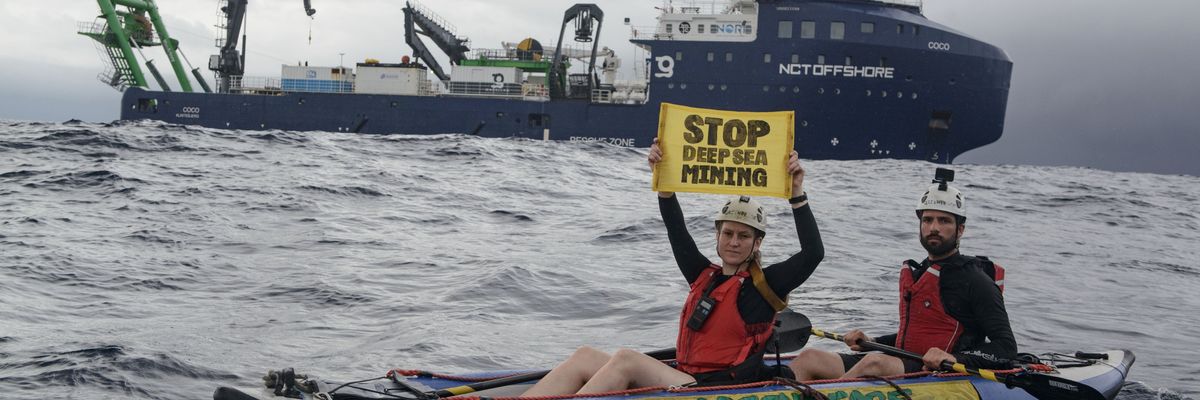
Greenpeace kayaktivists hold up a sign reading "stop deep-sea mining" during a November 2023 protest near a Nauru Ocean Resources Inc. exploration ship in the Pacific Ocean.
As we have begun to unravel the mysteries of the deep sea over the past two decades, the wisdom behind the international community’s commitments to protect it is clearer than ever. Now is time to act.
This week’s United Nations General Assembly marks nearly 20 years since the body first resolved to restrict bottom trawling on the world’s seamounts, submarine mountains that rise thousands of feet above the sea floor and comprise some of the most biologically rich marine ecosystems on the planet.
Led by Palau and other small island nations with generations-long ties to the ocean, the ensuing decades witnessed a raft of subsequent agreements that expanded protections for more of the deep sea—the dark, cold waters below 200 meters—culminating last year with the adoption of a treaty to protect marine biodiversity in areas beyond national jurisdiction.
These are important achievements that should be celebrated. But, we have been involved in diplomacy long enough to know that such agreements are often just the beginning of a long and winding journey to full implementation.
Today, for instance, not only does bottom trawling continue on seamounts, it occurs in ever deeper waters, despite scientific evidence of the severe damage it causes to corals and other habitats. In fact, the UN’s most recent World Ocean Assessment found that “fishing, especially bottom trawling, constitutes the greatest current threat to seamount ecosystems”.
A similar story is unfolding elsewhere in the deep sea. Not long ago, the crushing pressure and near total darkness of the mesopelagic layer of the ocean, sometimes referred to as the “twilight zone” (200-1000 meters deep), was thought to be inhospitable to life.
However, technological advances like submersibles and remotely operated vehicles, now offer a window on a world that is alive with deep water fish, squid, and shrimp. It is estimated that this marine realm holds up to 95 percent of all ocean fish by weight and as many as 10 million different species—a level of biodiversity akin to tropical rainforests.
We also now know that the deep sea environment is critical to the health of the ocean’s wider food web, including fish stocks that countless people around the world depend on for food and employment.
Moreover, new research has revealed that the mesopelagic’s staggering biomass plays an indispensable role in the climate system by keeping enormous amounts of heat-trapping gasses out of the atmosphere in a process known as the carbon pump.
However, as overfishing, pollution, and rapidly warming waters continue to take a toll on global fish stocks, nations have increasingly been looking at authorizing their fleets to exploit the deep sea in order to meet the insatiable demand for fish products used in fertilizer, aquaculture, and dietary supplements.
The danger of over-exploitation doesn’t end 1000 meters down. Mining companies have long looked to extend their reach from the land into the deep sea. Today, for example, the UN-affiliated International Seabed Authority, which regulates deep-sea mining, is working on finalizing rules to manage commercial operations on the ocean floor.
It has already permitted exploratory mining voyages in the Pacific’s vast Clarion-Clipperton Zone, where the ships dredge the sea floor 4000-5000 meters below the surface for nodules of nickel, manganese, copper, and cobalt that without government subsidies would never turn a profit.
As elsewhere, the activities could cause irreversible damage to the ecosystem and potentially release carbon that has been stored safely for millennia. If approved, full-scale mining could commence in a few years.
Remarkably (and not without irony), research funded in part by a corporate mining interest recently discovered the presence of “dark oxygen” in the same area of the seabed. It has long been understood that oxygen was created by living organisms in the presence of light through the process of photosynthesis.
However, a study published over the summer suggests that the electrochemical properties of the aforementioned nodules can generate oxygen in total darkness. The findings could have far-reaching implications that help us understand the origins of life and demonstrate the high stakes involved with mining.
As we have begun to unravel the mysteries of the deep sea over the past two decades, the wisdom behind the international community’s commitments to protect it is clearer than ever. Our imperative task today is to fully implement them before it is too late.
Dear Common Dreams reader, It’s been nearly 30 years since I co-founded Common Dreams with my late wife, Lina Newhouser. We had the radical notion that journalism should serve the public good, not corporate profits. It was clear to us from the outset what it would take to build such a project. No paid advertisements. No corporate sponsors. No millionaire publisher telling us what to think or do. Many people said we wouldn't last a year, but we proved those doubters wrong. Together with a tremendous team of journalists and dedicated staff, we built an independent media outlet free from the constraints of profits and corporate control. Our mission has always been simple: To inform. To inspire. To ignite change for the common good. Building Common Dreams was not easy. Our survival was never guaranteed. When you take on the most powerful forces—Wall Street greed, fossil fuel industry destruction, Big Tech lobbyists, and uber-rich oligarchs who have spent billions upon billions rigging the economy and democracy in their favor—the only bulwark you have is supporters who believe in your work. But here’s the urgent message from me today. It's never been this bad out there. And it's never been this hard to keep us going. At the very moment Common Dreams is most needed, the threats we face are intensifying. We need your support now more than ever. We don't accept corporate advertising and never will. We don't have a paywall because we don't think people should be blocked from critical news based on their ability to pay. Everything we do is funded by the donations of readers like you. When everyone does the little they can afford, we are strong. But if that support retreats or dries up, so do we. Will you donate now to make sure Common Dreams not only survives but thrives? —Craig Brown, Co-founder |
This week’s United Nations General Assembly marks nearly 20 years since the body first resolved to restrict bottom trawling on the world’s seamounts, submarine mountains that rise thousands of feet above the sea floor and comprise some of the most biologically rich marine ecosystems on the planet.
Led by Palau and other small island nations with generations-long ties to the ocean, the ensuing decades witnessed a raft of subsequent agreements that expanded protections for more of the deep sea—the dark, cold waters below 200 meters—culminating last year with the adoption of a treaty to protect marine biodiversity in areas beyond national jurisdiction.
These are important achievements that should be celebrated. But, we have been involved in diplomacy long enough to know that such agreements are often just the beginning of a long and winding journey to full implementation.
Today, for instance, not only does bottom trawling continue on seamounts, it occurs in ever deeper waters, despite scientific evidence of the severe damage it causes to corals and other habitats. In fact, the UN’s most recent World Ocean Assessment found that “fishing, especially bottom trawling, constitutes the greatest current threat to seamount ecosystems”.
A similar story is unfolding elsewhere in the deep sea. Not long ago, the crushing pressure and near total darkness of the mesopelagic layer of the ocean, sometimes referred to as the “twilight zone” (200-1000 meters deep), was thought to be inhospitable to life.
However, technological advances like submersibles and remotely operated vehicles, now offer a window on a world that is alive with deep water fish, squid, and shrimp. It is estimated that this marine realm holds up to 95 percent of all ocean fish by weight and as many as 10 million different species—a level of biodiversity akin to tropical rainforests.
We also now know that the deep sea environment is critical to the health of the ocean’s wider food web, including fish stocks that countless people around the world depend on for food and employment.
Moreover, new research has revealed that the mesopelagic’s staggering biomass plays an indispensable role in the climate system by keeping enormous amounts of heat-trapping gasses out of the atmosphere in a process known as the carbon pump.
However, as overfishing, pollution, and rapidly warming waters continue to take a toll on global fish stocks, nations have increasingly been looking at authorizing their fleets to exploit the deep sea in order to meet the insatiable demand for fish products used in fertilizer, aquaculture, and dietary supplements.
The danger of over-exploitation doesn’t end 1000 meters down. Mining companies have long looked to extend their reach from the land into the deep sea. Today, for example, the UN-affiliated International Seabed Authority, which regulates deep-sea mining, is working on finalizing rules to manage commercial operations on the ocean floor.
It has already permitted exploratory mining voyages in the Pacific’s vast Clarion-Clipperton Zone, where the ships dredge the sea floor 4000-5000 meters below the surface for nodules of nickel, manganese, copper, and cobalt that without government subsidies would never turn a profit.
As elsewhere, the activities could cause irreversible damage to the ecosystem and potentially release carbon that has been stored safely for millennia. If approved, full-scale mining could commence in a few years.
Remarkably (and not without irony), research funded in part by a corporate mining interest recently discovered the presence of “dark oxygen” in the same area of the seabed. It has long been understood that oxygen was created by living organisms in the presence of light through the process of photosynthesis.
However, a study published over the summer suggests that the electrochemical properties of the aforementioned nodules can generate oxygen in total darkness. The findings could have far-reaching implications that help us understand the origins of life and demonstrate the high stakes involved with mining.
As we have begun to unravel the mysteries of the deep sea over the past two decades, the wisdom behind the international community’s commitments to protect it is clearer than ever. Our imperative task today is to fully implement them before it is too late.
This week’s United Nations General Assembly marks nearly 20 years since the body first resolved to restrict bottom trawling on the world’s seamounts, submarine mountains that rise thousands of feet above the sea floor and comprise some of the most biologically rich marine ecosystems on the planet.
Led by Palau and other small island nations with generations-long ties to the ocean, the ensuing decades witnessed a raft of subsequent agreements that expanded protections for more of the deep sea—the dark, cold waters below 200 meters—culminating last year with the adoption of a treaty to protect marine biodiversity in areas beyond national jurisdiction.
These are important achievements that should be celebrated. But, we have been involved in diplomacy long enough to know that such agreements are often just the beginning of a long and winding journey to full implementation.
Today, for instance, not only does bottom trawling continue on seamounts, it occurs in ever deeper waters, despite scientific evidence of the severe damage it causes to corals and other habitats. In fact, the UN’s most recent World Ocean Assessment found that “fishing, especially bottom trawling, constitutes the greatest current threat to seamount ecosystems”.
A similar story is unfolding elsewhere in the deep sea. Not long ago, the crushing pressure and near total darkness of the mesopelagic layer of the ocean, sometimes referred to as the “twilight zone” (200-1000 meters deep), was thought to be inhospitable to life.
However, technological advances like submersibles and remotely operated vehicles, now offer a window on a world that is alive with deep water fish, squid, and shrimp. It is estimated that this marine realm holds up to 95 percent of all ocean fish by weight and as many as 10 million different species—a level of biodiversity akin to tropical rainforests.
We also now know that the deep sea environment is critical to the health of the ocean’s wider food web, including fish stocks that countless people around the world depend on for food and employment.
Moreover, new research has revealed that the mesopelagic’s staggering biomass plays an indispensable role in the climate system by keeping enormous amounts of heat-trapping gasses out of the atmosphere in a process known as the carbon pump.
However, as overfishing, pollution, and rapidly warming waters continue to take a toll on global fish stocks, nations have increasingly been looking at authorizing their fleets to exploit the deep sea in order to meet the insatiable demand for fish products used in fertilizer, aquaculture, and dietary supplements.
The danger of over-exploitation doesn’t end 1000 meters down. Mining companies have long looked to extend their reach from the land into the deep sea. Today, for example, the UN-affiliated International Seabed Authority, which regulates deep-sea mining, is working on finalizing rules to manage commercial operations on the ocean floor.
It has already permitted exploratory mining voyages in the Pacific’s vast Clarion-Clipperton Zone, where the ships dredge the sea floor 4000-5000 meters below the surface for nodules of nickel, manganese, copper, and cobalt that without government subsidies would never turn a profit.
As elsewhere, the activities could cause irreversible damage to the ecosystem and potentially release carbon that has been stored safely for millennia. If approved, full-scale mining could commence in a few years.
Remarkably (and not without irony), research funded in part by a corporate mining interest recently discovered the presence of “dark oxygen” in the same area of the seabed. It has long been understood that oxygen was created by living organisms in the presence of light through the process of photosynthesis.
However, a study published over the summer suggests that the electrochemical properties of the aforementioned nodules can generate oxygen in total darkness. The findings could have far-reaching implications that help us understand the origins of life and demonstrate the high stakes involved with mining.
As we have begun to unravel the mysteries of the deep sea over the past two decades, the wisdom behind the international community’s commitments to protect it is clearer than ever. Our imperative task today is to fully implement them before it is too late.