SUBSCRIBE TO OUR FREE NEWSLETTER
Daily news & progressive opinion—funded by the people, not the corporations—delivered straight to your inbox.
5
#000000
#FFFFFF
To donate by check, phone, or other method, see our More Ways to Give page.
Daily news & progressive opinion—funded by the people, not the corporations—delivered straight to your inbox.
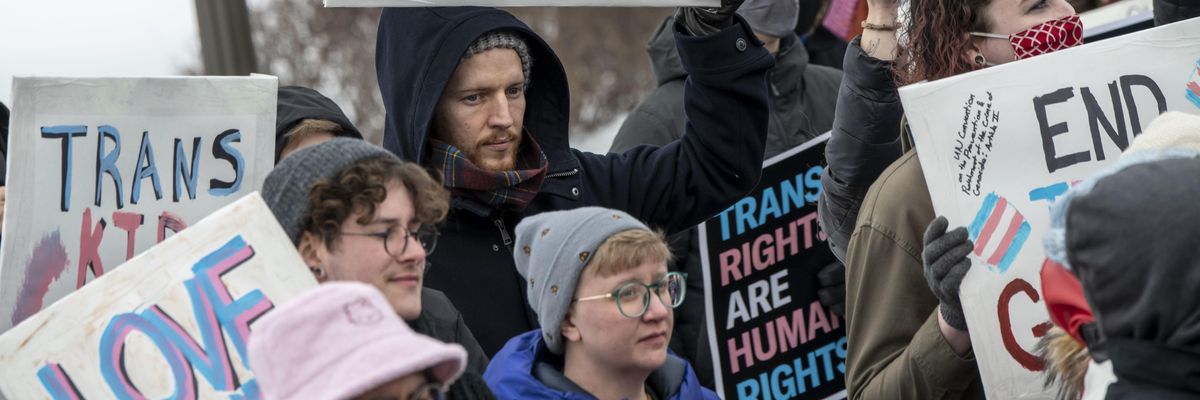
Supporters of transgender youth held a protest in St. Paul, Minnesota on March 6, 2022.
"It undermines the health and well-being of adolescents, limits the options of doctors, patients, and parents, and violates the constitutional rights of these families," said the ACLU of Utah's executive director.
Defying the guidance of the nation's leading medical organizations, Republican Utah Gov. Spencer Cox on Saturday signed into law a bill banning gender-affirming care for minors in the state.
Passed by the Utah House of Representatives on Thursday and the state Senate on Friday, S.B. 16 prohibits gender-affirming surgeries for trans youth and bars hormonal treatment for new patients who were not diagnosed with gender dysphoria before the bill's effective date, May 3.
"This bill effectively bans access to lifesaving medical care for transgender youth in Utah," said Brittney Nystrom, executive director of the ACLU of Utah, after the Senate vote Friday. "It undermines the health and well-being of adolescents, limits the options of doctors, patients, and parents, and violates the constitutional rights of these families."
Nystrom also sent Cox a letter urging him to veto the bill. She wrote that "the ACLU of Utah is deeply concerned about the damaging and potentially catastrophic effects this law will have on people's lives and medical care, and the grave violations of people's constitutional rights it will cause."
Cathryn Oakley, Human Rights Campaign's state legislative director and senior counsel, had also pressured Cox to veto the bill, arguing Friday that "Utah legislators capitulated to extremism and fear-mongering, and by doing so, shamelessly put the lives and well-being of young Utahans at risk—young transgender folks who are simply trying to navigate life as their authentic selves."
"Every parent wants and deserves access to the highest quality healthcare for our kids," Oakley said. "This discriminatory legislation bans care that is age-appropriate and supported by every major medical association, representing more than 1.3 million doctors. Medical decisions are best left to medical experts and parents or guardians, not politicians without an ounce of medical training acting as if they know how to raise and support our children better than we do."
Dr. Jack Turban, an assistant professor of child and adolescent psychiatry at the University of California, San Francisco who researches the mental health of transgender and gender diverse youth, also pointed out that the new Utah law contradicts the positions of various medical organizations.
Some LGBTQ+ advocates had hoped Cox would be compelled to block the bill because last March, citing trans youth suicide rates, he vetoed H.B. 11, which banned transgender girls from playing on school sports teams that align with their gender identity. Utah lawmakers swiftly overrode his veto but a state judge in August issued a preliminary injunction blocking enforcement of the law.
Republican lawmakers in various states have ramped up efforts to enact anti-trans laws—particularly those targeting youth—over the past few years. As The New York Times reported Wednesday:
But even by those standards, the start of the 2023 legislative season stands out for the aggressiveness with which lawmakers are pushing into new territory.
The bills they have proposed—more than 150 in at least 25 states—include bans on transition care into young adulthood; restrictions on drag shows using definitions that could broadly encompass performances by transgender people; measures that would prevent teachers in many cases from using names or pronouns matching students' gender identities; and requirements that schools out transgender students to their parents.
Legislative researcher Erin Reed, who is transgender, told the Times that the more aggressive proposals could make others seem like compromises.
"I really hope that people don't allow that to happen," Reed said. "Because these bills still target trans people who will then have to suffer the consequences."
In a tweet about Cox's decision Saturday, Reed said that "my heart breaks for Utah trans kids."
After the Utah House passed the measure Thursday, the chamber's Democrats expressed their disappointment with what they called "a misguided step by our Legislature and a violation of parents' rights," and said that "we recognize that gender-affirming healthcare is lifesaving, patient-center healthcare."
"With no pathway forward for children in need of care, this legislation will inevitably lead to litigation and a likely injunction," they added. "This is a tremendous waste of taxpayer money, and worse, a terrible message for our Legislature to send to transgender Utahns, their family, and their friends."
After the governor signed the bill, the ACLU of Utah tweeted Saturday that "trans kids are kids—they deserve to grow up without constant political attacks on their lives and healthcare; we will defend that right. We see you. We support you."
Dear Common Dreams reader, It’s been nearly 30 years since I co-founded Common Dreams with my late wife, Lina Newhouser. We had the radical notion that journalism should serve the public good, not corporate profits. It was clear to us from the outset what it would take to build such a project. No paid advertisements. No corporate sponsors. No millionaire publisher telling us what to think or do. Many people said we wouldn't last a year, but we proved those doubters wrong. Together with a tremendous team of journalists and dedicated staff, we built an independent media outlet free from the constraints of profits and corporate control. Our mission has always been simple: To inform. To inspire. To ignite change for the common good. Building Common Dreams was not easy. Our survival was never guaranteed. When you take on the most powerful forces—Wall Street greed, fossil fuel industry destruction, Big Tech lobbyists, and uber-rich oligarchs who have spent billions upon billions rigging the economy and democracy in their favor—the only bulwark you have is supporters who believe in your work. But here’s the urgent message from me today. It's never been this bad out there. And it's never been this hard to keep us going. At the very moment Common Dreams is most needed, the threats we face are intensifying. We need your support now more than ever. We don't accept corporate advertising and never will. We don't have a paywall because we don't think people should be blocked from critical news based on their ability to pay. Everything we do is funded by the donations of readers like you. When everyone does the little they can afford, we are strong. But if that support retreats or dries up, so do we. Will you donate now to make sure Common Dreams not only survives but thrives? —Craig Brown, Co-founder |
Defying the guidance of the nation's leading medical organizations, Republican Utah Gov. Spencer Cox on Saturday signed into law a bill banning gender-affirming care for minors in the state.
Passed by the Utah House of Representatives on Thursday and the state Senate on Friday, S.B. 16 prohibits gender-affirming surgeries for trans youth and bars hormonal treatment for new patients who were not diagnosed with gender dysphoria before the bill's effective date, May 3.
"This bill effectively bans access to lifesaving medical care for transgender youth in Utah," said Brittney Nystrom, executive director of the ACLU of Utah, after the Senate vote Friday. "It undermines the health and well-being of adolescents, limits the options of doctors, patients, and parents, and violates the constitutional rights of these families."
Nystrom also sent Cox a letter urging him to veto the bill. She wrote that "the ACLU of Utah is deeply concerned about the damaging and potentially catastrophic effects this law will have on people's lives and medical care, and the grave violations of people's constitutional rights it will cause."
Cathryn Oakley, Human Rights Campaign's state legislative director and senior counsel, had also pressured Cox to veto the bill, arguing Friday that "Utah legislators capitulated to extremism and fear-mongering, and by doing so, shamelessly put the lives and well-being of young Utahans at risk—young transgender folks who are simply trying to navigate life as their authentic selves."
"Every parent wants and deserves access to the highest quality healthcare for our kids," Oakley said. "This discriminatory legislation bans care that is age-appropriate and supported by every major medical association, representing more than 1.3 million doctors. Medical decisions are best left to medical experts and parents or guardians, not politicians without an ounce of medical training acting as if they know how to raise and support our children better than we do."
Dr. Jack Turban, an assistant professor of child and adolescent psychiatry at the University of California, San Francisco who researches the mental health of transgender and gender diverse youth, also pointed out that the new Utah law contradicts the positions of various medical organizations.
Some LGBTQ+ advocates had hoped Cox would be compelled to block the bill because last March, citing trans youth suicide rates, he vetoed H.B. 11, which banned transgender girls from playing on school sports teams that align with their gender identity. Utah lawmakers swiftly overrode his veto but a state judge in August issued a preliminary injunction blocking enforcement of the law.
Republican lawmakers in various states have ramped up efforts to enact anti-trans laws—particularly those targeting youth—over the past few years. As The New York Times reported Wednesday:
But even by those standards, the start of the 2023 legislative season stands out for the aggressiveness with which lawmakers are pushing into new territory.
The bills they have proposed—more than 150 in at least 25 states—include bans on transition care into young adulthood; restrictions on drag shows using definitions that could broadly encompass performances by transgender people; measures that would prevent teachers in many cases from using names or pronouns matching students' gender identities; and requirements that schools out transgender students to their parents.
Legislative researcher Erin Reed, who is transgender, told the Times that the more aggressive proposals could make others seem like compromises.
"I really hope that people don't allow that to happen," Reed said. "Because these bills still target trans people who will then have to suffer the consequences."
In a tweet about Cox's decision Saturday, Reed said that "my heart breaks for Utah trans kids."
After the Utah House passed the measure Thursday, the chamber's Democrats expressed their disappointment with what they called "a misguided step by our Legislature and a violation of parents' rights," and said that "we recognize that gender-affirming healthcare is lifesaving, patient-center healthcare."
"With no pathway forward for children in need of care, this legislation will inevitably lead to litigation and a likely injunction," they added. "This is a tremendous waste of taxpayer money, and worse, a terrible message for our Legislature to send to transgender Utahns, their family, and their friends."
After the governor signed the bill, the ACLU of Utah tweeted Saturday that "trans kids are kids—they deserve to grow up without constant political attacks on their lives and healthcare; we will defend that right. We see you. We support you."
Defying the guidance of the nation's leading medical organizations, Republican Utah Gov. Spencer Cox on Saturday signed into law a bill banning gender-affirming care for minors in the state.
Passed by the Utah House of Representatives on Thursday and the state Senate on Friday, S.B. 16 prohibits gender-affirming surgeries for trans youth and bars hormonal treatment for new patients who were not diagnosed with gender dysphoria before the bill's effective date, May 3.
"This bill effectively bans access to lifesaving medical care for transgender youth in Utah," said Brittney Nystrom, executive director of the ACLU of Utah, after the Senate vote Friday. "It undermines the health and well-being of adolescents, limits the options of doctors, patients, and parents, and violates the constitutional rights of these families."
Nystrom also sent Cox a letter urging him to veto the bill. She wrote that "the ACLU of Utah is deeply concerned about the damaging and potentially catastrophic effects this law will have on people's lives and medical care, and the grave violations of people's constitutional rights it will cause."
Cathryn Oakley, Human Rights Campaign's state legislative director and senior counsel, had also pressured Cox to veto the bill, arguing Friday that "Utah legislators capitulated to extremism and fear-mongering, and by doing so, shamelessly put the lives and well-being of young Utahans at risk—young transgender folks who are simply trying to navigate life as their authentic selves."
"Every parent wants and deserves access to the highest quality healthcare for our kids," Oakley said. "This discriminatory legislation bans care that is age-appropriate and supported by every major medical association, representing more than 1.3 million doctors. Medical decisions are best left to medical experts and parents or guardians, not politicians without an ounce of medical training acting as if they know how to raise and support our children better than we do."
Dr. Jack Turban, an assistant professor of child and adolescent psychiatry at the University of California, San Francisco who researches the mental health of transgender and gender diverse youth, also pointed out that the new Utah law contradicts the positions of various medical organizations.
Some LGBTQ+ advocates had hoped Cox would be compelled to block the bill because last March, citing trans youth suicide rates, he vetoed H.B. 11, which banned transgender girls from playing on school sports teams that align with their gender identity. Utah lawmakers swiftly overrode his veto but a state judge in August issued a preliminary injunction blocking enforcement of the law.
Republican lawmakers in various states have ramped up efforts to enact anti-trans laws—particularly those targeting youth—over the past few years. As The New York Times reported Wednesday:
But even by those standards, the start of the 2023 legislative season stands out for the aggressiveness with which lawmakers are pushing into new territory.
The bills they have proposed—more than 150 in at least 25 states—include bans on transition care into young adulthood; restrictions on drag shows using definitions that could broadly encompass performances by transgender people; measures that would prevent teachers in many cases from using names or pronouns matching students' gender identities; and requirements that schools out transgender students to their parents.
Legislative researcher Erin Reed, who is transgender, told the Times that the more aggressive proposals could make others seem like compromises.
"I really hope that people don't allow that to happen," Reed said. "Because these bills still target trans people who will then have to suffer the consequences."
In a tweet about Cox's decision Saturday, Reed said that "my heart breaks for Utah trans kids."
After the Utah House passed the measure Thursday, the chamber's Democrats expressed their disappointment with what they called "a misguided step by our Legislature and a violation of parents' rights," and said that "we recognize that gender-affirming healthcare is lifesaving, patient-center healthcare."
"With no pathway forward for children in need of care, this legislation will inevitably lead to litigation and a likely injunction," they added. "This is a tremendous waste of taxpayer money, and worse, a terrible message for our Legislature to send to transgender Utahns, their family, and their friends."
After the governor signed the bill, the ACLU of Utah tweeted Saturday that "trans kids are kids—they deserve to grow up without constant political attacks on their lives and healthcare; we will defend that right. We see you. We support you."