SUBSCRIBE TO OUR FREE NEWSLETTER
Daily news & progressive opinion—funded by the people, not the corporations—delivered straight to your inbox.
5
#000000
#FFFFFF
To donate by check, phone, or other method, see our More Ways to Give page.
Daily news & progressive opinion—funded by the people, not the corporations—delivered straight to your inbox.
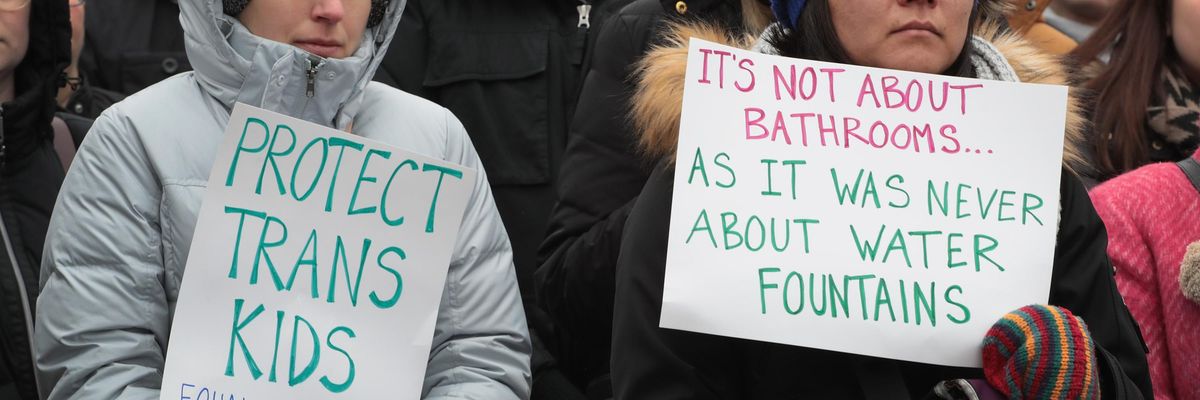
Demonstrators protest for transgender rights on February 25, 2017 in Chicago, Illinois.
"The one thing that we do know is that when we have shown up in the past, when we have shown up in state capitols, which trans people and those who love us always do, we have been able to beat these bills," said one advocate.
Just one week into 2023, state legislatures across the United States are already planning to consider more than two dozen bills aiming to cut off transgender people's access to healthcare, with adults as well as minors targeted.
The legislation that was introduced or pre-filed in the first week of the year includes Senate Bill 129 in Oklahoma, which is set to be formally introduced in the state Senate in early February. The pre-filed legislation would ban all gender-affirming surgery for people under the age of 26, indicating, according to researcher Erin Reed, that the previously "hypothetical escalation" of transition bans for adults is now in motion.
"This is the worst anti-trans bill I have ever seen filed in any state," Reed told the Associated Press on Saturday.
Vivian Topping, director of advocacy and civic engagement at the Equality Federation, said the proposal signifies the "startling new evolution of what these bills can be."
"This is the worst anti-trans bill I have ever seen filed in any state."
“We haven't seen these types of bills in previous years," Topping told The 19th.
Lawmakers in Kansas, Kentucky, Missouri, Montana, New Hampshire, South Carolina, Tennessee, Texas, Utah, and Virginia will also consider restrictions on healthcare for transgender people.
Republicans in South Carolina have proposed banning gender-affirming care for people who are 21 or younger.
In preparation for the new session, lawmakers in Texas pre-filed 10 anti-transgender bills in the last two months on 2022, including a proposal to make gender-affirming care for minors a second-degree felony for physicians and categorizing the prescription of hormonal therapy for minors with gender dysphoria as child abuse.
Both Oklahoma and Arizona lawmakers will consider legislation requiring school staff to refer to children by the name and sex found on their birth certificate unless parents provide written consent for the child to be addressed otherwise—effectively demanding that adults "misgender trans and nonbinary students by default until informed otherwise by a parent," The 19th reported.
Topping noted that dozens of anti-trans bills have failed to pass in state legislatures across the country as advocates have ramped up pressure on lawmakers to protect LGBTQ rights.
"Who knows what happens with these bills as we move forward," Topping told The 19th. "The one thing that we do know is that when we have shown up in the past, when we have shown up in state capitols, which trans people and those who love us always do, we have been able to beat these bills."
Dear Common Dreams reader, It’s been nearly 30 years since I co-founded Common Dreams with my late wife, Lina Newhouser. We had the radical notion that journalism should serve the public good, not corporate profits. It was clear to us from the outset what it would take to build such a project. No paid advertisements. No corporate sponsors. No millionaire publisher telling us what to think or do. Many people said we wouldn't last a year, but we proved those doubters wrong. Together with a tremendous team of journalists and dedicated staff, we built an independent media outlet free from the constraints of profits and corporate control. Our mission has always been simple: To inform. To inspire. To ignite change for the common good. Building Common Dreams was not easy. Our survival was never guaranteed. When you take on the most powerful forces—Wall Street greed, fossil fuel industry destruction, Big Tech lobbyists, and uber-rich oligarchs who have spent billions upon billions rigging the economy and democracy in their favor—the only bulwark you have is supporters who believe in your work. But here’s the urgent message from me today. It's never been this bad out there. And it's never been this hard to keep us going. At the very moment Common Dreams is most needed, the threats we face are intensifying. We need your support now more than ever. We don't accept corporate advertising and never will. We don't have a paywall because we don't think people should be blocked from critical news based on their ability to pay. Everything we do is funded by the donations of readers like you. When everyone does the little they can afford, we are strong. But if that support retreats or dries up, so do we. Will you donate now to make sure Common Dreams not only survives but thrives? —Craig Brown, Co-founder |
Just one week into 2023, state legislatures across the United States are already planning to consider more than two dozen bills aiming to cut off transgender people's access to healthcare, with adults as well as minors targeted.
The legislation that was introduced or pre-filed in the first week of the year includes Senate Bill 129 in Oklahoma, which is set to be formally introduced in the state Senate in early February. The pre-filed legislation would ban all gender-affirming surgery for people under the age of 26, indicating, according to researcher Erin Reed, that the previously "hypothetical escalation" of transition bans for adults is now in motion.
"This is the worst anti-trans bill I have ever seen filed in any state," Reed told the Associated Press on Saturday.
Vivian Topping, director of advocacy and civic engagement at the Equality Federation, said the proposal signifies the "startling new evolution of what these bills can be."
"This is the worst anti-trans bill I have ever seen filed in any state."
“We haven't seen these types of bills in previous years," Topping told The 19th.
Lawmakers in Kansas, Kentucky, Missouri, Montana, New Hampshire, South Carolina, Tennessee, Texas, Utah, and Virginia will also consider restrictions on healthcare for transgender people.
Republicans in South Carolina have proposed banning gender-affirming care for people who are 21 or younger.
In preparation for the new session, lawmakers in Texas pre-filed 10 anti-transgender bills in the last two months on 2022, including a proposal to make gender-affirming care for minors a second-degree felony for physicians and categorizing the prescription of hormonal therapy for minors with gender dysphoria as child abuse.
Both Oklahoma and Arizona lawmakers will consider legislation requiring school staff to refer to children by the name and sex found on their birth certificate unless parents provide written consent for the child to be addressed otherwise—effectively demanding that adults "misgender trans and nonbinary students by default until informed otherwise by a parent," The 19th reported.
Topping noted that dozens of anti-trans bills have failed to pass in state legislatures across the country as advocates have ramped up pressure on lawmakers to protect LGBTQ rights.
"Who knows what happens with these bills as we move forward," Topping told The 19th. "The one thing that we do know is that when we have shown up in the past, when we have shown up in state capitols, which trans people and those who love us always do, we have been able to beat these bills."
Just one week into 2023, state legislatures across the United States are already planning to consider more than two dozen bills aiming to cut off transgender people's access to healthcare, with adults as well as minors targeted.
The legislation that was introduced or pre-filed in the first week of the year includes Senate Bill 129 in Oklahoma, which is set to be formally introduced in the state Senate in early February. The pre-filed legislation would ban all gender-affirming surgery for people under the age of 26, indicating, according to researcher Erin Reed, that the previously "hypothetical escalation" of transition bans for adults is now in motion.
"This is the worst anti-trans bill I have ever seen filed in any state," Reed told the Associated Press on Saturday.
Vivian Topping, director of advocacy and civic engagement at the Equality Federation, said the proposal signifies the "startling new evolution of what these bills can be."
"This is the worst anti-trans bill I have ever seen filed in any state."
“We haven't seen these types of bills in previous years," Topping told The 19th.
Lawmakers in Kansas, Kentucky, Missouri, Montana, New Hampshire, South Carolina, Tennessee, Texas, Utah, and Virginia will also consider restrictions on healthcare for transgender people.
Republicans in South Carolina have proposed banning gender-affirming care for people who are 21 or younger.
In preparation for the new session, lawmakers in Texas pre-filed 10 anti-transgender bills in the last two months on 2022, including a proposal to make gender-affirming care for minors a second-degree felony for physicians and categorizing the prescription of hormonal therapy for minors with gender dysphoria as child abuse.
Both Oklahoma and Arizona lawmakers will consider legislation requiring school staff to refer to children by the name and sex found on their birth certificate unless parents provide written consent for the child to be addressed otherwise—effectively demanding that adults "misgender trans and nonbinary students by default until informed otherwise by a parent," The 19th reported.
Topping noted that dozens of anti-trans bills have failed to pass in state legislatures across the country as advocates have ramped up pressure on lawmakers to protect LGBTQ rights.
"Who knows what happens with these bills as we move forward," Topping told The 19th. "The one thing that we do know is that when we have shown up in the past, when we have shown up in state capitols, which trans people and those who love us always do, we have been able to beat these bills."