SUBSCRIBE TO OUR FREE NEWSLETTER
Daily news & progressive opinion—funded by the people, not the corporations—delivered straight to your inbox.
5
#000000
#FFFFFF
To donate by check, phone, or other method, see our More Ways to Give page.
Daily news & progressive opinion—funded by the people, not the corporations—delivered straight to your inbox.
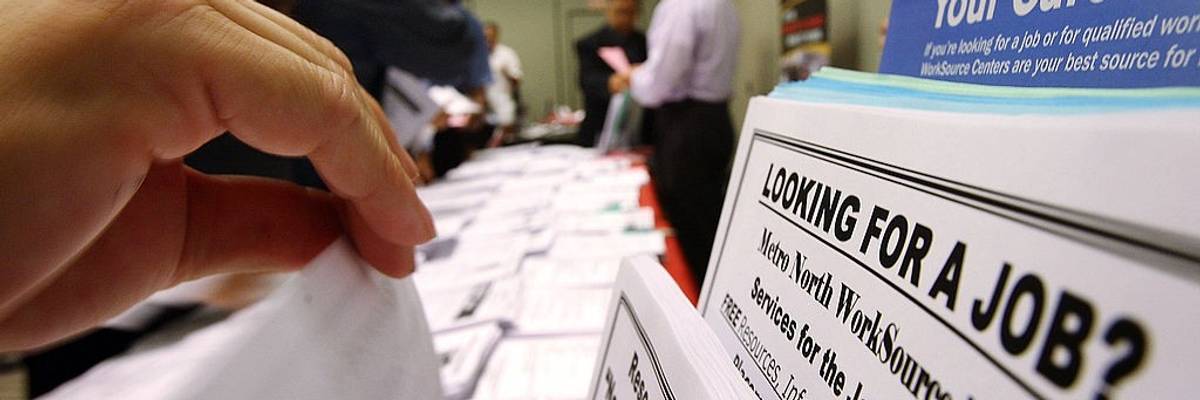
Job seekers look over job opening fliers at the WorkSource exhibit, a collaborative effort by governmental agencies to offer jobs and job training resources at the Greater Los Angeles Career Expo at the Pasadena Convention Center on May 14, 2009 in Pasadena, California.
A functional unemployment insurance system for today’s economy would cover more workers, including part-time, gig, and temporary workers, and would provide benefits that actually allow families to survive while searching for new work.
For millions of workers, the conversation about artificial intelligence and the future of work is no longer theoretical. It is already showing up in layoffs, hiring freezes, shrinking departments, and growing anxiety about whether the paycheck families rely on today will still exist tomorrow.
But the most important question is not simply which jobs AI will eliminate. It is whether workers will have any real support when those jobs disappear.
While policymakers, executives, and economists debate which industries will thrive and which occupations will disappear in the age of AI, working Americans are focused on more immediate concerns: paying rent, affording groceries, covering childcare, and figuring out how they would support their families if their income suddenly vanished.
Workers are right to worry, because the system meant to help them through job loss is already failing to meet this moment.
While we may not be able to control every change AI will bring, we can decide whether workers will face those changes alone.
America’s unemployment insurance system was built for a different era entirely, one in which AI was nonexistent. It was built for an era that assumed stable full-time employment, long-term employer relationships, and relatively predictable layoffs. Today’s economy looks nothing like that.
Millions of workers now move between part-time jobs, contract work, temporary positions, caregiving responsibilities, and periods outside the workforce entirely. But unemployment insurance rules still exclude many of those workers from receiving help when they need it most.
Today, only about 1 in 4 unemployed workers receive unemployment benefits nationwide. In some states, fewer than 13% received support at all. And even when workers do qualify, benefits are often too low and too short-lived to keep families financially stable while they search for new work.
The result of this broken system is families scrambling to avoid financial free fall: draining savings accounts, falling behind on rent, or taking the first low-paying jobs they can find because they can’t afford to wait for something better.
That disconnect is already visible. While the number of unemployed workers has climbed sharply over the past year, unemployment claims have remained relatively flat—not because people are unaffected, but because so many workers are locked out of a system that no longer reflects the realities of modern work.
The first wave of AI disruption is already here. As adoption of these technologies increases, more workers will cycle between jobs, more families will navigate periods of unemployment, and more people will be forced to rebuild after losing work through no fault of their own.
And those burdens will not fall equally. Women—especially Black women, who are disproportionately represented in clerical and administrative jobs—are among the workers most vulnerable to displacement. Workers of color already face persistently higher unemployment rates because of structural inequities in the labor market. Yet when they lose work, they are significantly less likely to receive unemployment benefits and the economic stability those benefits are supposed to provide.
That reality is colliding with an already fragile economy. Data from the New York Federal Reserve shows that college graduates are now experiencing recession-level rates of unemployment. Over the last year, unemployment among young college graduates averaged 5.5%—the highest sustained level outside the brief peak of the Covid-19 pandemic since the aftermath of the Great Recession.
These are graduates who were told that if they worked hard, earned a degree, and applied themselves, they would find stability and opportunity. Instead, many are entering a labor market defined by uncertainty and shrinking opportunities, all while facing a weakening safety net.
That is why modernizing our unemployment systems must be part of the AI conversation.
A functional unemployment insurance system for today’s economy would cover more workers, including part-time, gig, and temporary workers. It would provide benefits that actually allow families to survive while searching for new work. It would make it easier, not harder, for eligible workers to receive support. And it would actually be prepared to withstand economic downturns.
Unemployment insurance should be understood for what it truly is: economic infrastructure.
Just as roads and bridges help goods move through the economy, unemployment insurance helps people move through economic change without falling into crisis. A strong UI system gives people the stability to search for good jobs instead of being pushed into the first low-wage position available. It stabilizes families, communities, and local businesses during periods of disruption.
The age of stable employment is fading. More workers will inevitably face periods of transition, disruption, and job loss in the years ahead.
While we may not be able to control every change AI will bring, we can decide whether workers will face those changes alone. Modernizing unemployment insurance is not simply a matter of compassion. It is a matter of economic readiness.
Dear Common Dreams reader, It’s been nearly 30 years since I co-founded Common Dreams with my late wife, Lina Newhouser. We had the radical notion that journalism should serve the public good, not corporate profits. It was clear to us from the outset what it would take to build such a project. No paid advertisements. No corporate sponsors. No millionaire publisher telling us what to think or do. Many people said we wouldn't last a year, but we proved those doubters wrong. Together with a tremendous team of journalists and dedicated staff, we built an independent media outlet free from the constraints of profits and corporate control. Our mission has always been simple: To inform. To inspire. To ignite change for the common good. Building Common Dreams was not easy. Our survival was never guaranteed. When you take on the most powerful forces—Wall Street greed, fossil fuel industry destruction, Big Tech lobbyists, and uber-rich oligarchs who have spent billions upon billions rigging the economy and democracy in their favor—the only bulwark you have is supporters who believe in your work. But here’s the urgent message from me today. It's never been this bad out there. And it's never been this hard to keep us going. At the very moment Common Dreams is most needed, the threats we face are intensifying. We need your support now more than ever. We don't accept corporate advertising and never will. We don't have a paywall because we don't think people should be blocked from critical news based on their ability to pay. Everything we do is funded by the donations of readers like you. When everyone does the little they can afford, we are strong. But if that support retreats or dries up, so do we. Will you donate now to make sure Common Dreams not only survives but thrives? —Craig Brown, Co-founder |
For millions of workers, the conversation about artificial intelligence and the future of work is no longer theoretical. It is already showing up in layoffs, hiring freezes, shrinking departments, and growing anxiety about whether the paycheck families rely on today will still exist tomorrow.
But the most important question is not simply which jobs AI will eliminate. It is whether workers will have any real support when those jobs disappear.
While policymakers, executives, and economists debate which industries will thrive and which occupations will disappear in the age of AI, working Americans are focused on more immediate concerns: paying rent, affording groceries, covering childcare, and figuring out how they would support their families if their income suddenly vanished.
Workers are right to worry, because the system meant to help them through job loss is already failing to meet this moment.
While we may not be able to control every change AI will bring, we can decide whether workers will face those changes alone.
America’s unemployment insurance system was built for a different era entirely, one in which AI was nonexistent. It was built for an era that assumed stable full-time employment, long-term employer relationships, and relatively predictable layoffs. Today’s economy looks nothing like that.
Millions of workers now move between part-time jobs, contract work, temporary positions, caregiving responsibilities, and periods outside the workforce entirely. But unemployment insurance rules still exclude many of those workers from receiving help when they need it most.
Today, only about 1 in 4 unemployed workers receive unemployment benefits nationwide. In some states, fewer than 13% received support at all. And even when workers do qualify, benefits are often too low and too short-lived to keep families financially stable while they search for new work.
The result of this broken system is families scrambling to avoid financial free fall: draining savings accounts, falling behind on rent, or taking the first low-paying jobs they can find because they can’t afford to wait for something better.
That disconnect is already visible. While the number of unemployed workers has climbed sharply over the past year, unemployment claims have remained relatively flat—not because people are unaffected, but because so many workers are locked out of a system that no longer reflects the realities of modern work.
The first wave of AI disruption is already here. As adoption of these technologies increases, more workers will cycle between jobs, more families will navigate periods of unemployment, and more people will be forced to rebuild after losing work through no fault of their own.
And those burdens will not fall equally. Women—especially Black women, who are disproportionately represented in clerical and administrative jobs—are among the workers most vulnerable to displacement. Workers of color already face persistently higher unemployment rates because of structural inequities in the labor market. Yet when they lose work, they are significantly less likely to receive unemployment benefits and the economic stability those benefits are supposed to provide.
That reality is colliding with an already fragile economy. Data from the New York Federal Reserve shows that college graduates are now experiencing recession-level rates of unemployment. Over the last year, unemployment among young college graduates averaged 5.5%—the highest sustained level outside the brief peak of the Covid-19 pandemic since the aftermath of the Great Recession.
These are graduates who were told that if they worked hard, earned a degree, and applied themselves, they would find stability and opportunity. Instead, many are entering a labor market defined by uncertainty and shrinking opportunities, all while facing a weakening safety net.
That is why modernizing our unemployment systems must be part of the AI conversation.
A functional unemployment insurance system for today’s economy would cover more workers, including part-time, gig, and temporary workers. It would provide benefits that actually allow families to survive while searching for new work. It would make it easier, not harder, for eligible workers to receive support. And it would actually be prepared to withstand economic downturns.
Unemployment insurance should be understood for what it truly is: economic infrastructure.
Just as roads and bridges help goods move through the economy, unemployment insurance helps people move through economic change without falling into crisis. A strong UI system gives people the stability to search for good jobs instead of being pushed into the first low-wage position available. It stabilizes families, communities, and local businesses during periods of disruption.
The age of stable employment is fading. More workers will inevitably face periods of transition, disruption, and job loss in the years ahead.
While we may not be able to control every change AI will bring, we can decide whether workers will face those changes alone. Modernizing unemployment insurance is not simply a matter of compassion. It is a matter of economic readiness.
For millions of workers, the conversation about artificial intelligence and the future of work is no longer theoretical. It is already showing up in layoffs, hiring freezes, shrinking departments, and growing anxiety about whether the paycheck families rely on today will still exist tomorrow.
But the most important question is not simply which jobs AI will eliminate. It is whether workers will have any real support when those jobs disappear.
While policymakers, executives, and economists debate which industries will thrive and which occupations will disappear in the age of AI, working Americans are focused on more immediate concerns: paying rent, affording groceries, covering childcare, and figuring out how they would support their families if their income suddenly vanished.
Workers are right to worry, because the system meant to help them through job loss is already failing to meet this moment.
While we may not be able to control every change AI will bring, we can decide whether workers will face those changes alone.
America’s unemployment insurance system was built for a different era entirely, one in which AI was nonexistent. It was built for an era that assumed stable full-time employment, long-term employer relationships, and relatively predictable layoffs. Today’s economy looks nothing like that.
Millions of workers now move between part-time jobs, contract work, temporary positions, caregiving responsibilities, and periods outside the workforce entirely. But unemployment insurance rules still exclude many of those workers from receiving help when they need it most.
Today, only about 1 in 4 unemployed workers receive unemployment benefits nationwide. In some states, fewer than 13% received support at all. And even when workers do qualify, benefits are often too low and too short-lived to keep families financially stable while they search for new work.
The result of this broken system is families scrambling to avoid financial free fall: draining savings accounts, falling behind on rent, or taking the first low-paying jobs they can find because they can’t afford to wait for something better.
That disconnect is already visible. While the number of unemployed workers has climbed sharply over the past year, unemployment claims have remained relatively flat—not because people are unaffected, but because so many workers are locked out of a system that no longer reflects the realities of modern work.
The first wave of AI disruption is already here. As adoption of these technologies increases, more workers will cycle between jobs, more families will navigate periods of unemployment, and more people will be forced to rebuild after losing work through no fault of their own.
And those burdens will not fall equally. Women—especially Black women, who are disproportionately represented in clerical and administrative jobs—are among the workers most vulnerable to displacement. Workers of color already face persistently higher unemployment rates because of structural inequities in the labor market. Yet when they lose work, they are significantly less likely to receive unemployment benefits and the economic stability those benefits are supposed to provide.
That reality is colliding with an already fragile economy. Data from the New York Federal Reserve shows that college graduates are now experiencing recession-level rates of unemployment. Over the last year, unemployment among young college graduates averaged 5.5%—the highest sustained level outside the brief peak of the Covid-19 pandemic since the aftermath of the Great Recession.
These are graduates who were told that if they worked hard, earned a degree, and applied themselves, they would find stability and opportunity. Instead, many are entering a labor market defined by uncertainty and shrinking opportunities, all while facing a weakening safety net.
That is why modernizing our unemployment systems must be part of the AI conversation.
A functional unemployment insurance system for today’s economy would cover more workers, including part-time, gig, and temporary workers. It would provide benefits that actually allow families to survive while searching for new work. It would make it easier, not harder, for eligible workers to receive support. And it would actually be prepared to withstand economic downturns.
Unemployment insurance should be understood for what it truly is: economic infrastructure.
Just as roads and bridges help goods move through the economy, unemployment insurance helps people move through economic change without falling into crisis. A strong UI system gives people the stability to search for good jobs instead of being pushed into the first low-wage position available. It stabilizes families, communities, and local businesses during periods of disruption.
The age of stable employment is fading. More workers will inevitably face periods of transition, disruption, and job loss in the years ahead.
While we may not be able to control every change AI will bring, we can decide whether workers will face those changes alone. Modernizing unemployment insurance is not simply a matter of compassion. It is a matter of economic readiness.